Once I saw this guy on a bridge about to jump.

Christians have many ways to bridge our differences – ranging from local ministerial to worldwide networks like the Global Christian Forum (the organization I serve). But we often fail to take advantage of them, identifying ourselves with our narrowest affiliations rather than with the wider Christian community.

Comedian Emo Philips told a joke that captures this problem well:

Once I saw this guy on a bridge about to jump. I said,
“Don’t do it!” He said, “Nobody loves me.” I said, “God loves you. Do you believe in God?” He said, “Yes.” I said, “Are you a Christian or a Jew?” He said, “A Christian.” I said, “Me, too! Protestant or Catholic?” He said, “Protestant.” I said, “Me, too! What franchise?”
He said, “Baptist.” I said, “Me, too! Northern Baptist or Southern Baptist?” He said, “Northern Baptist.” I said, “Me, too! Northern Conservative Baptist or Northern Liberal Baptist?” He said, “Northern Conservative Baptist.” I said, “Me, too! Northern Conservative Baptist Great Lakes Region, or Northern Conservative Baptist Eastern Region?” He said, “Northern Conservative Baptist Great Lakes Region.” I said, “Me, too! Northern Conservative Baptist Great Lakes Region Council of 1879, or Northern Conservative Baptist Great Lakes Region Council of 1912?” He said, “Northern Conservative Baptist Great Lakes Region Council of 1912.” I said, “Die, heretic!” And I pushed him over.1


Quoted from the November/December 2025 issue of Ecumenical Trends Magazine. The Paul Wattson Lecture, Chicago The Global Christian Forum: Reshaping the Global Ecumenical Landscape

A Hunter’s Heart, A Franciscan’s Call: Why We Must Support Michigan’s New Gun Safety Agenda


I have lived in Michigan my entire life. Like many of you, I grew up with the rhythm of the seasons—the crisp air of October, the quiet of the woods, and the anticipation of deer season. I am a lifelong gun owner and a hunter. I respect firearms for what they are: tools that require responsibility, training, and deep respect.

But I am also a Secular Franciscan.

A few years ago, Br. George OFM Cap asked me a question that has stuck with me ever since. He asked about the possibility of the Secular Franciscan Order (OFS) being more aggressive in the area of gun control legislation and regulation. At the time, I gave a thoughtful answer, but looking at where we are today—in late 2025—I feel compelled to give a more public, urgent response.

The answer is yes. It is time for us to be aggressive. And as a gun owner, I am telling you that the agenda currently moving through Lansing is not the enemy of the Second Amendment; it is the ally of the Gospel.

The Myth of the “Anti-Gun” Agenda

There is a narrative often pushed by groups like Great Lakes Gun Rights that any regulation is a slippery slope to confiscation. As a hunter, I find this disingenuous. The legislation we are seeing in 2025 targets specific, modern threats that have nothing to do with my ability to fill a freezer with venison.

Take Senate Bills 331 and 332, for example. These bills seek to ban “ghost guns”—firearms built from kits or 3D-printed at home without serial numbers. These weapons bypass background checks entirely. They are designed for one purpose: to evade the law. No ethical hunter needs a ghost gun. Yet, these bills are currently stalled in the State House, with leadership threatening they are “dead on arrival”. Why? Why should we tolerate untraceable weapons flooding our streets in the name of “freedom”?  

Similarly, we recently saw the passage of Public Act 157, which prohibits firearms in polling places. Critics screamed about disarmament, but the law actually includes an exemption for CPL holders to carry concealed. It strikes a balance: it prevents the intimidation of open carry at the ballot box while respecting the rights of licensed carriers. This is sensible policy, not tyranny.  

The Task Force Report: A Public Health Roadmap

What strikes me most, however, is the courage shown by the Governor’s Gun Violence Prevention Task Force, led by Dr. Natasha Bagdasarian. On November 24, they released a report that treats gun violence not as a political football, but as a public health crisis—similar to how we tackled car accidents in the 20th century.  

Their recommendations go beyond the “safe” political choices. They are calling for:

  • A ban on assault weapons: Weapons of war have no place in our communities.  
  • Raising the minimum purchase age to 21: The data shows that young brains are still developing impulse control. Raising the age saves lives, particularly regarding suicide.  
  • Closing the CPL loophole: Ensuring that every firearm purchase includes a background check, even for license holders, so that those who have become prohibited persons since getting their license can’t slip through the cracks.  
  • Universal Waiting Periods: A “cooling-off” period to prevent impulsive acts of violence and self-harm.  

As a hunter, none of these proposals threaten my way of life. But as a Franciscan, they align perfectly with our Rule.

A Pro-Life Stance

We Franciscans are called to “create conditions of life worthy of people redeemed by Christ” (OFS Rule, Art. 13). We cannot claim to build a culture of life if we ignore the instruments of death that kill over 40,000 Americans a year.

The U.S. Bishops have consistently called for a ban on assault weapons and stricter controls on handguns. The Franciscan Action Network has declared gun violence a “pro-life issue and a moral issue”. When Br. George asked me about the OFS being more aggressive, he was tapping into a deep truth: our silence is complicity.

We often hear the argument that “guns don’t kill people, people kill people.” But as Franciscans, we know that we are influenced by the world around us. A society awash in military-grade weaponry is a society that has normalized violence. By regulating the tools of violence, we can help shape the heart of the culture.

My Response to Br. George

So, here is my response to Br. George, and my plea to my fellow Michigan gun owners:

We can support these laws. We must support these laws. Supporting a ban on ghost guns or assault weapons does not make you a “bad” gun owner; it makes you a responsible citizen. It makes you a neighbor who cares more about the safety of children in classrooms than the convenience of hobbyists.

The legislative path is hard. The bills banning ghost guns and bump stocks are stuck in the House, blocked by partisan gridlock. But we have a voice. I urge you to contact your representatives. Tell them you are a gun owner, a person of faith, and that you support the Task Force recommendations.  

Let us be aggressive in our pursuit of peace.

Pax et Bonum.

Living the Gospel: Four Principles of Secular Franciscan Life

As Secular Franciscans, our commitment is to live the Gospel in the spirit of Saint Francis. But how do we truly grasp that spirit today? By anchoring our lives in four essential documents that create a cohesive and powerful framework for our vocation.


I. The First Principle: The Interior Source (Dilexit Nos)

Our entire vocation begins with a single, non-negotiable truth: God loved us first. Pope Francis’s Apostolic Exhortation, Dilexit Nos (“He Loved Us”), on the Sacred Heart of Jesus, is the source of our motivation.

  • The Why: We are called to place our “mind and will… under the ‘political rule of the heart.” This means our decisions, thoughts, and intentions are governed by the gentleness, humility, and boundless love of Christ, who poured out everything on the Cross.
  • The Demand: For us, this is the call to radical interior conversion. The external life of service only has merit if it flows from a heart shaped by the self-giving love of Christ. If our heart is not ruled by His, our actions risk becoming mere philanthropy, not Christian charity.

II. The Second Principle: The Exterior Mandate (Dilexi Te)

The love we contemplate in Dilexit Nos must immediately translate into concrete action, a mandate beautifully articulated in Pope Leo XIV’s Apostolic Exhortation, Dilexi Te (“I Have Loved You”). This document—a spiritual successor to the call of the Sacred Heart—focuses entirely on the preferential option for the poor.

  • The What: Pope Leo XIV makes it clear: “Love for the Lord… is one with love for the poor.” The poor are not just objects of our pity; they are the “sacramental presence of the Lord.” For us, the wounded Heart of Christ is revealed in the wounds of the marginalized in our communities.
  • The Demand: Our vocation is not just about charity; it is about justice. Dilexi Te calls us to address the “structural causes of poverty and inequality.” As Secular Franciscans living in the world—in our careers, families, and neighborhood like Grosse Pointe Park—we are mandated to speak out against indifference and the “throwaway culture” and work for fairness.

III. The Third Principle: The Authentic Spirit (The Testament of St. Francis)

The Testament of Saint Francis is the authentic, un-glossed spirit required to successfully live out the mandates of the two Popes. It provides the necessary Franciscan attitude to connect divine love with difficult service.

  • The How: The Testament begins with Francis’s conversion: the moment he showed mercy to the lepers. This teaches us that true evangelical action requires physical encounter and the spiritual ability to transform the “bitter” into the “sweetness of soul.”
  • The Demand: Francis demands radical humility and minority. We must be “simple and subject to all,” avoiding pride and ambition. By commanding us not to “gloss” his words, Francis insists on a literal, uncluttered commitment to evangelical poverty, which is the only way to avoid judging the poor or being corrupted by worldly values.

IV. The Fourth Principle: The Practical Guide (The OFS Rule of Life)

The Rule of the Secular Franciscan Order (1978) is the blueprint that structures the first three principles into our daily, secular life.

  • The Where: The Rule ensures our commitment is lived in the world through a committed fraternity. It guides our actions:
    • The call to Conversion (Article 7) is powered by the love of Dilexit Nos.
    • The focus on Justice and Peace (Article 15) is directed by the demands of Dilexi Te.
    • The practice of Simplicity and Poverty (Article 11) is modeled after the spirit of the Testament.
  • The Response: The Rule makes our vocation communal. As a local fraternity, we must constantly hold these four anchors in dialogue during our formation and apostolate, ensuring our prayer feeds our action, and our action validates our prayer.

By embracing this Quadruple Anchor, we live a life rooted in the heart of the Church and the essential documents of the OFS, making us true witnesses of Christ’s love in the world today.

Fighting PFAS in the Water

Here’s a link to an interview on the Greenstreet Environmental Health show with Tony and the Co-Chair at the Great Lakes PFAS Action Network.  The interview aired on WBAI radio in New York City on Friday, and it aired yesterday  on affiliate radio stations in Los Angeles and in Berkeley, California.  Please feel free to share if you think it’s of interest…

https://www.greenstreetnews.org/post/fighting-pfas-in-the-water

Peace and Every Good

[Verse]
Walking through the morning light, peace is shining bright
Every step I take, I feel the love ignite
Gentle whispers in the breeze, every good I see
Hope and kindness in the air, setting spirits free

[Chorus]
Peace and every good, flowing like a song
In my heart I know, where I belong
Hand in hand we stand, in harmony and cheer
Peace and every good, forever near

[Bridge]
Through the storms and rain, we find our way again
Faith and love remain, in every joyful refrain
Nothing can divide, when hearts are open wide
Peace and every good, our eternal guide So let the world sing loud, with peace in every sound
Goodness all around, in love we’re bound

Strangers No Longer

A Franciscan Invitation to Welcome

One of the great gifts of our Franciscan vocation is that it is always bigger than ourselves. We are called into fraternity—not only with those who gather with us each month, but with the poor, the excluded, and the stranger at our door. This is why I recently reached out to Strangers No Longer, to see how our fraternities in the Divine Mercy Region might walk with them.

Catholic Roots and Mission

For anyone unfamiliar with Strangers No Longer, let me offer a bit of background. The name comes from the 2003 pastoral letter Strangers No Longer: Together on the Journey of Hope, written by the Catholic bishops of the United States and Mexico. That letter called on the Church to see immigrants not as problems to be solved, but as brothers and sisters to be welcomed.

Out of that vision, Catholic leaders and parishes in Detroit came together to form what we now know as Strangers No Longer. It is a network rooted in the Church, working with parishes, schools, and Catholic organizations across the lower peninsula. Its Circles of Support always begin with prayer, Scripture, and the recognition that Christ is present in each person.


✦ A Note on Strangers No Longer

Some may wonder if Strangers No Longer is truly Catholic. The answer is yes. The movement’s name comes directly from the bishops’ pastoral letter, and its work is firmly grounded in Catholic social teaching—especially the dignity of every human person.

Circles of Support open with prayer, are led in collaboration with Catholic parishes, and flow out of the Church’s call to accompany immigrants and refugees. When we Franciscans walk with Strangers No Longer, we are not stepping outside the Church. We are standing firmly within her, living the Gospel in the spirit of Saint Francis.


Why It Matters for Franciscans

For us as Secular Franciscans in the Divine Mercy Region—with fraternities spread across the lower peninsula and Toledo—this connection is very natural. Our Rule calls us to be peacemakers (Art. 13), to respect cultural diversity and work for justice (Art. 19), and to collaborate with all people of goodwill for human dignity (Constitutions 18.2).

By participating in Strangers No Longer, we are not taking on “one more program.” We are living what our Rule already asks of us, in communion with the wider Church.

A Call to Fraternity

Saint Francis himself lived as a pilgrim and stranger, finding Christ in the leper, the poor, and the outsider. When we join hands with immigrants and refugees today, we walk the same path.

Our Region is blessed with many gifts and wide reach. Together, we can help make real the words of St. Paul: “You are no longer strangers and sojourners, but fellow citizens with the saints and members of the household of God” (Eph. 2:19).

In the end, this is not about politics or programs. It is about fraternity—seeing Christ in the faces of those who arrive among us, and letting them see Christ in us.


A Franciscan Blessing

May the Lord bless you and keep you.
May He make His face shine upon you, especially in the faces of the strangers who become friends.
May He give you courage to welcome, patience to listen, and joy in walking together as brothers and sisters.
And may the peace of Christ, which Francis carried into every place, guard your hearts and guide your steps.

Peace and all good.

Mike

Email: mikeofs@ofsmike.com

D.E.I.

A Canticle of God’s Love

(Based on Auxiliary Bishop Roy Campbell Jr writings)

Let us sing of God, O people, for God is within us, And God’s name, Dei, is a light for all the world.

We praise you, O God of Diversity, For you called forth a people from every nation, An assembly of nations from Jacob’s loins. You are the one who makes us fruitful and multiplies our grace, Bringing together a rich tapestry of life and tongues, That we might know your face in every face.

We give thanks to you, O God of Equity, For your works are true and just and reliable are your decrees. You sent forth your Son, and his example is our way, To share what we have and not to hoard, That your truth and your justice may be applied with love to all, For your law is written on our hearts.

We worship you, O God of Inclusion, For you read your law to every single soul: To the elders, the women, the children, and the resident aliens among us. You call us to live your law as one, a single flock, a single people, To know that the love we have for one another Is how the world will know we are your own.

For the dignity of every human being is your will, O God.
You work among us and through us,
To make us fruitful and to bring us all home to you.

Glory to God, Father, Son, and Holy Spirit,
The source of all diversity, equity, and inclusion,
Now and forever.

Amen

A Tale of Two Sites: A Franciscan Reflection from Baltimore

By a Secular Franciscan Observer

When I arrived in Baltimore for the National Chapter meeting, I expected fellowship, prayer, and peace—and I found all of that. Yet I also encountered something unexpected: a quiet spiritual tension.

As I walked the grounds of the places we visited, I carried with me certain difficult truths I had come to know beforehand. They became part of my inner dialogue throughout the gathering. Two sites—each beautiful, each steeped in history—led me into a deeper reflection on what it means to live our Catholic and Franciscan vocation with honesty and compassion.


A Peaceful Place That Stirred a Deep Memory

Our meeting was held at a serene retreat center owned by the Sisters of Bon Secours. The setting was peaceful, and our time together was filled with moments of grace—especially when Carolyn Towns received the annual Justice, Peace, and Integrity of Creation (JPIC) Award.

While nothing was said about the past, I found myself quietly recalling something I had previously learned about the Bon Secours Mother and Baby Homes in Ireland. There, long ago, vulnerable women were placed in institutions where many served without pay, and many of their children died and were buried in unmarked graves.

No one spoke of this at the retreat, nor did I expect them to. It was simply something that came with me, unbidden, as I walked the grounds—a reminder of how our Church’s history holds both great love and real sorrow. That awareness did not diminish the beauty of the place or the kindness of the sisters who welcomed us. It simply deepened my prayer, making it more tender.


Echoes Across Continents

Those quiet thoughts also called to mind similar histories closer to home, such as the Indian residential schools in Canada and the United States, where Indigenous children were taken from their families, stripped of their identities, and often never returned. These stories, too, are part of our shared Catholic past.

They reminded me how easily institutions created to nurture can also cause harm—and how healing begins with honest remembrance. This was not part of our gathering, yet it was part of what I carried in my heart as I prayed for peace and justice.


A Quiet Moment of Honesty at the Shrine

Later in the week, we visited the St. Anthony Shrine. The shrine stands on land once owned by Charles Carroll of Carrollton—the largest Catholic slaveholder in U.S. history and the only Catholic signer of the Declaration of Independence.

Our tour included not only the grounds but also the interior of the complex, which has been cared for by the Conventual Franciscan Friars since they purchased the property in the 1920s. Inside, there was abundant evidence of our rich Franciscan heritage—statues, devotional artwork, and architectural details that spoke to nearly a century of prayer and ministry by the friars.

Yet as I walked through the buildings and grounds, something quietly stirred in me. I saw no visible remembrance or images of the enslaved people who had lived and labored there long before the friars arrived—no pictorial history of the slave quarters once on the property, no mention of the slave cemetery that has since been discovered, and no acknowledgment of the enslaved people who are believed to have built at least one of the original structures still standing.

This absence was not something I took as neglect or erasure; rather, it simply struck me as a silence. It reminded me that these stories often remain hidden unless we choose to seek them out and name them. And it deepened the impact of what came next.

In a quiet and heartfelt moment, our guide Ray, a fellow Secular Franciscan, gently pointed to a distant field where the enslaved once lived and, after I asked about the history of the land, he told me that a cemetery had been discovered there. It was a simple act of truth-telling. Hearing the story spoken aloud in that beautiful space felt like a small act of healing—acknowledging that our sacred places can hold both sorrow and grace, and that remembering is itself a form of love.


The Franciscan Call to Hold Truth Gently

What stayed with me most from both sites is this: as Franciscans, we are not called to turn away from the world’s pain, nor to condemn, but to hold the whole truth gently—in prayer, in humility, and with hope.

The Sisters of Bon Secours offered us gracious hospitality. The shrine offered quiet beauty and reverence. And my heart brought its own history to both places. That mix of grace and sorrow, welcome and memory, reminded me that true peace begins when we dare to see all of it, and still choose love.

A Vow of Obedience? Not for Me!

For many, the idea of a vow of obedience seems outdated, perhaps even restrictive. How can a Secular Franciscan, living in the world, embrace a concept that seems to run counter to our culture’s values of personal freedom?

The Franciscan View of Obedience

When we talk about obedience in the Franciscan context, we’re not talking about blind submission to an authority figure. We’re talking about a radical act of love and surrender, modeled on Jesus Christ himself. As Secular Franciscans, we don’t take a vow of obedience to a superior in the same way as our friar or sister counterparts. Instead, our obedience is directed toward God, the Church, and our Rule of Life.

Let’s look at Philippians 2:5-13, a passage foundational to our understanding of this topic: “Have among yourselves the same attitude of mind that is also yours in Christ Jesus…he humbled himself, becoming obedient to the point of death, even death on a cross.” This is the core of Franciscan obedience: a willingness to “empty oneself” for the sake of love, following the example of Christ’s ultimate act of humility.

For St. Francis, obedience was not about giving up his will to a person, but about aligning his will with God’s. He saw obedience as the path to true freedom, a way to shed the chains of his own ego and desires. In fact, he warned against the pride of those who would only obey “when they will and what they will.”

How this Applies to Secular Franciscans

As Secular Franciscans, our life of obedience is practical and lived out in our daily circumstances. Our Essential Documents of the Secular Franciscan Order guide us here, but it’s not a list of rigid rules. Instead, it’s a call to a certain way of life.

Our obedience is expressed in several key ways:

  • Obedience to the Gospel: This is our primary call. We commit to living the Gospel in our secular state, which means we strive to live as Jesus did—in humility, poverty, and love. This requires an ongoing conversion of heart, a daily “yes” to God’s will.
  • Obedience to the Church: We are called to be in full communion with the Church and to be obedient to its teachings. This is a sign of our love for the Body of Christ and a recognition that we are not lone spiritual agents, but part of a larger community.
  • Obedience to the Rule and Fraternity: We promise to live according to our Rule and Constitutions. This includes actively participating in the life of our fraternity, which helps us to grow in community and to put aside our own will for the good of the group.

In this light, a vow of obedience isn’t about giving up your will to another person. It’s about a daily commitment to follow Christ, to live the Gospel, and to walk in the footsteps of St. Francis, trusting that this path leads to genuine freedom and joy. The freedom of the Christian is not in doing whatever one wants, but in doing what God wants. And in that, there is true peace.

Email me at: Mikeofs@ofsmike.com

Wounded Whispers

A Taizé-style sung litany

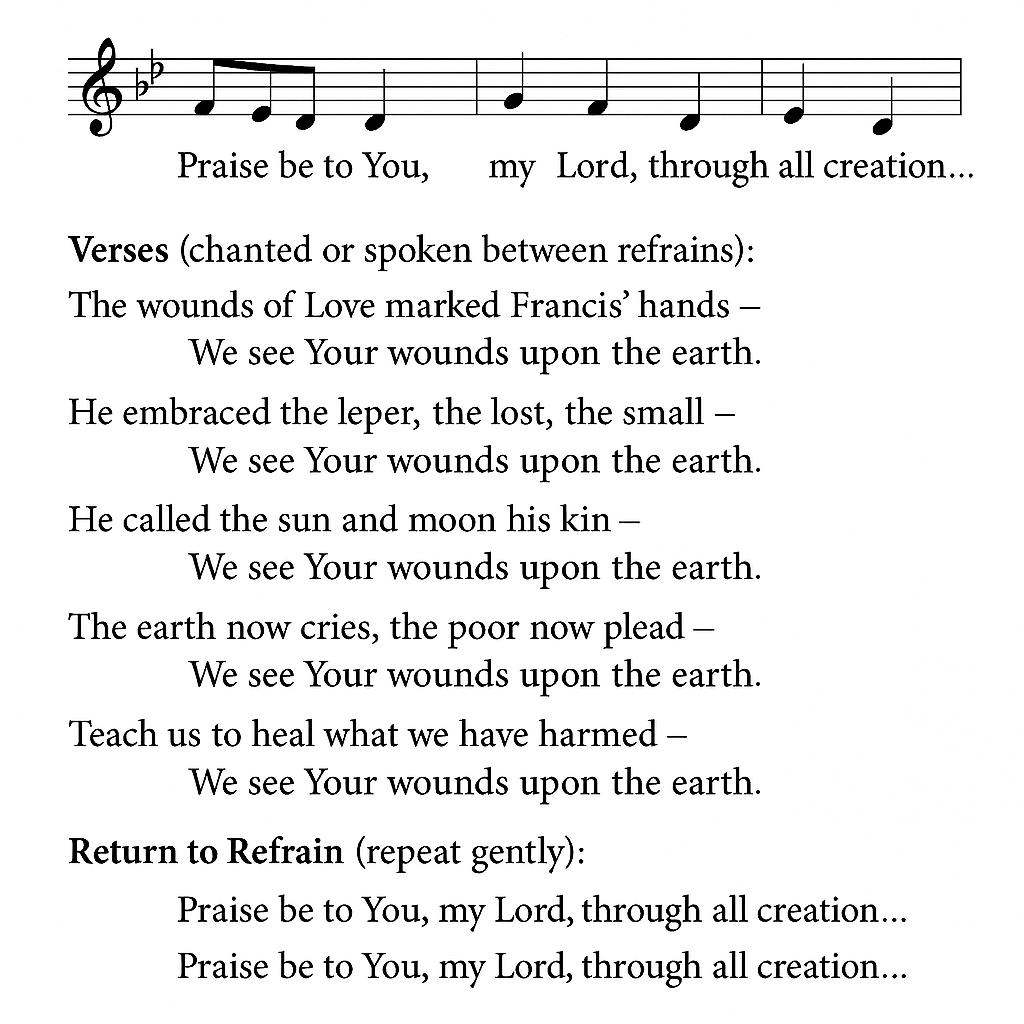
Refrain (sung softly, repeat):

Praise be to You, my Lord, through all creation…

Verses (chanted or spoken between refrains):

  • The wounds of Love marked Francis’ hands —
    We see Your wounds upon the earth.
  • He embraced the leper, the lost, the small —
    We see Your wounds upon the earth.
  • He called the sun and moon his kin —
    We see Your wounds upon the earth.
  • The earth now cries, the poor now plead —
    We see Your wounds upon the earth.
  • Teach us to heal what we have harmed —
    We see Your wounds upon the earth.

(Return to Refrain, repeat gently)

Praise be to You, my Lord, through all creation…