
The World as Cloister: A Theological and Practical Guide for the Secular Franciscan

by Mike Carsten OFS

Audio MP3 File of The World as Cloister

Introduction: Embracing the Sacred Paradox

To be a Secular Franciscan is to live at the heart of a sacred paradox. The teaching that “the world is my cloister” is not a casual motto but a profound spiritual axiom that encapsulates the unique genius of the Franciscan way of life for the laity.1 At first glance, the phrase presents an almost jarring contradiction. The word “cloister,” derived from the Latin claustrum, evokes images of enclosure, separation, and retreat from the world—a quiet, walled garden set apart for God.3 The “world,” in contrast, suggests the bustling, often chaotic, arena of secular life: family, work, society, and all its attendant responsibilities and distractions. To claim the world as one’s cloister seems to be a contradiction in terms.

Yet, this very paradox validates the depth of the question and reveals the radical nature of the Secular Franciscan vocation. The phrase, often attributed to St. Francis of Assisi, represents a revolutionary re-imagining of religious life and sacred space.2 It challenges the notion that holiness is found primarily by withdrawing from the world. Instead, it proposes that the world itself, in all its complexity and messiness, is the very place where the Secular Franciscan is called to live a life of deep prayer, penance, and communion with God. This vocation is not a diluted or lesser form of monasticism; it is a distinct and demanding spiritual path that requires immense interior discipline. It is a call to be a contemplative in action, to find the silence of the cell in the noise of the city, and to see the face of Christ in every person encountered in the public square.

This personal reflection seeks to unpack this sacred paradox for the professed Secular Franciscan. It will first build a thorough understanding of the traditional cloister, both in its physical architecture and its spiritual purpose, to establish the model that Franciscanism so radically re-imagined. It will then explore the unique history and charism of the Secular Franciscan Order (OFS), defining its mission as one of sanctifying the world from within. Finally, it will synthesize these two concepts through the lens of a profoundly incarnational theology, demonstrating how the world, seen through the eyes of St. Francis, truly becomes a sacred enclosure for God. This exploration will culminate in a practical guide for living this reality, translating theological principles into the concrete actions of daily life, so that the Secular Franciscan may joyfully and faithfully live out the truth that their cloister has no walls but is as wide as creation itself.

Part I: The Enclosed Garden – Understanding the Traditional Cloister

To grasp the revolutionary nature of the statement “the world is my cloister,” one must first have a deep appreciation for what a traditional cloister is and what it represents. The monastic cloister is far more than a beautiful architectural feature; it is a physical manifestation of a specific theology, a carefully designed environment for a particular way of life dedicated to seeking God through separation from the world.
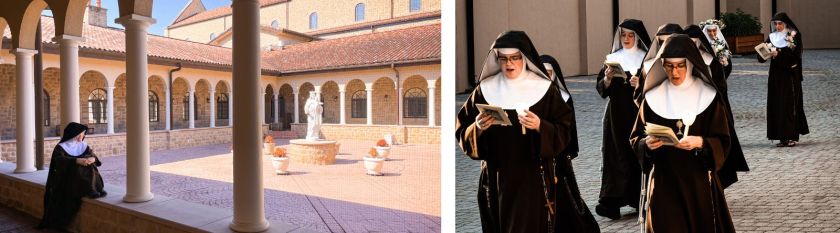
Our Lady of the Angles Monastery, Alabama

The Claustrum: Architecture as Theology

The term “cloister” has its roots in the Latin word claustrum, meaning an enclosure, a lock, or a place that is shut.3 This etymology reveals its primary function: to create a boundary. Architecturally, a cloister is a quadrilateral enclosure, typically a courtyard or garden, surrounded by covered walkways.4 These walkways connect the most important buildings of a monastery or convent: the church, the refectory (dining hall), the dormitory, and the chapter house (the community meeting room).3 This design makes the cloister the very “heart of a monastery,” the central hub of communication and movement for the religious community.3

However, its function is not merely practical. The design of the cloister is a form of enacted theology. It serves as a “continuous and solid architectural barrier… that effectively separates the world of the monks from that of the serfs and workmen”.4 This physical separation is deliberate and purposeful. In the Benedictine model, for example, the refectory was placed on the side opposite the church to ensure that the “worshipers might be removed from kitchen noises and smells,” a small detail that underscores the overarching goal of minimizing worldly distractions.8 The cloister creates a microcosm, an ordered and protected space that stands in stark contrast to the perceived chaos of the external world. The central courtyard, often containing a garden and a well, becomes a symbol of paradise, a new Eden where the community can live in peace and commune with God.3 The arcaded walkways provide light for study and reading, shelter for exercise, and a place for quiet meditation, making the entire structure a tool for spiritual formation.9

Thus, the traditional cloister can be understood not merely as a building, but as a highly refined spiritual technology. Its every architectural element and the canonical rules that govern it were designed with a singular purpose: to minimize external stimuli and maximize the monk’s or nun’s focus on the divine. The cloister operates on the principle that a structured separation from the world is the most effective means to achieve an unstructured union with God. This very principle, of course, presupposes a certain theological dualism: a “world” that is distracting, chaotic, and a source of temptation, and a “monastery” that is ordered, peaceful, and holy.4 It is this fundamental dichotomy between the sacred space inside and the secular space outside that the Franciscan worldview would eventually challenge and transform.

The Life Within: Clausura, Prayer, and Separation

Beyond the physical walls, the cloister represents a formal, canonical state of life defined by the principle of clausura. This term, the Latin for “to shut up,” refers to the body of ecclesiastical law that strictly governs who may enter the monastic enclosure and, just as importantly, who may leave it.12 These legal restrictions are not arbitrary; they are the formal means of protecting the spiritual purpose of the cloister. The goal is to create and maintain an environment of silence, solitude, and prayer, free from the “vices and passions of the world”.7 For the soul called to a contemplative vocation, this separation is not seen as a deprivation but as a necessity. As one prioress explained, for such a soul, immersion in the active world would be a burden that would cause it to “wilt and waste away,” because it would “steal God from her”.13

The rhythm of cloistered life is dictated by this principle of separation. The day is structured around the Opus Dei, the Divine Office, which is prayed in community at set hours, including in the middle of the night.14 The time between communal prayers is filled with private prayer, spiritual reading (lectio divina), and manual labor performed within the monastery walls, such as gardening or baking altar breads.14 This entire way of life, known as the “claustral life,” is synonymous with the monastic vocation itself.4 It is a radical commitment to seek God by leaving the secular world behind, a choice that often “defied their God-given temperaments… dashed plans for marriage and children… (and) meant their world would shrink… so that their minds could dwell on God”.14 The cloister, in this sense, is the ultimate expression of a life singularly focused on God, achieved through a radical act of physical and social withdrawal.

The Cloister of the Heart: An Interior Space for God

Even within the highly structured world of the physical cloister, the ultimate spiritual goal has always been the cultivation of an interior space for God. The external walls and rules are ultimately aids to building an internal “cloister of the heart,” a sacred space within the soul where one can commune with God at any time and in any circumstance.15 This concept is the crucial bridge between the traditional monastic life and the Secular Franciscan vocation.

The understanding is that the physical separation is a means to an end. The end is an uninterrupted state of prayer, an interior silence that is not dependent on external quiet. This idea is powerfully expressed in the saying, “The world is my cloister, my body is my cell, and my soul is the hermit within”.16 This formulation reveals that even for those who live within a physical monastery, the true spiritual work is internal. The body becomes the “cell,” the immediate boundary of one’s physical existence, and the soul becomes the “hermit,” the one who dwells in solitude with God. This insight is transformative because it suggests that if the internal cloister is sufficiently strong and well-formed, the external, physical cloister may not be an absolute necessity. It opens the door to a new possibility: a way of life that maintains the spiritual intensity and focus of the cloister without the physical walls, a life lived in the world but not of it. This is the very space that the Secular Franciscan is called to inhabit.

Part II: The Open Field – The Vocation of the Secular Franciscan

In stark contrast to the enclosed garden of the monastery stands the open field of the world, the designated arena for the Secular Franciscan. The Ordo Franciscanus Saecularis (OFS) is not a society for laypeople who admire St. Francis, but a true Order within the Catholic Church, with a distinct history, a formal Rule, and a unique mission.17 Understanding this vocation requires setting aside the monastic model of withdrawal and embracing a charism of engagement, where “secularity” is not a limitation but the very essence of the call.

A Vocation for the Laity: The Historical Context

The Secular Franciscan Order was not an afterthought or a later development; its origins are traceable to the lifetime of St. Francis himself and his response to the profound spiritual desires of the common people.19 As Francis and his first friars preached a radical, joyful, and penitential living of the Gospel, they attracted countless followers. Many of these were married men and women, artisans, merchants, and farmers who were deeply moved by the Franciscan spirit but could not abandon their families, homes, and worldly responsibilities to join the First Order of friars or the Second Order of cloistered nuns founded by St. Clare.18

Rather than turning them away, Francis gave them a way of life, a rule that would allow them to pursue holiness within their secular state. This was a revolutionary act. In an era when the path to serious sanctity was largely seen as reserved for priests, monks, and nuns, Francis created a formal, Church-approved Third Order for the laity.19 Originally known as the “Brothers and Sisters of Penance,” their vocation was centered on ongoing conversion (metanoia) in the midst of ordinary life.19 This established a new paradigm in the Church: a lay person could now belong to a formal religious Order, with a profession and a rule, without leaving their secular state. This act was a profound innovation in ecclesiology, anticipating by seven centuries the Second Vatican Council’s articulation of the “universal call to holiness” and its affirmation of the sanctification of ordinary life as a genuine path to God.20

The Rule as a Form of Life: “From Gospel to Life and Life to Gospel”

The heart of the Secular Franciscan vocation is its Rule, which is not merely a set of regulations but a forma vivendi—a form of life.24 The fundamental directive of the Rule, both in its earliest forms and in the current version approved by Pope Paul VI in 1978, is “to observe the gospel of our Lord Jesus Christ by following the example of St. Francis of Assisi who made Christ the inspiration and the center of his life with God and people”.17 This Christocentric focus is paramount.

This observance is lived out through a dynamic, cyclical process captured in the motto: “going from gospel to life and life to gospel”.17 This is a profound spiritual practice, a hermeneutical circle that defines the Secular Franciscan’s engagement with the world. One first goes to the Gospel, reading it carefully and prayerfully, to allow the words and actions of Christ to inform and shape one’s own intentions and actions. Then, one goes into life—to family, to work, to the community—and attempts to live out that Gospel message. Finally, one brings the experiences of life—the successes, the failures, the challenges, the joys—back to the Gospel, reflecting on them in the light of Christ’s teaching to discern, correct, and grow in holiness.27

This way of life is sealed by a permanent, public profession. This is not a private devotion but a solemn promise made within the fraternity and before the Church to live according to the OFS Rule for the rest of one’s life.17 This act of profession is what formally constitutes a person as a Secular Franciscan and distinguishes the Order from a pious society or prayer group. It is this commitment that provides the spiritual structure for a life lived without physical walls. In this sense, the Rule itself functions as a portable cloister. While a monk is enclosed by the walls of a monastery, the Secular Franciscan is enclosed by their fidelity to the Rule. It provides the spiritual boundary, the discipline, and the focus that allows them to maintain a consecrated life in the midst of secular affairs.

In Saeculo: The Mission to Sanctify the World from Within

The defining characteristic of the OFS is its “secular” nature, a term that must be understood in its positive, theological sense. The vocation of the Secular Franciscan is to live in saeculo—in the age, in the world.29 Their mission is not to be less worldly in a negative sense, but to be fully in the world as a leaven, an agent of transformation, and a witness to the Gospel.21 The Rule states that members “strive for perfect charity in their own secular state”.17 Their secularity is not an impediment to their holiness, but the very context for it.

Therefore, the apostolate of the Secular Franciscan is the world itself. They are called to “go forth as witnesses and instruments of her [the Church’s] mission among all people, proclaiming Christ by their life and words”.17 Their family, their workplace, their neighborhood, and their civic involvements are the “primary fields where they are called to plant the seeds of the Gospel”.29 They are called, like St. Francis, to “rebuild the Church” not by laying bricks, but by energetically living in communion with the Church and bringing an apostolic creativity to their daily lives.17 This mission is one of sanctifying the world from within, finding God in the ordinary and transforming it through a life of Gospel charity.

Part III: Reconciling the Paradox – “The World is My Cloister”

The resolution to the apparent contradiction in “the world is my cloister” lies in a profound theological synthesis. By viewing the world through a uniquely Franciscan incarnational lens, the very meaning of “cloister” is transformed. The enclosure ceases to be a physical place of separation and becomes a spiritual state of consecration. The purpose shifts from withdrawal from the world to redemptive engagement with it. This section will unpack this synthesis, demonstrating how the paradox is not only resolved but revealed as the cornerstone of the Secular Franciscan identity.

The Incarnational Lens: Seeing the World as Sacred Space

The indispensable key to understanding the Secular Franciscan vocation is its profoundly incarnational worldview. While some theological traditions have historically viewed the material world with a degree of suspicion—as a place of sin and temptation to be fled for the sake of the soul—Franciscan theology takes a radically different approach.31 Rooted in the life of St. Francis, this tradition sees the created world not as a distraction from God, but as the primary arena of God’s self-revelation. Pope Francis, in his encyclical Laudato si’, channels this spirit when he describes nature as a “magnificent book in which God speaks to us and grants us a glimpse of his infinite beauty and goodness”.33

This perspective fundamentally collapses the dualism between the sacred and the secular. The Incarnation—God becoming flesh and dwelling among us—is the ultimate affirmation that matter can bear the divine. For the Franciscan, this event sanctified the entire created order. Consequently, there is “only one reality—the underlying unity in all things”.2 St. Francis preached that the world was an “emanation of God and inherently good”.31 Every creature, “animate and inanimate,” from Sister Moon and Brother Sun to the humblest worm, bears the “imprint of the Most High” and is part of a universal kinship.17

This incarnational lens allows the Secular Franciscan to see the world as a “burning bush ablaze with God’s glory”.2 Every place, from the quiet home to the bustling office, from “ghettos to gated communities,” becomes holy ground because God is present there.2 The world is no longer a problem to be solved or a danger to be escaped, but a “joyful mystery to be contemplated”.33 This way of seeing is not a mere intellectual exercise; it is a transformative spiritual practice. It is what makes it possible to say “the world is my cloister,” because if the world is filled with the presence of God, then one does not need to retreat from it to find Him. This concept is a profoundly Christological statement. It is possible only because of the Incarnation. If God entered the world, then the world itself is the premier place to encounter the divine. The Secular Franciscan life is a radical living-out of the consequences of this belief, following Christ into the world rather than away from it.

The Spiritual Enclosure: Rule and Profession as the “Walls”

If the world is the cloister, what constitutes its walls? For the Secular Franciscan, the enclosure is not physical but spiritual, juridical, and relational. The “walls” are constructed from the solemn commitments made at Profession, the daily discipline of living the Rule, and the mutual accountability of the fraternity. This redefines the cloister from a place of separation from the world to a state of consecration within the world.

The act of Profession is a public, permanent commitment to live the Gospel in the manner of St. Francis, according to the OFS Rule.17 This promise, made to God in the context of the Church, consecrates the individual’s entire secular life. Their marriage, their family life, their work, and their social interactions are all brought under the spiritual discipline of the Rule. This commitment forms the boundary, the spiritual “enclosure.” The discipline required to maintain this boundary is not externally imposed by the ringing of a monastery bell, but must be internally generated through a constant, conscious fidelity to one’s promises.

This creates a unique spiritual state: the paradoxical nature of secular consecration. The OFS member is simultaneously fully “in the world” and yet, by their consecration, “not of the world.” They are set apart for God, but they live out that “apartness” through ordinary, secular means. This is, in many ways, a more demanding spiritual path than traditional monasticism, because the boundaries are not physical and must be constantly discerned and maintained through personal discipline, prayer, and the vital support of the fraternity. The “cloister” is therefore not a static place but a dynamic state of being, a continuous act of “going from Gospel to life and life to Gospel” to navigate the demands of the world without losing one’s consecrated focus.17

From Separation to Engagement: Transforming the World, Not Fleeing It

This redefinition of the cloister necessarily transforms its purpose. The goal of the traditional cloister is withdrawal for the sake of focused contemplation and intercession for the world.4 The goal of the secular cloister is active engagement for the sake of the world’s transformation. The Secular Franciscan is called to be a leaven in society, an instrument of peace, and a builder of a more fraternal world.17

The Rule is explicit on this point. Secular Franciscans are called to “rebuild the Church” and to “build a more fraternal and evangelical world so that the kingdom of God may be brought about more effectively”.17 They are to place themselves in the “forefront in promoting justice” and to firmly commit themselves to opposing “every form of exploitation, discrimination, and exclusion”.18 St. Francis himself, unlike some earlier contemplatives who saw separation from the world as a virtue, embraced engagement with the poor, the lepers, and all of society.31 For the OFS, the secular context is “not an obstacle to their vocation but the very place it is meant to be lived”.29 Their mission is to carry the peace, joy, and love of the Gospel into every corner of human life, sanctifying it from within.

Part IV: Living in the Secular Cloister – A Practical Guide

Understanding the theology of “the world as cloister” is the first step; living it is the lifelong journey. This requires a conscious and intentional effort to structure one’s secular life in a way that reflects the core functions of a traditional monastery. The core disciplines of monasticism—a regulated prayer life, community accountability, study, detachment, and work—are not abandoned by the Secular Franciscan but are creatively and faithfully re-contextualized into the settings of home, office, and neighborhood. The what (the spiritual practice) remains, but the how and where are radically transformed.

The Daily Office: A Rule of Life in the World

Just as a monastery operates according to a horarium, or schedule, that sanctifies the hours of the day with prayer, the Secular Franciscan must intentionally structure their day around prayer and contemplation amidst their secular duties. This creates a rhythm of grace that permeates all of their activities.

The primary way this is achieved is through participation in the prayer of the Church, especially the Liturgy of the Hours.24 By praying the Morning and Evening Prayer, the Secular Franciscan joins their voice to the universal prayer of the Church, sanctifying the beginning and end of the workday. This practice creates spiritual bookends for the day, ensuring that all the activity in between is offered to God. Furthermore, the call is to “pray without ceasing,” which means cultivating a “continuous, conscious connection with God” throughout the day.40 This is the essence of the contemplative life integrated into an active one: finding moments for silent prayer in the car, offering a quick prayer before a meeting, or seeing the face of Christ in a difficult colleague. This interior disposition is sustained by the penitential practice of a nightly examination of conscience, a key discipline that fosters the ongoing conversion (metanoia) that is central to the Franciscan charism.24

The Chapter House: The Fraternity as a Place of Communion

In a monastery, the Chapter House is where the community gathers for instruction, correction, and important decisions. For the Secular Franciscan, this essential function is fulfilled by the local fraternity and its regular meetings.17 The fraternity meeting is not an optional social club; it is an indispensable element of the vocation. It is the “Chapter House” of the secular cloister.

The fraternity is where members are “animated and guided,” and where they experience themselves as a “true spiritual family”.41 The purpose of these gatherings is threefold: mutual support in the ups and downs of life, ongoing formation in the Franciscan spirit, and the communal renewal of their commitment to live the Gospel.20 It is within the fraternity that the Secular Franciscan finds the encouragement and accountability necessary to persevere in a demanding vocation. The sense of community fostered there is what makes members “joyful and ready to place themselves on an equal basis with all people,” especially the lowly.17 This fraternal love is the lifeblood of the Order, preventing the secular vocation from devolving into an isolated and individualistic piety.

The Scriptorium & Library: “Going from Gospel to Life”

Medieval cloisters were vital centers of learning, where monks painstakingly copied manuscripts in the scriptorium and studied in the library.8 The Secular Franciscan’s “scriptorium” is their commitment to ongoing formation, particularly through the “careful reading of the gospel”.17 This is not a static, academic exercise. It is a dynamic, living process. It involves “going from gospel to life and life to gospel”.17

This requires dedicating intentional time to study. The primary text is always Sacred Scripture, which should be read slowly and reflectively, allowing the Holy Spirit to speak through the text and apply it to one’s personal situation.27 This is the “Gospel to life” movement. This study is enriched by reading the writings of St. Francis and St. Clare, Church documents (especially those of the Second Vatican Council, which so deeply inform the modern OFS Rule), and other sound Franciscan spiritual resources.29 This intellectual and spiritual formation is what equips the Secular Franciscan to then bring their “life to the Gospel,” discerning their actions and experiences in the light of their faith. This integration of the contemplative and active lives is not automatic; it is a skill honed through the disciplined practice of study and reflection.

The Refectory & Cellar: Simplicity, Detachment, and Stewardship

The monastic refectory and cellar are the places that govern the community’s relationship with material goods—food, drink, and provisions. The Secular Franciscan lives out the spirit of these spaces through the practice of poverty, which is expressed as simplicity, detachment, and stewardship. The call is to “seek a proper spirit of detachment from temporal goods by simplifying their own material needs”.8

This does not necessarily mean living in abject poverty, as the Secular Franciscan has legitimate responsibilities to provide for their family.45 Rather, it is a conscious and voluntary choice to live simply, to resist the tide of consumerism, and to cultivate a spirit of gratitude and contentment with what one has.45 It means purifying the heart from the “tendency and yearning for possession and power”.8 A key aspect of this is seeing oneself not as an owner, but as a “steward of the goods received for the benefit of God’s children”.17 This perspective transforms one’s relationship with money and possessions. They are no longer for personal aggrandizement but are tools to be used for the glory of God and the service of the human community.

The Apostolate: Work, Family, and Social Action as Sacred Service

In a monastery, the “work” of the monk is prayer and the manual labor necessary to sustain the community. For the Secular Franciscan, the “work”—the apostolate—is their entire engagement with the secular world. Their family life, their job, and their civic responsibilities are not distractions from their vocation; they are the very substance of their vocation.

The family is explicitly named as “the first place in which to live their Christian commitment and Franciscan vocation”.18 It is here that one first practices patience, forgiveness, and selfless love. Likewise, secular work is to be esteemed as a “gift and as a sharing in the creation, redemption, and service of the human community”.1 Whether one is a teacher, a mechanic, a parent, or an executive, the work itself is an opportunity to serve God and neighbor and to develop one’s own personality.

Finally, this service extends to the broader society. Secular Franciscans are called to be “bearers of peace” and active agents in building a more “fraternal and evangelical world”.18 This is not a vague sentiment but a call to concrete action for social and environmental justice, inspired by St. Francis’s love for the poor and his reverence for all creation.18 By integrating their prayer and formation into their daily lives, Secular Franciscans resolve the traditional tension between the contemplative life and the active life. Contemplation of the Gospel fuels their action in the world, and their action in the world drives them back to the Gospel for guidance and renewal, creating a seamless garment of a life lived for God.

Conclusion: The Joyful Mystery of the Secular Vocation

The teaching that “the world is my cloister” is ultimately a profound and joyful mystery. It is not a command to build imaginary walls around oneself, but an invitation to tear down the walls that separate the sacred from the secular, God from daily life, and prayer from action. It is a call to discover that the enclosure for which the human heart longs is not a place, but a state of being: a state of “continual conversion,” of constantly turning the heart toward God in the midst of every human experience.20

To live this vocation is to embark on a path that is both challenging and liberating. It demands the discipline of a monk but applies it to the life of a layperson. It requires seeing the world not as a marketplace of temptations, but as a sacrament of God’s presence. This perspective, rooted in the Incarnation and exemplified by St. Francis, leads to a characteristic Franciscan joy—a joy that comes from recognizing Christ in the face of every brother and sister, and from seeing all of creation as a gift from the Lord.17

Embracing the world as one’s cloister means accepting the call to find God everywhere, to serve Him in everyone, and to sanctify the most ordinary moments of life through extraordinary love. It is to become a living witness that a life of deep communion with God is possible not in spite of our worldly commitments, but precisely through them. As “witnesses and instruments” of the Church’s mission, Secular Franciscans are called to carry the peace and good (pax et bonum) of Christ not out of a cloister, but throughout the vast, beautiful, and sacred cloister of the world itself.17

Peace and every good, Mike

I can be reached at – mikeofs@ofsmike.com

Works cited

  1. Secular Franciscan Order : Living the Way of St Francis of Assisi – FranciscanSeculars.com, accessed July 22, 2025, http://franciscanseculars.com/
  2. Incarnational Training Framework by Street Psalms, accessed July 22, 2025, https://streetpsalms.org/wp-content/uploads/2020/11/Incarnational-Training-Framework-2nd-Ed.pdf
  3. Cloister – Architecture Planning and Preservation – Oxford Bibliographies, accessed July 22, 2025, https://www.oxfordbibliographies.com/abstract/document/obo-9780190922467/obo-9780190922467-0018.xml
  4. Cloister – Wikipedia, accessed July 22, 2025, https://en.wikipedia.org/wiki/Cloister
  5. cloister: Meaning and Definition of – InfoPlease, accessed July 22, 2025, https://www.infoplease.com/dictionary/cloister
  6. Whispering Willows – Rackcdn.com, accessed July 22, 2025, http://96bda424cfcc34d9dd1a-0a7f10f87519dba22d2dbc6233a731e5.r41.cf2.rackcdn.com/fslf1/ourjourneypublication/Our_Journey_Spring15.pdf
  7. cloister – definition and meaning – Wordnik, accessed July 22, 2025, https://www.wordnik.com/words/cloister
  8. Cloister | Monastic Life, Design & History | Britannica, accessed July 22, 2025, https://www.britannica.com/topic/cloister
  9. cloister – Students | Britannica Kids | Homework Help, accessed July 22, 2025, https://kids.britannica.com/students/article/cloister/319861
  10. Cloister – Designing Buildings Wiki, accessed July 22, 2025, https://www.designingbuildings.co.uk/wiki/Cloister
  11. Cloister – Durham World Heritage Site, accessed July 22, 2025, https://www.durhamworldheritagesite.com/architecture/cathedral/intro/cloister
  12. CATHOLIC ENCYCLOPEDIA: Cloister – New Advent, accessed July 22, 2025, https://www.newadvent.org/cathen/04060a.htm
  13. Active/contemplative Or Cloistered How Do You Know Which Is For You? – Page 2 – Catholic Vocation Station – Phatmass, accessed July 22, 2025, https://www.phatmass.com/phorum/topic/123232-activecontemplative-or-cloistered-how-do-you-know-which-is-for-you/page/2/
  14. Life-changing experience within nuns’ cloister – Arlington Catholic Herald, accessed July 22, 2025, https://www.catholicherald.com/article/national/life-changing-experience-within-nuns-cloister/
  15. What’s a Cloister?, accessed July 22, 2025, https://cloisters.tripod.com/id89.html
  16. The Jesus Prayer: A Cry for Mercy, a Path of Renewal 978-0830835775 – DOKUMEN.PUB, accessed July 22, 2025, https://dokumen.pub/the-jesus-prayer-a-cry-for-mercy-a-path-of-renewal-978-0830835775.html
  17. THE RULE OF THE SECULAR FRANCISCAN ORDER, accessed July 22, 2025, https://secularfranciscansusa.org/wp-content/uploads/2017/07/RULE.pdf
  18. Secular Franciscan Order – Wikipedia, accessed July 22, 2025, https://en.wikipedia.org/wiki/Secular_Franciscan_Order
  19. Historical Outline Of The Secular Franciscan Order – Secular …, accessed July 22, 2025, https://ofsaustralia.org.au/historical-outline-of-the-secular-franciscan-order/
  20. What Is the Secular Franciscan Order?, accessed July 22, 2025, https://www.franciscanmedia.org/ask-a-franciscan/what-is-the-secular-franciscan-order/
  21. Who are the Secular Franciscans, and what do they do? – St. Joseph Catholic Church | Charlton, MA, accessed July 22, 2025, https://www.stjosephscharlton.com/documents/2017/11/Who%20Are%20the%20Secular%20Franciscans%20and%20What%20do%20they%20Do.pdf
  22. History – Franciscan Friars, T.O.R., accessed July 22, 2025, https://franciscanstor.org/our-community/history
  23. The Rule of the Secular Franciscan Order: A Short Meditation on the …, accessed July 22, 2025, https://www.hprweb.com/2016/10/the-rule-of-the-secular-franciscan-order-a-short-meditation-on-the-call-to-penance/
  24. History of Our Rule of Life – IL POVERELLO FRATERNITY, accessed July 22, 2025, https://ilpoverellofraternityofs.org/rule-of-life/
  25. Rule and Life of the brothers and sisters of the Third Order Regular of St. Francis – Franciscan Friars of the Atonement, accessed July 22, 2025, https://www.atonementfriars.org/rule-and-life-of-the-brothers-and-sisters-of-the-third-order-regular-of-st-francis/
  26. Exactly how does one live the Gospel values of Secular Franciscans in the world?, accessed July 22, 2025, https://www.secularfranciscansusa.org/faq-items/exactly-how-does-one-live-the-gospel-values-of-secular-franciscans-in-the-world/
  27. REFLECTIONS ON THE SFO RULE, accessed July 22, 2025, https://sfo.franciscans.org.au/sfo30/reflections.htm
  28. Process for becoming a Secular Franciscan, accessed July 22, 2025, https://www.secularfranciscansusa.org/process-for-becoming-a-secular-franciscan/
  29. Chasing The Wild Goose – A Lay Franciscan’s Journal, accessed July 22, 2025, https://ofsmike.com/
  30. One Family, Two Paths: A Secular Franciscan’s Guide to the Rule of the Third Order Regular, accessed July 22, 2025, https://ofsmike.com/2025/07/21/one-family-two-paths-a-secular-franciscans-guide-to-the-rule-of-the-third-order-regular/
  31. Francis of Assisi– Mystic and Environmental Advocate – Dominic Cogan, accessed July 22, 2025, https://dominiccogan.com/francis-of-assisi-mystic-and-environmental-advocate/
  32. How a Little Man Changed the World: St. Francis of Assisi – Rocky Ruggiero, accessed July 22, 2025, https://rockyruggiero.com/how-a-little-man-changed-the-world-st-francis-of-assisi/
  33. Laudato si’ (24 May 2015) | Francis – The Holy See, accessed July 22, 2025, https://www.vatican.va/content/francesco/en/encyclicals/documents/papa-francesco_20150524_enciclica-laudato-si.html
  34. St. Francis of Assisi: A Reverence for Nature, accessed July 22, 2025, https://www.sfc.edu/blog/st-francis-of-assisi-a-reverence-for-nature
  35. Main Page – Ordo Franciscanus Saecularis, accessed July 22, 2025, https://ciofs.info/category/main-page/
  36. Called To Be A Sister Or A Nun – Franciscan Sisters of Christian Charity, accessed July 22, 2025, https://fscc-calledtobe.org/becoming-a-franciscan-sister/called-to-be-a-sister-or-a-nun/
  37. The Life of a Secular Franciscan – SpiritualDirection.com, accessed July 22, 2025, https://spiritualdirection.com/2022/09/26/the-life-of-a-secular-franciscan
  38. What do Secular Franciscans do at their monthly gatherings, accessed July 22, 2025, https://www.dmfofs2.com/what-do-secular-franciscans-do-at-their-monthly-gatherings
  39. What is the difference between a Franciscan nun and a regular nun? – Quora, accessed July 22, 2025, https://www.quora.com/What-is-the-difference-between-a-Franciscan-nun-and-a-regular-nun
  40. Secular Franciscan Order – USA – Following Christ in the footsteps of St. Francis, accessed July 22, 2025, https://www.secularfranciscansusa.org/
  41. Cloister Definition & Meaning | YourDictionary, accessed July 22, 2025, https://www.yourdictionary.com/cloister
  42. Who we are – Secular Franciscans of Great Britain – ofsgb, accessed July 22, 2025, https://ofsgb.org/join-us/franciscan-witness/who-we-are/
  43. Ordo Franciscanus Saecularis – Consilium Internationale OFS (CIOFS) | Secular Franciscan Order, accessed July 22, 2025, https://ciofs.info/
  44. Secular Franciscan Order – Chasing The Wild Goose, accessed July 22, 2025, https://ofsmike.com/category/secular-franciscan-order/
  45. What IS Secular Order Profession – Our Walk Together, accessed July 22, 2025, https://ourwalktogether.com/2024/04/09/what-is-secular-order-profession/
  46. A Life of Simplicity, Humility, and Harmony with Nature – St. Francis College, accessed July 22, 2025, https://www.sfc.edu/blog/a-life-of-simplicity-humility-and-harmony-with-nature

One Family, Two Paths: A Secular Franciscan’s Guide to the Rule of the Third Order Regular

The Enduring Call to Penance

The great Franciscan family, a spiritual tree with many branches, springs from a single, powerful seed: the call to do penance. This was the life St. Francis of Assisi embraced after his conversion, a life of turning completely from sin and self to follow the poor and crucified Christ in the Gospel. This fundamental call to metanoia—a radical, ongoing conversion of heart—is the shared spiritual DNA of every man and woman who follows the Poverello. From this common root, two major branches of the Third Order grew, each a distinct and beautiful expression of the same charism. The Secular Franciscan Order (OFS) represents the original vision for lay men and women to live the Gospel in the heart of the world, while the many congregations of the Third Order Regular (TOR) represent the desire for a vowed, communal expression of the same penitential spirit.

The two modern Rules that govern these Orders—the Rule of the OFS, Seraphicus Patriarcha, approved by Pope St. Paul VI in 1978, and the Rule of the TOR, Franciscanum Vitae Propositum, approved by Pope St. John Paul II in 1982—are not competing documents but spiritual siblings. They are parallel flowerings from the same root, each updated after the Second Vatican Council to speak with fresh clarity to the modern world. For a professed Secular Franciscan, the TOR Rule is not a foreign text. It is a family heirloom, a mirror reflecting the radical heart of the Franciscan vocation in its most concentrated form. This article serves as a comprehensive guide for the Secular Franciscan who wishes to explore this shared heritage. It will trace the historical and juridical journey that led to two distinct paths and conduct a deep comparative analysis of the two Rules. This exploration is an invitation to see the two Rules not as a division, but as a dialogue that reveals the immense breadth and depth of the one call to observe the Holy Gospel in the footsteps of St. Francis of Assisi.

1: A Shared Root, Two Distinct Branches: The Historical and Juridical Journey

To understand the relationship between the Secular Franciscan Order and the Third Order Regular, one must first grasp their shared history. Their divergence was not a schism over doctrine but an organic development responding to the varied ways the Holy Spirit called people to live the Franciscan charism. The OFS is not a “lesser” version of the TOR; it is the original lay expression of the penitential life, from which the TOR later branched off to form a new mode of consecrated religious life. This historical reality affirms the equal dignity and distinct purpose of each vocation within the one Franciscan family.

1.1 The Common Genesis: The Brothers and Sisters of Penance

The Franciscan movement began with St. Francis himself, but it quickly attracted followers from every state of life. Around the year 1221, Francis established what was originally called the “Brothers and Sisters of Penance”. This was his answer for the many married men and women, diocesan priests, and other laypeople who were inspired by his radical living of the Gospel but who, because of their existing commitments, could not join the Friars Minor (the First Order) or the Poor Ladies (the Second Order).

The “primitive rule” for this lay movement was Francis’s own Letter to All the Faithful (also known as the Earlier Exhortation to the Brothers and Sisters of Penance). This document was not a legal code but a powerful spiritual exhortation, a “form of life” calling the laity to a profound interior conversion. Its core tenets were simple and drawn directly from the Gospel: to love God with one’s whole being and one’s neighbor as oneself; to turn away from sin; to receive the Body and Blood of Christ; and to produce “worthy fruits of penance” through acts of charity and forgiveness. The inclusion of this very letter as the Prologue to the modern OFS Rule, and its partial inclusion in the TOR Rule, serves as a testament to the direct lineage both Orders trace back to the founder’s original inspiration.

This burgeoning lay movement soon required a more formal structure. With the help of Cardinal Ugolino (the future Pope Gregory IX), a formal Rule known as the Memoriale Propositi was approved by Pope Honorius III in 1221, giving canonical status to the Order of Penance. This marked the official birth of what would become the Third Order.

1.2 The Fork in the Road: Community Life and the Birth of the Third Order Regular

Within the widespread Order of Penance, a new spiritual desire began to emerge. Some tertiaries, both men and women, felt called to a more intense and structured form of penitential life. Organically, without a single founder, they began to gather into small groups, living in common either as hermits or in communities dedicated to prayer and works of mercy. This development created a natural “fork in the road.” While the majority of tertiaries continued to live the Franciscan charism in their homes and workplaces, these new communities began to move toward a more formal, consecrated life.

This new expression of Franciscan life eventually adopted the traditional religious vows of poverty, chastity, and obedience. For over two centuries, these communities grew and developed in various regions, particularly in Italy, the Netherlands, and Germany, often in isolation from one another. The Church recognized the authenticity of this new form of life and, in 1447, Pope Nicholas V issued the apostolic letter Pastoralis officii. This landmark document effectively organized these disparate communities of vowed tertiaries into a new, independent mendicant order: the Third Order Regular of St. Francis of Penance. This moment marks the official juridical separation of the TOR from its secular counterpart, establishing two distinct but related branches from the same trunk.

1.3 Parallel Paths of Renewal: The Evolution of the Rules to the Modern Era

Following their formal separation, the two branches continued on parallel paths of development and renewal, with the Church periodically updating their respective Rules to meet the needs of the times.

The Rule for the secular branch was revised and confirmed by Pope Nicholas IV in 1289 with the bull Supra montem and again by Pope Leo XIII in 1883 with Misericors Dei Filius, which adapted the Order to the challenges of the 19th century. The most recent and current Rule is Seraphicus Patriarcha, promulgated by Pope St. Paul VI in 1978.

The Third Order Regular also saw its Rule evolve. Pope Leo X provided a significant unifying Rule in 1521 with the bull Inter cetera to bring uniformity to the many congregations. This and other statutes guided the TOR for centuries until, like the OFS, it underwent a period of post-Vatican II renewal. This process culminated in the approval of the current Rule, Franciscanum Vitae Propositum, by Pope St. John Paul II in 1982.

It is crucial to recognize that both modern Rules—1978 for the OFS and 1982 for the TOR—were born from the same spirit of aggiornamento (updating) that swept the Church after the Second Vatican Council. Both sought to return to the primitive inspiration and authentic charism of St. Francis while courageously adapting their way of life to the realities of the contemporary world.

1.4 A Family Reunited: Understanding Autonomy and “Vital Reciprocity”

The modern era has brought a mature and clear definition of the relationship between the Franciscan Orders. The 1978 Rule established the Secular Franciscan Order as a fully autonomous Order within the Church. It is not a subsidiary or “third-class” part of the Franciscan family, but an equal member, alongside the First and Second Orders, with its own international governance.

This autonomy, however, does not imply isolation. The Church, recognizing the profound family bond, has formally codified the relationship under the principle of “vital reciprocity” (vitalis reciprocatio). The Holy See has entrusted the spiritual and pastoral assistance of the OFS to the friars of the First Order and the Third Order Regular. This is not a relationship of juridical control but of fraternal service and spiritual animation. The friars are tasked with guaranteeing the fidelity of the OFS to the Franciscan charism and fostering communion within the entire family. This arrangement is a beautiful expression of the Church’s wisdom. After centuries of varied and sometimes inconsistent levels of engagement between the branches, “vital reciprocity” establishes a relationship of equals who are spiritually interdependent. For a Secular Franciscan, this means the TOR is not just another religious order; it is a designated spiritual resource, an elder sibling in the faith, and a living witness to the same charism.

2: The Rules in Dialogue: A Comparative Spiritual Analysis

While rooted in a common history, the Rule of the Secular Franciscan Order (OFS) and the Rule of the Third Order Regular (TOR) are distinct documents tailored to different ways of life. A careful comparison reveals a shared heart but different modes of expression, reflecting their unique roles within the Church. The TOR Rule, steeped in the founder’s own words, aims to form the religious by direct immersion in the source. The OFS Rule, integrating the language of Vatican II, aims to form the laity by connecting the Franciscan charism to their universal call to holiness and mission in the world. Understanding these differences in pedagogy and focus is key to appreciating the unique gift of each Rule.

2.1 Foundational Principle: To Observe the Holy Gospel

The bedrock of both Rules is identical: a life dedicated to observing the Holy Gospel in the footsteps of St. Francis of Assisi. This shared foundation is the source of their profound spiritual unity.

  • OFS Rule, Article 4: “The rule and life of the Secular Franciscans is this: to observe the gospel of our Lord Jesus Christ by following the example of St. Francis of Assisi who made Christ the inspiration and the center of his life with God and people”.
  • TOR Rule, Chapter I, Article 1: “The form of life of the Brothers and Sisters of the Third Order Regular of Saint Francis is this: to observe the Holy Gospel of Our Lord Jesus Christ by living in obedience, in poverty and in chastity”.

Both Orders see St. Francis not as the end, but as the model, the one who shows them how to make Christ the center of everything. This Christocentric, Gospel-driven life is the non-negotiable core of their shared identity.

2.2 The Nature of Commitment: Profession in the World vs. Vows in Community

The most significant and defining difference between the two Orders lies in the nature of their public commitment and the state of life it entails.

  • Members of the Third Order Regular are consecrated religious. They profess the three public, evangelical vows of poverty, chastity, and obedience and live a common life in a fraternal community, such as a friary or convent. Their life is structurally set apart from the world to be a specific sign within the Church.
  • Members of the Secular Franciscan Order, by contrast, live their vocation in their own secular state. They make a public profession—a solemn promise, not a canonical vow—to live according to their Rule for their entire life. They can be married or single, laypeople or diocesan clergy, and they live in their own homes, work in secular jobs, and raise families.

This fundamental distinction shapes the entire content and structure of each Rule. The TOR Rule must necessarily legislate for the practicalities of a common life, while the OFS Rule provides guiding principles for living the Franciscan charism within the vast and varied circumstances of secular life.

2.3 The Arena of Life: The World as Cloister

Flowing directly from the nature of their commitment is the difference in their primary “arena” of life and apostolate.

  • For the TOR, life is centered in and flows from the religious house. Their apostolic works, whether in education, parish ministry, or social justice, are typically undertaken as a community and are an extension of their common life.
  • For the OFS, the world itself is their cloister. As Pope St. John Paul II affirmed, their vocation is to live the Gospel in saeculo—in the world. Their family, their workplace, their neighborhood, and their parish are the primary fields where they are called to plant the seeds of the Gospel. The OFS Rule is explicitly designed to be adaptable, meeting the “needs and expectations of the Holy Church in the conditions of changing times”, recognizing that the secular context is not an obstacle to their vocation but the very place it is meant to be lived.

2.4 A Tale of Two Texts: Spiritual Tone and Guiding Influences

While both Rules are deeply spiritual, they have a different texture and draw from different primary sources, revealing their distinct pedagogical aims.

  • The TOR Rule is almost entirely spiritual and ascetical in its tone. It is a beautiful mosaic composed largely of direct quotations from the writings of St. Francis and St. Clare of Assisi. A comparative analysis shows it contains 92 references to Francis’s writings and 12 to Clare’s. Reading it feels like receiving a direct exhortation from the founders themselves.
  • The OFS Rule is rooted in Franciscan sources, with 21 references to Francis’s writings. However, it is profoundly shaped by the theology of the laity that emerged from the Second Vatican Council. It contains 18 references to Vatican II documents. It specifically highlights Lumen Gentium (Dogmatic Constitution on the Church). It also emphasizes Gaudium et Spes (Pastoral Constitution on the Church in the Modern World). Its language about the lay apostolate promotes justice. It speaks about building a more fraternal world and emphasizes the dignity of the family. These points echo the council’s vision for the mission of the laity.

This difference in source material is not accidental. It reveals a specific intention for the formation of the members. The TOR Rule aims to form the religious by immersing them directly in the founders’ teachings. This immersion is suitable for a life lived in a dedicated Franciscan environment. The OFS Rule seeks to form the laity by explicitly connecting the Franciscan charism to the universal call to holiness. It connects this charism to the specific mission of the laity in the Church and the world. This connection is defined by the most recent ecumenical council. The OFS Rule, thus, acts as a bridge. It links the specific Franciscan path to the great highway of the Church’s life in the modern age.

Conclusion: One Family, One Charism, Many Paths

The journey through the Rules of the Secular Franciscan Order and the Third Order Regular reveals a profound and beautiful truth: the Franciscan charism is a single, vibrant reality expressed in a plurality of forms. The OFS and the TOR are not rival systems but complementary vocations, two authentic paths for living the one Gospel life revealed to St. Francis of Assisi. They share a common origin in the penitential movement, a common goal of conformity to Christ, and a common mission to rebuild the Church from within.

The differences between them are not of essence but of application. The TOR, with its public vows and community life, offers a concentrated, prophetic witness to the evangelical counsels. Its Rule, steeped in the very words of Francis and Clare, is a powerful call to radical self-renunciation for the sake of the kingdom. The OFS, with its profession made in the world, offers a leavening witness, demonstrating that a life of deep conversion and apostolic love is possible within the ordinary circumstances of family, work, and society. Its Rule, in dialogue with the modern Church, provides a bridge between the Franciscan ideal and the universal call to holiness for all the baptized.

Ultimately, to study the two Rules in parallel is to listen to a conversation within one’s own spiritual family. It is to see the same fire of love for Christ burning in a different hearth, revealing the immense breadth and depth of the one call to observe the Holy Gospel in the footsteps of their common Seraphic Father, St. Francis.

Peace, Mike

The Abdication of Conscience: How the American Church Built Its Own Concentration Camps

by Mike Carsten OFS

The Alligator in the Sanctuary

Deep in the Florida Everglades, on land considered sacred by Native American tribes and vital to a fragile ecosystem, a new monument to American cruelty is taking shape.1 It is a massive immigrant detention camp, built in just eight days on an abandoned airfield, designed to house 5,000 undocumented human beings awaiting deportation.1 Its architects, the political leaders of Florida and the Trump administration, have christened it “Alligator Alcatraz,” a name chosen with deliberate, theatrical sadism.1 This is not merely a bureaucratic designation; it is a public declaration of intent. The name, evoking the nation’s most notorious prison known for its brutal conditions, is meant to “send a message” of deterrence through fear.1

The physical reality of the camp matches its name. It is a sprawling complex of tents surrounded by over 28,000 feet of barbed wire and monitored by more than 200 security cameras.1 It sits in a remote swamp, prone to flooding from the frequent heavy rains, and offers little protection from the oppressive heat and swarms of mosquitoes.1 The message is clear: those held within are not worthy of humane treatment; they are to be made an example of. This message is amplified by the gleeful marketing of “Alligator Alcatraz” merchandise and the circulation of official memes depicting the barbed-wire compound “guarded” by alligators wearing Immigration and Customs Enforcement (ICE) hats.1 This is not policy; it is a performance of state-sanctioned contempt, a spectacle of dehumanization where President Trump himself could tour the facility and boast, “We’re going to teach them how to run away from an alligator if they escape prison”.4

The construction of such a place has rightly sparked outrage. Critics have reached for the most potent language they can find, nicknaming the facility “Alligator Auschwitz”.4 This comparison has, just as rightly, drawn concern from Jewish leaders and others who caution against making false equivalencies that disrespect the unique horror of the Holocaust.4 The point is well taken. The industrial-scale extermination of the Shoah is a singular evil. Yet, as Rabbi Ammos Chorny of Naples, Florida, warned in a sermon regarding the facility, “we would be dangerously blind not to hear the echoes of history in our midst”.4 The use of such a loaded term, while historically imprecise, signals a moral emergency. It reflects a gut-level recognition that the process of stripping a group of its humanity to justify its indefinite detention in punitive conditions is a path that has led to unspeakable darkness before. Therefore, this analysis will use the term “concentration camp” not to equate its function with the death camps of the Third Reich, but in its historically accurate sense: a place where a civilian population is imprisoned outside the normal judicial process, based on their group identity, for the purposes of control, punishment, and deterrence.

And this brings us to the provocative, yet necessary, thesis of this investigation. While these camps are built and funded by the state, they are the direct and foreseeable consequence of a profound moral and theological failure on the part of the institutional Catholic Church in the United States. They are the bitter harvest of a Church that has abdicated its prophetic duty in exchange for perceived political influence. They are, in a real and damning sense, Catholic Concentration Camps (CCC). This is not because the Church provided the funding or the barbed wire, but because it has meticulously cultivated the political and moral vacuum in which such atrocities can be conceived, built, and defended without facing the full, unified, and uncompromising opposition of the Body of Christ. This abdication is rooted in a duplicitous policy of “neutrality” and a deep-seated theological sin of “othering,” which together have made the American Church a silent partner in the construction of its own gulags.

Part I: The Doctrine of the Empty Chair: Neutrality as a Moral Stance

The American Catholic hierarchy, when confronted with its failure to oppose the architects of these camps, retreats behind a carefully constructed shield: the doctrine of political neutrality. This official policy, however, is not a position of moral integrity or spiritual detachment. It is a calculated political strategy, a legalistic fiction that, in the polarized landscape of American politics, amounts to a partisan choice and a catastrophic dereliction of the Gospel’s prophetic demand. It is the doctrine of the empty chair, a deliberate absence from the battlefield of justice that cedes the territory to the forces of cruelty.

1.1: ‘Forming Consciences’ or Forbidding Prophecy?

The official line from the United States Conference of Catholic Bishops (USCCB) is consistent and clear. In a statement offered on July 8, 2025, in response to a new IRS interpretation of rules governing political speech by non-profits, the Conference reaffirmed its long-held position: “The Catholic Church maintains its stance of not endorsing or opposing political candidates”.5 The stated purpose of the Church’s engagement in the public square, according to the USCCB, is not to pick winners in elections but to “help Catholics form their conscience in the Gospel so they might discern which candidates and policies would advance the common good”.5 This process of conscience formation, they argue, is a lifelong obligation for the faithful, requiring study of scripture and Church teaching, examination of facts, and prayerful reflection to discern God’s will.7

This posture of principled non-partisanship, however, collapses under the weight of the Church’s own teachings and priorities. The USCCB’s neutrality is, in practice, highly selective. While claiming not to endorse candidates, the bishops have been anything but neutral on certain issues. The most prominent example is abortion. In their document “Catholics in Political Life,” the bishops declare that abortion is an “intrinsically evil” act and that failing to protect the unborn from the moment of conception is a “sin against justice”.8 This teaching is presented not as a matter for prudential judgment, but as an absolute, a “constant and received teaching of the Church” that has been affirmed since the first century.8 Consequently, politicians who consistently act to support abortion rights risk being publicly labeled as “cooperators in evil”.8 The bishops even state that Catholic institutions “should not honor those who act in defiance of our fundamental moral principles” by giving them awards or platforms.8

Herein lies the central contradiction. The USCCB claims neutrality regarding candidates but elevates one specific issue to the status of a “non-negotiable” litmus test.8 In a two-party political system where one party is broadly perceived as being aligned with this “non-negotiable” issue, the instruction to “form consciences” is no longer a neutral exercise in moral discernment. It becomes a thinly veiled and powerful political directive. The faithful are told that one issue is of such paramount importance that it creates a unique and grave moral obligation. When one political party is seen as the champion of that issue, the act of “forming one’s conscience” according to the bishops’ guidance leads to a predictable political conclusion.

This transforms the entire moral calculus of the Church’s political engagement. The refusal to issue a similarly absolute condemnation of the politicians and policies responsible for caging human beings in places like “Alligator Alcatraz” becomes the implicit price of maintaining influence with the party that aligns on the “non-negotiable” issue. The dehumanization of the migrant, the separation of families, the construction of concentration camps—these are relegated to the category of issues requiring “prudential judgment,” where “Catholics may choose different ways to respond to compelling social problems”.7 This creates a hierarchy of sin, where the caging of a child is a debatable policy choice, but abortion is an absolute evil that places a politician outside the bounds of Catholic honor. The doctrine of “forming consciences” has been weaponized. It has been perverted from a tool for seeking truth into a sophisticated mechanism for laundering a partisan political alignment through the language of faith. The USCCB’s professed neutrality is a lie. They have chosen a side not by endorsing a candidate, but by choosing which sins to treat as absolute and which to treat as negotiable. This selective outrage, this moral gerrymandering, is the foundational act of complicity that allows the camps to exist.

1.2: The Price of a Tax Exemption and the Taint of Federal Funds

The hierarchy’s strategic neutrality is reinforced by a deep-seated institutional anxiety, rooted in both legal and financial realities. The primary legal justification for this caution is the Johnson Amendment, a provision in the U.S. tax code that explicitly prohibits 501(c)(3) tax-exempt organizations, including churches, from participating or intervening in “any political campaign on behalf of (or in opposition to) any candidate for public office”.11 While the USCCB’s Office of General Counsel provides detailed guidelines on navigating these rules, the overarching effect has been to foster a culture of profound risk aversion.11 The fear of jeopardizing the Church’s vast financial and institutional tax-exempt status has, in practice, often trumped the moral imperative for a clear, prophetic voice. Institutional self-preservation becomes the highest good, a goal before which even the most egregious injustices must be addressed with carefully parsed language and an abundance of caution.

This institutional timidity is further complicated by the Church’s direct financial entanglement with the very government whose policies it is called to critique. This issue has become a flashpoint, creating a rare point of agreement between critics on the theological left and right. From a traditionalist perspective, commentators on forums like Reddit have argued that the USCCB has become a “magnet for federal funds, to the point of distorting the doctrinal messages it projects, such as emphasizing pro-immigration over pro-life”.10 This critique found a powerful voice in the political mainstream when Vice President J.D. Vance, a Catholic himself, publicly challenged the bishops’ motives for condemning the Trump administration’s immigration policies. Vance questioned whether the bishops’ stance was genuinely rooted in pastoral concern or if they were “actually worried about their bottom line,” citing the fact that U.S. dioceses receive over $100 million in federal grants for refugee resettlement programs.12

The USCCB immediately refuted this accusation, issuing a statement clarifying that the federal funds they receive are part of a long-standing partnership with the government to carry out the “work of mercy” of resettling refugees, and that these funds are insufficient to cover the full costs of the programs.12 While the bishops’ defense may be factually correct, the political damage is done. The mere existence of such a significant financial relationship creates the

perception of a conflict of interest, providing a ready-made excuse for politicians to dismiss the Church’s moral witness as the self-interested lobbying of a government contractor.

This situation places the USCCB in a pincer movement of critique. On one side, progressive Catholics—the intended audience of this very blog—decry the Conference for its moral cowardice, its failure to stand unequivocally with the oppressed, and its prioritization of institutional access over prophetic witness. On the other side, traditionalist Catholics lambast the USCCB as a “limp-wristed bureaucracy” that has become too liberal, too entangled with government, and too compromised by federal money to speak with authentic Catholic authority.10 Though they come from opposing theological and political poles, both critiques converge on the same diagnosis of institutional decay: a Conference that has become so focused on its own bureaucratic preservation, its legal status, and its government partnerships that it has lost the ability to speak with the clear, uncompromised, and courageous moral voice the Gospel demands. This widespread crisis of legitimacy, felt across the ideological spectrum of American Catholicism, reveals an institution that is failing its primary mission, an institution whose silence on the camps in the Everglades is not an accident, but the logical outcome of its own internal priorities.

Part II: The Gospel vs. The Conference: A Church Divided on the Stranger

There exists a vast and tragic chasm between the official teachings of the Catholic Church on the treatment of migrants and the brutal reality that its political quietism allows to fester. On one side of this chasm is a rich, beautiful, and biblically-grounded tradition of welcome and solidarity. On the other side is the barbed wire, the flooding tents, and the calculated cruelty of “Alligator Alcatraz.” The failure of the USCCB is not that it lacks the right words, but that it refuses to give those words political teeth, creating a profound dissonance that leaves the most vulnerable members of its own flock abandoned and afraid.

2.1: The Eloquence of Teaching

To read the official documents of the Catholic Church on migration is to encounter a radical call to compassion and justice. The teaching is not ambiguous, tentative, or new; it is a consistent and powerful thread running from the Old Testament to the modern papacy. The Holy See, in its “Twenty Action Points for the Global Compacts,” provides a detailed policy blueprint for a just and humane migration system, calling on states to ban arbitrary and collective expulsions, to expand legal pathways for migration, and, crucially, to “adopt national policies that prefer alternatives to the detention of those seeking access to the territory”.13

The USCCB, in its own documents, echoes and amplifies this universal teaching for the American context. In their “Catholic Elements of Immigration Reform,” the bishops insist that all enforcement efforts must be “targeted, proportional, and humane”.14 They declare that the “dehumanization or vilification of noncitizens as a means to deprive them of protection under the law is not only contrary to the rule of law but an affront to God himself, who has created them in his own image”.14 They argue for limiting the use of detention, “especially for families, children, pregnant women, the sick, elderly, and disabled, given its proven harms and the pervasive lack of appropriate care in detention settings”.14 Their teaching is grounded in the deepest roots of the faith, recalling the story of Exodus and reminding the faithful, “You shall treat the alien who resides with you no differently than the natives born among you; have the same love for him as for yourself; for you too were aliens in the land of Egypt”.15 The New Testament mandate is even more direct, with Jesus identifying himself with the stranger: “a stranger and you welcomed me” (Mt 25:35).15

Even in the face of the current crisis, the bishops have continued to issue statements that are, on paper, pastorally sensitive and morally correct. In a June 2025 statement, USCCB President Archbishop Timothy Broglio directly addressed the surge in immigration enforcement, decrying it as a “profound social crisis” that goes “well beyond those with criminal histories”.16 He spoke directly to the immigrant community, assuring them, “As your shepherds, your fear echoes in our hearts and we make your pain our own. Count on the commitment of all of us to stand with you in this challenging hour”.16 These are powerful, beautiful, and deeply Catholic words. They articulate a vision of the Church as a mother and a sanctuary for the vulnerable. The tragedy is that they remain just words, rendered hollow by the Conference’s refusal to confront the political powers that create the fear their words purport to soothe.

2.2: The Brutality of Reality

The eloquent teachings of the Church stand in stark, almost grotesque, contrast to the lived reality of the policies they fail to stop. The “Alligator Alcatraz” facility is not a regrettable but necessary component of a humane enforcement system; it is the physical embodiment of the very dehumanization the bishops condemn. It is a system built not on proportionality, but on cruelty as a form of communication. Governor Ron DeSantis and other state officials have been explicit that the facility’s “rugged and remote” location in the Everglades and its deliberately intimidating name are meant as a “deterrent”.1 The message is not one of justice, but of suffering: do not come here, or this is what awaits you.

The conditions within the camp fulfill the promise of its name. Human rights advocates, environmental groups, and Native American tribes have all protested its construction, citing the cruelty of exposing detainees to extreme heat and mosquitoes, the threat to the fragile Everglades ecosystem, and the desecration of land the tribes consider sacred.1 The facility’s structural integrity is dangerously inadequate for its location. During a visit by President Trump to mark its opening, a simple heavy rainstorm caused flooding in the tents.1 While state officials claim the complex can withstand a Category 2 hurricane, they have also indicated that the detainees would not be evacuated in such an event, a policy that one state lawmaker described as creating a structure that would “blow apart like matchsticks” in a major storm.2

This architecture of cruelty is accompanied by a political spectacle of contempt. President Trump’s tour, where he joked about alligators hunting escaped detainees, was not an off-the-cuff remark but a calculated performance for his political base.4 It was a moment of political theater designed to mock and degrade the very people the Church, in its documents, calls “our neighbors, friends and family members”.17 The selling of “Alligator Alcatraz” merchandise and the gleeful sharing of caged-in bunk photos by political supporters are not incidental details; they are evidence of a political culture that has moved beyond mere policy disagreement and into the realm of reveling in the suffering of a designated out-group.4 This is the brutal reality that the USCCB’s carefully worded statements and claims of neutrality have failed to prevent. It is a reality that makes a mockery of their assurances that “your fear echoes in our hearts.”

2.3: The Dissonance of the Faithful

The most damning evidence of the USCCB’s pastoral failure is the emergence of a de facto schism between the “Church of the Conference” and the “Church of the Parish.” While the national leadership in Washington D.C. navigates the political tightrope of neutrality and abstract advocacy, priests and bishops on the ground are dealing with a full-blown pastoral crisis. The consequences of the policies that the USCCB refuses to unequivocally condemn are not abstract; they are terror and panic in the pews.

In Southern California, a region on the front lines of the administration’s aggressive deportation campaign, the response from local Church leaders has been one of emergency action. In a truly extraordinary measure, Bishop Alberto Rojas of the Diocese of San Bernardino issued a formal decree freeing members of his diocese from their Sunday and Holy Day obligation to attend Mass if they fear “potential immigration enforcement actions by civil authorities”.18 This move came after federal agents detained migrants on Catholic Church property in his diocese, violating a decades-old norm that treated houses of worship as sanctuaries.18 The implication of Bishop Rojas’s decree is staggering: the policies of the state have become so threatening that a bishop must release his flock from their most sacred weekly obligation for their own safety.

This is not an isolated incident. Across the region, priests and laypeople are mobilizing to fill the void left by their national leadership. Fr. Brendan Busse, a pastor in Boyle Heights, described the language his community uses: “they feel hunted”.18 He volunteers with a neighborhood rapid response network, trained to provide support and resources when ICE activity is reported.18 Other dioceses have organized workshops to teach parishioners their rights, coordinated prayer vigils, and made food deliveries to families too afraid to leave their homes.18 Priests and deacons are accompanying individuals to immigration court, a simple act of presence that appears to improve outcomes for asylum seekers.18

This stark contrast reveals the catastrophic nature of the USCCB’s failure. Their strategy of high-level, politically cautious engagement has effectively abandoned the flock on the ground. It has created a situation where local pastors must improvise pastoral strategies to deal with a state of terror that their own national conference is unwilling to name and condemn with the full force of its moral authority. The “Church of the Conference” issues statements lamenting the “palpable cries of anxiety and fear,” while the “Church of the Parish” is left to comfort the hunted and dispense them from their religious duties. This is more than a political failure; it is a pastoral abdication of the highest order. By refusing to be a shield for the most vulnerable, the USCCB has left its own people defenseless, forcing them to wonder if they are being hunted not only by the state, but by the silence of their own shepherds.

Part III: The Theology of Othering: The Original Sin of the American Church

The political calculations and pastoral failures of the American hierarchy are not merely strategic errors; they are symptoms of a much deeper theological disease. The moral paralysis of the institutional Church in the face of state-sanctioned cruelty is made possible by a foundational sin: the sin of “othering.” It is this process of theological and social boundary-drawing, of defining who is “us” and who is “them,” that provides the moral anesthetic required for a Christian people to tolerate the intolerable. The concentration camps in the Everglades are the physical manifestation of a spiritual wall that has first been erected in the hearts of a significant portion of the American Church.

3.1: Defining the Sin: ‘Us’ vs. ‘Them’

“Othering” is the process by which a dominant social group defines certain individuals or groups as not belonging, as outside the circle of shared norms and moral concern.19 As writer Ched Myers explains, while all groups establish boundaries, othering weaponizes these boundaries to “shore up the privileges of the strong against the needs of the weak”.20 It functions by labeling the “Other” as inferior, unclean, dangerous, or subhuman, thereby rationalizing their subjugation.20 This dynamic is a “historical constant,” visible in the way European settlers portrayed Native Americans as “savages” to justify genocide and the way white society portrayed African Americans as an “inferior race” to justify slavery and segregation.19

Within the Church, this sin manifests as a form of tribalism that stands in direct opposition to the Gospel’s universal call. As Patrick Saint-Jean, S.J., observes, “our American Catholic Church is polarized by its factions: pro-life vs. pro-choice, gun restrictions vs. pro-gun, Democrat vs. Republican, CNN vs. Fox News”.19 This factionalism creates an “us vs. them” mentality, a “selective activism” where Catholics choose to side with one group’s agenda while ignoring other pressing social justice issues.21 This divisive attitude, this creation of an “other” within the Body of Christ, is what Saint-Jean calls “a new sin in the Church”.21

The theological antidote to this poison lies at the very heart of Catholic Social Teaching. The seven key themes of this tradition are a systematic refutation of othering. The principle of the Life and Dignity of the Human Person proclaims that every person is precious and sacred, the foundation of a moral vision for society.22 The

Call to Family, Community, and Participation teaches that the person is not only sacred but also social, with a right and duty to participate in society.22 The principle of

Solidarity is the most direct counter-argument: “We are one human family whatever our national, racial, ethnic, economic, and ideological differences. We are our brothers and sisters keepers, wherever they may be”.22 Finally, the

Option for the Poor and Vulnerable provides the basic moral test for any society: “how our most vulnerable members are faring”.22 Together, these principles demand that the Christian see every human being not as an “other,” but as a brother or sister for whom we are responsible.

3.2: The Immigrant as the ‘Other’ in the ‘Traditionalist’ Church

I belive that a “traditionalist Church” has been built in the USA that enables these policies. It is crucial, however, to clarify this term. While there is a small and vocal group of liturgical traditionalists who focus on the pre-Vatican II Latin Mass and are often critical of the USCCB’s perceived liberalism 10, the more potent force in this context is a broader, politically conservative and nationalist bloc within American Catholicism. This bloc, while not necessarily “traditionalist” in the strict liturgical sense, has successfully adopted and propagated a narrative that “others” the immigrant, transforming them from a person to be welcomed into a threat to be repelled.

This narrative directly contradicts the consistent teaching of the Church. Where Church teaching, from the Pope down to the local bishops, speaks of migrants as families fleeing poverty and violence, as our “neighbors, friends and family members” 17, this nationalist bloc frames them as an invasion of criminals, a drain on the economy, and a danger to national identity and security. This is precisely the kind of discriminatory narrative that Pope Francis has warned against, stating that any measure that “tacitly or explicitly identifies the illegal status of some migrants with criminality” is something a “rightly formed conscience cannot fail to make a critical judgment” against.25

This process of othering is not just a political tactic; it is a psychological and theological prerequisite for cruelty. Catholic Social Teaching demands that the migrant be seen as Christ in disguise, a brother or sister in need.15 Policies like the construction of “Alligator Alcatraz,” however, are predicated on a foundation of extreme cruelty and dehumanization. It is psychologically and theologically impossible for a person to simultaneously view the detainees as their brothers and sisters in Christ and also support their indefinite confinement in a remote, flood-prone swamp under the threat of alligators. The cognitive dissonance is too great.

Therefore, for a Catholic to support such policies, the migrant must first be stripped of their shared humanity. They must be redefined. They must be “othered.” The narrative of invasion and criminality serves this exact purpose. It recasts the desperate family fleeing violence as a dangerous alien, the asylum seeker as a law-breaking invader. Once this redefinition is complete, once the “other” is no longer seen as a person with inherent dignity but as a problem to be managed, then the policies of cruelty become not only possible, but logical. The camps, then, are not merely a policy outcome of a political disagreement. They are the physical architecture built upon a foundation of successful theological malpractice. The campaign of “othering” within a powerful segment of the American Church has provided the moral license for Catholic voters and politicians to endorse and enact policies that would be utterly unthinkable if viewed through the clear, uncompromised lens of the Gospel.

The Blasphemy of Othering: A God Who is ‘Other’

The ultimate theological refutation of this sinful othering lies in the very nature of God as revealed in Christian faith. While political and social othering casts the stranger as a threat, Catholic theology presents God himself as the ultimate “Other.” In the thought of modern theologians, and influential popes like John Paul II, “the Other” is often a term used to refer to God.27 God is the one who is wholly distinct from creation, who comes to us from outside our limited human categories, who speaks into our silence in ways we do not expect.27 The mystery of the Trinity itself is a revelation of God as a communion of relational otherness—three distinct Persons who are one divine essence.28 God is not a monolithic, self-contained being, but an eternal, dynamic relationship of love between the Father, the Son, and the Holy Spirit.28

This understanding of God as the transcendent “Other” imbues the biblical command to “welcome the stranger” with profound theological weight. It is not merely an ethical injunction to be kind to foreigners. It is the central act of faith through which we welcome God himself. When we create space for the human other, the stranger, the migrant, we are creating space for God to enter our world. As Pope John Paul II wrote, “All, believers and non-believers alike, need to learn a silence that allows the Other to speak when and how he wishes, and allows us to understand his words”.27

From this perspective, the construction of walls and concentration camps takes on a terrifying theological meaning. By building physical barriers to exclude the human other, we are engaging in a spiritual project to exclude God. By creating a system designed to dehumanize and silence the migrant, we are attempting to silence the voice of the divine “Other” who comes to us in the distressing disguise of the poor and the displaced. This is the ultimate blasphemy of the policies enacted at our border. It is a rejection not just of a fellow human being, but of the very nature of a God who reveals himself in the face of the stranger. The South African bishops, in their condemnation of apartheid, correctly identified this theological endpoint, trembling “at the blasphemy of thus attributing to God the offences against charity and justice that are apartheid’s necessary accompaniment”.29 In the same way, the camps in the Everglades are not just an injustice; they are a blasphemy, a monument to a faction of the Church that, in its attempt to wall out the stranger, has succeeded only in walling out its God.

Part IV: Echoes in the Chamber: Historical Precedents for Complicity

The current crisis of the American Church is not a new or unique failure. It is a tragic echo of a recurring pattern of institutional compromise and moral failure that has played out whenever the Church has been confronted by powerful, nationalist, and authoritarian regimes. An examination of the Church’s response to Nazi Germany, Apartheid South Africa, and Argentina’s Dirty War reveals a consistent and damning history of institutional self-preservation often taking precedence over prophetic witness. The silence from the USCCB today is not an anomaly; it is the modern verse of a very old and sorrowful song.

4.1: The Ghost of the Reichskonkordat: Nazi Germany

The clearest and most chilling historical parallel to the American Church’s current predicament is its relationship with Nazi Germany in the 1930s. Before Hitler’s rise to power, the Catholic Church in Germany was one of the strongest voices of opposition to Nazism. Sermons and Catholic newspapers vigorously denounced the party’s neopaganism and racism, and priests were known to refuse the sacraments to Catholics in Nazi uniforms.30 In the 1933 elections, the proportion of Catholics who voted for the Nazi Party was significantly lower than the national average.30

However, once Hitler became Chancellor, this opposition faltered, culminating in the signing of the Reichskonkordat in July 1933 between the Vatican and the Nazi government.30 From the Vatican’s perspective, the concordat was a pragmatic move to protect the institutional rights of the Church in a hostile environment. The Church pledged to abstain from political activity in exchange for the Reich’s guarantee of religious freedom for Catholics.31 More critically, many in the Church hierarchy saw “atheistic communism” as a far greater existential threat than National Socialism, viewing Hitler as an indispensable “bulwark against Bolshevism”.31 For Hitler, the treaty was a massive propaganda victory. It granted his new, radical regime international legitimacy and, by securing the dissolution of the powerful Catholic Centre Party, neutralized a major source of organized domestic opposition.31

The fruits of this devil’s bargain were immediate and devastating for the Church. The Nazi regime began to violate the treaty almost immediately, systematically shutting down Catholic schools, newspapers, and youth groups, confiscating Church property, and imprisoning or murdering clergy and lay leaders.30 The Vatican’s strong public condemnation, the encyclical

Mit brennender Sorge (“With Burning Concern”), was smuggled into Germany and read from the pulpits in 1937. It was a courageous and powerful denunciation of the regime’s “fundamental hostility” to the church, but it came four years after the concordat had helped solidify Hitler’s power, when the regime was fully entrenched and organized opposition had been crushed.30

The parallels to the current situation in the United States are disturbingly precise. The American hierarchy’s singular focus on the “non-negotiable” issue of abortion, and its corresponding fear of a Democratic party that largely supports abortion rights, mirrors the 1930s hierarchy’s fear of communism. This fear has led to a similarly transactional and morally compromised approach toward a Republican administration that commits other grave evils. The USCCB’s stance of “neutrality,” which in practice provides cover for the administration’s anti-immigrant policies, is a modern-day, informal concordat. Political silence on the creation of concentration camps is the price being paid for perceived political access and influence on the issue of abortion. The Church is once again making a deal with a nationalist power that it sees as an ally against a greater ideological foe, all while that power systematically violates the very principles of human dignity the Church claims to uphold.

4.2: The Sins of Silence and Division: Apartheid and Argentina

The pattern of institutional compromise is not limited to Nazi Germany. The Church’s history in Apartheid South Africa and during Argentina’s Dirty War reveals similar dynamics of internal division and a tragic gap between eloquent teaching and concrete action.

In South Africa, the Catholic bishops issued a powerful and theologically profound statement in 1957, condemning the principle of apartheid as “intrinsically evil” and a “blasphemy” that attributed to God the “offences against charity and justice”.29 They correctly identified that enthroning racial discrimination as the supreme principle of the state was a direct contradiction of Christ’s teaching. Yet, in the very same document, the bishops were forced to make a stunning admission: “The practice of segregation, though officially not recognized in our churches, characterizes nevertheless many of our church societies, our schools, seminaries, convents, hospitals and the social life of our people”.29 They went on to state, “We are hypocrites if we condemn apartheid in South African society and condone it in our own institutions”.29 This reveals a Church capable of articulating the highest moral principles while simultaneously confessing its own deep complicity in the very sin it condemns. This is a direct parallel to the USCCB today, which produces eloquent documents on welcoming the stranger while a significant portion of its flock and its political allies support policies of radical exclusion.

The case of Argentina’s Dirty War (1976-1983) presents an even more chilling parallel. The war was a conflict fought between Catholics. The military junta, led by devout Catholics like General Jorge Videla, saw itself as defending “Christian civilization” from leftist subversion.34 Their victims were often “committed Catholics”—priests, nuns, and laypeople influenced by Vatican II and liberation theology to work for social justice among the poor.34 The junta branded these Catholics as “communists” and “subversives who misinterpreted Catholic doctrine,” and proceeded to kidnap, torture, and murder them by the thousands.34

During this time, the institutional Church hierarchy was largely silent or, in some cases, actively complicit. Fearing the “Marxist” threat and seeking to preserve its own institutional status, the bishops’ conference publicly counseled Argentinians “to cooperate in a positive way with the new government” and assured the junta that the Church “in no way intends to take a critical position”.35 This created a profound internal fracture. The “committed Catholics” who were being persecuted by the state were effectively abandoned—and “othered”—by their own institution. They were denied communion in prison, a “de facto excommunication” that signaled the institutional Church’s acceptance of the state’s authority to decide “who was or wasn’t Catholic”.34 This painful history, in which Pope Francis himself was the Jesuit provincial and faced accusations of not doing enough to protect his priests, demonstrates the ultimate danger of the Church allowing a nationalist state to define who belongs within the circle of Catholic concern.36

The parallel to the United States today is stark. The “othering” of social-justice-oriented Catholics in Argentina is mirrored in the “othering” of immigrants and their advocates in the contemporary American Church. When a political leader can call the USCCB a “bad partner in common sense immigration enforcement,” it echoes the junta’s language of priests being “communist infiltrators”.12 In both cases, a nationalist power seeks to divide the Church against itself, branding those who follow the Gospel’s call to serve the poor and the stranger as enemies of the state and of “authentic” faith. The silence of the hierarchy in the face of this division is a sin that has been committed before, with devastating consequences.

Conclusion: Tearing Down the Temple Walls

The barbed wire encircling the camps in the Florida Everglades does more than imprison human bodies; it lays bare a profound spiritual crisis at the heart of the American Catholic Church. These camps are the poisoned fruit of a tree whose roots run deep into the soil of institutional compromise. They are the logical endpoint of a Church that has chosen the perceived safety of political neutrality over the dangerous clarity of prophetic witness, the security of its tax-exempt status over the moral courage to defend the vulnerable, and the divisive tribalism of “othering” over the radical, universal solidarity demanded by the Gospel.

The claim of neutrality by the United States Conference of Catholic Bishops is a transparent fiction, a semantic shield that fails to conceal a clear political and moral choice. By elevating one issue to the status of a “non-negotiable” absolute while relegating the caging of human beings to a matter of “prudential judgment,” the hierarchy has made its allegiance clear. It has entered into an unspoken concordat with a political power that tramples on the dignity of the immigrant, trading its silence on the camps for perceived influence on other fronts. This is not neutrality; it is the complicity of the bystander, a choice for the oppressor. As the historical record from Nazi Germany to Apartheid South Africa to Argentina’s Dirty War shows, such bargains with nationalist powers never end well for the Church or for the victims of the state.

The theological foundation for this failure is the sin of “othering.” A powerful faction within the American Church has successfully redefined the immigrant, transforming the “stranger” whom Christ commands us to welcome into a criminal, an invader, a threat. This act of theological malpractice is the necessary prerequisite for cruelty, providing the moral license for Catholic citizens and politicians to support policies of dehumanization that would otherwise be unthinkable. In doing so, they commit a form of blasphemy, for in rejecting the human “other,” they reject the God who reveals Himself as the ultimate “Other,” the stranger who comes to us in the distressing disguise of the poor.

This brings the challenge directly to the readers of this blog, to those who are “Chasing the Wild Goose”—the wild, untamable Spirit of God. The critical question is not, “What will the bishops do?” The historical record suggests we already know the answer: they will issue carefully worded statements, balance competing interests, and prioritize the institution. The real question is, “What will we do?” The Spirit of justice cannot be caged by the cautious bureaucracy of a national conference or the cynical calculations of partisan politics.

The work, then, is not to politely petition the USCCB for reform, but to build a Church on the ground that makes the USCCB’s current stance of moral abdication impossible. The work is to tear down the walls of “othering” that have been erected in our own parishes, our own communities, and our own hearts. The work is to refuse the false choice between being “pro-life” and “pro-immigrant,” and to instead proclaim a consistent ethic of life that defends the dignity of the human person from the moment of conception to their last breath, whether that breath is threatened in the womb or in a sweltering tent in the Everglades.

The Church is not the marble building in Washington D.C. that issues press releases. The Church is the Mystical Body of Christ. And right now, a part of that Body is being held in bondage, isolated and tormented. The only question that matters now is whether the rest of the Body has the courage to feel that pain and the will to act to set it free.

Works cited

  1. First immigration detainees arrive at ‘Alligator Alcatraz’ in Florida …, accessed July 12, 2025, https://www.pbs.org/newshour/nation/first-immigration-detainees-arrive-at-alligator-alcatraz-in-florida-everglades
  2. First detainees arrive at Alligator Alcatraz facility in Everglades – CBS News, accessed July 12, 2025, https://www.cbsnews.com/miami/news/first-immigration-detainees-arrive-at-florida-center-in-the-everglades/
  3. ‘Alligator Alcatraz’ expected to house 5,000 migrants in Florida Everglades – YouTube, accessed July 12, 2025, https://www.youtube.com/watch?v=-yBbnVlj3MU
  4. ‘Alligator Auschwitz’: Nickname for new ICE facility renews debate over Nazi comparisons, accessed July 12, 2025, https://www.timesofisrael.com/alligator-auschwitz-nickname-for-new-ice-facility-renews-debate-over-nazi-comparisons/
  5. “The Catholic Church maintains its stance of not endorsing or opposing political candidates.” | USCCB, accessed July 12, 2025, https://www.usccb.org/news/2025/catholic-church-maintains-its-stance-not-endorsing-or-opposing-political-candidates
  6. US Catholic bishops reaffirm political neutrality after IRS says churches can back candidates, accessed July 12, 2025, https://okcatholic.org/us-catholic-bishops-reaffirm-political-neutrality-after-irs-says-churches-can-back-candidates/
  7. Forming Consciences for Faithful Citizenship – Part I – The U.S. Bishops’ Reflection on Catholic Teaching and Political Life | USCCB, accessed July 12, 2025, https://www.usccb.org/issues-and-action/faithful-citizenship/forming-consciences-for-faithful-citizenship-part-one
  8. Catholics in Political Life | USCCB, accessed July 12, 2025, https://www.usccb.org/issues-and-action/faithful-citizenship/church-teaching/catholics-in-political-life
  9. Respect for Unborn Human Life: The Church’s Constant Teaching | USCCB, accessed July 12, 2025, https://www.usccb.org/issues-and-action/human-life-and-dignity/abortion/respect-for-unborn-human-life
  10. Disband the USCCB. The clergy are to Christianize the spiritual order, while laity are to Christianize the temporal order. The USCCB has no business having large amounts of money to promote political causes. : r/Catholicism – Reddit, accessed July 12, 2025, https://www.reddit.com/r/Catholicism/comments/993txz/disband_the_usccb_the_clergy_are_to_christianize/
  11. POLITICAL ACTIVITY AND LOBBYING GUIDELINES FOR CATHOLIC ORGANIZATIONS, accessed July 12, 2025, https://www.covdio.org/wp-content/uploads/2014/12/USCCB-Political-Activity-and-Lobbying-Guidelines-2016-07-01.pdf
  12. Vice President Vance criticizes US bishops over immigration – National Catholic Reporter, accessed July 12, 2025, https://www.ncronline.org/news/vice-president-vance-criticizes-us-bishops-over-immigration
  13. Responding to Refugees and Migrants: Twenty Action Points, accessed July 12, 2025, https://holyseemission.org/contents/statements/5a2716362f88c.php
  14. Catholic Elements of Immigration Reform | USCCB, accessed July 12, 2025, https://www.usccb.org/issues-and-action/human-life-and-dignity/immigration/churchteachingonimmigrationreform
  15. Catholic Social Teaching on Immigration and the Movement of Peoples | USCCB, accessed July 12, 2025, https://www.usccb.org/issues-and-action/human-life-and-dignity/immigration/catholic-teaching-on-immigration-and-the-movement-of-peoples
  16. USCCB president: Bishops stand with immigrants ‘in this …, accessed July 12, 2025, https://www.ncronline.org/news/usccb-president-bishops-stand-immigrants-challenging-hour
  17. June 17, 2025 – USCCB Statement on Increased Immigration Enforcement – Archdiocese of Boston, accessed July 12, 2025, https://bostoncatholic.org/news/june-17-2025-usccb-statement-on-increased-immigration-enforcement
  18. California bishops scramble to tend to Catholics feeling ‘hunted’ by ICE agents, accessed July 12, 2025, https://www.ncronline.org/news/california-bishops-scramble-tend-catholics-feeling-hunted-ice-agents
  19. ‘Othering’ – Sisters of Providence of Saint Mary-of-the-Woods, accessed July 12, 2025, https://spsmw.org/2024/10/10/othering/
  20. Othering – WWW.JESUSRADICALS.COM, accessed July 12, 2025, https://www.jesusradicals.com/othering.html
  21. If You Want Justice, Move from Othering to Oneness – Ignatian Solidarity Network, accessed July 12, 2025, https://ignatiansolidarity.net/blog/2020/11/24/justice-othering-oneness/
  22. Seven Themes of Catholic Social Teaching | USCCB, accessed July 12, 2025, https://www.usccb.org/beliefs-and-teachings/what-we-believe/catholic-social-teaching/seven-themes-of-catholic-social-teaching
  23. Traditionalist Catholicism – Wikipedia, accessed July 12, 2025, https://en.wikipedia.org/wiki/Traditionalist_Catholicism
  24. Pope Francis’ Plea for Migrants and Acton’s Core Principles – Religion & Liberty Online, accessed July 12, 2025, https://rlo.acton.org/archives/126686-pope-francis-plea-for-migrants-and-actons-core-principles.html
  25. Pope to U.S.: Migration policies built on force, not truth, ‘will end badly’ | USCCB, accessed July 12, 2025, https://www.usccb.org/news/2025/pope-us-migration-policies-built-force-not-truth-will-end-badly
  26. Immigration | USCCB, accessed July 12, 2025, https://www.usccb.org/committees/migration/immigration
  27. catholicism – The meaning of “The Other” in the writings by pope …, accessed July 12, 2025, https://christianity.stackexchange.com/questions/52675/the-meaning-of-the-other-in-the-writings-by-pope-john-paul-ii
  28. Explaining the Trinity | Catholic Answers Magazine, accessed July 12, 2025, https://www.catholic.com/magazine/online-edition/explaining-the-trinity
  29. ROMAN CATHOLIC BISHOPS ON THE BLASPHEMY OF APARTHEID, accessed July 12, 2025, https://www.sahistory.org.za/sites/default/files/archive-files2/asjan58.4.pdf
  30. Catholic Church and Nazi Germany – Wikipedia, accessed July 12, 2025, https://en.wikipedia.org/wiki/Catholic_Church_and_Nazi_Germany
  31. Hitler’s Agreement with the Catholic Church – Facing History & Ourselves, accessed July 12, 2025, https://www.facinghistory.org/resource-library/agreement-catholic-church
  32. Thoughts on this? Comments make it seem as if the Catholic Church completely sided with the nazis, but I swear I heard different before : r/Catholicism – Reddit, accessed July 12, 2025, https://www.reddit.com/r/Catholicism/comments/uthvfl/thoughts_on_this_comments_make_it_seem_as_if_the/
  33. Did the Catholic Church align with Adolf Hitler during WWII? – Quora, accessed July 12, 2025, https://www.quora.com/Did-the-Catholic-Church-align-with-Adolf-Hitler-during-WWII
  34. The Catholic Church & Argentina’s Dirty War | Commonweal Magazine, accessed July 12, 2025, https://www.commonwealmagazine.org/catholic-church-argentinas-dirty-war
  35. Pope Francis, the Catholic Church, and Argentina’s “Dirty War” – Freedom Socialist Party, accessed July 12, 2025, https://socialism.com/fs-article/pope-francis-the-catholic-church-and-argentinas-dirty-war/
  36. Pope Francis: ‘I did what I felt I had to do’ during Argentina’s Dirty War | America Magazine, accessed July 12, 2025, https://www.americamagazine.org/faith/2023/05/09/pope-speaks-painful-situation-jesuits-argentina-dirty-war-245254
  37. Catholic Church in South Africa – Wikipedia, accessed July 12, 2025, https://en.wikipedia.org/wiki/Catholic_Church_in_South_Africa
  38. Faith organisations and their involvement with the Anti Apartheid Movement, accessed July 12, 2025, https://www.aamarchives.org/who-was-involved/faith-organisations.html