

by Mike Carsten OFS
Audio MP3 File of The World as Cloister
Introduction: Embracing the Sacred Paradox
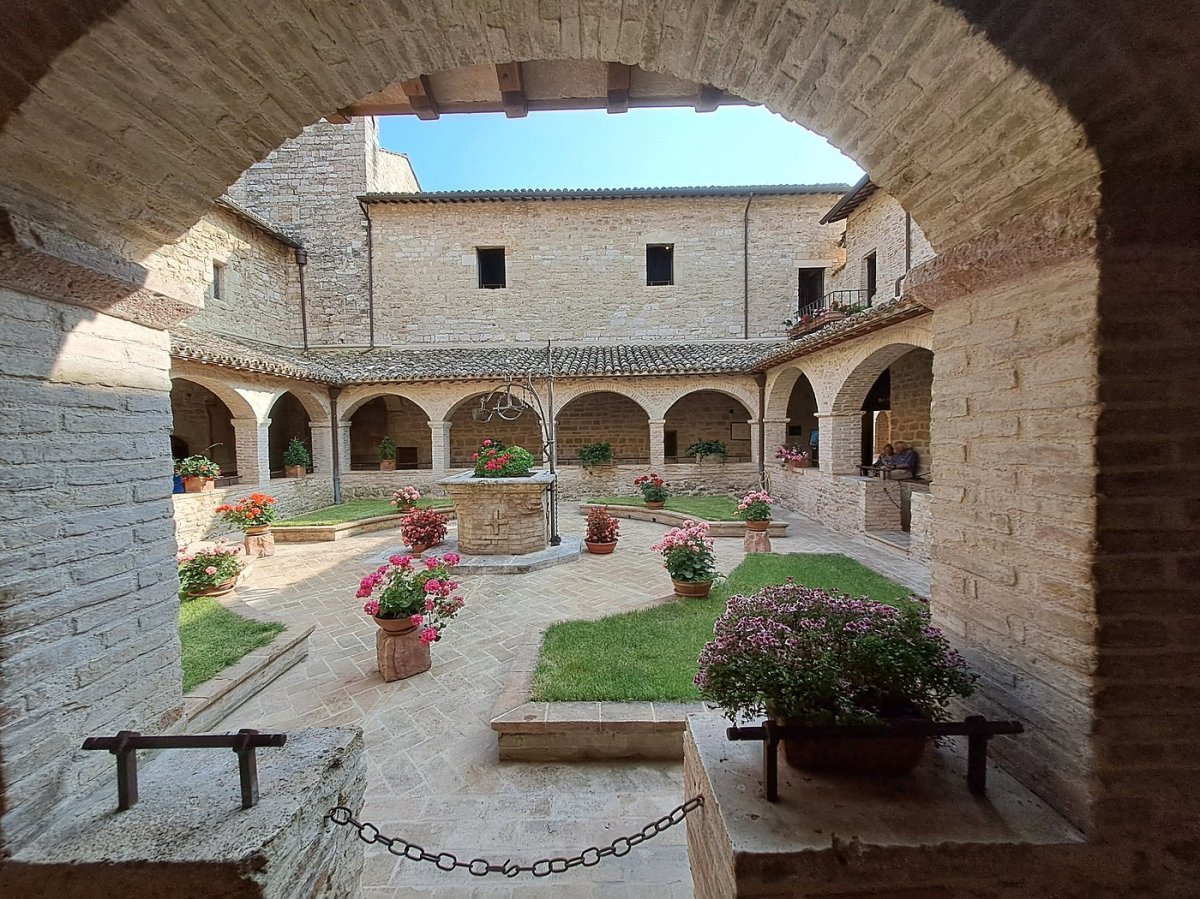
To be a Secular Franciscan is to live at the heart of a sacred paradox. The teaching that “the world is my cloister” is not a casual motto but a profound spiritual axiom that encapsulates the unique genius of the Franciscan way of life for the laity.1 At first glance, the phrase presents an almost jarring contradiction. The word “cloister,” derived from the Latin claustrum, evokes images of enclosure, separation, and retreat from the world—a quiet, walled garden set apart for God.3 The “world,” in contrast, suggests the bustling, often chaotic, arena of secular life: family, work, society, and all its attendant responsibilities and distractions. To claim the world as one’s cloister seems to be a contradiction in terms.
Yet, this very paradox validates the depth of the question and reveals the radical nature of the Secular Franciscan vocation. The phrase, often attributed to St. Francis of Assisi, represents a revolutionary re-imagining of religious life and sacred space.2 It challenges the notion that holiness is found primarily by withdrawing from the world. Instead, it proposes that the world itself, in all its complexity and messiness, is the very place where the Secular Franciscan is called to live a life of deep prayer, penance, and communion with God. This vocation is not a diluted or lesser form of monasticism; it is a distinct and demanding spiritual path that requires immense interior discipline. It is a call to be a contemplative in action, to find the silence of the cell in the noise of the city, and to see the face of Christ in every person encountered in the public square.
This personal reflection seeks to unpack this sacred paradox for the professed Secular Franciscan. It will first build a thorough understanding of the traditional cloister, both in its physical architecture and its spiritual purpose, to establish the model that Franciscanism so radically re-imagined. It will then explore the unique history and charism of the Secular Franciscan Order (OFS), defining its mission as one of sanctifying the world from within. Finally, it will synthesize these two concepts through the lens of a profoundly incarnational theology, demonstrating how the world, seen through the eyes of St. Francis, truly becomes a sacred enclosure for God. This exploration will culminate in a practical guide for living this reality, translating theological principles into the concrete actions of daily life, so that the Secular Franciscan may joyfully and faithfully live out the truth that their cloister has no walls but is as wide as creation itself.
Part I: The Enclosed Garden – Understanding the Traditional Cloister
To grasp the revolutionary nature of the statement “the world is my cloister,” one must first have a deep appreciation for what a traditional cloister is and what it represents. The monastic cloister is far more than a beautiful architectural feature; it is a physical manifestation of a specific theology, a carefully designed environment for a particular way of life dedicated to seeking God through separation from the world.
The Claustrum: Architecture as Theology
The term “cloister” has its roots in the Latin word claustrum, meaning an enclosure, a lock, or a place that is shut.3 This etymology reveals its primary function: to create a boundary. Architecturally, a cloister is a quadrilateral enclosure, typically a courtyard or garden, surrounded by covered walkways.4 These walkways connect the most important buildings of a monastery or convent: the church, the refectory (dining hall), the dormitory, and the chapter house (the community meeting room).3 This design makes the cloister the very “heart of a monastery,” the central hub of communication and movement for the religious community.3
However, its function is not merely practical. The design of the cloister is a form of enacted theology. It serves as a “continuous and solid architectural barrier… that effectively separates the world of the monks from that of the serfs and workmen”.4 This physical separation is deliberate and purposeful. In the Benedictine model, for example, the refectory was placed on the side opposite the church to ensure that the “worshipers might be removed from kitchen noises and smells,” a small detail that underscores the overarching goal of minimizing worldly distractions.8 The cloister creates a microcosm, an ordered and protected space that stands in stark contrast to the perceived chaos of the external world. The central courtyard, often containing a garden and a well, becomes a symbol of paradise, a new Eden where the community can live in peace and commune with God.3 The arcaded walkways provide light for study and reading, shelter for exercise, and a place for quiet meditation, making the entire structure a tool for spiritual formation.9
Thus, the traditional cloister can be understood not merely as a building, but as a highly refined spiritual technology. Its every architectural element and the canonical rules that govern it were designed with a singular purpose: to minimize external stimuli and maximize the monk’s or nun’s focus on the divine. The cloister operates on the principle that a structured separation from the world is the most effective means to achieve an unstructured union with God. This very principle, of course, presupposes a certain theological dualism: a “world” that is distracting, chaotic, and a source of temptation, and a “monastery” that is ordered, peaceful, and holy.4 It is this fundamental dichotomy between the sacred space inside and the secular space outside that the Franciscan worldview would eventually challenge and transform.
The Life Within: Clausura, Prayer, and Separation
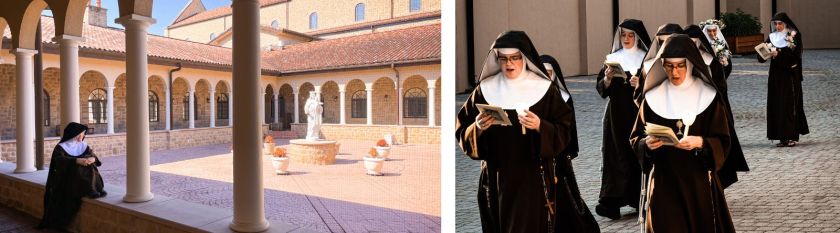
Beyond the physical walls, the cloister represents a formal, canonical state of life defined by the principle of clausura. This term, the Latin for “to shut up,” refers to the body of ecclesiastical law that strictly governs who may enter the monastic enclosure and, just as importantly, who may leave it.12 These legal restrictions are not arbitrary; they are the formal means of protecting the spiritual purpose of the cloister. The goal is to create and maintain an environment of silence, solitude, and prayer, free from the “vices and passions of the world”.7 For the soul called to a contemplative vocation, this separation is not seen as a deprivation but as a necessity. As one prioress explained, for such a soul, immersion in the active world would be a burden that would cause it to “wilt and waste away,” because it would “steal God from her”.13
The rhythm of cloistered life is dictated by this principle of separation. The day is structured around the Opus Dei, the Divine Office, which is prayed in community at set hours, including in the middle of the night.14 The time between communal prayers is filled with private prayer, spiritual reading (lectio divina), and manual labor performed within the monastery walls, such as gardening or baking altar breads.14 This entire way of life, known as the “claustral life,” is synonymous with the monastic vocation itself.4 It is a radical commitment to seek God by leaving the secular world behind, a choice that often “defied their God-given temperaments… dashed plans for marriage and children… (and) meant their world would shrink… so that their minds could dwell on God”.14 The cloister, in this sense, is the ultimate expression of a life singularly focused on God, achieved through a radical act of physical and social withdrawal.
The Cloister of the Heart: An Interior Space for God
Even within the highly structured world of the physical cloister, the ultimate spiritual goal has always been the cultivation of an interior space for God. The external walls and rules are ultimately aids to building an internal “cloister of the heart,” a sacred space within the soul where one can commune with God at any time and in any circumstance.15 This concept is the crucial bridge between the traditional monastic life and the Secular Franciscan vocation.
The understanding is that the physical separation is a means to an end. The end is an uninterrupted state of prayer, an interior silence that is not dependent on external quiet. This idea is powerfully expressed in the saying, “The world is my cloister, my body is my cell, and my soul is the hermit within”.16 This formulation reveals that even for those who live within a physical monastery, the true spiritual work is internal. The body becomes the “cell,” the immediate boundary of one’s physical existence, and the soul becomes the “hermit,” the one who dwells in solitude with God. This insight is transformative because it suggests that if the internal cloister is sufficiently strong and well-formed, the external, physical cloister may not be an absolute necessity. It opens the door to a new possibility: a way of life that maintains the spiritual intensity and focus of the cloister without the physical walls, a life lived in the world but not of it. This is the very space that the Secular Franciscan is called to inhabit.
Part II: The Open Field – The Vocation of the Secular Franciscan
In stark contrast to the enclosed garden of the monastery stands the open field of the world, the designated arena for the Secular Franciscan. The Ordo Franciscanus Saecularis (OFS) is not a society for laypeople who admire St. Francis, but a true Order within the Catholic Church, with a distinct history, a formal Rule, and a unique mission.17 Understanding this vocation requires setting aside the monastic model of withdrawal and embracing a charism of engagement, where “secularity” is not a limitation but the very essence of the call.
A Vocation for the Laity: The Historical Context
The Secular Franciscan Order was not an afterthought or a later development; its origins are traceable to the lifetime of St. Francis himself and his response to the profound spiritual desires of the common people.19 As Francis and his first friars preached a radical, joyful, and penitential living of the Gospel, they attracted countless followers. Many of these were married men and women, artisans, merchants, and farmers who were deeply moved by the Franciscan spirit but could not abandon their families, homes, and worldly responsibilities to join the First Order of friars or the Second Order of cloistered nuns founded by St. Clare.18
Rather than turning them away, Francis gave them a way of life, a rule that would allow them to pursue holiness within their secular state. This was a revolutionary act. In an era when the path to serious sanctity was largely seen as reserved for priests, monks, and nuns, Francis created a formal, Church-approved Third Order for the laity.19 Originally known as the “Brothers and Sisters of Penance,” their vocation was centered on ongoing conversion (metanoia) in the midst of ordinary life.19 This established a new paradigm in the Church: a lay person could now belong to a formal religious Order, with a profession and a rule, without leaving their secular state. This act was a profound innovation in ecclesiology, anticipating by seven centuries the Second Vatican Council’s articulation of the “universal call to holiness” and its affirmation of the sanctification of ordinary life as a genuine path to God.20
The Rule as a Form of Life: “From Gospel to Life and Life to Gospel”
The heart of the Secular Franciscan vocation is its Rule, which is not merely a set of regulations but a forma vivendi—a form of life.24 The fundamental directive of the Rule, both in its earliest forms and in the current version approved by Pope Paul VI in 1978, is “to observe the gospel of our Lord Jesus Christ by following the example of St. Francis of Assisi who made Christ the inspiration and the center of his life with God and people”.17 This Christocentric focus is paramount.
This observance is lived out through a dynamic, cyclical process captured in the motto: “going from gospel to life and life to gospel”.17 This is a profound spiritual practice, a hermeneutical circle that defines the Secular Franciscan’s engagement with the world. One first goes to the Gospel, reading it carefully and prayerfully, to allow the words and actions of Christ to inform and shape one’s own intentions and actions. Then, one goes into life—to family, to work, to the community—and attempts to live out that Gospel message. Finally, one brings the experiences of life—the successes, the failures, the challenges, the joys—back to the Gospel, reflecting on them in the light of Christ’s teaching to discern, correct, and grow in holiness.27
This way of life is sealed by a permanent, public profession. This is not a private devotion but a solemn promise made within the fraternity and before the Church to live according to the OFS Rule for the rest of one’s life.17 This act of profession is what formally constitutes a person as a Secular Franciscan and distinguishes the Order from a pious society or prayer group. It is this commitment that provides the spiritual structure for a life lived without physical walls. In this sense, the Rule itself functions as a portable cloister. While a monk is enclosed by the walls of a monastery, the Secular Franciscan is enclosed by their fidelity to the Rule. It provides the spiritual boundary, the discipline, and the focus that allows them to maintain a consecrated life in the midst of secular affairs.
In Saeculo: The Mission to Sanctify the World from Within
The defining characteristic of the OFS is its “secular” nature, a term that must be understood in its positive, theological sense. The vocation of the Secular Franciscan is to live in saeculo—in the age, in the world.29 Their mission is not to be less worldly in a negative sense, but to be fully in the world as a leaven, an agent of transformation, and a witness to the Gospel.21 The Rule states that members “strive for perfect charity in their own secular state”.17 Their secularity is not an impediment to their holiness, but the very context for it.
Therefore, the apostolate of the Secular Franciscan is the world itself. They are called to “go forth as witnesses and instruments of her [the Church’s] mission among all people, proclaiming Christ by their life and words”.17 Their family, their workplace, their neighborhood, and their civic involvements are the “primary fields where they are called to plant the seeds of the Gospel”.29 They are called, like St. Francis, to “rebuild the Church” not by laying bricks, but by energetically living in communion with the Church and bringing an apostolic creativity to their daily lives.17 This mission is one of sanctifying the world from within, finding God in the ordinary and transforming it through a life of Gospel charity.
Part III: Reconciling the Paradox – “The World is My Cloister”
The resolution to the apparent contradiction in “the world is my cloister” lies in a profound theological synthesis. By viewing the world through a uniquely Franciscan incarnational lens, the very meaning of “cloister” is transformed. The enclosure ceases to be a physical place of separation and becomes a spiritual state of consecration. The purpose shifts from withdrawal from the world to redemptive engagement with it. This section will unpack this synthesis, demonstrating how the paradox is not only resolved but revealed as the cornerstone of the Secular Franciscan identity.
The Incarnational Lens: Seeing the World as Sacred Space
The indispensable key to understanding the Secular Franciscan vocation is its profoundly incarnational worldview. While some theological traditions have historically viewed the material world with a degree of suspicion—as a place of sin and temptation to be fled for the sake of the soul—Franciscan theology takes a radically different approach.31 Rooted in the life of St. Francis, this tradition sees the created world not as a distraction from God, but as the primary arena of God’s self-revelation. Pope Francis, in his encyclical Laudato si’, channels this spirit when he describes nature as a “magnificent book in which God speaks to us and grants us a glimpse of his infinite beauty and goodness”.33
This perspective fundamentally collapses the dualism between the sacred and the secular. The Incarnation—God becoming flesh and dwelling among us—is the ultimate affirmation that matter can bear the divine. For the Franciscan, this event sanctified the entire created order. Consequently, there is “only one reality—the underlying unity in all things”.2 St. Francis preached that the world was an “emanation of God and inherently good”.31 Every creature, “animate and inanimate,” from Sister Moon and Brother Sun to the humblest worm, bears the “imprint of the Most High” and is part of a universal kinship.17
This incarnational lens allows the Secular Franciscan to see the world as a “burning bush ablaze with God’s glory”.2 Every place, from the quiet home to the bustling office, from “ghettos to gated communities,” becomes holy ground because God is present there.2 The world is no longer a problem to be solved or a danger to be escaped, but a “joyful mystery to be contemplated”.33 This way of seeing is not a mere intellectual exercise; it is a transformative spiritual practice. It is what makes it possible to say “the world is my cloister,” because if the world is filled with the presence of God, then one does not need to retreat from it to find Him. This concept is a profoundly Christological statement. It is possible only because of the Incarnation. If God entered the world, then the world itself is the premier place to encounter the divine. The Secular Franciscan life is a radical living-out of the consequences of this belief, following Christ into the world rather than away from it.
The Spiritual Enclosure: Rule and Profession as the “Walls”
If the world is the cloister, what constitutes its walls? For the Secular Franciscan, the enclosure is not physical but spiritual, juridical, and relational. The “walls” are constructed from the solemn commitments made at Profession, the daily discipline of living the Rule, and the mutual accountability of the fraternity. This redefines the cloister from a place of separation from the world to a state of consecration within the world.
The act of Profession is a public, permanent commitment to live the Gospel in the manner of St. Francis, according to the OFS Rule.17 This promise, made to God in the context of the Church, consecrates the individual’s entire secular life. Their marriage, their family life, their work, and their social interactions are all brought under the spiritual discipline of the Rule. This commitment forms the boundary, the spiritual “enclosure.” The discipline required to maintain this boundary is not externally imposed by the ringing of a monastery bell, but must be internally generated through a constant, conscious fidelity to one’s promises.
This creates a unique spiritual state: the paradoxical nature of secular consecration. The OFS member is simultaneously fully “in the world” and yet, by their consecration, “not of the world.” They are set apart for God, but they live out that “apartness” through ordinary, secular means. This is, in many ways, a more demanding spiritual path than traditional monasticism, because the boundaries are not physical and must be constantly discerned and maintained through personal discipline, prayer, and the vital support of the fraternity. The “cloister” is therefore not a static place but a dynamic state of being, a continuous act of “going from Gospel to life and life to Gospel” to navigate the demands of the world without losing one’s consecrated focus.17
From Separation to Engagement: Transforming the World, Not Fleeing It
This redefinition of the cloister necessarily transforms its purpose. The goal of the traditional cloister is withdrawal for the sake of focused contemplation and intercession for the world.4 The goal of the secular cloister is active engagement for the sake of the world’s transformation. The Secular Franciscan is called to be a leaven in society, an instrument of peace, and a builder of a more fraternal world.17
The Rule is explicit on this point. Secular Franciscans are called to “rebuild the Church” and to “build a more fraternal and evangelical world so that the kingdom of God may be brought about more effectively”.17 They are to place themselves in the “forefront in promoting justice” and to firmly commit themselves to opposing “every form of exploitation, discrimination, and exclusion”.18 St. Francis himself, unlike some earlier contemplatives who saw separation from the world as a virtue, embraced engagement with the poor, the lepers, and all of society.31 For the OFS, the secular context is “not an obstacle to their vocation but the very place it is meant to be lived”.29 Their mission is to carry the peace, joy, and love of the Gospel into every corner of human life, sanctifying it from within.
Part IV: Living in the Secular Cloister – A Practical Guide
Understanding the theology of “the world as cloister” is the first step; living it is the lifelong journey. This requires a conscious and intentional effort to structure one’s secular life in a way that reflects the core functions of a traditional monastery. The core disciplines of monasticism—a regulated prayer life, community accountability, study, detachment, and work—are not abandoned by the Secular Franciscan but are creatively and faithfully re-contextualized into the settings of home, office, and neighborhood. The what (the spiritual practice) remains, but the how and where are radically transformed.
The Daily Office: A Rule of Life in the World
Just as a monastery operates according to a horarium, or schedule, that sanctifies the hours of the day with prayer, the Secular Franciscan must intentionally structure their day around prayer and contemplation amidst their secular duties. This creates a rhythm of grace that permeates all of their activities.
The primary way this is achieved is through participation in the prayer of the Church, especially the Liturgy of the Hours.24 By praying the Morning and Evening Prayer, the Secular Franciscan joins their voice to the universal prayer of the Church, sanctifying the beginning and end of the workday. This practice creates spiritual bookends for the day, ensuring that all the activity in between is offered to God. Furthermore, the call is to “pray without ceasing,” which means cultivating a “continuous, conscious connection with God” throughout the day.40 This is the essence of the contemplative life integrated into an active one: finding moments for silent prayer in the car, offering a quick prayer before a meeting, or seeing the face of Christ in a difficult colleague. This interior disposition is sustained by the penitential practice of a nightly examination of conscience, a key discipline that fosters the ongoing conversion (metanoia) that is central to the Franciscan charism.24
The Chapter House: The Fraternity as a Place of Communion
In a monastery, the Chapter House is where the community gathers for instruction, correction, and important decisions. For the Secular Franciscan, this essential function is fulfilled by the local fraternity and its regular meetings.17 The fraternity meeting is not an optional social club; it is an indispensable element of the vocation. It is the “Chapter House” of the secular cloister.
The fraternity is where members are “animated and guided,” and where they experience themselves as a “true spiritual family”.41 The purpose of these gatherings is threefold: mutual support in the ups and downs of life, ongoing formation in the Franciscan spirit, and the communal renewal of their commitment to live the Gospel.20 It is within the fraternity that the Secular Franciscan finds the encouragement and accountability necessary to persevere in a demanding vocation. The sense of community fostered there is what makes members “joyful and ready to place themselves on an equal basis with all people,” especially the lowly.17 This fraternal love is the lifeblood of the Order, preventing the secular vocation from devolving into an isolated and individualistic piety.
The Scriptorium & Library: “Going from Gospel to Life”
Medieval cloisters were vital centers of learning, where monks painstakingly copied manuscripts in the scriptorium and studied in the library.8 The Secular Franciscan’s “scriptorium” is their commitment to ongoing formation, particularly through the “careful reading of the gospel”.17 This is not a static, academic exercise. It is a dynamic, living process. It involves “going from gospel to life and life to gospel”.17
This requires dedicating intentional time to study. The primary text is always Sacred Scripture, which should be read slowly and reflectively, allowing the Holy Spirit to speak through the text and apply it to one’s personal situation.27 This is the “Gospel to life” movement. This study is enriched by reading the writings of St. Francis and St. Clare, Church documents (especially those of the Second Vatican Council, which so deeply inform the modern OFS Rule), and other sound Franciscan spiritual resources.29 This intellectual and spiritual formation is what equips the Secular Franciscan to then bring their “life to the Gospel,” discerning their actions and experiences in the light of their faith. This integration of the contemplative and active lives is not automatic; it is a skill honed through the disciplined practice of study and reflection.
The Refectory & Cellar: Simplicity, Detachment, and Stewardship
The monastic refectory and cellar are the places that govern the community’s relationship with material goods—food, drink, and provisions. The Secular Franciscan lives out the spirit of these spaces through the practice of poverty, which is expressed as simplicity, detachment, and stewardship. The call is to “seek a proper spirit of detachment from temporal goods by simplifying their own material needs”.8
This does not necessarily mean living in abject poverty, as the Secular Franciscan has legitimate responsibilities to provide for their family.45 Rather, it is a conscious and voluntary choice to live simply, to resist the tide of consumerism, and to cultivate a spirit of gratitude and contentment with what one has.45 It means purifying the heart from the “tendency and yearning for possession and power”.8 A key aspect of this is seeing oneself not as an owner, but as a “steward of the goods received for the benefit of God’s children”.17 This perspective transforms one’s relationship with money and possessions. They are no longer for personal aggrandizement but are tools to be used for the glory of God and the service of the human community.
The Apostolate: Work, Family, and Social Action as Sacred Service
In a monastery, the “work” of the monk is prayer and the manual labor necessary to sustain the community. For the Secular Franciscan, the “work”—the apostolate—is their entire engagement with the secular world. Their family life, their job, and their civic responsibilities are not distractions from their vocation; they are the very substance of their vocation.
The family is explicitly named as “the first place in which to live their Christian commitment and Franciscan vocation”.18 It is here that one first practices patience, forgiveness, and selfless love. Likewise, secular work is to be esteemed as a “gift and as a sharing in the creation, redemption, and service of the human community”.1 Whether one is a teacher, a mechanic, a parent, or an executive, the work itself is an opportunity to serve God and neighbor and to develop one’s own personality.
Finally, this service extends to the broader society. Secular Franciscans are called to be “bearers of peace” and active agents in building a more “fraternal and evangelical world”.18 This is not a vague sentiment but a call to concrete action for social and environmental justice, inspired by St. Francis’s love for the poor and his reverence for all creation.18 By integrating their prayer and formation into their daily lives, Secular Franciscans resolve the traditional tension between the contemplative life and the active life. Contemplation of the Gospel fuels their action in the world, and their action in the world drives them back to the Gospel for guidance and renewal, creating a seamless garment of a life lived for God.
Conclusion: The Joyful Mystery of the Secular Vocation
The teaching that “the world is my cloister” is ultimately a profound and joyful mystery. It is not a command to build imaginary walls around oneself, but an invitation to tear down the walls that separate the sacred from the secular, God from daily life, and prayer from action. It is a call to discover that the enclosure for which the human heart longs is not a place, but a state of being: a state of “continual conversion,” of constantly turning the heart toward God in the midst of every human experience.20
To live this vocation is to embark on a path that is both challenging and liberating. It demands the discipline of a monk but applies it to the life of a layperson. It requires seeing the world not as a marketplace of temptations, but as a sacrament of God’s presence. This perspective, rooted in the Incarnation and exemplified by St. Francis, leads to a characteristic Franciscan joy—a joy that comes from recognizing Christ in the face of every brother and sister, and from seeing all of creation as a gift from the Lord.17
Embracing the world as one’s cloister means accepting the call to find God everywhere, to serve Him in everyone, and to sanctify the most ordinary moments of life through extraordinary love. It is to become a living witness that a life of deep communion with God is possible not in spite of our worldly commitments, but precisely through them. As “witnesses and instruments” of the Church’s mission, Secular Franciscans are called to carry the peace and good (pax et bonum) of Christ not out of a cloister, but throughout the vast, beautiful, and sacred cloister of the world itself.17
Peace and every good, Mike
I can be reached at – mikeofs@ofsmike.com
Works cited
- Secular Franciscan Order : Living the Way of St Francis of Assisi – FranciscanSeculars.com, accessed July 22, 2025, http://franciscanseculars.com/
- Incarnational Training Framework by Street Psalms, accessed July 22, 2025, https://streetpsalms.org/wp-content/uploads/2020/11/Incarnational-Training-Framework-2nd-Ed.pdf
- Cloister – Architecture Planning and Preservation – Oxford Bibliographies, accessed July 22, 2025, https://www.oxfordbibliographies.com/abstract/document/obo-9780190922467/obo-9780190922467-0018.xml
- Cloister – Wikipedia, accessed July 22, 2025, https://en.wikipedia.org/wiki/Cloister
- cloister: Meaning and Definition of – InfoPlease, accessed July 22, 2025, https://www.infoplease.com/dictionary/cloister
- Whispering Willows – Rackcdn.com, accessed July 22, 2025, http://96bda424cfcc34d9dd1a-0a7f10f87519dba22d2dbc6233a731e5.r41.cf2.rackcdn.com/fslf1/ourjourneypublication/Our_Journey_Spring15.pdf
- cloister – definition and meaning – Wordnik, accessed July 22, 2025, https://www.wordnik.com/words/cloister
- Cloister | Monastic Life, Design & History | Britannica, accessed July 22, 2025, https://www.britannica.com/topic/cloister
- cloister – Students | Britannica Kids | Homework Help, accessed July 22, 2025, https://kids.britannica.com/students/article/cloister/319861
- Cloister – Designing Buildings Wiki, accessed July 22, 2025, https://www.designingbuildings.co.uk/wiki/Cloister
- Cloister – Durham World Heritage Site, accessed July 22, 2025, https://www.durhamworldheritagesite.com/architecture/cathedral/intro/cloister
- CATHOLIC ENCYCLOPEDIA: Cloister – New Advent, accessed July 22, 2025, https://www.newadvent.org/cathen/04060a.htm
- Active/contemplative Or Cloistered How Do You Know Which Is For You? – Page 2 – Catholic Vocation Station – Phatmass, accessed July 22, 2025, https://www.phatmass.com/phorum/topic/123232-activecontemplative-or-cloistered-how-do-you-know-which-is-for-you/page/2/
- Life-changing experience within nuns’ cloister – Arlington Catholic Herald, accessed July 22, 2025, https://www.catholicherald.com/article/national/life-changing-experience-within-nuns-cloister/
- What’s a Cloister?, accessed July 22, 2025, https://cloisters.tripod.com/id89.html
- The Jesus Prayer: A Cry for Mercy, a Path of Renewal 978-0830835775 – DOKUMEN.PUB, accessed July 22, 2025, https://dokumen.pub/the-jesus-prayer-a-cry-for-mercy-a-path-of-renewal-978-0830835775.html
- THE RULE OF THE SECULAR FRANCISCAN ORDER, accessed July 22, 2025, https://secularfranciscansusa.org/wp-content/uploads/2017/07/RULE.pdf
- Secular Franciscan Order – Wikipedia, accessed July 22, 2025, https://en.wikipedia.org/wiki/Secular_Franciscan_Order
- Historical Outline Of The Secular Franciscan Order – Secular …, accessed July 22, 2025, https://ofsaustralia.org.au/historical-outline-of-the-secular-franciscan-order/
- What Is the Secular Franciscan Order?, accessed July 22, 2025, https://www.franciscanmedia.org/ask-a-franciscan/what-is-the-secular-franciscan-order/
- Who are the Secular Franciscans, and what do they do? – St. Joseph Catholic Church | Charlton, MA, accessed July 22, 2025, https://www.stjosephscharlton.com/documents/2017/11/Who%20Are%20the%20Secular%20Franciscans%20and%20What%20do%20they%20Do.pdf
- History – Franciscan Friars, T.O.R., accessed July 22, 2025, https://franciscanstor.org/our-community/history
- The Rule of the Secular Franciscan Order: A Short Meditation on the …, accessed July 22, 2025, https://www.hprweb.com/2016/10/the-rule-of-the-secular-franciscan-order-a-short-meditation-on-the-call-to-penance/
- History of Our Rule of Life – IL POVERELLO FRATERNITY, accessed July 22, 2025, https://ilpoverellofraternityofs.org/rule-of-life/
- Rule and Life of the brothers and sisters of the Third Order Regular of St. Francis – Franciscan Friars of the Atonement, accessed July 22, 2025, https://www.atonementfriars.org/rule-and-life-of-the-brothers-and-sisters-of-the-third-order-regular-of-st-francis/
- Exactly how does one live the Gospel values of Secular Franciscans in the world?, accessed July 22, 2025, https://www.secularfranciscansusa.org/faq-items/exactly-how-does-one-live-the-gospel-values-of-secular-franciscans-in-the-world/
- REFLECTIONS ON THE SFO RULE, accessed July 22, 2025, https://sfo.franciscans.org.au/sfo30/reflections.htm
- Process for becoming a Secular Franciscan, accessed July 22, 2025, https://www.secularfranciscansusa.org/process-for-becoming-a-secular-franciscan/
- Chasing The Wild Goose – A Lay Franciscan’s Journal, accessed July 22, 2025, https://ofsmike.com/
- One Family, Two Paths: A Secular Franciscan’s Guide to the Rule of the Third Order Regular, accessed July 22, 2025, https://ofsmike.com/2025/07/21/one-family-two-paths-a-secular-franciscans-guide-to-the-rule-of-the-third-order-regular/
- Francis of Assisi– Mystic and Environmental Advocate – Dominic Cogan, accessed July 22, 2025, https://dominiccogan.com/francis-of-assisi-mystic-and-environmental-advocate/
- How a Little Man Changed the World: St. Francis of Assisi – Rocky Ruggiero, accessed July 22, 2025, https://rockyruggiero.com/how-a-little-man-changed-the-world-st-francis-of-assisi/
- Laudato si’ (24 May 2015) | Francis – The Holy See, accessed July 22, 2025, https://www.vatican.va/content/francesco/en/encyclicals/documents/papa-francesco_20150524_enciclica-laudato-si.html
- St. Francis of Assisi: A Reverence for Nature, accessed July 22, 2025, https://www.sfc.edu/blog/st-francis-of-assisi-a-reverence-for-nature
- Main Page – Ordo Franciscanus Saecularis, accessed July 22, 2025, https://ciofs.info/category/main-page/
- Called To Be A Sister Or A Nun – Franciscan Sisters of Christian Charity, accessed July 22, 2025, https://fscc-calledtobe.org/becoming-a-franciscan-sister/called-to-be-a-sister-or-a-nun/
- The Life of a Secular Franciscan – SpiritualDirection.com, accessed July 22, 2025, https://spiritualdirection.com/2022/09/26/the-life-of-a-secular-franciscan
- What do Secular Franciscans do at their monthly gatherings, accessed July 22, 2025, https://www.dmfofs2.com/what-do-secular-franciscans-do-at-their-monthly-gatherings
- What is the difference between a Franciscan nun and a regular nun? – Quora, accessed July 22, 2025, https://www.quora.com/What-is-the-difference-between-a-Franciscan-nun-and-a-regular-nun
- Secular Franciscan Order – USA – Following Christ in the footsteps of St. Francis, accessed July 22, 2025, https://www.secularfranciscansusa.org/
- Cloister Definition & Meaning | YourDictionary, accessed July 22, 2025, https://www.yourdictionary.com/cloister
- Who we are – Secular Franciscans of Great Britain – ofsgb, accessed July 22, 2025, https://ofsgb.org/join-us/franciscan-witness/who-we-are/
- Ordo Franciscanus Saecularis – Consilium Internationale OFS (CIOFS) | Secular Franciscan Order, accessed July 22, 2025, https://ciofs.info/
- Secular Franciscan Order – Chasing The Wild Goose, accessed July 22, 2025, https://ofsmike.com/category/secular-franciscan-order/
- What IS Secular Order Profession – Our Walk Together, accessed July 22, 2025, https://ourwalktogether.com/2024/04/09/what-is-secular-order-profession/
- A Life of Simplicity, Humility, and Harmony with Nature – St. Francis College, accessed July 22, 2025, https://www.sfc.edu/blog/a-life-of-simplicity-humility-and-harmony-with-nature
Discover more from Chasing The Wild Goose
Subscribe to get the latest posts sent to your email.

