

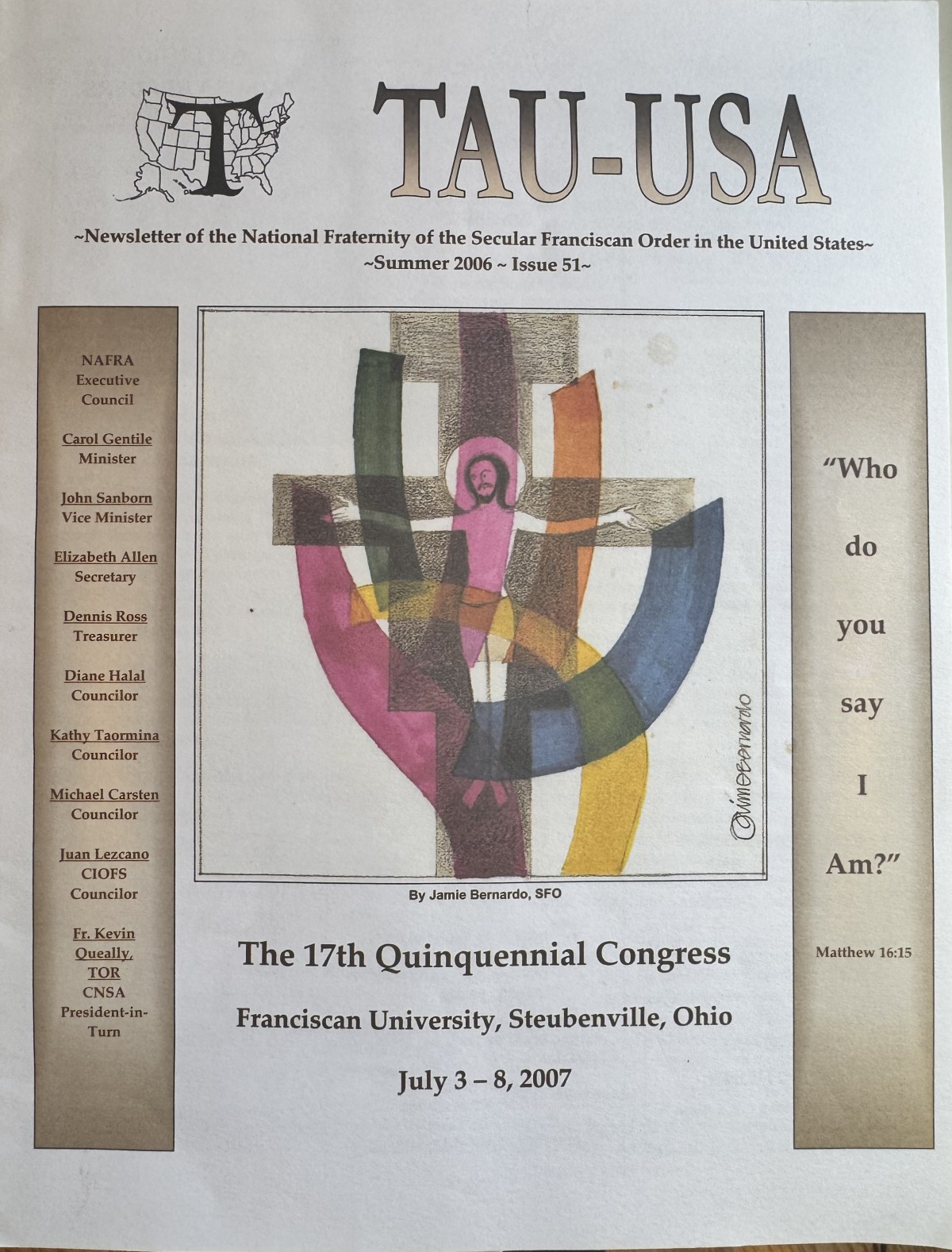
Part I: The Crisis at Steubenville: A Test of Franciscan Identity
The life of a Secular Franciscan is one of continual conversion, a journey of “going from gospel to life and life to gospel. “.1 This journey is not always serene; at times, it leads to moments of profound crisis where the very identity of the Order is tested. Such a moment arrived in 2007, a crucible that revealed two fundamentally opposed visions of what it means to be Franciscan in the modern world. One vision embraced dialogue, encounter, and the risk of reaching out in love. The other sought refuge in rigidity, exclusion, and fear. The collision of these two worldviews, precipitated by a decision of the National Executive Council (NEC) of the Secular Franciscan Order in the United States (OFS-USA), left an indelible scar on the Order and on the lives of those who sought to live its Rule with integrity. To understand the challenges facing OFS-USA today, one must first revisit this unresolved trauma and confront the truth of what transpired.
Section 1: A Courageous Decision, A Terrible Price
The Official Narrative vs. The Lived Reality
The public record of the 17th Quinquennial Congress of the OFS-USA presents a picture of harmony and success. The event, themed “Many cultures – through Francis – in Christ,” was scheduled for July 3-8, 2007.2. The Spring 2007 issue of
TAU-USA, the national newsletter, announced a change of venue from the originally planned site in Steubenville, Ohio, to the Radisson Hotel in Pittsburgh, Pennsylvania, explaining that the new location would “better accommodate the needs of the Secular Franciscan Order. “.2 Following the event, the Fall 2007 issue of
TAU-USA celebrated the Congress as an “overwhelming success”.4 It highlighted the positive reception of the keynote speaker, Reverend Eric H.F. Law, an Episcopal priest, whose message on diversity and inclusiveness was lauded. The official account, preserved in the Order’s publications, portrays smooth logistics and fruitful dialogue, a joyful “family reunion” for Franciscans from across the nation.5
This sanitized narrative, however, conceals a far more painful and violent reality. The decision to relocate the Congress was not a matter of simple accommodation. It was a moment of profound moral reckoning, a principled stand that came at a terrible personal and spiritual cost. The lived experience of those on the National Executive Council at the time bears little resemblance to the cheerful reports published for the wider Order. This chasm between the official story and the traumatic truth reveals a deep-seated reluctance within the institution to confront a virulent and un-Franciscan element that has been festering within its ranks. By failing to acknowledge the conflict, the Order created a permissive environment where the aggressors were shielded from accountability and the victims were left to carry their trauma in silence. This institutional denial is not a neutral act; it is a choice that has had lasting consequences, allowing the very poison that erupted in 2007 to continue its corrosive work within the fraternities.
The Untold Story of Principled Resistance
The true story of the 2007 Quinquennial Congress began not with a logistical review, but with an ultimatum. A few years prior, the NEC had selected Franciscan University of Steubenville as the site and, in keeping with the multicultural theme, had invited Reverend Eric H.F. Law as a keynote speaker. Rev. Law’s selection was announced nationally in the Summer 2006 edition of TAU-USA. Shortly after this announcement, Franciscan University informed the Quinquennial Committee that Rev. Law, an Episcopal priest, would not be permitted to speak on their grounds. The university, a self-described bastion of “dynamic orthodoxy” 6, effectively demanded that the OFS-USA censor its own event and discard its chosen speaker.
Faced with this challenge, the Quinquennial Committee met and reflected. Their recommendation to the NEC was not to capitulate, but to find a new location where the integrity of their program could be maintained. The Conference of National Spiritual Assistants (CNSA) and the full NEC concurred. The decision was made to move the entire national congress, a massive logistical and financial undertaking, rather than compromise the Franciscan principle of ecumenical dialogue and respectful encounter. This was not a choice for convenience; it was a courageous act of fidelity to the Order’s charism. It was a declaration that the Secular Franciscan Order would not allow its commitment to building bridges to be dictated by an institution whose vision of Catholicism was evidently more concerned with policing boundaries.
The Eruption of Vitriol and Violence
The aftermath of this courageous decision was not praise for the NEC’s integrity, but an explosion of rage from a segment of the Order’s own membership. The council was immediately inundated with a torrent of phone calls and emails. The demand was uniform and furious: the NEC should bow to the will of Franciscan University and disinvite Rev. Law. The reasons given were myriad, but none fell within the bounds of authentic Franciscan or Catholic thought. They were, without exception, expressions of a rigid, exclusionary, and fundamentalist Catholic mindset that viewed an Episcopal speaker not as a brother in Christ, but as a contaminant.
As the days passed, the hostility escalated dramatically. For those of us serving on the NEC, it was a descent into a nightmare. My own phone rang day and night. Vile, foul messages were left on my answering machine. Letters and postcards arrived at my home, condemning me as a heretic and informing me that I was destined to burn in hell. The campaign of harassment then crossed a terrifying line into direct threats of violence. I received death threats from professed Secular Franciscans—individuals who had made a lifelong commitment to follow Christ in the footsteps of the Poverello of Assisi, the universal bearer of peace. These members were convinced that I was a “Liberal menace” who was actively working to destroy the Church.
The threats became so specific and credible that they could not be ignored. The Michigan State Police and the Federal Bureau of Investigation (FBI) were contacted and launched a formal investigation. They traced the origins of the threats, identified the individuals and the geographic areas within Michigan from which they emanated, and advised me on the necessary steps to protect myself and my family. This was the lived reality of the 2007 Quinquennial: not just a disagreement over a speaker, but a campaign of terror waged by professed Franciscans against an elected national leader, requiring the intervention of federal law enforcement.
This weaponization of “orthodoxy” to justify threats of violence is a perversion of the faith. It demonstrates how a particular worldview can become so detached from the Gospel’s core message of love, mercy, and peace that it can rationalize mortal sin in the name of defending God. The attackers did not see their actions as a contradiction of their Franciscan profession; they saw them as its fulfillment. By framing the conflict as a holy war against a “menace,” they granted themselves a license for persecution, transforming a call to fidelity into a justification for terror. This pathology, which cloaks hatred in the language of faith, is the very essence of the fundamentalist spirit that the NEC had unknowingly challenged. The Quinquennial Congress was ultimately held in Pittsburgh without incident and, by all accounts, was a great success for those who attended. But the psychological damage was done, and the deep, violent rift within the Order had been exposed, even if it was never publicly acknowledged.
Section 2: Two Visions of Franciscanism in Conflict
The 2007 crisis was not a random event. It was the inevitable collision of two irreconcilable understandings of the Franciscan charism and the Catholic faith. On one side stood Franciscan University of Steubenville, representing an insular, defensive, and boundary-focused vision of Catholicism. On the other stood the National Executive Council of the OFS-USA, which, in selecting Reverend Eric H.F. Law, had embraced an open, dialogic, and mission-oriented vision rooted in the Rule of the Order. The conflict was a stark illustration of a choice every Franciscan institution must make: whether to be a fortress protecting a narrow identity or a bridge reaching out to a diverse world.
Franciscan University of Steubenville: A Fortress of “Dynamic Orthodoxy”
Franciscan University of Steubenville defines its core mission as a commitment to “dynamic orthodoxy”.6 It seeks “to educate, evangelize, and send forth joyful disciples” and to form students who can be a “transforming Christian presence in the world”.6 The university’s vision is to answer God’s call to “Rebuild my Church” by creating a “Christ-centered culture” where students are invited to “encounter Christ.”.6 These are laudable goals. However, the university’s actions in 2007 raise questions about the meaning of these terms. How does one build a “Christ-centered culture” of “encounter” by preemptively silencing a voice from another Christian tradition? How does one form students to be a “transforming Christian presence in the world” by refusing to engage with that world in its diversity?
The university’s decision to issue an ultimatum—disinvite Rev. Law or leave the campus—was an act of exclusion, not an act of encounter. It treated an Episcopal priest, an expert in building inclusive communities who has worked extensively with the Catholic Church, as a threat to be neutralized rather than a brother in Christ with whom to dialogue.7 This action revealed that their “dynamic orthodoxy,” when tested, was in fact static and defensive. It functioned not as a dynamic force for engagement but as a rigid wall for separation. In this instance, the university’s institutional identity as a particular brand of conservative Catholicism superseded its claimed identity as “Franciscan.” The name “Francis” was used as a historical and cultural label, but the core Franciscan charisms of humility, dialogue, and universal fraternity were conspicuously absent. This incident demonstrates a critical divergence: there are competing interpretations of what “Franciscan” means, and the university’s interpretation proved incompatible with the ecumenical spirit that has been a hallmark of the Secular Franciscan Order.
Reverend Eric H.F. Law: A Bridge-Builder for a Diverse World
The selection of Reverend Eric H.F. Law as the keynote speaker was a deliberate and faithful expression of the OFS-USA’s own identity and mission. Rev. Law, an Episcopal priest, is the founder and executive director of the Kaleidoscope Institute, whose mission is “to create diverse and sustainable communities” and provide “competent leadership in a diverse changing world”.7 For over two decades, he has worked as a consultant and trainer with a vast array of Christian denominations, including extensive work with the Roman Catholic Church in the United States, Canada, Asia, and Europe.7 His work is not about diluting faith but about providing practical tools, such as his “Kaleidoscope Bible Sharing” process, to help diverse communities engage scripture and one another more deeply.10
By inviting Rev. Law, the NEC was acting in perfect accord with the OFS-USA’s long-standing commitment to ecumenism. Following an invitation to the Anglican Third Order’s Quinquennial in 1997, the OFS-USA formed its own Ecumenical/Interfaith Committee to address relations with people of all faiths.11 The theme of the 2007 Congress itself—”Many cultures – through Francis – in Christ”—was a clear statement of the Order’s desire to embrace the diversity of the Church and the world.2 Rev. Law was not an outsider invited to challenge Franciscan values; he was a fellow Christian invited to help Secular Franciscans live their own values more fully in a multicultural context. His presence was intended to be an embodiment of the very dialogue the Order professes to seek.
The Secular Franciscan Order: A Vocation of Encounter
Ultimately, the NEC’s decision to stand by their speaker and relocate the Congress was an act of profound fidelity to the foundational documents of the Secular Franciscan Order. The 1978 Rule, approved by Pope Paul VI, is not a manual for building a defensive citadel against the world; it is a charter for engaging the world in a spirit of peace and fraternity. The Rule and life of the Secular Franciscan is “to observe the gospel of our Lord Jesus Christ by following the example of St. Francis of Assisi.”.1 This observance is made concrete in several key articles that formed the basis for the NEC’s decision:
- Article 5: “Secular Franciscans, therefore, should seek to encounter the living and active person of Christ in their brothers and sisters, in Sacred Scripture, in the Church, and in liturgical activity”.1 The call is to seek encounter, not to avoid it. The fundamentalist mindset that erupted in protest sought to prevent an encounter, thereby violating this primary directive.
- Article 13: “…with a gentle and courteous spirit accept all people as a gift of the Lord and an image of Christ.”.12 This article makes no exception for those of other Christian traditions. It demands an attitude of radical acceptance and hospitality, the very opposite of the suspicion and hostility directed at Rev. Law.
- Article 19: “Mindful that they are bearers of peace which must be built up unceasingly, they should seek out ways of unity and fraternal harmony through dialogue, trusting in the presence of the divine seed in everyone and in the transforming power of love and pardon”.1 This article is a direct mandate for the very action the NEC took. They chose dialogue over censorship, unity over exclusion, and trust in the “divine seed” in Rev. Law over fear of his different perspective.
The decision to move the 2007 Congress was, therefore, not a “liberal” political statement. It was a profoundly conservative act in the truest sense of the word: it conserved the essential charism of the Secular Franciscan Order as defined by its Rule. It affirmed that to be a Secular Franciscan is to be a person of encounter, dialogue, and peace, even when—and especially when—it is difficult and costly.
Section 3: The Aftermath in the Divine Mercy Region
The trauma of 2007 did not remain a national-level issue, confined to the memories of the NEC members who endured the attacks. Like a contagion, the spirit of fear and intimidation spread, poisoning the life of the Order at the regional level. The unresolved conflict and the lack of public institutional accountability for the perpetrators created a long-lasting trail of consequences. Years later, in my own Divine Mercy Region—which serves the Secular Franciscan fraternities of lower Michigan and Toledo, Ohio 13—the same toxic dynamic resurfaced, this time with the devastating effect of crippling regional formation and silencing open dialogue. The events demonstrated that the aggressors of 2007 did not feel chastened, but emboldened. They had learned that intimidation was an effective tool for controlling the narrative and enforcing their rigid worldview.
The Chilling Effect on Formation
A few years after my second term on the NEC had concluded, I was invited to speak at a Regional Candidates’ Day of Reflection. I accepted the invitation gladly, eager to share my Franciscan journey with those in formation. My presentation was met with a warm and enthusiastic reception, culminating in a standing ovation. However, the spirit of fraternity was shattered in an instant. Immediately following my talk, I was publicly confronted by the wife of one of the very individuals who had been identified to me by law enforcement as having made death threats against me and my family in 2007. I knew exactly who she was and what her purpose was. Her questions were not genuine inquiries but hostile, baited traps, designed to discredit me and publicly cast my Franciscan witness as unorthodox.
This moment revealed the long-term impact of the Order’s failure to address the 2007 crisis. The lack of any formal censure or even public condemnation of the death threats had sent a clear message: such behavior, while perhaps unpleasant, carried no meaningful consequences. This perceived impunity empowered the aggressors and their allies to continue their campaign of intimidation, moving it from anonymous phone calls to a face-to-face confrontation at an official formation event. They had successfully created a climate where they felt entitled to police the orthodoxy of a former national leader in a public forum, turning a day of reflection into a tribunal.
The Collapse of Dialogue
My response to the hostile questioning was a challenge to the rigid and uncharitable stance being taken. The result was an explosion. The carefully cultivated atmosphere of prayerful reflection and fraternal sharing disintegrated into open conflict. The Candidates’ Day of Reflection was effectively over at that moment. The confrontation had achieved its purpose: it had created an environment so toxic and unsafe that genuine dialogue became impossible.
The fallout was swift and devastating. In the wake of the incident, local fraternities within the Divine Mercy Region became unwilling to send their candidates, inquirers, and professed members to regional formation events. They were afraid of exposing their members to situations that were not perceived as safely “orthodox,” and they were unwilling to subject them to the kind of open hostility that had destroyed the Day of Reflection. This was the ultimate victory for the forces of fear and control. Through a single, aggressive act of public intimidation, they succeeded in shutting down the primary vehicle for regional-level formation and community-building.
The Victory of Fear
This episode illustrates a crucial and dangerous dynamic. The unresolved trauma of 2007 did not simply fade away; it metastasized into a chronic condition at the regional level. The aggressors successfully established ideological “no-go zones,” where certain speakers or topics were deemed too controversial or divisive to be addressed. This effectively cedes control over the content and spirit of formation to the most rigid, fearful, and intolerant members of the community.
When regional councils and formation directors must constantly self-censor to avoid “explosions,” formation ceases to be a journey of discovery and conversion. It becomes a sterile exercise in reinforcing a narrow and pre-approved set of ideas. It can no longer challenge members to grow, to encounter different perspectives, or to grapple with the complexities of living the Gospel in the world. It becomes indoctrination into a sectarian worldview, not formation in the rich, diverse, and expansive tradition of Franciscanism. The ultimate price is paid by the candidates and the newly professed, who are deprived of the opportunity for a robust and authentic formation, and by the Order itself, which loses its vitality and its capacity for prophetic witness. The fear of conflict leads to a silent, creeping paralysis, a peace not born of charity but of intimidation.
Part II: From Gospel to Life: Diagnosing the Ideological Divide
The painful events of 2007 and their lingering aftermath were not merely the result of a few difficult personalities. They were the symptoms of a deeper ideological disease, a spiritual worldview that stands in stark opposition to the authentic charism of St. Francis of Assisi. To understand the recurring conflicts within the OFS-USA, it is necessary to move from narrative to analysis, to name this counter-witness, and to hold it up to the mirror of the Rule. The mindset that drove the threats and intimidation can be identified as a form of “Catholic fundamentalism.” This is not a pejorative label meant to dismiss conservative belief, but a precise theological and sociological descriptor for a specific pattern of thought and behavior. This pattern is characterized by fear, a demand for absolute certitude, and a rejection of dialogue. When examined in the light of the Gospel and the Rule of the Secular Franciscan Order, it is revealed not as a zealous form of Franciscanism, but as its antithesis.
Section 4: Naming the Counter-Witness: An Analysis of Catholic Fundamentalism
The term “fundamentalism” is often associated with Protestantism, particularly its emphasis on the literal inerrancy of Scripture.15 However, scholars and theologians have identified a parallel phenomenon within the Catholic Church. While not centered on biblical literalism in the same way, Catholic fundamentalism is a distinct mindset that has emerged as a reaction to the changes and perceived uncertainties of the post-Vatican II era.17 It is, at its core, “a form of organised anger in reaction to the unsettling consequences of rapid social and religious change”.18 It yearns for a romanticized and purified past, a “pre-Vatican II golden age,” and it often reacts aggressively to perceived threats to that idealized vision.18
Based on a synthesis of theological and sociological analysis, this fundamentalist mindset can be defined by several key characteristics:
- A Sectarian Aversion to Dialogue: A primary feature is a “sectarian aversion to dialogue and cooperation”.19 It views engagement with those outside its own narrow ideological circle—whether they be from other Christian traditions, other religions, or fellow Catholics with different perspectives—not as an opportunity for mutual enrichment but as a dangerous contamination. This leads to an insular, fortress mentality.
- An Ahistorical Understanding of Doctrine: Catholic fundamentalism promotes an “ahistorical understanding of Catholic doctrine and tradition”.19 It sees truth as static, eternal, and untouched by history.20 In this view, any development of doctrine, any new application of timeless principles to new historical circumstances, is seen not as legitimate growth but as “apostasy from faith once delivered. “.20 This creates a rigid and brittle faith, incapable of adapting or speaking to the contemporary world.
- A Militant and Accusatory Rhetoric: The rhetorical style is often “marked by apocalyptic urgency” and an “almost breathless, accusatory, militant tone in their denunciations of others, especially fellow Catholics.”.20 This is not the language of fraternal correction but of holy war. Opponents are not simply mistaken; they are malicious actors, “menaces” working for the destruction of the Church.
- A Punitive and Fear-Based Spirituality: This mindset can foster a spirituality in which Jesus is portrayed primarily as an “unforgiving and punishing God.” At the same time, His overwhelming compassion and mercy are overlooked.18 The spiritual life becomes centered on fear of damnation, adherence to rules for their own sake, and the harsh judgment of others, rather than on the liberating joy of the Gospel.
These defining characteristics align perfectly with the actions observed during the 2007 crisis. The refusal of Franciscan University to allow Rev. Law to speak was a clear act of sectarian aversion to dialogue. The furious demands that the NEC capitulate were rooted in an ahistorical view that a specific, narrow expression of Catholicism was the only “orthodox” one. The death threats and accusations of being a “Liberal menace” working against the Church were the epitome of militant, accusatory rhetoric. And the letters condemning an elected leader to hell were a direct expression of a punitive, fear-based spirituality. The conflict was, in essence, a textbook case of this fundamentalist mindset clashing with the open, dialogic spirit of authentic Franciscanism.
Section 5: The Rule as a Mirror: The Franciscan Antidote to Fear
The most powerful refutation of this fundamentalist counter-witness is found in the very document that defines the life of every professed Secular Franciscan: the Rule. The Rule of the OFS is not a collection of rigid regulations designed to create a pure and separate elite. It is a guide to living the Gospel in the world, a charter for a life of love, service, and peace. When held up as a mirror, the Rule reflects back an image of a vocation that is the perfect antidote to the fear, rigidity, and anger of fundamentalism. A systematic examination of its key articles reveals a spirituality that is open, dynamic, relational, and missionary.
- Antidote to Doctrinal Rigidity (Rule, Art. 4 & 5): The fundamentalist mindset prioritizes abstract, ahistorical propositions. The Rule, in contrast, prioritizes a living relationship with Christ, one discovered in the dynamic interplay between Scripture and life. Article 4 states, “The rule and life of the Secular Franciscans is this: to observe the gospel of our Lord Jesus Christ…Secular Franciscans should devote themselves especially to careful reading of the gospel, going from gospel to life and life to gospel”.1 This is not a static process. It is a continual, prayerful discernment, applying the eternal truth of the Gospel to the ever-changing circumstances of secular life. Article 5 deepens this by directing Franciscans to “seek to encounter the living and active person of Christ in their brothers and sisters, in Sacred Scripture, in the Church, and in liturgical activity”.1 The focus is on
Encounter with a person, not simply intellectual assent to a set of doctrines. - Antidote to Exclusion and Hostility (Rule, Art. 13): The fundamentalist mindset is built on exclusion, on defining itself by who is “out.” The Rule mandates the opposite. Article 13 is a radical call to hospitality: “As the Father sees in every person the features of his Son…so the Secular Franciscans with a gentle and courteous spirit accept all people as a gift of the Lord and an image of Christ.”.12 This “gentle and courteous spirit” is the hallmark of the Franciscan posture toward the other. It directly refutes the hostile, suspicious, and violent actions taken against Rev. Law and the NEC. It commands Secular Franciscans to see every person not as a potential threat, but as a possible revelation of Christ.
- Antidote to a Sectarian Worldview (Rule, Art. 14): Fundamentalism tends toward sectarian withdrawal from a world it sees as corrupt and hostile. The Rule calls Secular Franciscans to be a leaven within the world. Article 14 states that they “are called to build a more fraternal and evangelical world so that the kingdom of God may be brought about more effectively.”.1 This is an outward-looking, missionary mandate. The goal is not to protect oneself from the world, but to transform the world through competent and loving service.
- Antidote to the Rejection of Dialogue (Rule, Art. 19): This article stands as the most direct and devastating indictment of the fundamentalist spirit of 2007. It reads: “Mindful that they are bearers of peace which must be built up unceasingly, they should seek out ways of unity and fraternal harmony through dialogue, trusting in the presence of the divine seed in everyone and in the transforming power of love and pardon”.1 This single article dismantles the entire fundamentalist framework. It replaces fear with trust in the “divine seed.” It replaces accusation with the “transforming power of love and pardon.” It replaces militant confrontation with the patient work of “dialogue.” It commands Franciscans to be active seekers of unity, not guardians of division. The actions of those who threatened and intimidated in 2007 were a direct and conscious violation of this sacred charge.
- Antidote to Indifference (Rule, Art. 18): Finally, the fundamentalist focus on a narrow set of doctrinal or moral issues can lead to an indifference toward the broader concerns of creation and the poor. The Rule instills a cosmic vision. Article 18 commands respect for “all creatures, animate and inanimate,” and calls Franciscans to move from “the temptation of exploiting creation to the Franciscan concept of universal kinship.”.1 This provides the spiritual foundation for the work of Justice, Peace, and Integrity of Creation (JPIC), which is a core apostolic dimension of the Franciscan vocation.
Part III: The Franciscan Family and the Call to Prophetic Witness
The ideological conflict that erupted in 2007 did not end in Pittsburgh. It has continued to simmer within the OFS-USA, manifesting most recently in the debate over the Order’s relationship with the Franciscan Action Network (FAN). The decision made several years ago by the National Fraternity Council to withdraw the OFS-USA from FAN was not an isolated administrative choice. It was a direct consequence of the same fear-based, exclusionary mindset that sought to silence Rev. Eric Law. The argument that FAN was “not Franciscan enough” is a smokescreen that conceals a more profound discomfort with the prophetic witness that is required when one truly goes “from gospel to life” in the public square. Today, the OFS-USA stands at a crossroads. The proposal to rejoin FAN is more than a question of membership; it is a test of our identity. It is an opportunity to heal the wounds of the past, to end our self-imposed isolation, and to reclaim our place as a vital member of the one, diverse Franciscan family, united in its call to be an instrument of peace in the world.
Section 6: The Franciscan Action Network: A Test of Unity
A Franciscan Voice, Co-Founded by the OFS
To understand the current debate, one must recall the history of FAN’s creation—a history in which the Secular Franciscan Order played a foundational role. The impetus for FAN came in the mid-2000s from Franciscans International (FI) and the “Roman VI,” the leadership of the various Franciscan branches in Rome. They recognized that their global advocacy work was deeply affected by public policy in the United States and called for the different branches of the Franciscan family to create a unified voice in Washington D.C..22
In response, a steering committee was formed, with Deacon Tom Bello, OFS, representing the Secular Franciscan Order as a key member.22 The formal creation of FAN emerged from a gathering of 150 Franciscans in Baltimore in the fall of 2007. This gathering included leaders from all four Catholic orders of men, as well as Secular, Episcopalian, and Ecumenical Franciscans.22 The OFS-USA was not a latecomer to FAN; it was present at the creation, a co-founder of this collective effort. FAN was established to be the “propagation of a restorative course of action for our culture through intelligent advocacy…rooted in the spiritual strength of an eight hundred year old faith tradition. “.22
Deconstructing the “Not Franciscan Enough” Argument
Given this history, the decision by the OFS-USA National Fraternity Council four or five years ago to withdraw from FAN, based on the rationale that the organization was “not Franciscan enough,” is deeply perplexing and warrants critical examination. This argument collapses under the weight of two undeniable facts: the nature of FAN’s mission and the composition of its membership.
First, FAN’s stated mission is “seeking to transform United States public policy related to peace making, care for creation, poverty, and human rights”.23 This mission is a direct and faithful application of the apostolic mandates found in the Rule of the OFS. Building a “more fraternal and evangelical world” (Art. 14), esteeming work and serving the human community (Art. 16), respecting creation and embracing universal kinship (Art. 18), and seeking unity and harmony as “bearers of peace” (Art. 19) are not optional extras for Secular Franciscans; they are essential dimensions of our vocation.1 FAN’s work on environmental justice, peacemaking, and human rights is a concrete way of living these articles in the public sphere.23 To claim this work is “not Franciscan enough” is to misunderstand the Rule itself.
Second, the OFS-USA’s withdrawal has placed it in a position of stark isolation from the rest of the Franciscan family. A review of FAN’s institutional members reveals a broad and deep coalition representing nearly every branch of the Franciscan tradition.24 Its members include numerous provinces of the First Order friars (OFM, OFM Conventual, OFM Capuchin), provinces of the Third Order Regular (TOR) friars, dozens of congregations of Franciscan sisters from across the country, The Franciscan Federations and Poor Clare Nuns, and even our ecumenical brothers and sisters, such as the Order of Lutheran Franciscans and the Third Order Society of St. Francis.24 The Secular Franciscan Order in the United States stands alone in its official rejection of FAN as our collective voice in Washington D.C. .
Institutional Members
Bernardine Franciscan Sisters
Reading, PA
Capuchin Franciscans, Province of St. Joseph (OFM Cap.)
Detroit, MI
Capuchin Franciscans, Province of St. Mary (OFM Cap.)
White Plains, NY
Felician Sisters of North America
Beaver Falls, PA
Franciscan Brothers of Brooklyn
Brooklyn, NY
Franciscan Friars Conventual, Province of Our Lady of the Angels (OFM Conv.)
Ellicott City, MD
Franciscan Friars Conventual, Province of Our Lady of Consolation (OFM Conv.)
Mt. St. Francis, IN
Franciscan Friars Conventual, Province of Saint Bonaventure (OFM Conv.)
Chicago, IL
Franciscan Friars Conventual, Province of Saint Joseph Cupertino (OFM Conv.)
California
Franciscan Friars, Province of Our Lady of Guadalupe (OFM)
Atlanta, GA
Franciscan Sisters of Allegany, NY
St. Bonaventure, NY
Franciscan Sisters of Little Falls, MN
Little Falls, MN
Franciscan Sisters of Mary
Bridgeton, MO
Franciscan Sisters of Our Lady of Perpetual Help of St. Louis, MO
St. Louis, MO
Franciscan Sisters of Peace
Haverstraw, NY
Franciscan Sisters of Perpetual Adoration of Lacrosse, WI
Lacrosse, WI
Franciscan Sisters of St. Joseph
Hamburg, NY
Franciscan Sisters of the Poor (SFP)
Cincinnati, OH
Franciscan Sisters of the Sacred Heart
Frankfort, IL
Holy Name Federation of Poor Clare Nuns
Travelers Rest, SC
Missionary Sisters of the Immaculate Conception
Paterson, NJ & Rome, Italy
Mother Madalene Bentivoglio, Federation of Poor Clare Nuns
New Orleans, LA
Order of Ecumenical Franciscans
Willimantic, CT
Order of Franciscans Ecumenical
Corona, CA
Order of Lesser Sisters and Brothers
Order of Secular Franciscans, St. Margaret of Cortona Region
School Sisters of St. Francis, U.S. Province
Pittsburgh, PA
School Sisters of St. Francis of Milwaukee, WI
Milwaukee, WI
Sisters of Mercy of the Holy Cross
Merrill, WI
Sisters of St. Francis of Assisi – Lake Franciscans
St. Francis, WI
Sisters of St. Francis of Clinton, Iowa
Clinton, IA
Sisters of St. Francis of the Holy Cross
Merrill, WI
Sisters of St. Francis of the Holy Family
Dubuque, IA
Sisters of St. Francis of Holy Name Province of Stella Niagara, NY
Stella Niagara, NY
Sisters of St. Francis of Mary Immaculate
Joliet, IL
Sisters of St. Francis of the Neumann Communities
Syracuse, NY
Sisters of St. Francis of Oldenburg, IN
Oldenburg, IN
Sisters of St. Francis of Penance and Christian Charity of Denver, CO
Denver, CO
Sisters of St. Francis of Penance and Christian Charity of Redwood City, CA
Redwood City, CA
Sisters of St. Francis of Penance and Christian Charity of Stella Niagara
Stella Niagara, NY
Sisters of St. Francis of Perpetual Adoration of Colorado Springs, CO
Colorado Springs, CO
Sisters of St. Francis of Philadelphia
Aston, PA
Sisters of St. Francis of Rochester, MN
Rochester, MN
Sisters of St. Francis of Sylvania, OH
Sylvania, OH
Sisters of St. Francis of the Providence of God
Pittsburgh, PA
Sisters of St. Francis of Tiffin, OH
Tiffin, OH
Sisters of St. Joseph of the Third Order of St. Francis
Stevens Point, WI
Sisters of the Sorrowful Mother
Oshkosh, WI
Third Order Regular Franciscan Friars, Province of the Immaculate Conception (TOR)
Minneapolis, MN
Third Order Regular Franciscan Friars, Province of the Most Sacred Heart of Jesus (TOR)
Loretto, PA
Third Order Society of St. Francis, Province of the Americas
Wheaton Franciscans—Daughters of the Sacred Heart of Jesus and Mary
Wheaton, IL
This List makes the situation painfully clear. If all these diverse expressions of the Franciscan charism find FAN to be a worthy and authentic vehicle for their shared values, the claim that it is “not Franciscan enough” for the OFS-USA becomes untenable. The burden of proof lies not with FAN, but with the OFS-USA, to explain its solitary and divisive stance.
The Real Reason for Withdrawal: A Recurrence of the 2007 Fear
The “not Franciscan enough” argument is a convenient but transparent fiction. The true opposition to FAN stems from the same fundamentalist mindset that erupted in violence and intimidation in 2007. This mindset is deeply uncomfortable with the practical implications of applying Franciscan values and Catholic Social Teaching to complex public policy issues. FAN’s advocacy for “liberal immigration policies,” its opposition to specific military actions, and its focus on environmentalism are seen by this faction not as expressions of faith, but as partisan political acts. 26 For example, FAN’s work to promote a “just peace,” to call for ceasefires, and to advocate for immigrants and asylum seekers is a direct application of the Gospel mandate to welcome the stranger and be peacemakers.27 Yet, for a fundamentalist mindset that often conflates a particular nationalistic ideology with Christian faith, such actions can be perceived as unpatriotic or “liberal.” Similarly, FAN’s deep commitment to care for creation, rooted in St. Francis’s Canticle of the Creatures, leads it to advocate for policies that address climate change, which can conflict with specific economic and political interests.26 The opposition to FAN is not theological; it is ideological. It is a recurrence of the 2007 fear—a fear of engagement, a fear of complexity, and a fear of a faith that has real-world consequences beyond the church walls. The decision to leave FAN was another victory for the voice of fear over the voice of the Gospel.
Section 7: Rejoining the Family: A Path to Healing and Authenticity
The current discussion within the OFS-USA about rejoining the Franciscan Action Network presents the Order with a momentous opportunity. This is not merely an administrative or financial decision. It is a spiritual crossroad, a chance to make a definitive statement about who we are and what we are called to be. To rejoin FAN would be a profound spiritual act, a concrete step toward healing past divisions and embracing a future of authentic, collaborative, and prophetic witness. It is the most tangible way to reject the “void of fear and control” and to fill it instead with the truth of the Gospel as lived by St. Francis of Assisi.
A Call to Prophetic Witness
Rejoining FAN is an act with multiple layers of significance for the spiritual health and integrity of the Secular Franciscan Order in the United States.
First, it would be an act of healing. It would serve as a concrete repudiation of the fear-based, exclusionary spirit that caused the trauma of 2007 and led to our withdrawal from FAN. It would signal to the entire Order that we are choosing the path of encounter and dialogue over the path of suspicion and division. It would be a public acknowledgment that the threats and intimidation tactics of the fundamentalist faction do not represent the true spirit of the OFS-USA. It would be a step toward restoring the trust that was broken and creating a culture where open and respectful dialogue is not only possible but cherished.
Second, it would be an act of fidelity. The Rule of the OFS is not a private devotional guide; it is a public charter for a life of apostolic action. Our profession commits us to “build a more fraternal and evangelical world” and to be “bearers of peace”.1 In the complex reality of the 21st century, this requires more than individual acts of kindness; it requires a concerted, intelligent, and prayerful engagement with the structures and policies that shape our world. FAN provides the vehicle for this engagement. Rejoining FAN is a way to live our Rule more fully, to move “from gospel to life” in the public square where decisions affecting the poor, the marginalized, and creation itself are made every day.
Finally, it would be an act of humility and solidarity. Our current isolation from the rest of the Franciscan family is a posture of pride. It implicitly suggests that we, alone among all the branches of the family, have a purer understanding of the charism. To rejoin FAN would be to humbly acknowledge the wisdom and witness of our brothers and sisters—the friars, the Poor Clares, the religious sisters, and the ecumenical Franciscans. It would be to recognize that our voice is stronger, our witness is more credible, and our mission is more effective when we stand together. It would be to reclaim our identity not as a separate and isolated entity, but as an integral part of the great, diverse, and beautiful Franciscan family.
Confronting the Nonsense, Speaking Truth into the Void
The time has come to confront this nonsense. The time has come to speak truth into the void of fear and control that has paralyzed parts of our Order for too long. The truth is that our vocation as Secular Franciscans calls us to be in the world as a leaven of peace, reconciliation, and justice. The truth is that our Rule commands us to seek dialogue and to trust in the divine seed present in every person. The truth is that the entire Franciscan family, with the notable exception of the OFS-USA, has recognized the Franciscan Action Network as a faithful and effective instrument for this mission.
We must follow the rest of the Franciscan Movement. We must join with the Friars, the Orders of Sisters, the Poor Clares, the Franciscan Federation, and the Franciscan Orders that thrive outside of Catholicism. We must join them in supporting, contributing to, and defending the Franciscan Action Network. To do so is to see and understand how wrong those who speak against FAN are, and how their arguments are rooted not in the rich soil of Franciscan spirituality, but in the barren ground of fear.
The choice before us is the same choice that faced the NEC in 2007. It is the choice between being a closed citadel, defending a rigid and fearful identity, or being an open-hearted instrument of peace, joyfully and courageously engaging the world. Let us choose to be instruments of peace. Let us choose to rejoin our family. Let us choose to live our Rule with integrity and to be the prophetic, healing presence that our Church and our world so desperately need.
Works cited
- THE RULE OF THE SECULAR FRANCISCAN ORDER, accessed August 30, 2025, https://secularfranciscansusa.org/wp-content/uploads/2017/07/RULE.pdf
- Race Relations and the Secular Franciscan Order, accessed August 30, 2025, https://www.secularfranciscansusa.org/2020/12/race-relations-and-the-secular-franciscan-order/
- “Many cultures – through Francis – in Christ” – Secular Franciscan Order, accessed August 30, 2025, https://www.secularfranciscansusa.org/wp-content/uploads/Tau_USA_054_spr_07.pdf
- …Only God can make a tree! – Secular Franciscan Order, accessed August 30, 2025, https://www.secularfranciscansusa.org/wp-content/uploads/Tau_USA_056_fal_07.pdf
- Glory to God! There is no need to be afraid, little flock, For it has …, accessed August 30, 2025, https://www.secularfranciscansusa.org/wp-content/uploads/Tau_USA_055_sum_07.pdf
- Mission and Core Values | Franciscan University of Steubenville, accessed August 30, 2025, https://franciscan.edu/mission-charisms/
- Eric H.F. Law – Ecclesio.com, accessed August 30, 2025, https://www.ecclesio.com/conversation-schedule/conversation-partners-2011-3/responder-bios/2011-2/eric-h-f-law/
- The KI Team — The Kaleidoscope Institute, accessed August 30, 2025, https://www.kscopeinstitute.org/the-ki-team
- Eric HF Law – Chalice Press, accessed August 30, 2025, https://chalicepress.com/pages/law-eric-h-f
- Bible Sharing For Preachers – The Kaleidoscope Institute, accessed August 30, 2025, https://www.kscopeinstitute.org/kaleidoscope-bible-sharing-for-preachers
- National USA Fraternity (NAFRA), accessed August 30, 2025, https://ilpoverellofraternityofs.org/national-usa-fraternity/
- The Rule of the Secular Franciscan Order | EWTN, accessed August 30, 2025, https://www.ewtn.com/catholicism/library/rule-of-the-secular-franciscan-order-11961
- About – Divine Mercy Region Secular Franciscans, accessed August 30, 2025, https://divinemercyregionofs.org/about/
- Divine Mercy Region Secular Franciscans: Home, accessed August 30, 2025, https://divinemercyregionofs.org/
- Christian fundamentalism – Wikipedia, accessed August 30, 2025, https://en.wikipedia.org/wiki/Christian_fundamentalism
- Fundamentalism | Catholic Answers Tract, accessed August 30, 2025, https://www.catholic.com/tract/fundamentalism
- Catholic fundamentalism | religion – Britannica, accessed August 30, 2025, https://www.britannica.com/topic/Catholic-fundamentalism
- Catholic Fundamentalism, accessed August 30, 2025, https://catholicoutlook.org/catholic-fundamentalism/
- Catholic Fundamentalism and the Search for Truth, accessed August 30, 2025, https://www.catholicworldreport.com/2025/05/20/catholic-fundamentalism-and-the-search-for-truth/
- What Is Catholic Fundamentalism? – The Catholic Thing, accessed August 30, 2025, https://www.thecatholicthing.org/2025/04/08/what-is-catholic-fundamentalism/
- Secular Franciscan Order – Wikipedia, accessed August 30, 2025, https://en.wikipedia.org/wiki/Secular_Franciscan_Order
- History of FAN – Franciscan Action Network, accessed August 30, 2025, https://franciscanaction.org/about/history-of-fan/
- About – Franciscan Action Network, accessed August 30, 2025, https://franciscanaction.org/about/
- Who We Are – Franciscan Action Network, accessed August 30, 2025, https://franciscanaction.org/about/who-we-are/
- Franciscan Networks, accessed August 30, 2025, https://www.sbfranciscans.org/who-are-we/franciscan-spirituality/franciscan-networks/
- Franciscan Action Network – InfluenceWatch, accessed August 30, 2025, https://www.influencewatch.org/non-profit/franciscan-action-network/
- Franciscan Action Network: Home, accessed August 30, 2025, https://franciscanaction.org/
- Home – Franciscan Action Network, accessed August 30, 2025, https://franciscanaction.org/page/3/?et_blog
Upcoming Events – Franciscan Action Network, accessed August 30, 2025, https://franciscanaction.org/events/
Discover more from Chasing The Wild Goose
Subscribe to get the latest posts sent to your email.

