
by Michael Carsten OFS
Study Guides: 1. Audio Deep Dive of the 7 Chapters. 2. Formation Slides for Presentation to Fraternities for ongoing formation.
Seven Chapters Exploring the Heart of Secular Franciscan Spirituality
Chapter 1
The Heart of the Secular Franciscan Vocation
The call to live the Gospel in the world resonates deeply within the Christian tradition, and for centuries, the Franciscan charism has offered a distinctive path for answering this call. The Secular Franciscan Order (OFS) stands as a vibrant expression of this charism, inviting lay men and women, as well as diocesan clergy, to embrace a life dedicated to observing the Gospel of our Lord Jesus Christ in the spirit of St. Francis of Assisi.4 Originating within the lifetime of St. Francis himself, the OFS, historically known as the Third Order of St. Francis, is an “organic union of all Catholic fraternities scattered throughout the world.” Within these fraternities, members, whether married or single, “strive for perfect charity in their own secular state,” guided by the Holy Spirit.4 Their commitment is formalized by a profession to live the Gospel according to a Rule approved by the Church, the most recent of which was promulgated in 1978 after extensive worldwide consultation among Secular Franciscans.4
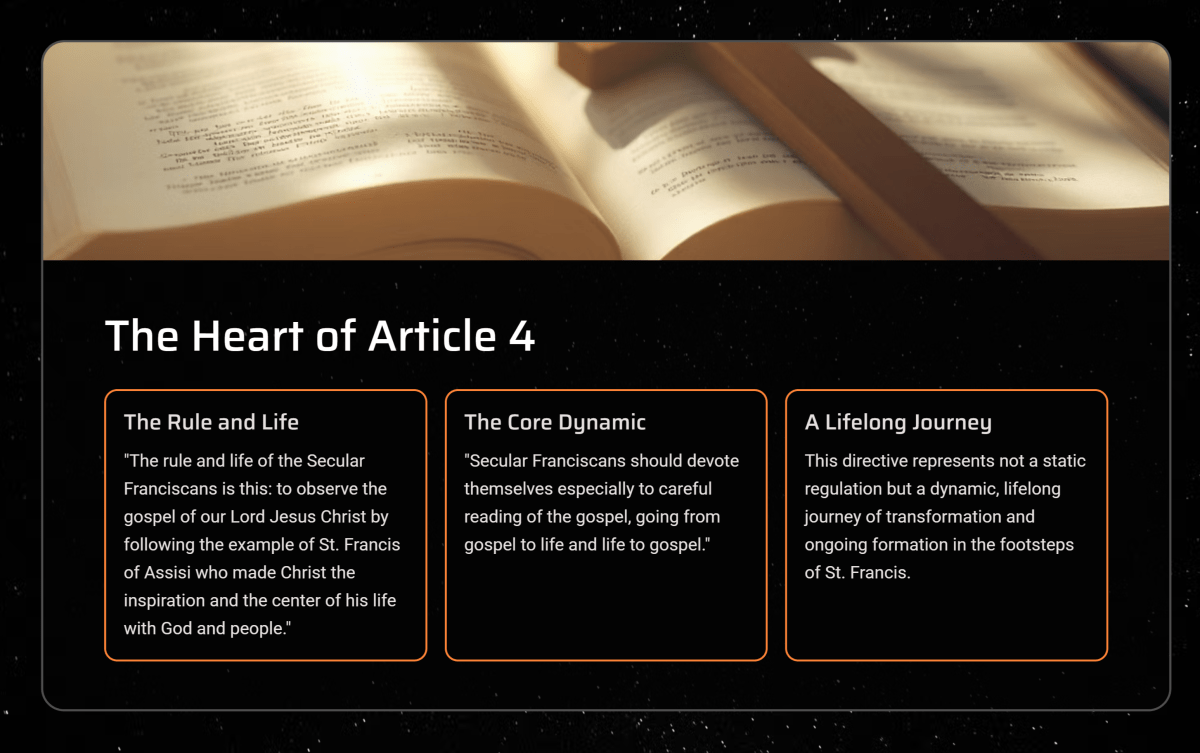
At the core of this Rule lies Article 4, a passage that encapsulates the essence of the Secular Franciscan way of life: “The rule and life of the Secular Franciscans is this: to observe the gospel of our Lord Jesus Christ by following the example of St. Francis of Assisi who made Christ the inspiration and the center of his life with God and people”.5 This foundational article further directs that “Secular Franciscans should devote themselves especially to careful reading of the gospel, going from gospel to life and life to gospel”.5 This report seeks to delve into the profound meaning and vital importance of this specific directive, exploring it not as a static regulation but as a dynamic, lifelong journey of transformation and ongoing formation.7
The journey of “going from Gospel to life and life back to the Gospel” is deeply rooted in the earliest Franciscan understanding of Christian living. The Prologue to the 1978 Rule is, in fact, St. Francis’ own Exhortation to the Brothers and Sisters of Penance, the original name for Secular Franciscans.4 This foundational text immediately establishes a spirit of “penance”—not primarily as acts of self-punishment, but as a continuous, heartfelt turning towards God. This understanding of penance is synonymous with what the Gospel itself terms “conversion” (μεταˊνοια, metanoia), a “radical interior change”.4 This ongoing conversion, this persistent reorienting of one’s life towards Christ, serves as the very engine driving the dynamic interplay between Gospel and life. The call to move from Gospel to life and then from life back to the Gospel is, therefore, lived within this fundamental framework of continuous conversion, a core element of Franciscan spirituality from its inception. It is not an optional extra but the very soil in which the Gospel dynamic is intended to flourish, shaping the Secular Franciscan’s response to God’s call in the midst of the world.
Chapter 2
Understanding “From Gospel to Life”: Letting the Word Shape Our World
The first movement in this vital spiritual dynamic, “from Gospel to life,” signifies the deliberate and consistent effort to take the Gospel of Jesus Christ as the primary source, inspiration, and guiding principle for every dimension of a Secular Franciscan’s existence.9 It is an active process of allowing the person, teachings, and values of Jesus, as revealed in the Gospels, to permeate and shape one’s thoughts, attitudes, decisions, and actions. Christ is acknowledged not merely as a historical figure but as “the way to him [the Father], the truth into which the Holy Spirit leads us, and the life which he has come to give abundantly”.5 The Gospel, therefore, is the privileged place where Secular Franciscans encounter this Christ and learn the path to abundant life.
Crucially, Article 4 of the Rule prefaces the directive “going from gospel to life” with an indispensable foundation: “Secular Franciscans should devote themselves especially to careful reading of the gospel”.5 This is not a suggestion for occasional or superficial engagement with Scripture but a call to a dedicated, prayerful, and sustained immersion in the sacred text. The purpose of this careful reading is to “seek to encounter the living and active person of Christ”.5 The sequential phrasing in Article 4—”careful reading of the gospel, going from gospel to life…”—is significant. It implies a necessary preparatory and ongoing discipline. A genuine and fruitful movement “from Gospel to life” is predicated upon this deep, personal, and continuous engagement with the Gospel text itself. It is not simply about aspiring to live a “good life” in an abstract sense, but about living a life specifically informed by, responsive to, and modeled on the person and teachings of Jesus Christ as encountered in the richness of Scripture. This careful reading anchors the subsequent “living” in the objective Word of God, preventing a purely subjective or uninformed approach to Christian discipleship.
When approached with such dedication, the Gospel becomes a comprehensive lens through which the Secular Franciscan views and engages with their secular reality. It offers “Perspectives for life. Values that guide our actions. For our inner spirit to grow. Attitudes on social issues and the judgments we make in daily life. In fact, nothing in our life is outside the reach of the Gospel of Jesus Christ”.9 The call is to “conform their thoughts and deeds to those of Christ”.4 This means actively applying Gospel values within their families, workplaces, social interactions, and civic responsibilities, transforming these everyday arenas into spaces where the Kingdom of God can be made manifest.2 The Rule itself provides concrete examples of how this “Gospel to life” movement takes shape:
- Seeking a “proper spirit of detachment from temporal goods by simplifying their own material needs,” and understanding themselves as “stewards of the goods received for the benefit of God’s children” (Rule, Article 11).5
- With a “gentle and courteous spirit accept all people as a gift of the Lord and an image of Christ,” placing themselves on an equal basis with all, especially “the lowly for whom they shall strive to create conditions of life worthy of people redeemed by Christ” (Rule, Article 13).5
- Esteeming work “both as a gift and as a sharing in the creation, redemption, and service of the human community” (Rule, Article 16).5
- Respecting “all creatures, animate and inanimate, which ‘bear the imprint of the Most High,'” and striving “to move from the temptation of exploiting creation to the Franciscan concept of universal kinship” (Rule, Article 18).5
In this endeavor, St. Francis of Assisi stands as the luminous exemplar. The Rule explicitly states that the observance of the Gospel is to be undertaken “by following the example of St. Francis of Assisi who made Christ the inspiration and the center of his life with God and people”.5 St. Francis’s life was a powerful testament to the possibility of taking the Gospel’s message with radical seriousness and joyful fidelity, translating its often-challenging demands into tangible, lived reality. His transformative encounter with the leper, his wholehearted embrace of poverty, his tireless preaching of peace and penance—all these flowed directly from his profound immersion in the Gospel and his unwavering desire to conform his life to Christ. St. Francis did not merely read or admire the Gospel; he sought to become a living reflection of it. For Secular Franciscans, therefore, the “Gospel to life” movement involves a similar striving for this spiritual transparency, where the love, compassion, and truth of Christ become visible through their own actions, attitudes, and priorities. The example of St. Francis provides not only profound inspiration but also a concrete methodology for making Christ the true center of one’s life, demonstrating how the Word can indeed become flesh in the ordinary circumstances of the world.10
Chapter 3:
Understanding “From Life back to the Gospel”: Finding Christ in Our Experiences
The second movement in this dynamic spiritual cycle, “from life back to the Gospel,” represents the equally crucial reflective dimension of the Secular Franciscan way. It involves the intentional practice of taking one’s daily experiences—the joys and sorrows, successes and failures, challenges and consolations—and bringing them back to the light of the Gospel for deeper understanding, discernment, and spiritual insight.9 This is not a retreat from life, but a prayerful engagement with life, asking critical questions: How do my lived realities resonate with, challenge, or affirm the teachings of Jesus Christ? Where is God present and active in these moments? What is the Spirit inviting me to learn or to change?
This reflective movement “from life back to the Gospel” is intrinsically linked to the unceasing call to daily conversion, or metanoia. Article 7 of the OFS Rule, drawing from the spirit of the Prologue, powerfully articulates this: “United by their vocation as ‘brothers and sisters of penance’ and motivated by the dynamic power of the Gospel, let them conform their thoughts and deeds to those of Christ by means of that radical interior change which the Gospel calls ‘conversion.’ Human frailty makes it necessary that this conversion be carried out daily”.4 The “life to Gospel” practice is essential for this daily conversion. By honestly examining their lived experiences through the clarifying lens of the Gospel, Secular Franciscans can identify areas in their lives that are not yet fully aligned with Christ’s teachings, recognize patterns of sin or uncharitable behavior, and discern the specific ways they are being called to transformation, repentance, and renewed commitment. The Sacrament of Reconciliation holds a privileged place in this ongoing journey of conversion, serving as a “privileged sign of the Father’s mercy and the source of grace” (Rule, Article 7).11
The Rule’s explicit acknowledgment that “human frailty makes it necessary that this conversion be carried out daily” imbues this principle with profound realism and compassion.9 It recognizes that the path of discipleship is not about achieving a static state of sinless perfection, but about a persistent, humble, and hopeful return to the Gospel whenever life’s experiences reveal personal shortcomings, weaknesses, or failures. This understanding prevents the Franciscan path from becoming a source of discouragement over imperfections; instead, it fosters a spirit of constant renewal, grounded in the mercy of God and a reliance on His grace rather than on one’s own strength. This realistic appraisal of the human condition encourages a gentle humility and a continuous openness to growth.
The movement “from life back to the Gospel” is not intended to be a solely individualistic or purely introspective exercise. It thrives on intentional reflection, wherein Secular Franciscans actively “seek to encounter the living and active person of Christ in their brothers and sisters, in Sacred Scripture, in the Church, and in liturgical activity” (Rule, Article 5).5 Life’s varied experiences, when prayerfully considered, become arenas for these encounters. The OFS fraternity plays an indispensable role in this process. As one source notes, “In fraternal gatherings we share insights and reflections for implementing the Gospel in everyday life”.9 Within the supportive environment of the fraternity, members “learn to share insights and failures, dreams and frustrations, excitements and disappointments, vision and action. We do not seek an escape from daily life”.9 This communal reflection is vital for discerning God’s will, for gaining new perspectives on how the Gospel speaks to contemporary challenges, and for receiving the mutual support and encouragement needed to align their lives more closely with Gospel values.4 The fraternity thus functions as a kind of hermeneutic community, where shared life experiences are collectively brought before the wisdom of the Gospel, and the Gospel’s light is, in turn, collectively brought to bear on those experiences. This shared journey of interpretation and application safeguards against purely subjective understandings and provides a network of accountability and spiritual companionship, making the call to daily conversion a more attainable and less isolating endeavor.
Chapter 4
The Indissoluble Link: The Dynamic Cycle of Faith in Action
The directive for Secular Franciscans to move “from Gospel to life and life to the Gospel” describes not two separate activities but two poles of a single, dynamic, and continuous process. It is “our Process of Formation; This is our Way of life”.7 This is not a linear progression with a definitive endpoint, but a cyclical interaction where each movement perpetually informs and energizes the other.9 The Gospel, carefully read and prayerfully pondered, illuminates the path for living; and lived experiences, when reflected upon through the prism of the Gospel, lead to a deeper, more nuanced understanding of the Gospel itself and a renewed commitment to its practice.
The practical outworking of this cycle can be seen in innumerable daily situations. For instance:
- From Gospel to Life: A Secular Franciscan reads Jesus’ challenging call in the Sermon on the Mount to love one’s enemies and pray for those who persecute (Matthew 5:44). Consciously recalling this teaching, they then make a deliberate effort to show kindness, patience, or offer a prayer for a particularly difficult colleague at work or a family member with whom there is tension.
- From Life back to the Gospel: The attempt to live out this Gospel call may meet with varying degrees of success. Perhaps the effort is met with continued hostility, leading to feelings of frustration or inadequacy. Or perhaps a small breakthrough occurs, a moment of unexpected grace or understanding. The Secular Franciscan then brings this concrete experience—the struggle, the failure, or the small victory—back to the Gospel. They might re-read Jesus’ words, meditate on His own example of forgiving His persecutors from the Cross, or recognize more acutely their own need for God’s grace and strength to love in such a radical way. This reflection, born from lived reality, then informs and strengthens their resolve for the next attempt to put the Gospel into action.
This dynamic interplay ensures that faith is not confined to the realm of the intellectual or the theoretical, nor does it become a static set of beliefs disconnected from the realities of daily existence. Instead, faith is lived, tested, refined, and deepened in the crucible of everyday life.10 This principle calls Secular Franciscans to be active participants with God in the ongoing work of creation and redemption, not passive observers of life. They are called to be “witnesses and instruments of her [the Church’s] mission among all people, proclaiming Christ by their life and words” (Rule, Article 6).5 Their work, in whatever form it takes, is to be esteemed as “a sharing in the creation, redemption, and service of the human community” (Rule, Article 16).5
The cyclical nature of “Gospel to Life and Life to Gospel” is inherently generative. It is designed to produce what the Prologue to the Rule, quoting St. Francis, calls “worthy fruits of penance”.11 This implies that the process is not solely for the purpose of personal sanctification, though that is a primary aim; it also has an outward, apostolic thrust. Each turn of the cycle—from hearing the Word, to striving to live it, to reflecting on that lived experience in light of the Word, and then returning to live it more fully—should ideally lead to a more authentic, effective, and visible Christian witness in the world.
To further clarify the distinct yet interconnected movements within this single dynamic, the following table offers a comparative overview:
The Dynamic Cycle of “Gospel to Life and Life to Gospel”
| Feature | From Gospel to Life | From Life to Gospel |
| Starting Point/Focus | The Word of God (Sacred Scripture, teachings of Christ) | Daily lived experiences (personal, familial, social, professional) |
| Primary Action | Application: Actively seeking to implement Gospel values and Christ’s example in life | Reflection: Examining life experiences through the lens of the Gospel |
| Direction of Movement | Scripture → Daily Living | Daily Living → Scripture |
| Key Question(s) | How can I live this Gospel truth today? What would Jesus do/teach in this situation? | What does this experience teach me about the Gospel? Where was Christ in this? How can I grow? |
| Primary Outcome/Goal | Conforming thoughts and deeds to Christ; living a Christ-centered life | Deeper understanding of the Gospel; ongoing conversion (metanoia); renewed commitment |
| Key OFS Rule Reference | “to observe the gospel… by following the example of St. Francis” (Art. 4) 5 | “radical interior change which the gospel calls ‘conversion’…carried out daily” (Art. 7) 9 |
| Role of St. Francis | Model of Gospel living | Exemplar of penitential life and continuous turning to God |
| Role of Fraternity | Mutual encouragement to live the Gospel; shared learning | Sharing insights, failures, discernment; collective wisdom in interpreting life & Gospel |
This table visually distinguishes the two phases while underscoring their interdependence. The outcome of “Life to Gospel” (e.g., a renewed commitment or deeper understanding) becomes the enriched starting point for the next phase of “Gospel to Life,” thus perpetuating a spiral of growth in holiness and witness.
Chapter 5
The Profound Importance of This Principle for Secular Franciscans
The directive to move “from Gospel to life and life back to the Gospel” is far more than a mere suggestion or a pious exhortation; it lies at the very heart of what it means to be a Secular Franciscan. Its importance is multifaceted, touching upon the authenticity of their vocation, their journey towards Christ-likeness, the way they live their Rule, their witness to the world, and their overall spiritual vitality.
Theologian Michele Altmeyer underscores a critical aspect of this principle, stating: “From the Gospel, it means from Jesus, to life, and from life to the Gospel. Here the authenticity of our vocation and our commitment come into play”.10 The active, conscious, and continuous engagement in this dynamic cycle is not an optional extra for the committed Secular Franciscan; it is the very arena where the genuineness of their vocation is tested and demonstrated. Their solemn profession is a pledge “to live the gospel in the manner of Saint Francis” (Rule, Article 2).5 This pledge moves from a noble aspiration to a tangible reality precisely through the consistent practice of applying the Gospel to life’s circumstances and then bringing those circumstances back to the Gospel for illumination and
transformation. Without this dynamic interplay, the vocation risks becoming superficial, a mere label rather than a lived truth. This principle, therefore, is what gives substance, integrity, and authenticity to their Franciscan identity in the world.
The ultimate spiritual aspiration for any Christian, and particularly for a follower of St. Francis, is an ever-deepening “intimate union with Christ” 2, a state where, in the words of St. Paul, it is “no longer I who live, but Christ lives in me” (Galatians 2:20, referenced in 2). St. Francis himself “sought to know and live Christ in His total fullness… conforming himself, by grace, to Him to the point of being considered an alter Christus,” another Christ.10 The “Gospel to life” movement directly serves this profound goal of conformation, as it involves the deliberate effort to shape one’s thoughts, words, and deeds according to the mind and heart of Christ.4 The complementary “life to Gospel” movement then refines and deepens this process through the mechanism of ongoing, daily conversion, ensuring that the journey towards Christ-likeness is constantly renewed and readjusted in light of lived experience.
Furthermore, this principle is the key to truly living the Rule of the Secular Franciscan Order. The Rule is described as “spirit and life,” an “authentic treasure” in the hands of the Secular Franciscan.10 However, as Altmeyer cautions, “We cannot limit ourselves at just an intellectual adherence to the contents of the Rule, we must move on to its concrete implementation”.10 The “Gospel to life and life to Gospel” dynamic is the primary means by which this concrete implementation occurs. It transforms the Rule from a revered document into a lived, vibrant reality. It is through this active engagement that the “life-giving force of the Rule” is experienced, a force that “is the consequence of practicing it and not only of understanding it”.3 The deepest wisdom of the Rule, therefore, is not unlocked through academic study alone, however valuable that may be, but through the experiential knowledge gained in the daily effort to live its precepts. This practice is what makes the Rule truly “spirit and life” for the individual Secular Franciscan.
This inner transformation inevitably overflows into outward witness and evangelization. Secular Franciscans are explicitly called to “go forth as witnesses and instruments of her [the Church’s] mission among all people, proclaiming Christ by their life and words” (Rule, Article 6).5 By consistently striving to live “from Gospel to life,” they increasingly “become a living gospel for all to read”.2 Their transformed lives, characterized by Franciscan virtues such as peace, joy, simplicity, and compassion, become a powerful and attractive form of evangelization within their families, workplaces, and broader secular environments. As Kathryn Swegart, OFS, shared, “Gospel to life, life to Gospel makes you take a deeper dive into being a witness in the world, even in small ways”.1
Living this dynamic also fosters profound spiritual vitality and imbues life with deeper meaning. This practice “takes care of our vitality in order that it does not die out”.3 It helps individuals to give meaning to their daily actions, to internalize their experiences rather than living superficially, and to cultivate a strong sense of fellowship.3 This way of life leads to a “new kind of happiness,” one that comes from sharing in the Lord’s own life and mission.2 Numerous Secular Franciscans testify to how this path has strengthened their faith, brought them profound joy, and nurtured a closer, more personal relationship with God.1
Finally, the faithful living of this principle has implications that extend beyond the individual to the broader Church and society. Secular Franciscans are “called like Saint Francis to rebuild the Church” and, in pursuit of this, they “devote themselves energetically to living in full communion with the pope, bishops, and priests” (Rule, Article 6).5 The “rebuilding” St. Francis was called to was not merely about physical structures but about renewing the spiritual fervor and Gospel integrity of the Church. Secular Franciscans contribute to this ongoing mission primarily through the witness of their transformed lives lived in the heart of the world. Their commitment to peace, justice, the sanctity of family life, care for creation, and service to the poor and marginalized—all flowing from the “Gospel to life” dynamic—helps to infuse both the Church and secular society with the leaven of the Gospel.2 This personal transformation, driven by the constant interplay between Gospel and life, thus generates ripples that contribute to the healing and renewal of the wider human community.
Chapter 6
Living “Gospel to Life and Life to Gospel” Today: Practical Pathways
The call to journey “from Gospel to life and life back to the Gospel” is not an abstract ideal but a practical spirituality meant to be lived out in the concrete realities of daily life. Several pathways and supports are essential for Secular Franciscans seeking to faithfully embrace this transformative process.
At the forefront is the primacy of prayer and the sacramental life. The Rule exhorts: “As Jesus was the true worshipper of the Father, so let prayer and contemplation be the soul of all they are and do” (Rule, Article 8).11 A consistent life of personal and communal prayer, especially meditation on the Gospels, fuels the entire dynamic. Essential to this is active participation in the sacramental life of the Church, “above all the Eucharist” (Rule, Article 8).11 St. Francis’s profound Eucharistic faith, encapsulated in his declaration, “I see nothing bodily of the Most High Son of God in this world except His most holy body and blood,” is to be the inspiration and pattern for their own Eucharistic life (Rule, Article 5).5 Furthermore, Secular Franciscans are encouraged to express their “ardent love” for the Virgin Mary, “humble servant of the Lord… open to his every word and call,” by imitating her complete self-giving and by praying earnestly and confidently (Rule, Article 9).11
Integral to this way of life is the cultivation and practice of Franciscan virtues in everyday circumstances. These include:
- Simplicity and Detachment: This involves “simplifying their own material needs” and recognizing themselves as “stewards of the goods received for the benefit of God’s children” (Rule, Article 11).5 Kay Spofford, OFS, emphasizes “the life of simplicity” as central to the Franciscan charism.1
- Humility: St. Francis chose for himself and his mother “a poor and humble life” (Rule, Article 11).5 Kathryn Swegart, OFS, rightly calls humility a “huge word” in understanding Franciscan spirituality.1
- Poverty of Spirit: This is the ongoing effort to purify their hearts “from every tendency and yearning for possession and power” (Rule, Article 11).5
- Peace and Reconciliation: Following the example of St. Francis, who was a “messenger of true peace,” Secular Franciscans are to be “bearers of peace” in their families, workplaces, and communities, always seeking paths of reconciliation.
- Respect for Creation and Universal Kinship: They are called to “respect all creatures, animate and inanimate,” and to strive to move from any temptation of exploiting creation towards the “Franciscan concept of universal kinship” (Rule, Article 18).5 This involves appreciating, as Kathryn Swegart notes, “the simplicity, the beauty of God’s creation,” seeing it as “the masterpiece of God”.1
The journey “from Gospel to life and life back to the Gospel” is not meant to be undertaken in isolation. The indispensable role of the OFS fraternity cannot be overstated. Local fraternities typically meet monthly for “prayer, ongoing formation in the Franciscan charism, and mutual support in living more deeply the good news of Jesus Christ”.4 The Rule itself states that “the entire community is engaged in the process of growth by its own manner of living” (Rule, Article 23).5 The fraternity provides a vital space for members to share their insights from Gospel reading, their struggles in applying it to life, and their experiences of bringing life back to the Gospel for discernment. This shared wisdom, mutual encouragement, and loving accountability make the journey less solitary and more resilient.9 Daniel Spofford, OFS, aptly describes the fraternity as having “become a family,” where members “love each other, and we help each other, not only in faith but in our life situations”.1
This inner transformation naturally flows outward into concrete acts of service and witness, often referred to as apostolates. While some fraternities may undertake corporate ministries, many Secular Franciscans assist other religious or civic groups in addressing urgent human needs that are often overlooked.4 The St. John the Baptist Fraternity in Maine, for example, has supported campus ministry, assisted refugee families, organized clothing drives for the poor, and conducted food drives for local pantries.1 These are tangible expressions of “Gospel to Life,” where faith inspires compassionate action. As Daniel Spofford, OFS, articulates their mission, “We seek to bring the light of Christ to others every day… try to sow peace in the world”.1
Finally, it is crucial to recognize that the dynamic of “Gospel to life and life to Gospel” is the very essence of ongoing formation, which is a lifelong commitment for the Secular Franciscan. The process of becoming a member involves a period of initiation, at least a year of initial formation, and then a permanent profession to live by the OFS Rule.4 This profession, however, marks not an end but a beginning of a “life-long commitment of ongoing formation to become Christ like through the values of St. Francis of Assisi”.6 Significantly, the phrase “Gospel to life; life to the Gospel” is explicitly identified as “our Process of Formation; This is our Way of life”.7 This underscores that this dynamic is not an advanced practice reserved for the spiritually mature, but the fundamental pedagogical method by which individuals are formed as Secular Franciscans from their earliest days of inquiry and candidacy. It is the path they walk from the moment they begin their journey and one that continues to shape them throughout their lives.
Chapter 7
Conclusion: Embracing the Journey of Transformation
The call embedded in Article 4 of the Secular Franciscan Rule—”to go from Gospel to Life and Life back to the Gospel”—is far more than a pithy slogan or a simple guideline. It is a profound summons to a dynamic, transformative, and lifelong discipleship in the footsteps of St. Francis of Assisi. This principle articulates the very method by which Secular Franciscans strive to make Christ truly “the inspiration and the center of his life with God and people”.4 It is the spiritual engine that drives their vocation, enabling them to live the Gospel authentically within the unique circumstances of their secular lives.
Embracing this journey requires perseverance in the daily effort of conversion. The recognition that “human frailty makes it necessary that this conversion be carried out daily” is not a cause for discouragement but an invitation to rely ever more deeply on the mercy and grace of God.9 While the path of conforming one’s life to Christ is undoubtedly demanding, it is, at its heart, a “response to the crucified love of Jesus” 10, a love that empowers and sustains.
The fruits of faithfully living this Gospel-centered dynamic are abundant and life-giving. They include a progressively deeper and more personal relationship with God 1, growth in “perfect charity” (Rule, Article 2) 5, and the experience of profound joy and peace, even amidst life’s challenges.1 Ultimately, this way of life enables Secular Franciscans to become, like St. Francis before them, a “living gospel for all to read” 2, radiating the light, love, and hope of Christ within their families, workplaces, and the wider world. The journey “from Gospel to life and life back to the Gospel,” while calling for constant effort and renewal, is fundamentally a path to spiritual freedom and the deep, abiding joy that is the hallmark of authentic Franciscan spirituality—a joy found in intimate union with Christ and in the wholehearted living of one’s God-given vocation.
References
10 Altmeyer, Michele OFS. “The Spiritual Features of the Rule of the Secular Franciscan Order.” CIOFS (International Council of the Secular Franciscan Order). https://ciofs.info/wp-content/uploads/2020/03/EN-Michele-Altmeyer-spiritual-features-of-rule.pdf
11 OFS Ongoing Formation. “OFS Rule.” OFSongoing.com. https://ofsongoing.com/ofs-rule/
1 Diocese of Portland. “Secular Franciscans: Bringing the Gospel to life.” Portland Diocese. https://portlanddiocese.org/news/secular-franciscans-bringing-gospel-life
6 St. Philip Neri & St. Theodore Catholic Church. “Secular Franciscan Order (SFO).” MossBluffCatholic.org. https://mossbluffcatholic.org/secular-franciscan-order-sfo
3 Order of Friars Minor. “The spiritual dimension of the Franciscan Rule.” Koinonia 02/2023 (English Edition). https://ofm.org/uploads/Koinonia%2002_2023_English.pdf
2 Secular Franciscan Order – Australia, National Formation Commission. “Commentary on the Rule and Constitutions.” Franciscans.org.au. https://sfo.franciscans.org.au/rulesconst/commentary.htm (This citation corresponds to 2 in the previous version’s reference list)
9 Secular Franciscan Order Great Britain (OFSGB). “Franciscan Witness: Gospel to Life – Life to the Gospel.” OFSGB.org. https://ofsgb.org/join-us/franciscan-witness/
10 Altmeyer, Michele OFS. “The Spiritual Features of the Rule of the Secular Franciscan Order.” CIOFS (International Council of the Secular Franciscan Order). https://ciofs.info/wp-content/uploads/2020/03/EN-Michele-Altmeyer-spiritual-features-of-rule.pdf 10
1 Diocese of Portland. “Secular Franciscans: Bringing the Gospel to life.” Portland Diocese. https://portlanddiocese.org/news/secular-franciscans-bringing-gospel-life
9 Secular Franciscan Order Great Britain (OFSGB). “Franciscan Witness: Gospel to Life – Life to the Gospel.” OFSGB.org. https://ofsgb.org/join-us/franciscan-witness/ 9
4 Franciscan Media. “What Is the Secular Franciscan Order?” Franciscan Media. https://www.franciscanmedia.org/ask-a-franciscan/what-is-the-secular-franciscan-order/
1 Diocese of Portland. “Secular Franciscans: Bringing the Gospel to life.” Portland Diocese. https://portlanddiocese.org/news/secular-franciscans-bringing-gospel-life 1
2 Secular Franciscan Order – Australia, National Formation Commission. “Commentary on the Rule and Constitutions.” Franciscans.org.au. https://sfo.franciscans.org.au/rulesconst/commentary.htm
5 National Fraternity of the Secular Franciscan Order – USA. “The Rule of the Secular Franciscan Order.” Secular Franciscans USA.(https://secularfranciscansusa.org/wp-content/uploads/2017/07/RULE.pdf)
7 Cooper, John OFM Cap. “Gospel to life; life to the Gospel.” Secular Franciscan Order Australia. https://ofsaustralia.org.au/monthly-spiritual-message/gospel-to-life-life-to-the-gospel/
8 Cooper, John OFM Cap. “Gospel to life; life to the Gospel.” Secular Franciscan Order Australia. https://ofsaustralia.org.au/monthly-spiritual-message/gospel-to-life-life-to-the-gospel/ 7
Peace and All Good – Mike