Accepting All People as A Gift of The Lord

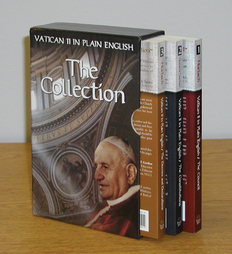
From: Vatican II in Plain English

 With Pope Francis, the Franciscan Family celebrates the 800th anniversary of the meeting of Br. Francis and Br. Illuminato with Sultan Malek al Kamil. Considering the Pope’s efforts, let’s take a moment to reflect on what the church has to say in regard to our active involvement with non-Christian religions.

From Book 3 (from a set of three books) entitled The Decrees and Declarations, I have excerpted certain quotes.

Book 3 – The Decrees and Declarations – Chapter 4, The Declaration on the Relationship of the Church to Non-Christian Religions

(Although the “verses” below are written in psalm-scripture style in the book, I present them in paragraph form to save space.)

1 In our day and age, people everywhere are growing closer together, and their ties are becoming more profound, even when they are socially diverse.

Because of this reality, the Church is giving more attention to its relationship with non-Christian religions and, toward that end, gives primary consideration in this document to what unites all people and to what people have in common.

This furthers the Church’s task of fostering unity and love among people and even among various nations.

For we believe and teach that all men and women form one human family, have a common origin and God, and share a common destiny in divine Providence.

People naturally look to various religions to answer profound human questions:       What does it mean to be human?

What is goodness? What is sin?

What makes us sad?

What is the path to happiness?

What does death mean?

What is beyond the grave?

What, in short, is the mystery of life?

2 People have long sensed the presence of the divine, however that is understood or defined. It seems to hover near us, mysteriously present in the events of life. We have variously known this as a supreme being – a divinity or heavenly sort of parent – and this has given people a religious sense.

In Hinduism for example, people contemplate this divine mystery and speak of it through myths and penetrating inquiry, seeking relief of human struggle through aesthetical practice, meditation, or movement toward God.

In various forms of Buddhism, too, people understand that the current situation is not sufficient and that there is a path for life on which people can reach greater freedom or enlightenment.

In many other religions around the world as well, people strive to relieve the restless hearts through religious practices and lifestyles that consist of teachings, rules of life, and sacred rights.

The Catholic Church does not reject anything that is true and holy in any of these religions and, in fact, looks upon them with sincere respect.

Even though they differ from us, their ways of life and doctrines often reflect the truth that we all seek.

The church of course, continues to proclaim Christ as “the way, the truth, and the life,” but we all exhort all our members to be prudent and loving and open to dialogue with others.

We urge Christians to defend and promote the spiritual and moral benefits found among other world religions, including the values found in their cultures.

3 We also appreciate the Muslems, who adore one God who, they believe, acts with mercy and power, who is our creator and sustainer.

They seek to obey God in the spirit of Abraham and Sarah, even when the divine decrees seem inscrutable.

Even though they do not believe in the divinity of Jesus, nonetheless they revere him as a prophet, and they honor Mary, his mother.

They wait with us for the judgment day, when God will give all their due, and therefore, they value a moral life and practice prayer, fasting, and almsgiving. Even though we have had many hostilities between Christians and Muslims, we now urge all to forget the past and work for mutual understanding and peace.

4 This council also recalls the spiritual bonds that unite Christians and Jews: our common heritage in Sarah and Abraham.

We are the Church of Christ, but we acknowledge that the roots of our faith are in the spiritual ancestors, Moses, and the prophets whom we hold in common.

The very story of Christianity – that God is leading us to freedom – was foreshadowed by the journey of the Jews from bondage to freedom through the desert.

We cannot forget, therefore, that we receive divine revelation through the Jews.

… As Christians, we are rooted in Judaism, and we even believe that in Christ, Jew and Gentile were reconciled once and for all.

Mary herself was a Jew, of course, as we’re all the apostles, not to mention Christ himself – a faithful Jew. …

5 It is really not possible to call upon God, the creator and sustainer of all, if we treat anyone less than lovingly.

The scriptures themselves say as much when they remind us that whoever does not love does not know God, because God is love.

Hence, one’s relationship to God is intimately linked to one’s relationship to those around him or her.

There is absolutely no ground, then, to offer anyone less than full dignity and respect.

Therefore, we outrightly reject and abhor any discrimination against anyone based on race, color, condition of life, or religion.

We beg all Christians to be at peace and to maintain good relations with all peoples.

The Word of the Church

Our Shared Journey With All People

 Pope Francis continues to call the Church, the People of God, to address issues of violence, oppression, and death of human beings, and the planet itself.  He is empowered to shout this out to millions of Catholics through the statements of compassionate concern and brilliant guidance as given to all of us in the Second Vatican Council documents.

The Council has much to say to us about how we navigate our relationships with each other and our planet. I was recently introduced to a paraphrased version of the documents of the Council, and I have found them to be quite helpful. “Vatican II in Plain English” is written by Bill Huebsch and Paul Thurmes. For authentication of the paraphrased version, on the Publisher Page, the following is written: “The Nihil Obstat and Imprimatur are official declarations that the material reviewed is free of doctrinal or moral error”.

I believe that we have an obligation to read these important documents and to incorporate them into our daily life, most especially into our prayer lives. This set of books is a great resource for doing just that.

From Book 2 (from a set of three books) entitled “The Constitutions”, I have excerpted certain paragraphs and sentences.  This Book helps us recall our shared journey, our need for a renewed understanding of our sense of community, our sense of unity, one that places us on an equal basis with all people, and all their faith traditions, most especially the lowly for whom we strive to create conditions of life worthy of people redeemed by Christ.

Constitution on the Church

Chapter 2, The People of God

(As I quote these “verses” below, which are written in the psalm-scripture style in the book, in an effort to save space, the verses are in paragraph form.  Also, in bold and italicized form, I have parenthetically made brief comments in verse 9.)

 9 God has always welcomed anyone whose heart is ready to experience the divine presence. These are the ones whose lives reflect goodness and who cultivate a sense of awe. But God has always chosen to welcome women and men, not merely as individuals but bound together, united as a people who recognize the divine. So, coming together as a people is an essential element of salvation. … the house of Israel came as one people, united in a covenant with God, slowly growing more and more ready to receive God fully, ready to live within a full and new covenant. In Christ, this new covenant was instituted, and all were called together as a people: Both Jew and Gentile, united in one common Spirit. … The church is constantly moving and searching, wandering . . . not unlike the Hebrew experience in the desert. (or the experience of the displaced now moving north through Mexico). And even though the Church’s movement is sometimes filled with trial and tribulation, nonetheless, it (we) remain faithful overall. It (we) continues to be a visible sign of unity, a sacrament of salvation for all people. Aware of the absolute importance of its mission, the Church seeks constant renewal. It never ceases to beg the Holy Spirit for the grace it needs to be the light of the world.          Lumen Gentium! …

12 … This same spirit likewise sanctifies the whole world, which means that through the Spirit every aspect of the world will eventually be brought to goodness and holiness. This will happen because the Spirit gives gifts to each person and assists each in using them well. The power we need to do this comes only from God and leads us insistently to more and more become exactly who we are created to be. We call this shared, loving, sacred power by a name: we call it “grace.” … It is given to everyone at every rank of the Church. It forms us into a community which also has a name: The People of God!

13 All people everywhere and throughout all time are called to belong to this People of God. And doesn’t this fit God’s way of doing things? God did, after all, create us in the divine image to share human nature together. Together we share an inescapable sameness. God even became one of us in Jesus Christ so that we might be united as human beings, that we might begin to realize that this sameness is a wonderful gift. But human unity may seem like a far-off dream. Our experience of national tensions and cultural warfare makes such … unity appear impossible! God’s reign, however, is not like an earthly one because it encompasses citizens of every race with all their various cultures and it forms these people into a Church. …

14 Everyone on earth is welcomed into this unity, and each is called in a unique way. For those called to be Catholic, the church is necessary for salvation, according to both Scripture and tradition. …

15 Those called to be Christians in other churches and with whom the pope is not yet fully united are nonetheless linked to the Church in many ways. United to Roman Catholics by Scripture, prayer, charity, and even sacraments, together we hope and work toward full unity. The Church urges all its members to lives that are holy and renewed to enable this.

16 And the many people who are not Christian are also connected to the People of God. The Jews remain dear to God for example, as do the people of Islam, as well as all those who seek God with a sincere heart. Likewise, those who seek no God whatsoever, if they are good and true, are also related to God’s People. …

 The Word of the Church

Mike Carsten, OFS

November 7, 2018

www.ofsusaecumenicalinterfaith.org

USCCB: Exercise ‘Extreme Caution’ Before Giving Credence to Alt-Catholic Groups

Millennial's avatarMillennial

via NBC News:

Websites like Church Militant, LifeSite News and the Lepanto Institute are ratcheting up the rhetoric while replacing polite and prayerful discourse with personal attacks on supporters of gay Catholics, they say….

“They inject fear, hatred and homophobia into religious discourse,” said the Rev. James Martin, a Jesuit priest and author of “Building a Bridge: How the Catholic Church and the LGBT Community Can Enter into a Relationship of Respect, Compassion and Sensitivity.”

“They use the same tactics as the political alt-right: lies, personal vilification and demonization of minority groups,” he said….

In response to repeated requests for comment from NBC News, the U.S. Conference of Catholic Bishops released the following response from their spokesman Bishop Christopher Coyne of Burlington, Vermont:

“The promotion and defense of the faith should invite an encounter with the merciful love of Christ and contribute to a more civil and peaceful dialogue…

View original post 57 more words

On the Canonization of Archbishop Oscar Romero

National Chapter of Elections 2018

Pope: If You Want to Help the Church, Move Vatican II Forward

Millennial's avatarMillennial

via La Civiltà Cattolica:

A young Lithuanian Jesuit who did his theological training in Africa asks: “When you were elected pope I was studying theology. Three years ago when I was ordained priest, you became a source of inspiration for my life as a Jesuit priest. You have given so much to the Church. I want to ask you how we can help you.”

Thank you! I don’t know what to ask from you specifically. But what needs to be done today is to accompany the Church in a deep spiritual renewal. I believe the Lord wants a change in the Church. I have said many times that a perversion of the Church today is clericalism. But 50 years ago the Second Vatican Council said this clearly: the Church is the People of God. Read number 12 of Lumen Gentium. I know that the Lord wants the Council…

View original post 54 more words

In This Political Situation by Rabbi Shefa Gold

ALEPH: Alliance for Jewish Renewal's avatarKol ALEPH

The political situation that we find ourselves in, has been filled with spiritual peril, for me and for many of my colleagues and friends. My deepest intention is to love everyone, to know the whole world as my extended family. And yet, I find myself seething in outrage, and sometime despairing. My reactivity reveals some pretty shadowy places, places in me that are yearning to be healed.

Since what I do well is lead fellow seekers in the process of transformative retreat, I decided to create the next SOULIFT especially for activists and seekers who struggle with these issues and aspire to heal the world through a journey that is also self-healing, awakening compassion and power through spiritual practices that are grounded in Jewish Wisdom.

The retreat is called “Healing into Action.” I have called on a great teacher of activists to collaborate with me on this. Cherie Brown is someone…

View original post 490 more words

Pope Francis is not afraid of the truth — Leonardo Boff

We are presently suffering an enormous vacuum of leadership, both in the Church and in society. But there is one who stands out from this mediocrity. That is Pope Francis, precisely because he is not afraid to speak the truth. A Pope who speaks the truth in the Church The institutional Church, as all power […]

via Pope Francis is not afraid of the truth — Leonardo Boff

Now is the Time: A Call for Ecumenical/Interfaith Prophets

Let us find together those prophets living amongst us that are willing to speak truth and take us to those peoples and places where we may not really want to go.

Fall 2017

Now is the Time: A Call for Ecumenical/Interfaith Prophets

     Gods peace be upon each of you,

This past week the Troubadours of St. Clare Fraternity Council agreed to create within the Council the position of Ecumenical/Interfaith Formator. Our sister Barbara Jur, OFS, has consented to be the first facilitator of this new Council position. Barbara is already an elected Councilor with active voice within the Council. Her acceptance of this new role will be a blessing to us all.

To the best of my knowledge, we are the first and only fraternity to have taken such a step; further, I believe, no Region in the United States has moved in this direction, including Divine Mercy Region. We are very grateful to Barbara for her generous “yes” in response to the Council request. She has assumed this new role, and we look forward to her guidance and our own future formation.

Why is such a position necessary within a National, Regional, Local fraternity? The answer for me is simple. We need prophets. We need those brothers and sisters who will:

  • put themselves out there and speak truth to us;
  • remind us of our call as Franciscans to be in loving relationship with everyone;
  • help us fulfill the responsibilities of our profession; and,
  • take us places we would rather not go.

I encourage all Regional Executive Councils (most especially Divine Mercy Region) to explore the possibility of creating such a position within their respective Regions. I ask most especially the fraternities of Divine Mercy Region to search out and call forward into service those in our local fraternities who have a passion for Ecumenical and Interfaith dialogue and relationship.

Let us find together those prophets living amongst us that are willing to speak truth and take us to those peoples and places where we may not really want to go.

Pax et bonum,

Mike

“The Sultan and the Saint”


Review  by Donna Hollis, OFS


The docudrama, “The Sultan and the Saint”, is about Muslim and Christian Peacemaking.

The film was presented at Holy Family Catholic Church, Albuquerque, NM April 20th, 2017,

 sponsored by the Franciscan Province of Our Lady of Guadalupe and the New Mexico Islamic community who were in attendance.

This film shown in Albuquerque is 1 of 50 premieres showing across the Country.

“The Sultan and the Saint” will be aired on PBS, December 18th, 2017


Introduction of the docudrama was presented by several leaders.  Fr. Jack Clark Robinson, OFM, Provincial, introduced the event and welcomed all people in attendance.  He went on to share that God of all mankind has many names and ways of praying and honoring Him. Creation is the footprint of God the most High and the first gift to all humans to be shared by All.  We are intertwined with all creation, rooted in the earth that raise our hearts and minds to the Heavens.  We share Mother Earth and the Sacred Space; this is our Home.   

 The Producer of the film, Michael Wolfe, was introduced. He shared about the ‘Unity Production Foundation’ (UPF). The documentary was made to enhance discussions between the isles of different Faiths and listen to one another (Muslim and Christian communities)

In the intro clip it begins with a story, the props, costumes, sets and story lines.  The two stories of both the Sultan and St. Francis goes outside each of their faith traditions familiarity in order to bring Peace among each other.  Both of their lives intertwine within the time of their own Faith journey.


Awards were given out:  The Peace award was given to Arch Bishop John Weston in Albuquerque not in attendance.

The Islamic Community Award was given to the leader of the Islamic Center based in Albuquerque.  He shares the same vision of building bridges and finding common ground among our beliefs.  


This docudrama is about Peace in a war torn Country, much like todays unrest in our own time. Intermittent interviews flow throughout the film.

 The film has two lessons:

  1. History lesson – the Crusades fighting for authority and power. Christians versus Muslims wanting to rule Persia. The first part of the film shows the foundation and reason for so much unrest which brings about the fighting for control and power both from the stand points of the Church and Muslim rule.
  2. Courage Lesson – The two biographies of St. Francis and the Sultan were woven together to show the courage each faced toward one another. Their differences taught them to be against each other. The only way they could understand each other was to Listen and be open to each other; learning from each other.

(Human beings drive war) 

It is a story for our times of Peace in a time of turmoil!


The Movie begins with the height of the Crusades in 1220, Christians and Muslims defy the act of time.  People respond by dehumanizing each other, killing, damming, inflicting evil on one another.   What was the life of the Sultan and St. Francis about? They were each going through their own transformation during this time and were both becoming better than what they saw in war through prayer in their own way.  Lepers were abolished in the time of St. Francis yet he realized they were suffering human beings and he began to reach out to them. Francis preached a message of Peace through his example.  Francis by this time had dropped out of the violence and war of the Crusades.  Francis knew we were created for a better purpose; to become peace makers.  The Medieval Church called for a powerful struggle in the war of taking and killing others , killing all that would not bend the knee to them and their Church. The one true Church was all about control.

Francis and the Sultan both begin to value opposing direction of their traditions and times and behavior.  They both wanted to promote Peace which was embraced in their prayer; the true core of their faiths.   They have to face off those that do not value their understanding; rejected by the norm of their day in beliefs and values. They both saw the trauma of war and death by killing another which re-enforce power over another.  The offering of Peace as a option was seen as weakness. Francis believed that only when we see Christ in one another there can be peace among us.  Francis reached out to the Church and Crusade leaders but was not listened to, they wanted power and control not peace as Francis lived it.  On his way to reach out to the Sultan in peace he was met with criticism by the Crusaders and lack of trust from the Muslims until they realized he was not a warrior.   The Sultan was open to listening to this man of Peace and a dialogue developed. There was a source of peace that grew among the two of them. Francis watched the Muslims pray five times a day. He came to the insight that Prayer is of the essence of preaching and becomes prayer itself. The Sultan and Francis came to respect and understand one another not as enemies but as brothers. 

In giving up the rhetoric of war, peace sets in, bridges can be mended. Francis and the Sultan had to change their way of thinking and judging.   Just because they had differences didn’t mean they had to win each other over but they learned to respect and accept each other for who they are and befriend each other.  Lesson learned – We can live in peace if we allow ourselves to be equal to those we fear or don’t understand ; no one is better than the other. 

Staying true to their beliefs and prayer to God, Allah; Francis and the Sultan had a faith exchange and how God had led them to where they are, allowing God to be God in both perspectives.    The Sultan saw Allah as Merciful with kindness and compassion and forgiveness, 99 names of Allah embody Allah and who he is. To be self transformed  is an act of Humanity.    Francis and the Sultan’s Meeting and life ended in peace and prayer; showing God’s mercy and compassion.      Transcending differences brought about peace.

   If we want peace in the world then we need to exude peace. We are all made different and have different ways to worship God/Allah and call on Him. 

 A reception was followed after the movie in the Parish hall.  Attendees were invited to witness our Muslim Brothers and Sisters as they participated in their fourth prayer of the day facing East. 

 The purpose of the reception was to dialogue with one another and share our faith and understanding/acceptance of each other.  I  entered into conversations with the Islamic women. They shared their stories, where they came from, Jordan, Israel, Persia and how they came to the US to be with their husbands who had come before them to prepare a home for their families.  The Muslims have close knit communities with one another; they are all as one family. 

As we sat down to eat the food their community prepared we shared further about our Culture, beliefs and where they are at now with the community.  They were a delight to talk with. Some of the ladies are converts to Islam and shared their stories as well.  I found the women very open and hospitable.  They invited us to come and pray with them at their Mosque anytime.  The women handed out brochures about Islam which explains their faith in detail.  It is a way to explore more about who they are and what their faith represents. 

 I spoke with Producer Michael Wolfe at the reception. He shared how and why he converted to Islam.  He has written many books on the ‘Haag’, their place of worship.  Michael did not know the story about the Sultan meeting St. Francis until he was at a Retreat Center on retreat and met a Franciscan Friar who shared with him about the chance meeting of the Sultan and St. Francis.  At that time Michael began to explore the life of St. Francis and was deeply impressed.  He asked his Co Producer if they could make this event into a movie/documentary.   Michael is a writer and began to write the script for the documentary. Michael comes across as a very humble, devoted man of deep faith.

He desires and seeks ways to bring Peaceful dialogue with all faiths and not allow society to dictate how we should act.  

 I came home full of hope that we can cross boundaries of different Faiths and find common ground on which to build dialogue and lasting friendships.  With openness and respect towards one another we can build bridges and see the many faces of God/Allah who lives in us all.  He has many names and we have many ways of praying to Him.