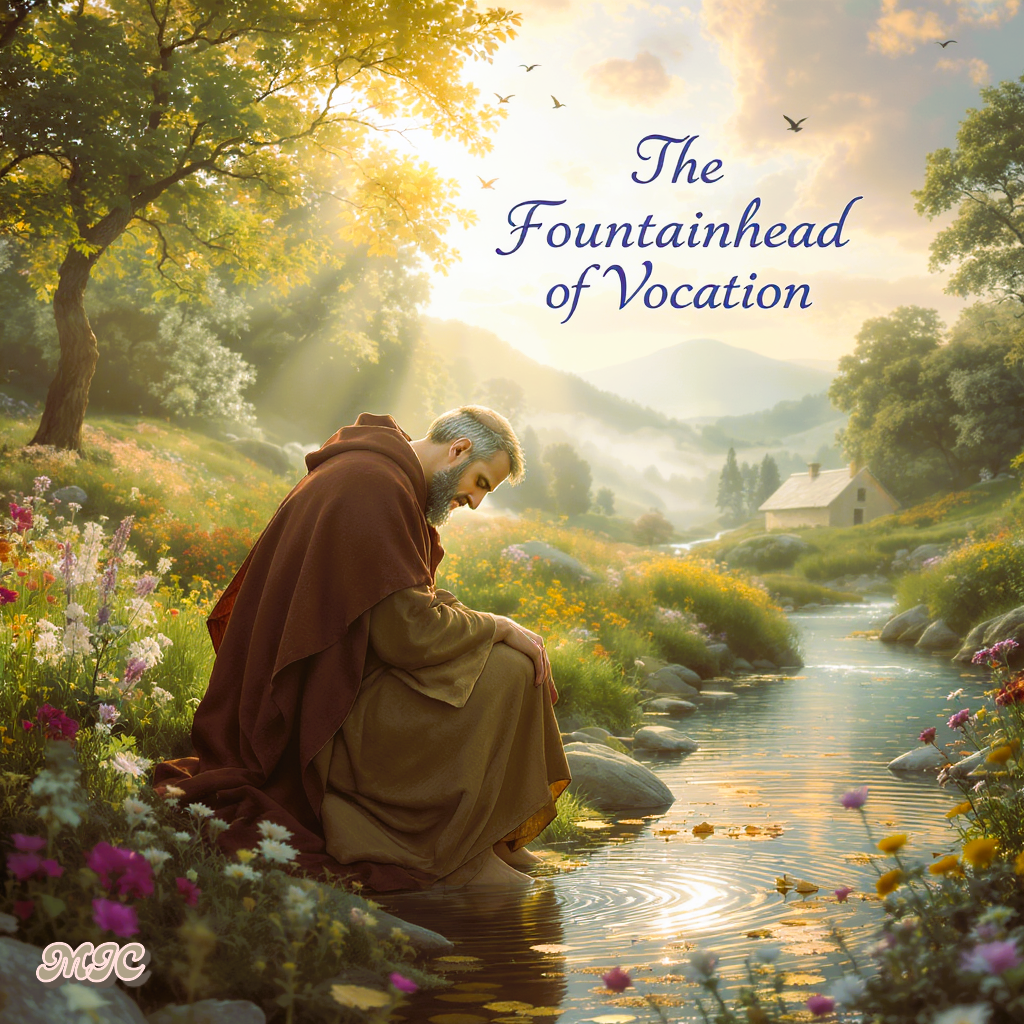
When we sit on our porch in Detroit and feel the cool breeze, or watch a butterfly flutter by, what are we really seeing? Is it just air molecules and a tiny insect, or something more? For us as Secular Franciscans, our hearts tell us it’s something infinitely more profound.
Science often describes the world in a beautiful yet impersonal way. It talks about physics, chemistry, and biology. Yet, our faith reminds us that behind all the laws and all the atoms is a profound and loving presence. This isn’t a new idea; it’s the very heart of the Franciscan way.
Beyond a Creator, to a Presence
For our founder, St. Francis of Assisi, God wasn’t just a powerful being far away in the heavens. God was intimately present in every part of creation. St. Francis didn’t just see the sun as a star; he called it “Brother Sun.” He didn’t just see water as H₂O; he called it “Sister Water,” for its beauty and utility.
This is because the universe is not just a creation, but a divine poem. A poem isn’t just words on a page; it’s a window into the mind and heart of the poet. In the same way, the universe isn’t just matter and energy. It’s a profound and beautiful expression of God’s wisdom, love, and divine conscience.
This is a simple truth that anyone can grasp, yet it is so profound. It asks us to look at a cloud, a tree, or even our spouse, Kathleen, and see not just what they are, but whose they are.
Living with a Cosmic Conscience
If the universe is a reflection of a divine conscience, then our own conscience is a spark of that same light. Our inner voice that tells us to do good and to love isn’t just a random feeling. It’s a small part of God’s own self-awareness that resides within us.
This understanding directly connects to our Franciscan life. Caring for creation isn’t just a “green” initiative; it’s a sacred duty. It’s about honoring the divine reality present in all things, just as we would praise God Himself. To harm creation is to harm the very expression of God’s goodness.
So, let’s go out and live with a cosmic conscience. Let’s pause to truly see the world around us. Let’s find God in the everyday, in the small moments of wonder and in the simple, loving acts we perform for one another. It’s in this that we honor the divine poem and live out our call as brothers and sisters of St. Francis.
You have made me a great grandfather, a grandfather, a father, and a husband, and a son of Francis and Clare, a son of the Church. I am to be an instrument of Your peace, but my spirit finds no peace in this world. My heart is a barren land, and my eyes are a river of tears. I find only a litany of sorrows and a silence that wounds me to the core.
I cry out for the children of Gaza, O Lord. The land that Francis walked in peace is now a prison of despair for a million souls. They are hungry and broken, their spirits withered by a life under siege. How long, O Lord, will You allow this open wound?
I cry out for the children of Africa, O Lord. Their small bodies are withered by a famine of our own making, a famine of indifference. They die slowly and quietly, out of sight. Hear their silent screams, O Lord, and turn the hearts of all who have turned away.
I cry out for the children of my own nation, O Lord. In a land of staggering wealth, over a million are without a home. They sleep in cold cars and huddle in fear, forgotten in the shadow of our plenty. You, too, were without a home. Remember them, O Lord.
I cry out for the indigenous children, O Lord, whose hope was stolen on a path of broken promises. Their heritage is a river of tears, and their spirits are burdened by a history of wounds. Let the stones of this land cry out for justice, O Lord.
I cry out for the children at our border, O Lord. They are the stranger You commanded us to welcome, yet their faces are filled with terror. They flee from violence, only to find fear in our land. Let our hearts not be hardened, O Lord.
I cry out for the hungry children in our streets, O Lord. Their tables are empty because of the policies of men. You, who gave us manna from heaven, now see them denied the simple bread they need to live. Their bodies are made vulnerable, and their minds suffer for lack of a meal. Is there no feast for them, O Lord?
I cry out for the children suffering sexual abuse, O Lord. Their innocence is stolen in the shadows, their trust broken by those who should protect them. Their voices are silenced by shame, and their spirits carry wounds unseen. Heal them, O Lord, and bring them into the light.
I cry out for the children in our hospitals, O Lord. Their lives are measured by ledgers and spreadsheets, not by Your infinite worth. They die from treatable sickness, not for lack of a cure, but for lack of care. Have mercy on them, O Lord, for their lives are sacred.
And I cry out for the children in our schools, O Lord. They are slaughtered in their places of safety, and their blood flows as a river through our land. Firearms have become the greatest threat to their young lives. This silence, O Lord, is a sickness of our soul.
My spirit is weary, and my voice is small against this present darkness. But I will not be quiet. And yet, in the midst of my anguish, I see a small light. I thank You for Franciscan Action Network (FAN), O Lord, a voice for the voiceless in our own nation. And I thank You for Franciscans International (FI) at the United Nations, speaking for the poor and defending Your creation. I thank You for the work of Church World Service (CWS) and Sojourners for the homeless, and for the tireless dedication of Catholic Charities and St. Jude in the fight against sickness. I thank You for the justice sought by Hebrew Immigrant Aid Society(HIAS) and American Jewish World Service (AJWS), and for the mercy of Islamic Relief and the Zakat Foundation. I also thank you for the Interfaith Alliance and all who unite across faiths to defend human dignity. They are proof that Your heart is not silent, and for this, I am grateful.
My soul finds its purpose in this, O Lord, a path of peace and justice You have set before me. Help me to hold fast to the words of St. Francis: “Let us begin to do good, for up to now we have done so little.” Strengthen my voice and my heart to be an instrument of Your peace.
Part I: The Crisis at Steubenville: A Test of Franciscan Identity
The life of a Secular Franciscan is one of continual conversion, a journey of “going from gospel to life and life to gospel. “.1 This journey is not always serene; at times, it leads to moments of profound crisis where the very identity of the Order is tested. Such a moment arrived in 2007, a crucible that revealed two fundamentally opposed visions of what it means to be Franciscan in the modern world. One vision embraced dialogue, encounter, and the risk of reaching out in love. The other sought refuge in rigidity, exclusion, and fear. The collision of these two worldviews, precipitated by a decision of the National Executive Council (NEC) of the Secular Franciscan Order in the United States (OFS-USA), left an indelible scar on the Order and on the lives of those who sought to live its Rule with integrity. To understand the challenges facing OFS-USA today, one must first revisit this unresolved trauma and confront the truth of what transpired.
Section 1: A Courageous Decision, A Terrible Price
The Official Narrative vs. The Lived Reality
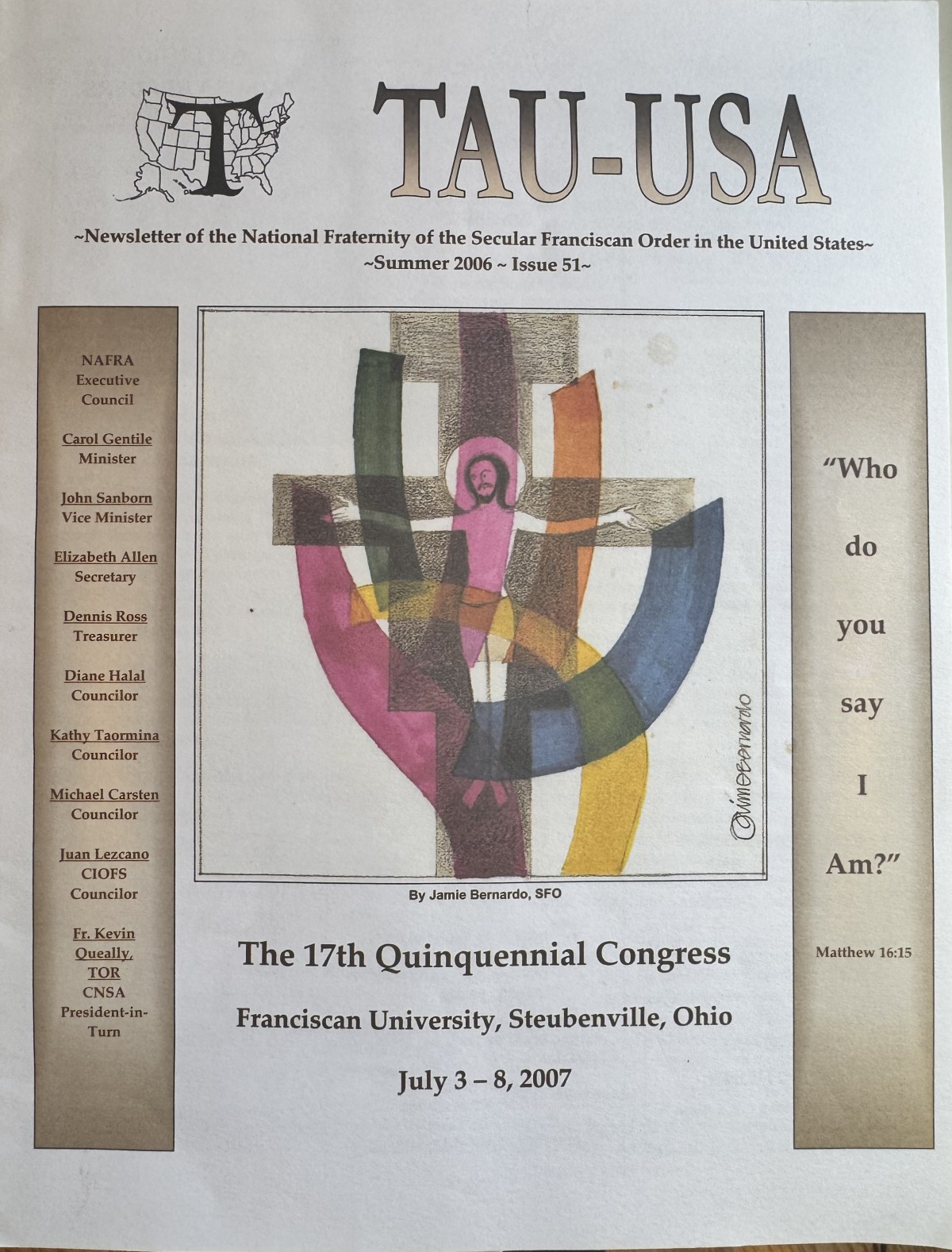
The public record of the 17th Quinquennial Congress of the OFS-USA presents a picture of harmony and success. The event, themed “Many cultures – through Francis – in Christ,” was scheduled for July 3-8, 2007.2. The Spring 2007 issue of
TAU-USA, the national newsletter, announced a change of venue from the originally planned site in Steubenville, Ohio, to the Radisson Hotel in Pittsburgh, Pennsylvania, explaining that the new location would “better accommodate the needs of the Secular Franciscan Order. “.2 Following the event, the Fall 2007 issue of
TAU-USA celebrated the Congress as an “overwhelming success”.4 It highlighted the positive reception of the keynote speaker, Reverend Eric H.F. Law, an Episcopal priest, whose message on diversity and inclusiveness was lauded. The official account, preserved in the Order’s publications, portrays smooth logistics and fruitful dialogue, a joyful “family reunion” for Franciscans from across the nation.5
This sanitized narrative, however, conceals a far more painful and violent reality. The decision to relocate the Congress was not a matter of simple accommodation. It was a moment of profound moral reckoning, a principled stand that came at a terrible personal and spiritual cost. The lived experience of those on the National Executive Council at the time bears little resemblance to the cheerful reports published for the wider Order. This chasm between the official story and the traumatic truth reveals a deep-seated reluctance within the institution to confront a virulent and un-Franciscan element that has been festering within its ranks. By failing to acknowledge the conflict, the Order created a permissive environment where the aggressors were shielded from accountability and the victims were left to carry their trauma in silence. This institutional denial is not a neutral act; it is a choice that has had lasting consequences, allowing the very poison that erupted in 2007 to continue its corrosive work within the fraternities.
The Untold Story of Principled Resistance
The true story of the 2007 Quinquennial Congress began not with a logistical review, but with an ultimatum. A few years prior, the NEC had selected Franciscan University of Steubenville as the site and, in keeping with the multicultural theme, had invited Reverend Eric H.F. Law as a keynote speaker. Rev. Law’s selection was announced nationally in the Summer 2006 edition of TAU-USA. Shortly after this announcement, Franciscan University informed the Quinquennial Committee that Rev. Law, an Episcopal priest, would not be permitted to speak on their grounds. The university, a self-described bastion of “dynamic orthodoxy” 6, effectively demanded that the OFS-USA censor its own event and discard its chosen speaker.
Faced with this challenge, the Quinquennial Committee met and reflected. Their recommendation to the NEC was not to capitulate, but to find a new location where the integrity of their program could be maintained. The Conference of National Spiritual Assistants (CNSA) and the full NEC concurred. The decision was made to move the entire national congress, a massive logistical and financial undertaking, rather than compromise the Franciscan principle of ecumenical dialogue and respectful encounter. This was not a choice for convenience; it was a courageous act of fidelity to the Order’s charism. It was a declaration that the Secular Franciscan Order would not allow its commitment to building bridges to be dictated by an institution whose vision of Catholicism was evidently more concerned with policing boundaries.
The Eruption of Vitriol and Violence
The aftermath of this courageous decision was not praise for the NEC’s integrity, but an explosion of rage from a segment of the Order’s own membership. The council was immediately inundated with a torrent of phone calls and emails. The demand was uniform and furious: the NEC should bow to the will of Franciscan University and disinvite Rev. Law. The reasons given were myriad, but none fell within the bounds of authentic Franciscan or Catholic thought. They were, without exception, expressions of a rigid, exclusionary, and fundamentalist Catholic mindset that viewed an Episcopal speaker not as a brother in Christ, but as a contaminant.
As the days passed, the hostility escalated dramatically. For those of us serving on the NEC, it was a descent into a nightmare. My own phone rang day and night. Vile, foul messages were left on my answering machine. Letters and postcards arrived at my home, condemning me as a heretic and informing me that I was destined to burn in hell. The campaign of harassment then crossed a terrifying line into direct threats of violence. I received death threats from professed Secular Franciscans—individuals who had made a lifelong commitment to follow Christ in the footsteps of the Poverello of Assisi, the universal bearer of peace. These members were convinced that I was a “Liberal menace” who was actively working to destroy the Church.
The threats became so specific and credible that they could not be ignored. The Michigan State Police and the Federal Bureau of Investigation (FBI) were contacted and launched a formal investigation. They traced the origins of the threats, identified the individuals and the geographic areas within Michigan from which they emanated, and advised me on the necessary steps to protect myself and my family. This was the lived reality of the 2007 Quinquennial: not just a disagreement over a speaker, but a campaign of terror waged by professed Franciscans against an elected national leader, requiring the intervention of federal law enforcement.
This weaponization of “orthodoxy” to justify threats of violence is a perversion of the faith. It demonstrates how a particular worldview can become so detached from the Gospel’s core message of love, mercy, and peace that it can rationalize mortal sin in the name of defending God. The attackers did not see their actions as a contradiction of their Franciscan profession; they saw them as its fulfillment. By framing the conflict as a holy war against a “menace,” they granted themselves a license for persecution, transforming a call to fidelity into a justification for terror. This pathology, which cloaks hatred in the language of faith, is the very essence of the fundamentalist spirit that the NEC had unknowingly challenged. The Quinquennial Congress was ultimately held in Pittsburgh without incident and, by all accounts, was a great success for those who attended. But the psychological damage was done, and the deep, violent rift within the Order had been exposed, even if it was never publicly acknowledged.
Section 2: Two Visions of Franciscanism in Conflict
The 2007 crisis was not a random event. It was the inevitable collision of two irreconcilable understandings of the Franciscan charism and the Catholic faith. On one side stood Franciscan University of Steubenville, representing an insular, defensive, and boundary-focused vision of Catholicism. On the other stood the National Executive Council of the OFS-USA, which, in selecting Reverend Eric H.F. Law, had embraced an open, dialogic, and mission-oriented vision rooted in the Rule of the Order. The conflict was a stark illustration of a choice every Franciscan institution must make: whether to be a fortress protecting a narrow identity or a bridge reaching out to a diverse world.
Franciscan University of Steubenville: A Fortress of “Dynamic Orthodoxy”
Franciscan University of Steubenville defines its core mission as a commitment to “dynamic orthodoxy”.6 It seeks “to educate, evangelize, and send forth joyful disciples” and to form students who can be a “transforming Christian presence in the world”.6 The university’s vision is to answer God’s call to “Rebuild my Church” by creating a “Christ-centered culture” where students are invited to “encounter Christ.”.6 These are laudable goals. However, the university’s actions in 2007 raise questions about the meaning of these terms. How does one build a “Christ-centered culture” of “encounter” by preemptively silencing a voice from another Christian tradition? How does one form students to be a “transforming Christian presence in the world” by refusing to engage with that world in its diversity?
The university’s decision to issue an ultimatum—disinvite Rev. Law or leave the campus—was an act of exclusion, not an act of encounter. It treated an Episcopal priest, an expert in building inclusive communities who has worked extensively with the Catholic Church, as a threat to be neutralized rather than a brother in Christ with whom to dialogue.7 This action revealed that their “dynamic orthodoxy,” when tested, was in fact static and defensive. It functioned not as a dynamic force for engagement but as a rigid wall for separation. In this instance, the university’s institutional identity as a particular brand of conservative Catholicism superseded its claimed identity as “Franciscan.” The name “Francis” was used as a historical and cultural label, but the core Franciscan charisms of humility, dialogue, and universal fraternity were conspicuously absent. This incident demonstrates a critical divergence: there are competing interpretations of what “Franciscan” means, and the university’s interpretation proved incompatible with the ecumenical spirit that has been a hallmark of the Secular Franciscan Order.
Reverend Eric H.F. Law: A Bridge-Builder for a Diverse World
The selection of Reverend Eric H.F. Law as the keynote speaker was a deliberate and faithful expression of the OFS-USA’s own identity and mission. Rev. Law, an Episcopal priest, is the founder and executive director of the Kaleidoscope Institute, whose mission is “to create diverse and sustainable communities” and provide “competent leadership in a diverse changing world”.7 For over two decades, he has worked as a consultant and trainer with a vast array of Christian denominations, including extensive work with the Roman Catholic Church in the United States, Canada, Asia, and Europe.7 His work is not about diluting faith but about providing practical tools, such as his “Kaleidoscope Bible Sharing” process, to help diverse communities engage scripture and one another more deeply.10
By inviting Rev. Law, the NEC was acting in perfect accord with the OFS-USA’s long-standing commitment to ecumenism. Following an invitation to the Anglican Third Order’s Quinquennial in 1997, the OFS-USA formed its own Ecumenical/Interfaith Committee to address relations with people of all faiths.11 The theme of the 2007 Congress itself—”Many cultures – through Francis – in Christ”—was a clear statement of the Order’s desire to embrace the diversity of the Church and the world.2 Rev. Law was not an outsider invited to challenge Franciscan values; he was a fellow Christian invited to help Secular Franciscans live their own values more fully in a multicultural context. His presence was intended to be an embodiment of the very dialogue the Order professes to seek.
The Secular Franciscan Order: A Vocation of Encounter
Ultimately, the NEC’s decision to stand by their speaker and relocate the Congress was an act of profound fidelity to the foundational documents of the Secular Franciscan Order. The 1978 Rule, approved by Pope Paul VI, is not a manual for building a defensive citadel against the world; it is a charter for engaging the world in a spirit of peace and fraternity. The Rule and life of the Secular Franciscan is “to observe the gospel of our Lord Jesus Christ by following the example of St. Francis of Assisi.”.1 This observance is made concrete in several key articles that formed the basis for the NEC’s decision:
Article 5: “Secular Franciscans, therefore, should seek to encounter the living and active person of Christ in their brothers and sisters, in Sacred Scripture, in the Church, and in liturgical activity”.1 The call is to seek encounter, not to avoid it. The fundamentalist mindset that erupted in protest sought to prevent an encounter, thereby violating this primary directive.
Article 13: “…with a gentle and courteous spirit accept all people as a gift of the Lord and an image of Christ.”.12 This article makes no exception for those of other Christian traditions. It demands an attitude of radical acceptance and hospitality, the very opposite of the suspicion and hostility directed at Rev. Law.
Article 19: “Mindful that they are bearers of peace which must be built up unceasingly, they should seek out ways of unity and fraternal harmony through dialogue, trusting in the presence of the divine seed in everyone and in the transforming power of love and pardon”.1 This article is a direct mandate for the very action the NEC took. They chose dialogue over censorship, unity over exclusion, and trust in the “divine seed” in Rev. Law over fear of his different perspective.
The decision to move the 2007 Congress was, therefore, not a “liberal” political statement. It was a profoundly conservative act in the truest sense of the word: it conserved the essential charism of the Secular Franciscan Order as defined by its Rule. It affirmed that to be a Secular Franciscan is to be a person of encounter, dialogue, and peace, even when—and especially when—it is difficult and costly.
Section 3: The Aftermath in the Divine Mercy Region
The trauma of 2007 did not remain a national-level issue, confined to the memories of the NEC members who endured the attacks. Like a contagion, the spirit of fear and intimidation spread, poisoning the life of the Order at the regional level. The unresolved conflict and the lack of public institutional accountability for the perpetrators created a long-lasting trail of consequences. Years later, in my own Divine Mercy Region—which serves the Secular Franciscan fraternities of lower Michigan and Toledo, Ohio 13—the same toxic dynamic resurfaced, this time with the devastating effect of crippling regional formation and silencing open dialogue. The events demonstrated that the aggressors of 2007 did not feel chastened, but emboldened. They had learned that intimidation was an effective tool for controlling the narrative and enforcing their rigid worldview.
The Chilling Effect on Formation
A few years after my second term on the NEC had concluded, I was invited to speak at a Regional Candidates’ Day of Reflection. I accepted the invitation gladly, eager to share my Franciscan journey with those in formation. My presentation was met with a warm and enthusiastic reception, culminating in a standing ovation. However, the spirit of fraternity was shattered in an instant. Immediately following my talk, I was publicly confronted by the wife of one of the very individuals who had been identified to me by law enforcement as having made death threats against me and my family in 2007. I knew exactly who she was and what her purpose was. Her questions were not genuine inquiries but hostile, baited traps, designed to discredit me and publicly cast my Franciscan witness as unorthodox.
This moment revealed the long-term impact of the Order’s failure to address the 2007 crisis. The lack of any formal censure or even public condemnation of the death threats had sent a clear message: such behavior, while perhaps unpleasant, carried no meaningful consequences. This perceived impunity empowered the aggressors and their allies to continue their campaign of intimidation, moving it from anonymous phone calls to a face-to-face confrontation at an official formation event. They had successfully created a climate where they felt entitled to police the orthodoxy of a former national leader in a public forum, turning a day of reflection into a tribunal.
The Collapse of Dialogue
My response to the hostile questioning was a challenge to the rigid and uncharitable stance being taken. The result was an explosion. The carefully cultivated atmosphere of prayerful reflection and fraternal sharing disintegrated into open conflict. The Candidates’ Day of Reflection was effectively over at that moment. The confrontation had achieved its purpose: it had created an environment so toxic and unsafe that genuine dialogue became impossible.
The fallout was swift and devastating. In the wake of the incident, local fraternities within the Divine Mercy Region became unwilling to send their candidates, inquirers, and professed members to regional formation events. They were afraid of exposing their members to situations that were not perceived as safely “orthodox,” and they were unwilling to subject them to the kind of open hostility that had destroyed the Day of Reflection. This was the ultimate victory for the forces of fear and control. Through a single, aggressive act of public intimidation, they succeeded in shutting down the primary vehicle for regional-level formation and community-building.
The Victory of Fear
This episode illustrates a crucial and dangerous dynamic. The unresolved trauma of 2007 did not simply fade away; it metastasized into a chronic condition at the regional level. The aggressors successfully established ideological “no-go zones,” where certain speakers or topics were deemed too controversial or divisive to be addressed. This effectively cedes control over the content and spirit of formation to the most rigid, fearful, and intolerant members of the community.
When regional councils and formation directors must constantly self-censor to avoid “explosions,” formation ceases to be a journey of discovery and conversion. It becomes a sterile exercise in reinforcing a narrow and pre-approved set of ideas. It can no longer challenge members to grow, to encounter different perspectives, or to grapple with the complexities of living the Gospel in the world. It becomes indoctrination into a sectarian worldview, not formation in the rich, diverse, and expansive tradition of Franciscanism. The ultimate price is paid by the candidates and the newly professed, who are deprived of the opportunity for a robust and authentic formation, and by the Order itself, which loses its vitality and its capacity for prophetic witness. The fear of conflict leads to a silent, creeping paralysis, a peace not born of charity but of intimidation.
Part II: From Gospel to Life: Diagnosing the Ideological Divide
The painful events of 2007 and their lingering aftermath were not merely the result of a few difficult personalities. They were the symptoms of a deeper ideological disease, a spiritual worldview that stands in stark opposition to the authentic charism of St. Francis of Assisi. To understand the recurring conflicts within the OFS-USA, it is necessary to move from narrative to analysis, to name this counter-witness, and to hold it up to the mirror of the Rule. The mindset that drove the threats and intimidation can be identified as a form of “Catholic fundamentalism.” This is not a pejorative label meant to dismiss conservative belief, but a precise theological and sociological descriptor for a specific pattern of thought and behavior. This pattern is characterized by fear, a demand for absolute certitude, and a rejection of dialogue. When examined in the light of the Gospel and the Rule of the Secular Franciscan Order, it is revealed not as a zealous form of Franciscanism, but as its antithesis.
Section 4: Naming the Counter-Witness: An Analysis of Catholic Fundamentalism
The term “fundamentalism” is often associated with Protestantism, particularly its emphasis on the literal inerrancy of Scripture.15 However, scholars and theologians have identified a parallel phenomenon within the Catholic Church. While not centered on biblical literalism in the same way, Catholic fundamentalism is a distinct mindset that has emerged as a reaction to the changes and perceived uncertainties of the post-Vatican II era.17 It is, at its core, “a form of organised anger in reaction to the unsettling consequences of rapid social and religious change”.18 It yearns for a romanticized and purified past, a “pre-Vatican II golden age,” and it often reacts aggressively to perceived threats to that idealized vision.18
Based on a synthesis of theological and sociological analysis, this fundamentalist mindset can be defined by several key characteristics:
A Sectarian Aversion to Dialogue: A primary feature is a “sectarian aversion to dialogue and cooperation”.19 It views engagement with those outside its own narrow ideological circle—whether they be from other Christian traditions, other religions, or fellow Catholics with different perspectives—not as an opportunity for mutual enrichment but as a dangerous contamination. This leads to an insular, fortress mentality.
An Ahistorical Understanding of Doctrine: Catholic fundamentalism promotes an “ahistorical understanding of Catholic doctrine and tradition”.19 It sees truth as static, eternal, and untouched by history.20 In this view, any development of doctrine, any new application of timeless principles to new historical circumstances, is seen not as legitimate growth but as “apostasy from faith once delivered. “.20 This creates a rigid and brittle faith, incapable of adapting or speaking to the contemporary world.
A Militant and Accusatory Rhetoric: The rhetorical style is often “marked by apocalyptic urgency” and an “almost breathless, accusatory, militant tone in their denunciations of others, especially fellow Catholics.”.20 This is not the language of fraternal correction but of holy war. Opponents are not simply mistaken; they are malicious actors, “menaces” working for the destruction of the Church.
A Punitive and Fear-Based Spirituality: This mindset can foster a spirituality in which Jesus is portrayed primarily as an “unforgiving and punishing God.” At the same time, His overwhelming compassion and mercy are overlooked.18 The spiritual life becomes centered on fear of damnation, adherence to rules for their own sake, and the harsh judgment of others, rather than on the liberating joy of the Gospel.
These defining characteristics align perfectly with the actions observed during the 2007 crisis. The refusal of Franciscan University to allow Rev. Law to speak was a clear act of sectarian aversion to dialogue. The furious demands that the NEC capitulate were rooted in an ahistorical view that a specific, narrow expression of Catholicism was the only “orthodox” one. The death threats and accusations of being a “Liberal menace” working against the Church were the epitome of militant, accusatory rhetoric. And the letters condemning an elected leader to hell were a direct expression of a punitive, fear-based spirituality. The conflict was, in essence, a textbook case of this fundamentalist mindset clashing with the open, dialogic spirit of authentic Franciscanism.
Section 5: The Rule as a Mirror: The Franciscan Antidote to Fear
The most powerful refutation of this fundamentalist counter-witness is found in the very document that defines the life of every professed Secular Franciscan: the Rule. The Rule of the OFS is not a collection of rigid regulations designed to create a pure and separate elite. It is a guide to living the Gospel in the world, a charter for a life of love, service, and peace. When held up as a mirror, the Rule reflects back an image of a vocation that is the perfect antidote to the fear, rigidity, and anger of fundamentalism. A systematic examination of its key articles reveals a spirituality that is open, dynamic, relational, and missionary.
Antidote to Doctrinal Rigidity (Rule, Art. 4 & 5): The fundamentalist mindset prioritizes abstract, ahistorical propositions. The Rule, in contrast, prioritizes a living relationship with Christ, one discovered in the dynamic interplay between Scripture and life. Article 4 states, “The rule and life of the Secular Franciscans is this: to observe the gospel of our Lord Jesus Christ…Secular Franciscans should devote themselves especially to careful reading of the gospel, going from gospel to life and life to gospel”.1 This is not a static process. It is a continual, prayerful discernment, applying the eternal truth of the Gospel to the ever-changing circumstances of secular life. Article 5 deepens this by directing Franciscans to “seek to encounter the living and active person of Christ in their brothers and sisters, in Sacred Scripture, in the Church, and in liturgical activity”.1 The focus is on Encounter with a person, not simply intellectual assent to a set of doctrines.
Antidote to Exclusion and Hostility (Rule, Art. 13): The fundamentalist mindset is built on exclusion, on defining itself by who is “out.” The Rule mandates the opposite. Article 13 is a radical call to hospitality: “As the Father sees in every person the features of his Son…so the Secular Franciscans with a gentle and courteous spirit accept all people as a gift of the Lord and an image of Christ.”.12 This “gentle and courteous spirit” is the hallmark of the Franciscan posture toward the other. It directly refutes the hostile, suspicious, and violent actions taken against Rev. Law and the NEC. It commands Secular Franciscans to see every person not as a potential threat, but as a possible revelation of Christ.
Antidote to a Sectarian Worldview (Rule, Art. 14): Fundamentalism tends toward sectarian withdrawal from a world it sees as corrupt and hostile. The Rule calls Secular Franciscans to be a leaven within the world. Article 14 states that they “are called to build a more fraternal and evangelical world so that the kingdom of God may be brought about more effectively.”.1 This is an outward-looking, missionary mandate. The goal is not to protect oneself from the world, but to transform the world through competent and loving service.
Antidote to the Rejection of Dialogue (Rule, Art. 19): This article stands as the most direct and devastating indictment of the fundamentalist spirit of 2007. It reads: “Mindful that they are bearers of peace which must be built up unceasingly, they should seek out ways of unity and fraternal harmony through dialogue, trusting in the presence of the divine seed in everyone and in the transforming power of love and pardon”.1 This single article dismantles the entire fundamentalist framework. It replaces fear with trust in the “divine seed.” It replaces accusation with the “transforming power of love and pardon.” It replaces militant confrontation with the patient work of “dialogue.” It commands Franciscans to be active seekers of unity, not guardians of division. The actions of those who threatened and intimidated in 2007 were a direct and conscious violation of this sacred charge.
Antidote to Indifference (Rule, Art. 18): Finally, the fundamentalist focus on a narrow set of doctrinal or moral issues can lead to an indifference toward the broader concerns of creation and the poor. The Rule instills a cosmic vision. Article 18 commands respect for “all creatures, animate and inanimate,” and calls Franciscans to move from “the temptation of exploiting creation to the Franciscan concept of universal kinship.”.1 This provides the spiritual foundation for the work of Justice, Peace, and Integrity of Creation (JPIC), which is a core apostolic dimension of the Franciscan vocation.
Part III: The Franciscan Family and the Call to Prophetic Witness
The ideological conflict that erupted in 2007 did not end in Pittsburgh. It has continued to simmer within the OFS-USA, manifesting most recently in the debate over the Order’s relationship with the Franciscan Action Network (FAN). The decision made several years ago by the National Fraternity Council to withdraw the OFS-USA from FAN was not an isolated administrative choice. It was a direct consequence of the same fear-based, exclusionary mindset that sought to silence Rev. Eric Law. The argument that FAN was “not Franciscan enough” is a smokescreen that conceals a more profound discomfort with the prophetic witness that is required when one truly goes “from gospel to life” in the public square. Today, the OFS-USA stands at a crossroads. The proposal to rejoin FAN is more than a question of membership; it is a test of our identity. It is an opportunity to heal the wounds of the past, to end our self-imposed isolation, and to reclaim our place as a vital member of the one, diverse Franciscan family, united in its call to be an instrument of peace in the world.
Section 6: The Franciscan Action Network: A Test of Unity
A Franciscan Voice, Co-Founded by the OFS
To understand the current debate, one must recall the history of FAN’s creation—a history in which the Secular Franciscan Order played a foundational role. The impetus for FAN came in the mid-2000s from Franciscans International (FI) and the “Roman VI,” the leadership of the various Franciscan branches in Rome. They recognized that their global advocacy work was deeply affected by public policy in the United States and called for the different branches of the Franciscan family to create a unified voice in Washington D.C..22
In response, a steering committee was formed, with Deacon Tom Bello, OFS, representing the Secular Franciscan Order as a key member.22 The formal creation of FAN emerged from a gathering of 150 Franciscans in Baltimore in the fall of 2007. This gathering included leaders from all four Catholic orders of men, as well as Secular, Episcopalian, and Ecumenical Franciscans.22 The OFS-USA was not a latecomer to FAN; it was present at the creation, a co-founder of this collective effort. FAN was established to be the “propagation of a restorative course of action for our culture through intelligent advocacy…rooted in the spiritual strength of an eight hundred year old faith tradition. “.22
Deconstructing the “Not Franciscan Enough” Argument
Given this history, the decision by the OFS-USA National Fraternity Council four or five years ago to withdraw from FAN, based on the rationale that the organization was “not Franciscan enough,” is deeply perplexing and warrants critical examination. This argument collapses under the weight of two undeniable facts: the nature of FAN’s mission and the composition of its membership.
First, FAN’s stated mission is “seeking to transform United States public policy related to peace making, care for creation, poverty, and human rights”.23 This mission is a direct and faithful application of the apostolic mandates found in the Rule of the OFS. Building a “more fraternal and evangelical world” (Art. 14), esteeming work and serving the human community (Art. 16), respecting creation and embracing universal kinship (Art. 18), and seeking unity and harmony as “bearers of peace” (Art. 19) are not optional extras for Secular Franciscans; they are essential dimensions of our vocation.1 FAN’s work on environmental justice, peacemaking, and human rights is a concrete way of living these articles in the public sphere.23 To claim this work is “not Franciscan enough” is to misunderstand the Rule itself.
Second, the OFS-USA’s withdrawal has placed it in a position of stark isolation from the rest of the Franciscan family. A review of FAN’s institutional members reveals a broad and deep coalition representing nearly every branch of the Franciscan tradition.24 Its members include numerous provinces of the First Order friars (OFM, OFM Conventual, OFM Capuchin), provinces of the Third Order Regular (TOR) friars, dozens of congregations of Franciscan sisters from across the country, The Franciscan Federations and Poor Clare Nuns, and even our ecumenical brothers and sisters, such as the Order of Lutheran Franciscans and the Third Order Society of St. Francis.24 The Secular Franciscan Order in the United States stands alone in its official rejection of FAN as our collective voice in Washington D.C. .
This List makes the situation painfully clear. If all these diverse expressions of the Franciscan charism find FAN to be a worthy and authentic vehicle for their shared values, the claim that it is “not Franciscan enough” for the OFS-USA becomes untenable. The burden of proof lies not with FAN, but with the OFS-USA, to explain its solitary and divisive stance.
The Real Reason for Withdrawal: A Recurrence of the 2007 Fear
The “not Franciscan enough” argument is a convenient but transparent fiction. The true opposition to FAN stems from the same fundamentalist mindset that erupted in violence and intimidation in 2007. This mindset is deeply uncomfortable with the practical implications of applying Franciscan values and Catholic Social Teaching to complex public policy issues. FAN’s advocacy for “liberal immigration policies,” its opposition to specific military actions, and its focus on environmentalism are seen by this faction not as expressions of faith, but as partisan political acts. 26 For example, FAN’s work to promote a “just peace,” to call for ceasefires, and to advocate for immigrants and asylum seekers is a direct application of the Gospel mandate to welcome the stranger and be peacemakers.27 Yet, for a fundamentalist mindset that often conflates a particular nationalistic ideology with Christian faith, such actions can be perceived as unpatriotic or “liberal.” Similarly, FAN’s deep commitment to care for creation, rooted in St. Francis’s Canticle of the Creatures, leads it to advocate for policies that address climate change, which can conflict with specific economic and political interests.26 The opposition to FAN is not theological; it is ideological. It is a recurrence of the 2007 fear—a fear of engagement, a fear of complexity, and a fear of a faith that has real-world consequences beyond the church walls. The decision to leave FAN was another victory for the voice of fear over the voice of the Gospel.
Section 7: Rejoining the Family: A Path to Healing and Authenticity
The current discussion within the OFS-USA about rejoining the Franciscan Action Network presents the Order with a momentous opportunity. This is not merely an administrative or financial decision. It is a spiritual crossroad, a chance to make a definitive statement about who we are and what we are called to be. To rejoin FAN would be a profound spiritual act, a concrete step toward healing past divisions and embracing a future of authentic, collaborative, and prophetic witness. It is the most tangible way to reject the “void of fear and control” and to fill it instead with the truth of the Gospel as lived by St. Francis of Assisi.
A Call to Prophetic Witness
Rejoining FAN is an act with multiple layers of significance for the spiritual health and integrity of the Secular Franciscan Order in the United States.
First, it would be an act of healing. It would serve as a concrete repudiation of the fear-based, exclusionary spirit that caused the trauma of 2007 and led to our withdrawal from FAN. It would signal to the entire Order that we are choosing the path of encounter and dialogue over the path of suspicion and division. It would be a public acknowledgment that the threats and intimidation tactics of the fundamentalist faction do not represent the true spirit of the OFS-USA. It would be a step toward restoring the trust that was broken and creating a culture where open and respectful dialogue is not only possible but cherished.
Second, it would be an act of fidelity. The Rule of the OFS is not a private devotional guide; it is a public charter for a life of apostolic action. Our profession commits us to “build a more fraternal and evangelical world” and to be “bearers of peace”.1 In the complex reality of the 21st century, this requires more than individual acts of kindness; it requires a concerted, intelligent, and prayerful engagement with the structures and policies that shape our world. FAN provides the vehicle for this engagement. Rejoining FAN is a way to live our Rule more fully, to move “from gospel to life” in the public square where decisions affecting the poor, the marginalized, and creation itself are made every day.
Finally, it would be an act of humility and solidarity. Our current isolation from the rest of the Franciscan family is a posture of pride. It implicitly suggests that we, alone among all the branches of the family, have a purer understanding of the charism. To rejoin FAN would be to humbly acknowledge the wisdom and witness of our brothers and sisters—the friars, the Poor Clares, the religious sisters, and the ecumenical Franciscans. It would be to recognize that our voice is stronger, our witness is more credible, and our mission is more effective when we stand together. It would be to reclaim our identity not as a separate and isolated entity, but as an integral part of the great, diverse, and beautiful Franciscan family.
Confronting the Nonsense, Speaking Truth into the Void
The time has come to confront this nonsense. The time has come to speak truth into the void of fear and control that has paralyzed parts of our Order for too long. The truth is that our vocation as Secular Franciscans calls us to be in the world as a leaven of peace, reconciliation, and justice. The truth is that our Rule commands us to seek dialogue and to trust in the divine seed present in every person. The truth is that the entire Franciscan family, with the notable exception of the OFS-USA, has recognized the Franciscan Action Network as a faithful and effective instrument for this mission.
We must follow the rest of the Franciscan Movement. We must join with the Friars, the Orders of Sisters, the Poor Clares, the Franciscan Federation, and the Franciscan Orders that thrive outside of Catholicism. We must join them in supporting, contributing to, and defending the Franciscan Action Network. To do so is to see and understand how wrong those who speak against FAN are, and how their arguments are rooted not in the rich soil of Franciscan spirituality, but in the barren ground of fear.
The choice before us is the same choice that faced the NEC in 2007. It is the choice between being a closed citadel, defending a rigid and fearful identity, or being an open-hearted instrument of peace, joyfully and courageously engaging the world. Let us choose to be instruments of peace. Let us choose to rejoin our family. Let us choose to live our Rule with integrity and to be the prophetic, healing presence that our Church and our world so desperately need.
To be a Secular Franciscan is to live at the heart of a sacred paradox. The teaching that “the world is my cloister” is not a casual motto but a profound spiritual axiom that encapsulates the unique genius of the Franciscan way of life for the laity.1 At first glance, the phrase presents an almost jarring contradiction. The word “cloister,” derived from the Latin claustrum, evokes images of enclosure, separation, and retreat from the world—a quiet, walled garden set apart for God.3 The “world,” in contrast, suggests the bustling, often chaotic, arena of secular life: family, work, society, and all its attendant responsibilities and distractions. To claim the world as one’s cloister seems to be a contradiction in terms.
Yet, this very paradox validates the depth of the question and reveals the radical nature of the Secular Franciscan vocation. The phrase, often attributed to St. Francis of Assisi, represents a revolutionary re-imagining of religious life and sacred space.2 It challenges the notion that holiness is found primarily by withdrawing from the world. Instead, it proposes that the world itself, in all its complexity and messiness, is the very place where the Secular Franciscan is called to live a life of deep prayer, penance, and communion with God. This vocation is not a diluted or lesser form of monasticism; it is a distinct and demanding spiritual path that requires immense interior discipline. It is a call to be a contemplative in action, to find the silence of the cell in the noise of the city, and to see the face of Christ in every person encountered in the public square.
This personal reflection seeks to unpack this sacred paradox for the professed Secular Franciscan. It will first build a thorough understanding of the traditional cloister, both in its physical architecture and its spiritual purpose, to establish the model that Franciscanism so radically re-imagined. It will then explore the unique history and charism of the Secular Franciscan Order (OFS), defining its mission as one of sanctifying the world from within. Finally, it will synthesize these two concepts through the lens of a profoundly incarnational theology, demonstrating how the world, seen through the eyes of St. Francis, truly becomes a sacred enclosure for God. This exploration will culminate in a practical guide for living this reality, translating theological principles into the concrete actions of daily life, so that the Secular Franciscan may joyfully and faithfully live out the truth that their cloister has no walls but is as wide as creation itself.
Part I: The Enclosed Garden – Understanding the Traditional Cloister
To grasp the revolutionary nature of the statement “the world is my cloister,” one must first have a deep appreciation for what a traditional cloister is and what it represents. The monastic cloister is far more than a beautiful architectural feature; it is a physical manifestation of a specific theology, a carefully designed environment for a particular way of life dedicated to seeking God through separation from the world.
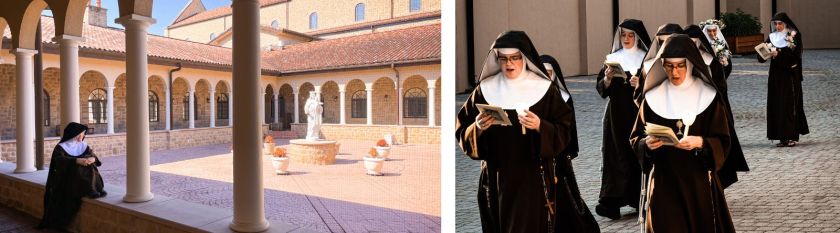
Our Lady of the Angles Monastery, Alabama
The Claustrum: Architecture as Theology
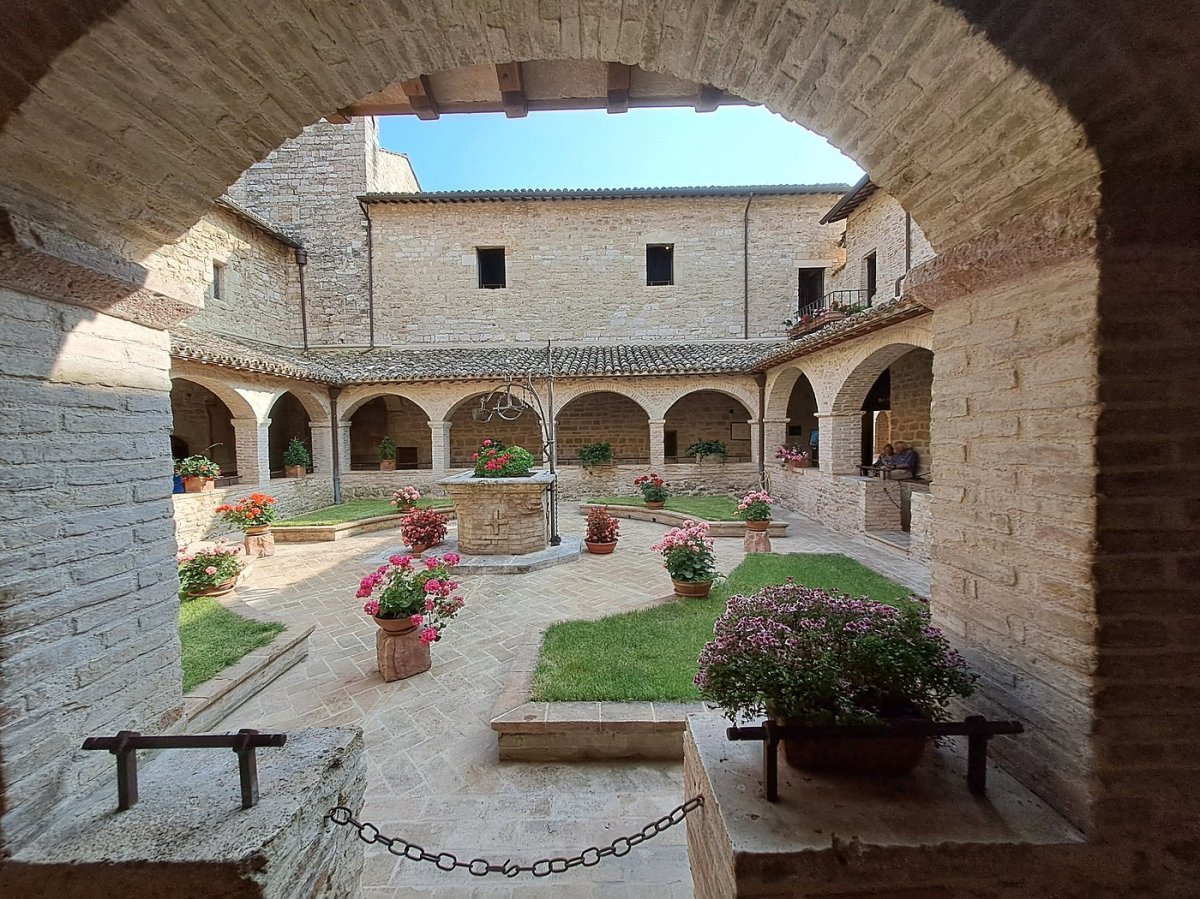
The term “cloister” has its roots in the Latin word claustrum, meaning an enclosure, a lock, or a place that is shut.3 This etymology reveals its primary function: to create a boundary. Architecturally, a cloister is a quadrilateral enclosure, typically a courtyard or garden, surrounded by covered walkways.4 These walkways connect the most important buildings of a monastery or convent: the church, the refectory (dining hall), the dormitory, and the chapter house (the community meeting room).3 This design makes the cloister the very “heart of a monastery,” the central hub of communication and movement for the religious community.3
However, its function is not merely practical. The design of the cloister is a form of enacted theology. It serves as a “continuous and solid architectural barrier… that effectively separates the world of the monks from that of the serfs and workmen”.4 This physical separation is deliberate and purposeful. In the Benedictine model, for example, the refectory was placed on the side opposite the church to ensure that the “worshipers might be removed from kitchen noises and smells,” a small detail that underscores the overarching goal of minimizing worldly distractions.8 The cloister creates a microcosm, an ordered and protected space that stands in stark contrast to the perceived chaos of the external world. The central courtyard, often containing a garden and a well, becomes a symbol of paradise, a new Eden where the community can live in peace and commune with God.3 The arcaded walkways provide light for study and reading, shelter for exercise, and a place for quiet meditation, making the entire structure a tool for spiritual formation.9
Thus, the traditional cloister can be understood not merely as a building, but as a highly refined spiritual technology. Its every architectural element and the canonical rules that govern it were designed with a singular purpose: to minimize external stimuli and maximize the monk’s or nun’s focus on the divine. The cloister operates on the principle that a structured separation from the world is the most effective means to achieve an unstructured union with God. This very principle, of course, presupposes a certain theological dualism: a “world” that is distracting, chaotic, and a source of temptation, and a “monastery” that is ordered, peaceful, and holy.4 It is this fundamental dichotomy between the sacred space inside and the secular space outside that the Franciscan worldview would eventually challenge and transform.
The Life Within: Clausura, Prayer, and Separation
Beyond the physical walls, the cloister represents a formal, canonical state of life defined by the principle of clausura. This term, the Latin for “to shut up,” refers to the body of ecclesiastical law that strictly governs who may enter the monastic enclosure and, just as importantly, who may leave it.12 These legal restrictions are not arbitrary; they are the formal means of protecting the spiritual purpose of the cloister. The goal is to create and maintain an environment of silence, solitude, and prayer, free from the “vices and passions of the world”.7 For the soul called to a contemplative vocation, this separation is not seen as a deprivation but as a necessity. As one prioress explained, for such a soul, immersion in the active world would be a burden that would cause it to “wilt and waste away,” because it would “steal God from her”.13
The rhythm of cloistered life is dictated by this principle of separation. The day is structured around the Opus Dei, the Divine Office, which is prayed in community at set hours, including in the middle of the night.14 The time between communal prayers is filled with private prayer, spiritual reading (lectio divina), and manual labor performed within the monastery walls, such as gardening or baking altar breads.14 This entire way of life, known as the “claustral life,” is synonymous with the monastic vocation itself.4 It is a radical commitment to seek God by leaving the secular world behind, a choice that often “defied their God-given temperaments… dashed plans for marriage and children… (and) meant their world would shrink… so that their minds could dwell on God”.14 The cloister, in this sense, is the ultimate expression of a life singularly focused on God, achieved through a radical act of physical and social withdrawal.
The Cloister of the Heart: An Interior Space for God
Even within the highly structured world of the physical cloister, the ultimate spiritual goal has always been the cultivation of an interior space for God. The external walls and rules are ultimately aids to building an internal “cloister of the heart,” a sacred space within the soul where one can commune with God at any time and in any circumstance.15 This concept is the crucial bridge between the traditional monastic life and the Secular Franciscan vocation.
The understanding is that the physical separation is a means to an end. The end is an uninterrupted state of prayer, an interior silence that is not dependent on external quiet. This idea is powerfully expressed in the saying, “The world is my cloister, my body is my cell, and my soul is the hermit within”.16 This formulation reveals that even for those who live within a physical monastery, the true spiritual work is internal. The body becomes the “cell,” the immediate boundary of one’s physical existence, and the soul becomes the “hermit,” the one who dwells in solitude with God. This insight is transformative because it suggests that if the internal cloister is sufficiently strong and well-formed, the external, physical cloister may not be an absolute necessity. It opens the door to a new possibility: a way of life that maintains the spiritual intensity and focus of the cloister without the physical walls, a life lived in the world but not of it. This is the very space that the Secular Franciscan is called to inhabit.
Part II: The Open Field – The Vocation of the Secular Franciscan
In stark contrast to the enclosed garden of the monastery stands the open field of the world, the designated arena for the Secular Franciscan. The Ordo Franciscanus Saecularis (OFS) is not a society for laypeople who admire St. Francis, but a true Order within the Catholic Church, with a distinct history, a formal Rule, and a unique mission.17 Understanding this vocation requires setting aside the monastic model of withdrawal and embracing a charism of engagement, where “secularity” is not a limitation but the very essence of the call.
A Vocation for the Laity: The Historical Context
The Secular Franciscan Order was not an afterthought or a later development; its origins are traceable to the lifetime of St. Francis himself and his response to the profound spiritual desires of the common people.19 As Francis and his first friars preached a radical, joyful, and penitential living of the Gospel, they attracted countless followers. Many of these were married men and women, artisans, merchants, and farmers who were deeply moved by the Franciscan spirit but could not abandon their families, homes, and worldly responsibilities to join the First Order of friars or the Second Order of cloistered nuns founded by St. Clare.18
Rather than turning them away, Francis gave them a way of life, a rule that would allow them to pursue holiness within their secular state. This was a revolutionary act. In an era when the path to serious sanctity was largely seen as reserved for priests, monks, and nuns, Francis created a formal, Church-approved Third Order for the laity.19 Originally known as the “Brothers and Sisters of Penance,” their vocation was centered on ongoing conversion (metanoia) in the midst of ordinary life.19 This established a new paradigm in the Church: a lay person could now belong to a formal religious Order, with a profession and a rule, without leaving their secular state. This act was a profound innovation in ecclesiology, anticipating by seven centuries the Second Vatican Council’s articulation of the “universal call to holiness” and its affirmation of the sanctification of ordinary life as a genuine path to God.20
The Rule as a Form of Life: “From Gospel to Life and Life to Gospel”
The heart of the Secular Franciscan vocation is its Rule, which is not merely a set of regulations but a forma vivendi—a form of life.24 The fundamental directive of the Rule, both in its earliest forms and in the current version approved by Pope Paul VI in 1978, is “to observe the gospel of our Lord Jesus Christ by following the example of St. Francis of Assisi who made Christ the inspiration and the center of his life with God and people”.17 This Christocentric focus is paramount.
This observance is lived out through a dynamic, cyclical process captured in the motto: “going from gospel to life and life to gospel”.17 This is a profound spiritual practice, a hermeneutical circle that defines the Secular Franciscan’s engagement with the world. One first goes to the Gospel, reading it carefully and prayerfully, to allow the words and actions of Christ to inform and shape one’s own intentions and actions. Then, one goes into life—to family, to work, to the community—and attempts to live out that Gospel message. Finally, one brings the experiences of life—the successes, the failures, the challenges, the joys—back to the Gospel, reflecting on them in the light of Christ’s teaching to discern, correct, and grow in holiness.27
This way of life is sealed by a permanent, public profession. This is not a private devotion but a solemn promise made within the fraternity and before the Church to live according to the OFS Rule for the rest of one’s life.17 This act of profession is what formally constitutes a person as a Secular Franciscan and distinguishes the Order from a pious society or prayer group. It is this commitment that provides the spiritual structure for a life lived without physical walls. In this sense, the Rule itself functions as a portable cloister. While a monk is enclosed by the walls of a monastery, the Secular Franciscan is enclosed by their fidelity to the Rule. It provides the spiritual boundary, the discipline, and the focus that allows them to maintain a consecrated life in the midst of secular affairs.
In Saeculo: The Mission to Sanctify the World from Within
The defining characteristic of the OFS is its “secular” nature, a term that must be understood in its positive, theological sense. The vocation of the Secular Franciscan is to live in saeculo—in the age, in the world.29 Their mission is not to be less worldly in a negative sense, but to be fully in the world as a leaven, an agent of transformation, and a witness to the Gospel.21 The Rule states that members “strive for perfect charity in their own secular state”.17 Their secularity is not an impediment to their holiness, but the very context for it.
Therefore, the apostolate of the Secular Franciscan is the world itself. They are called to “go forth as witnesses and instruments of her [the Church’s] mission among all people, proclaiming Christ by their life and words”.17 Their family, their workplace, their neighborhood, and their civic involvements are the “primary fields where they are called to plant the seeds of the Gospel”.29 They are called, like St. Francis, to “rebuild the Church” not by laying bricks, but by energetically living in communion with the Church and bringing an apostolic creativity to their daily lives.17 This mission is one of sanctifying the world from within, finding God in the ordinary and transforming it through a life of Gospel charity.
Part III: Reconciling the Paradox – “The World is My Cloister”
The resolution to the apparent contradiction in “the world is my cloister” lies in a profound theological synthesis. By viewing the world through a uniquely Franciscan incarnational lens, the very meaning of “cloister” is transformed. The enclosure ceases to be a physical place of separation and becomes a spiritual state of consecration. The purpose shifts from withdrawal from the world to redemptive engagement with it. This section will unpack this synthesis, demonstrating how the paradox is not only resolved but revealed as the cornerstone of the Secular Franciscan identity.
The Incarnational Lens: Seeing the World as Sacred Space
The indispensable key to understanding the Secular Franciscan vocation is its profoundly incarnational worldview. While some theological traditions have historically viewed the material world with a degree of suspicion—as a place of sin and temptation to be fled for the sake of the soul—Franciscan theology takes a radically different approach.31 Rooted in the life of St. Francis, this tradition sees the created world not as a distraction from God, but as the primary arena of God’s self-revelation. Pope Francis, in his encyclical Laudato si’, channels this spirit when he describes nature as a “magnificent book in which God speaks to us and grants us a glimpse of his infinite beauty and goodness”.33
This perspective fundamentally collapses the dualism between the sacred and the secular. The Incarnation—God becoming flesh and dwelling among us—is the ultimate affirmation that matter can bear the divine. For the Franciscan, this event sanctified the entire created order. Consequently, there is “only one reality—the underlying unity in all things”.2 St. Francis preached that the world was an “emanation of God and inherently good”.31 Every creature, “animate and inanimate,” from Sister Moon and Brother Sun to the humblest worm, bears the “imprint of the Most High” and is part of a universal kinship.17
This incarnational lens allows the Secular Franciscan to see the world as a “burning bush ablaze with God’s glory”.2 Every place, from the quiet home to the bustling office, from “ghettos to gated communities,” becomes holy ground because God is present there.2 The world is no longer a problem to be solved or a danger to be escaped, but a “joyful mystery to be contemplated”.33 This way of seeing is not a mere intellectual exercise; it is a transformative spiritual practice. It is what makes it possible to say “the world is my cloister,” because if the world is filled with the presence of God, then one does not need to retreat from it to find Him. This concept is a profoundly Christological statement. It is possible only because of the Incarnation. If God entered the world, then the world itself is the premier place to encounter the divine. The Secular Franciscan life is a radical living-out of the consequences of this belief, following Christ into the world rather than away from it.
The Spiritual Enclosure: Rule and Profession as the “Walls”
If the world is the cloister, what constitutes its walls? For the Secular Franciscan, the enclosure is not physical but spiritual, juridical, and relational. The “walls” are constructed from the solemn commitments made at Profession, the daily discipline of living the Rule, and the mutual accountability of the fraternity. This redefines the cloister from a place of separation from the world to a state of consecration within the world.
The act of Profession is a public, permanent commitment to live the Gospel in the manner of St. Francis, according to the OFS Rule.17 This promise, made to God in the context of the Church, consecrates the individual’s entire secular life. Their marriage, their family life, their work, and their social interactions are all brought under the spiritual discipline of the Rule. This commitment forms the boundary, the spiritual “enclosure.” The discipline required to maintain this boundary is not externally imposed by the ringing of a monastery bell, but must be internally generated through a constant, conscious fidelity to one’s promises.
This creates a unique spiritual state: the paradoxical nature of secular consecration. The OFS member is simultaneously fully “in the world” and yet, by their consecration, “not of the world.” They are set apart for God, but they live out that “apartness” through ordinary, secular means. This is, in many ways, a more demanding spiritual path than traditional monasticism, because the boundaries are not physical and must be constantly discerned and maintained through personal discipline, prayer, and the vital support of the fraternity. The “cloister” is therefore not a static place but a dynamic state of being, a continuous act of “going from Gospel to life and life to Gospel” to navigate the demands of the world without losing one’s consecrated focus.17
From Separation to Engagement: Transforming the World, Not Fleeing It
This redefinition of the cloister necessarily transforms its purpose. The goal of the traditional cloister is withdrawal for the sake of focused contemplation and intercession for the world.4 The goal of the secular cloister is active engagement for the sake of the world’s transformation. The Secular Franciscan is called to be a leaven in society, an instrument of peace, and a builder of a more fraternal world.17
The Rule is explicit on this point. Secular Franciscans are called to “rebuild the Church” and to “build a more fraternal and evangelical world so that the kingdom of God may be brought about more effectively”.17 They are to place themselves in the “forefront in promoting justice” and to firmly commit themselves to opposing “every form of exploitation, discrimination, and exclusion”.18 St. Francis himself, unlike some earlier contemplatives who saw separation from the world as a virtue, embraced engagement with the poor, the lepers, and all of society.31 For the OFS, the secular context is “not an obstacle to their vocation but the very place it is meant to be lived”.29 Their mission is to carry the peace, joy, and love of the Gospel into every corner of human life, sanctifying it from within.
Part IV: Living in the Secular Cloister – A Practical Guide
Understanding the theology of “the world as cloister” is the first step; living it is the lifelong journey. This requires a conscious and intentional effort to structure one’s secular life in a way that reflects the core functions of a traditional monastery. The core disciplines of monasticism—a regulated prayer life, community accountability, study, detachment, and work—are not abandoned by the Secular Franciscan but are creatively and faithfully re-contextualized into the settings of home, office, and neighborhood. The what (the spiritual practice) remains, but the how and where are radically transformed.
The Daily Office: A Rule of Life in the World
Just as a monastery operates according to a horarium, or schedule, that sanctifies the hours of the day with prayer, the Secular Franciscan must intentionally structure their day around prayer and contemplation amidst their secular duties. This creates a rhythm of grace that permeates all of their activities.
The primary way this is achieved is through participation in the prayer of the Church, especially the Liturgy of the Hours.24 By praying the Morning and Evening Prayer, the Secular Franciscan joins their voice to the universal prayer of the Church, sanctifying the beginning and end of the workday. This practice creates spiritual bookends for the day, ensuring that all the activity in between is offered to God. Furthermore, the call is to “pray without ceasing,” which means cultivating a “continuous, conscious connection with God” throughout the day.40 This is the essence of the contemplative life integrated into an active one: finding moments for silent prayer in the car, offering a quick prayer before a meeting, or seeing the face of Christ in a difficult colleague. This interior disposition is sustained by the penitential practice of a nightly examination of conscience, a key discipline that fosters the ongoing conversion (metanoia) that is central to the Franciscan charism.24
The Chapter House: The Fraternity as a Place of Communion
In a monastery, the Chapter House is where the community gathers for instruction, correction, and important decisions. For the Secular Franciscan, this essential function is fulfilled by the local fraternity and its regular meetings.17 The fraternity meeting is not an optional social club; it is an indispensable element of the vocation. It is the “Chapter House” of the secular cloister.
The fraternity is where members are “animated and guided,” and where they experience themselves as a “true spiritual family”.41 The purpose of these gatherings is threefold: mutual support in the ups and downs of life, ongoing formation in the Franciscan spirit, and the communal renewal of their commitment to live the Gospel.20 It is within the fraternity that the Secular Franciscan finds the encouragement and accountability necessary to persevere in a demanding vocation. The sense of community fostered there is what makes members “joyful and ready to place themselves on an equal basis with all people,” especially the lowly.17 This fraternal love is the lifeblood of the Order, preventing the secular vocation from devolving into an isolated and individualistic piety.
The Scriptorium & Library: “Going from Gospel to Life”
Medieval cloisters were vital centers of learning, where monks painstakingly copied manuscripts in the scriptorium and studied in the library.8 The Secular Franciscan’s “scriptorium” is their commitment to ongoing formation, particularly through the “careful reading of the gospel”.17 This is not a static, academic exercise. It is a dynamic, living process. It involves “going from gospel to life and life to gospel”.17
This requires dedicating intentional time to study. The primary text is always Sacred Scripture, which should be read slowly and reflectively, allowing the Holy Spirit to speak through the text and apply it to one’s personal situation.27 This is the “Gospel to life” movement. This study is enriched by reading the writings of St. Francis and St. Clare, Church documents (especially those of the Second Vatican Council, which so deeply inform the modern OFS Rule), and other sound Franciscan spiritual resources.29 This intellectual and spiritual formation is what equips the Secular Franciscan to then bring their “life to the Gospel,” discerning their actions and experiences in the light of their faith. This integration of the contemplative and active lives is not automatic; it is a skill honed through the disciplined practice of study and reflection.
The Refectory & Cellar: Simplicity, Detachment, and Stewardship
The monastic refectory and cellar are the places that govern the community’s relationship with material goods—food, drink, and provisions. The Secular Franciscan lives out the spirit of these spaces through the practice of poverty, which is expressed as simplicity, detachment, and stewardship. The call is to “seek a proper spirit of detachment from temporal goods by simplifying their own material needs”.8
This does not necessarily mean living in abject poverty, as the Secular Franciscan has legitimate responsibilities to provide for their family.45 Rather, it is a conscious and voluntary choice to live simply, to resist the tide of consumerism, and to cultivate a spirit of gratitude and contentment with what one has.45 It means purifying the heart from the “tendency and yearning for possession and power”.8 A key aspect of this is seeing oneself not as an owner, but as a “steward of the goods received for the benefit of God’s children”.17 This perspective transforms one’s relationship with money and possessions. They are no longer for personal aggrandizement but are tools to be used for the glory of God and the service of the human community.
The Apostolate: Work, Family, and Social Action as Sacred Service
In a monastery, the “work” of the monk is prayer and the manual labor necessary to sustain the community. For the Secular Franciscan, the “work”—the apostolate—is their entire engagement with the secular world. Their family life, their job, and their civic responsibilities are not distractions from their vocation; they are the very substance of their vocation.
The family is explicitly named as “the first place in which to live their Christian commitment and Franciscan vocation”.18 It is here that one first practices patience, forgiveness, and selfless love. Likewise, secular work is to be esteemed as a “gift and as a sharing in the creation, redemption, and service of the human community”.1 Whether one is a teacher, a mechanic, a parent, or an executive, the work itself is an opportunity to serve God and neighbor and to develop one’s own personality.
Finally, this service extends to the broader society. Secular Franciscans are called to be “bearers of peace” and active agents in building a more “fraternal and evangelical world”.18 This is not a vague sentiment but a call to concrete action for social and environmental justice, inspired by St. Francis’s love for the poor and his reverence for all creation.18 By integrating their prayer and formation into their daily lives, Secular Franciscans resolve the traditional tension between the contemplative life and the active life. Contemplation of the Gospel fuels their action in the world, and their action in the world drives them back to the Gospel for guidance and renewal, creating a seamless garment of a life lived for God.
Conclusion: The Joyful Mystery of the Secular Vocation
The teaching that “the world is my cloister” is ultimately a profound and joyful mystery. It is not a command to build imaginary walls around oneself, but an invitation to tear down the walls that separate the sacred from the secular, God from daily life, and prayer from action. It is a call to discover that the enclosure for which the human heart longs is not a place, but a state of being: a state of “continual conversion,” of constantly turning the heart toward God in the midst of every human experience.20
To live this vocation is to embark on a path that is both challenging and liberating. It demands the discipline of a monk but applies it to the life of a layperson. It requires seeing the world not as a marketplace of temptations, but as a sacrament of God’s presence. This perspective, rooted in the Incarnation and exemplified by St. Francis, leads to a characteristic Franciscan joy—a joy that comes from recognizing Christ in the face of every brother and sister, and from seeing all of creation as a gift from the Lord.17
Embracing the world as one’s cloister means accepting the call to find God everywhere, to serve Him in everyone, and to sanctify the most ordinary moments of life through extraordinary love. It is to become a living witness that a life of deep communion with God is possible not in spite of our worldly commitments, but precisely through them. As “witnesses and instruments” of the Church’s mission, Secular Franciscans are called to carry the peace and good (pax et bonum) of Christ not out of a cloister, but throughout the vast, beautiful, and sacred cloister of the world itself.17
Peace and every good, Mike
I can be reached at – mikeofs@ofsmike.com
Works cited
Secular Franciscan Order : Living the Way of St Francis of Assisi – FranciscanSeculars.com, accessed July 22, 2025, http://franciscanseculars.com/
The great Franciscan family, a spiritual tree with many branches, springs from a single, powerful seed: the call to do penance. This was the life St. Francis of Assisi embraced after his conversion, a life of turning completely from sin and self to follow the poor and crucified Christ in the Gospel. This fundamental call to metanoia—a radical, ongoing conversion of heart—is the shared spiritual DNA of every man and woman who follows the Poverello. From this common root, two major branches of the Third Order grew, each a distinct and beautiful expression of the same charism. The Secular Franciscan Order (OFS) represents the original vision for lay men and women to live the Gospel in the heart of the world, while the many congregations of the Third Order Regular (TOR) represent the desire for a vowed, communal expression of the same penitential spirit.
The two modern Rules that govern these Orders—the Rule of the OFS, Seraphicus Patriarcha, approved by Pope St. Paul VI in 1978, and the Rule of the TOR, Franciscanum Vitae Propositum, approved by Pope St. John Paul II in 1982—are not competing documents but spiritual siblings. They are parallel flowerings from the same root, each updated after the Second Vatican Council to speak with fresh clarity to the modern world. For a professed Secular Franciscan, the TOR Rule is not a foreign text. It is a family heirloom, a mirror reflecting the radical heart of the Franciscan vocation in its most concentrated form. This article serves as a comprehensive guide for the Secular Franciscan who wishes to explore this shared heritage. It will trace the historical and juridical journey that led to two distinct paths and conduct a deep comparative analysis of the two Rules. This exploration is an invitation to see the two Rules not as a division, but as a dialogue that reveals the immense breadth and depth of the one call to observe the Holy Gospel in the footsteps of St. Francis of Assisi.
1: A Shared Root, Two Distinct Branches: The Historical and Juridical Journey
To understand the relationship between the Secular Franciscan Order and the Third Order Regular, one must first grasp their shared history. Their divergence was not a schism over doctrine but an organic development responding to the varied ways the Holy Spirit called people to live the Franciscan charism. The OFS is not a “lesser” version of the TOR; it is the original lay expression of the penitential life, from which the TOR later branched off to form a new mode of consecrated religious life. This historical reality affirms the equal dignity and distinct purpose of each vocation within the one Franciscan family.
1.1 The Common Genesis: The Brothers and Sisters of Penance
The Franciscan movement began with St. Francis himself, but it quickly attracted followers from every state of life. Around the year 1221, Francis established what was originally called the “Brothers and Sisters of Penance”. This was his answer for the many married men and women, diocesan priests, and other laypeople who were inspired by his radical living of the Gospel but who, because of their existing commitments, could not join the Friars Minor (the First Order) or the Poor Ladies (the Second Order).
The “primitive rule” for this lay movement was Francis’s own Letter to All the Faithful (also known as the Earlier Exhortation to the Brothers and Sisters of Penance). This document was not a legal code but a powerful spiritual exhortation, a “form of life” calling the laity to a profound interior conversion. Its core tenets were simple and drawn directly from the Gospel: to love God with one’s whole being and one’s neighbor as oneself; to turn away from sin; to receive the Body and Blood of Christ; and to produce “worthy fruits of penance” through acts of charity and forgiveness. The inclusion of this very letter as the Prologue to the modern OFS Rule, and its partial inclusion in the TOR Rule, serves as a testament to the direct lineage both Orders trace back to the founder’s original inspiration.
This burgeoning lay movement soon required a more formal structure. With the help of Cardinal Ugolino (the future Pope Gregory IX), a formal Rule known as the Memoriale Propositi was approved by Pope Honorius III in 1221, giving canonical status to the Order of Penance. This marked the official birth of what would become the Third Order.
1.2 The Fork in the Road: Community Life and the Birth of the Third Order Regular
Within the widespread Order of Penance, a new spiritual desire began to emerge. Some tertiaries, both men and women, felt called to a more intense and structured form of penitential life. Organically, without a single founder, they began to gather into small groups, living in common either as hermits or in communities dedicated to prayer and works of mercy. This development created a natural “fork in the road.” While the majority of tertiaries continued to live the Franciscan charism in their homes and workplaces, these new communities began to move toward a more formal, consecrated life.
This new expression of Franciscan life eventually adopted the traditional religious vows of poverty, chastity, and obedience. For over two centuries, these communities grew and developed in various regions, particularly in Italy, the Netherlands, and Germany, often in isolation from one another. The Church recognized the authenticity of this new form of life and, in 1447, Pope Nicholas V issued the apostolic letter Pastoralis officii. This landmark document effectively organized these disparate communities of vowed tertiaries into a new, independent mendicant order: the Third Order Regular of St. Francis of Penance. This moment marks the official juridical separation of the TOR from its secular counterpart, establishing two distinct but related branches from the same trunk.
1.3 Parallel Paths of Renewal: The Evolution of the Rules to the Modern Era
Following their formal separation, the two branches continued on parallel paths of development and renewal, with the Church periodically updating their respective Rules to meet the needs of the times.
The Rule for the secular branch was revised and confirmed by Pope Nicholas IV in 1289 with the bull Supra montem and again by Pope Leo XIII in 1883 with Misericors Dei Filius, which adapted the Order to the challenges of the 19th century. The most recent and current Rule is Seraphicus Patriarcha, promulgated by Pope St. Paul VI in 1978.
The Third Order Regular also saw its Rule evolve. Pope Leo X provided a significant unifying Rule in 1521 with the bull Inter cetera to bring uniformity to the many congregations. This and other statutes guided the TOR for centuries until, like the OFS, it underwent a period of post-Vatican II renewal. This process culminated in the approval of the current Rule, Franciscanum Vitae Propositum, by Pope St. John Paul II in 1982.
It is crucial to recognize that both modern Rules—1978 for the OFS and 1982 for the TOR—were born from the same spirit of aggiornamento (updating) that swept the Church after the Second Vatican Council. Both sought to return to the primitive inspiration and authentic charism of St. Francis while courageously adapting their way of life to the realities of the contemporary world.
1.4 A Family Reunited: Understanding Autonomy and “Vital Reciprocity”
The modern era has brought a mature and clear definition of the relationship between the Franciscan Orders. The 1978 Rule established the Secular Franciscan Order as a fully autonomous Order within the Church. It is not a subsidiary or “third-class” part of the Franciscan family, but an equal member, alongside the First and Second Orders, with its own international governance.
This autonomy, however, does not imply isolation. The Church, recognizing the profound family bond, has formally codified the relationship under the principle of “vital reciprocity” (vitalis reciprocatio). The Holy See has entrusted the spiritual and pastoral assistance of the OFS to the friars of the First Order and the Third Order Regular. This is not a relationship of juridical control but of fraternal service and spiritual animation. The friars are tasked with guaranteeing the fidelity of the OFS to the Franciscan charism and fostering communion within the entire family. This arrangement is a beautiful expression of the Church’s wisdom. After centuries of varied and sometimes inconsistent levels of engagement between the branches, “vital reciprocity” establishes a relationship of equals who are spiritually interdependent. For a Secular Franciscan, this means the TOR is not just another religious order; it is a designated spiritual resource, an elder sibling in the faith, and a living witness to the same charism.
2: The Rules in Dialogue: A Comparative Spiritual Analysis
While rooted in a common history, the Rule of the Secular Franciscan Order (OFS) and the Rule of the Third Order Regular (TOR) are distinct documents tailored to different ways of life. A careful comparison reveals a shared heart but different modes of expression, reflecting their unique roles within the Church. The TOR Rule, steeped in the founder’s own words, aims to form the religious by direct immersion in the source. The OFS Rule, integrating the language of Vatican II, aims to form the laity by connecting the Franciscan charism to their universal call to holiness and mission in the world. Understanding these differences in pedagogy and focus is key to appreciating the unique gift of each Rule.
2.1 Foundational Principle: To Observe the Holy Gospel
The bedrock of both Rules is identical: a life dedicated to observing the Holy Gospel in the footsteps of St. Francis of Assisi. This shared foundation is the source of their profound spiritual unity.
OFS Rule, Article 4: “The rule and life of the Secular Franciscans is this: to observe the gospel of our Lord Jesus Christ by following the example of St. Francis of Assisi who made Christ the inspiration and the center of his life with God and people”.
TOR Rule, Chapter I, Article 1: “The form of life of the Brothers and Sisters of the Third Order Regular of Saint Francis is this: to observe the Holy Gospel of Our Lord Jesus Christ by living in obedience, in poverty and in chastity”.
Both Orders see St. Francis not as the end, but as the model, the one who shows them how to make Christ the center of everything. This Christocentric, Gospel-driven life is the non-negotiable core of their shared identity.
2.2 The Nature of Commitment: Profession in the World vs. Vows in Community
The most significant and defining difference between the two Orders lies in the nature of their public commitment and the state of life it entails.
Members of the Third Order Regular are consecrated religious. They profess the three public, evangelical vows of poverty, chastity, and obedience and live a common life in a fraternal community, such as a friary or convent. Their life is structurally set apart from the world to be a specific sign within the Church.
Members of the Secular Franciscan Order, by contrast, live their vocation in their own secular state. They make a public profession—a solemn promise, not a canonical vow—to live according to their Rule for their entire life. They can be married or single, laypeople or diocesan clergy, and they live in their own homes, work in secular jobs, and raise families.
This fundamental distinction shapes the entire content and structure of each Rule. The TOR Rule must necessarily legislate for the practicalities of a common life, while the OFS Rule provides guiding principles for living the Franciscan charism within the vast and varied circumstances of secular life.
2.3 The Arena of Life: The World as Cloister
Flowing directly from the nature of their commitment is the difference in their primary “arena” of life and apostolate.
For the TOR, life is centered in and flows from the religious house. Their apostolic works, whether in education, parish ministry, or social justice, are typically undertaken as a community and are an extension of their common life.
For the OFS, the world itself is their cloister. As Pope St. John Paul II affirmed, their vocation is to live the Gospel in saeculo—in the world. Their family, their workplace, their neighborhood, and their parish are the primary fields where they are called to plant the seeds of the Gospel. The OFS Rule is explicitly designed to be adaptable, meeting the “needs and expectations of the Holy Church in the conditions of changing times”, recognizing that the secular context is not an obstacle to their vocation but the very place it is meant to be lived.
2.4 A Tale of Two Texts: Spiritual Tone and Guiding Influences
While both Rules are deeply spiritual, they have a different texture and draw from different primary sources, revealing their distinct pedagogical aims.
The TOR Rule is almost entirely spiritual and ascetical in its tone. It is a beautiful mosaic composed largely of direct quotations from the writings of St. Francis and St. Clare of Assisi. A comparative analysis shows it contains 92 references to Francis’s writings and 12 to Clare’s. Reading it feels like receiving a direct exhortation from the founders themselves.
The OFS Rule is rooted in Franciscan sources, with 21 references to Francis’s writings. However, it is profoundly shaped by the theology of the laity that emerged from the Second Vatican Council. It contains 18 references to Vatican II documents. It specifically highlights Lumen Gentium (Dogmatic Constitution on the Church). It also emphasizes Gaudium et Spes (Pastoral Constitution on the Church in the Modern World). Its language about the lay apostolate promotes justice. It speaks about building a more fraternal world and emphasizes the dignity of the family. These points echo the council’s vision for the mission of the laity.
This difference in source material is not accidental. It reveals a specific intention for the formation of the members. The TOR Rule aims to form the religious by immersing them directly in the founders’ teachings. This immersion is suitable for a life lived in a dedicated Franciscan environment. The OFS Rule seeks to form the laity by explicitly connecting the Franciscan charism to the universal call to holiness. It connects this charism to the specific mission of the laity in the Church and the world. This connection is defined by the most recent ecumenical council. The OFS Rule, thus, acts as a bridge. It links the specific Franciscan path to the great highway of the Church’s life in the modern age.
Conclusion: One Family, One Charism, Many Paths
The journey through the Rules of the Secular Franciscan Order and the Third Order Regular reveals a profound and beautiful truth: the Franciscan charism is a single, vibrant reality expressed in a plurality of forms. The OFS and the TOR are not rival systems but complementary vocations, two authentic paths for living the one Gospel life revealed to St. Francis of Assisi. They share a common origin in the penitential movement, a common goal of conformity to Christ, and a common mission to rebuild the Church from within.
The differences between them are not of essence but of application. The TOR, with its public vows and community life, offers a concentrated, prophetic witness to the evangelical counsels. Its Rule, steeped in the very words of Francis and Clare, is a powerful call to radical self-renunciation for the sake of the kingdom. The OFS, with its profession made in the world, offers a leavening witness, demonstrating that a life of deep conversion and apostolic love is possible within the ordinary circumstances of family, work, and society. Its Rule, in dialogue with the modern Church, provides a bridge between the Franciscan ideal and the universal call to holiness for all the baptized.
Ultimately, to study the two Rules in parallel is to listen to a conversation within one’s own spiritual family. It is to see the same fire of love for Christ burning in a different hearth, revealing the immense breadth and depth of the one call to observe the Holy Gospel in the footsteps of their common Seraphic Father, St. Francis.
Deep in the Florida Everglades, on land considered sacred by Native American tribes and vital to a fragile ecosystem, a new monument to American cruelty is taking shape.1 It is a massive immigrant detention camp, built in just eight days on an abandoned airfield, designed to house 5,000 undocumented human beings awaiting deportation.1 Its architects, the political leaders of Florida and the Trump administration, have christened it “Alligator Alcatraz,” a name chosen with deliberate, theatrical sadism.1 This is not merely a bureaucratic designation; it is a public declaration of intent. The name, evoking the nation’s most notorious prison known for its brutal conditions, is meant to “send a message” of deterrence through fear.1
The physical reality of the camp matches its name. It is a sprawling complex of tents surrounded by over 28,000 feet of barbed wire and monitored by more than 200 security cameras.1 It sits in a remote swamp, prone to flooding from the frequent heavy rains, and offers little protection from the oppressive heat and swarms of mosquitoes.1 The message is clear: those held within are not worthy of humane treatment; they are to be made an example of. This message is amplified by the gleeful marketing of “Alligator Alcatraz” merchandise and the circulation of official memes depicting the barbed-wire compound “guarded” by alligators wearing Immigration and Customs Enforcement (ICE) hats.1 This is not policy; it is a performance of state-sanctioned contempt, a spectacle of dehumanization where President Trump himself could tour the facility and boast, “We’re going to teach them how to run away from an alligator if they escape prison”.4
The construction of such a place has rightly sparked outrage. Critics have reached for the most potent language they can find, nicknaming the facility “Alligator Auschwitz”.4 This comparison has, just as rightly, drawn concern from Jewish leaders and others who caution against making false equivalencies that disrespect the unique horror of the Holocaust.4 The point is well taken. The industrial-scale extermination of the Shoah is a singular evil. Yet, as Rabbi Ammos Chorny of Naples, Florida, warned in a sermon regarding the facility, “we would be dangerously blind not to hear the echoes of history in our midst”.4 The use of such a loaded term, while historically imprecise, signals a moral emergency. It reflects a gut-level recognition that the process of stripping a group of its humanity to justify its indefinite detention in punitive conditions is a path that has led to unspeakable darkness before. Therefore, this analysis will use the term “concentration camp” not to equate its function with the death camps of the Third Reich, but in its historically accurate sense: a place where a civilian population is imprisoned outside the normal judicial process, based on their group identity, for the purposes of control, punishment, and deterrence.
And this brings us to the provocative, yet necessary, thesis of this investigation. While these camps are built and funded by the state, they are the direct and foreseeable consequence of a profound moral and theological failure on the part of the institutional Catholic Church in the United States. They are the bitter harvest of a Church that has abdicated its prophetic duty in exchange for perceived political influence. They are, in a real and damning sense, Catholic Concentration Camps (CCC). This is not because the Church provided the funding or the barbed wire, but because it has meticulously cultivated the political and moral vacuum in which such atrocities can be conceived, built, and defended without facing the full, unified, and uncompromising opposition of the Body of Christ. This abdication is rooted in a duplicitous policy of “neutrality” and a deep-seated theological sin of “othering,” which together have made the American Church a silent partner in the construction of its own gulags.
Part I: The Doctrine of the Empty Chair: Neutrality as a Moral Stance
The American Catholic hierarchy, when confronted with its failure to oppose the architects of these camps, retreats behind a carefully constructed shield: the doctrine of political neutrality. This official policy, however, is not a position of moral integrity or spiritual detachment. It is a calculated political strategy, a legalistic fiction that, in the polarized landscape of American politics, amounts to a partisan choice and a catastrophic dereliction of the Gospel’s prophetic demand. It is the doctrine of the empty chair, a deliberate absence from the battlefield of justice that cedes the territory to the forces of cruelty.
1.1: ‘Forming Consciences’ or Forbidding Prophecy?
The official line from the United States Conference of Catholic Bishops (USCCB) is consistent and clear. In a statement offered on July 8, 2025, in response to a new IRS interpretation of rules governing political speech by non-profits, the Conference reaffirmed its long-held position: “The Catholic Church maintains its stance of not endorsing or opposing political candidates”.5 The stated purpose of the Church’s engagement in the public square, according to the USCCB, is not to pick winners in elections but to “help Catholics form their conscience in the Gospel so they might discern which candidates and policies would advance the common good”.5 This process of conscience formation, they argue, is a lifelong obligation for the faithful, requiring study of scripture and Church teaching, examination of facts, and prayerful reflection to discern God’s will.7
This posture of principled non-partisanship, however, collapses under the weight of the Church’s own teachings and priorities. The USCCB’s neutrality is, in practice, highly selective. While claiming not to endorse candidates, the bishops have been anything but neutral on certain issues. The most prominent example is abortion. In their document “Catholics in Political Life,” the bishops declare that abortion is an “intrinsically evil” act and that failing to protect the unborn from the moment of conception is a “sin against justice”.8 This teaching is presented not as a matter for prudential judgment, but as an absolute, a “constant and received teaching of the Church” that has been affirmed since the first century.8 Consequently, politicians who consistently act to support abortion rights risk being publicly labeled as “cooperators in evil”.8 The bishops even state that Catholic institutions “should not honor those who act in defiance of our fundamental moral principles” by giving them awards or platforms.8
Herein lies the central contradiction. The USCCB claims neutrality regarding candidates but elevates one specific issue to the status of a “non-negotiable” litmus test.8 In a two-party political system where one party is broadly perceived as being aligned with this “non-negotiable” issue, the instruction to “form consciences” is no longer a neutral exercise in moral discernment. It becomes a thinly veiled and powerful political directive. The faithful are told that one issue is of such paramount importance that it creates a unique and grave moral obligation. When one political party is seen as the champion of that issue, the act of “forming one’s conscience” according to the bishops’ guidance leads to a predictable political conclusion.
This transforms the entire moral calculus of the Church’s political engagement. The refusal to issue a similarly absolute condemnation of the politicians and policies responsible for caging human beings in places like “Alligator Alcatraz” becomes the implicit price of maintaining influence with the party that aligns on the “non-negotiable” issue. The dehumanization of the migrant, the separation of families, the construction of concentration camps—these are relegated to the category of issues requiring “prudential judgment,” where “Catholics may choose different ways to respond to compelling social problems”.7 This creates a hierarchy of sin, where the caging of a child is a debatable policy choice, but abortion is an absolute evil that places a politician outside the bounds of Catholic honor. The doctrine of “forming consciences” has been weaponized. It has been perverted from a tool for seeking truth into a sophisticated mechanism for laundering a partisan political alignment through the language of faith. The USCCB’s professed neutrality is a lie. They have chosen a side not by endorsing a candidate, but by choosing which sins to treat as absolute and which to treat as negotiable. This selective outrage, this moral gerrymandering, is the foundational act of complicity that allows the camps to exist.
1.2: The Price of a Tax Exemption and the Taint of Federal Funds
The hierarchy’s strategic neutrality is reinforced by a deep-seated institutional anxiety, rooted in both legal and financial realities. The primary legal justification for this caution is the Johnson Amendment, a provision in the U.S. tax code that explicitly prohibits 501(c)(3) tax-exempt organizations, including churches, from participating or intervening in “any political campaign on behalf of (or in opposition to) any candidate for public office”.11 While the USCCB’s Office of General Counsel provides detailed guidelines on navigating these rules, the overarching effect has been to foster a culture of profound risk aversion.11 The fear of jeopardizing the Church’s vast financial and institutional tax-exempt status has, in practice, often trumped the moral imperative for a clear, prophetic voice. Institutional self-preservation becomes the highest good, a goal before which even the most egregious injustices must be addressed with carefully parsed language and an abundance of caution.
This institutional timidity is further complicated by the Church’s direct financial entanglement with the very government whose policies it is called to critique. This issue has become a flashpoint, creating a rare point of agreement between critics on the theological left and right. From a traditionalist perspective, commentators on forums like Reddit have argued that the USCCB has become a “magnet for federal funds, to the point of distorting the doctrinal messages it projects, such as emphasizing pro-immigration over pro-life”.10 This critique found a powerful voice in the political mainstream when Vice President J.D. Vance, a Catholic himself, publicly challenged the bishops’ motives for condemning the Trump administration’s immigration policies. Vance questioned whether the bishops’ stance was genuinely rooted in pastoral concern or if they were “actually worried about their bottom line,” citing the fact that U.S. dioceses receive over $100 million in federal grants for refugee resettlement programs.12
The USCCB immediately refuted this accusation, issuing a statement clarifying that the federal funds they receive are part of a long-standing partnership with the government to carry out the “work of mercy” of resettling refugees, and that these funds are insufficient to cover the full costs of the programs.12 While the bishops’ defense may be factually correct, the political damage is done. The mere existence of such a significant financial relationship creates the
perception of a conflict of interest, providing a ready-made excuse for politicians to dismiss the Church’s moral witness as the self-interested lobbying of a government contractor.
This situation places the USCCB in a pincer movement of critique. On one side, progressive Catholics—the intended audience of this very blog—decry the Conference for its moral cowardice, its failure to stand unequivocally with the oppressed, and its prioritization of institutional access over prophetic witness. On the other side, traditionalist Catholics lambast the USCCB as a “limp-wristed bureaucracy” that has become too liberal, too entangled with government, and too compromised by federal money to speak with authentic Catholic authority.10 Though they come from opposing theological and political poles, both critiques converge on the same diagnosis of institutional decay: a Conference that has become so focused on its own bureaucratic preservation, its legal status, and its government partnerships that it has lost the ability to speak with the clear, uncompromised, and courageous moral voice the Gospel demands. This widespread crisis of legitimacy, felt across the ideological spectrum of American Catholicism, reveals an institution that is failing its primary mission, an institution whose silence on the camps in the Everglades is not an accident, but the logical outcome of its own internal priorities.
Part II: The Gospel vs. The Conference: A Church Divided on the Stranger
There exists a vast and tragic chasm between the official teachings of the Catholic Church on the treatment of migrants and the brutal reality that its political quietism allows to fester. On one side of this chasm is a rich, beautiful, and biblically-grounded tradition of welcome and solidarity. On the other side is the barbed wire, the flooding tents, and the calculated cruelty of “Alligator Alcatraz.” The failure of the USCCB is not that it lacks the right words, but that it refuses to give those words political teeth, creating a profound dissonance that leaves the most vulnerable members of its own flock abandoned and afraid.
2.1: The Eloquence of Teaching
To read the official documents of the Catholic Church on migration is to encounter a radical call to compassion and justice. The teaching is not ambiguous, tentative, or new; it is a consistent and powerful thread running from the Old Testament to the modern papacy. The Holy See, in its “Twenty Action Points for the Global Compacts,” provides a detailed policy blueprint for a just and humane migration system, calling on states to ban arbitrary and collective expulsions, to expand legal pathways for migration, and, crucially, to “adopt national policies that prefer alternatives to the detention of those seeking access to the territory”.13
The USCCB, in its own documents, echoes and amplifies this universal teaching for the American context. In their “Catholic Elements of Immigration Reform,” the bishops insist that all enforcement efforts must be “targeted, proportional, and humane”.14 They declare that the “dehumanization or vilification of noncitizens as a means to deprive them of protection under the law is not only contrary to the rule of law but an affront to God himself, who has created them in his own image”.14 They argue for limiting the use of detention, “especially for families, children, pregnant women, the sick, elderly, and disabled, given its proven harms and the pervasive lack of appropriate care in detention settings”.14 Their teaching is grounded in the deepest roots of the faith, recalling the story of Exodus and reminding the faithful, “You shall treat the alien who resides with you no differently than the natives born among you; have the same love for him as for yourself; for you too were aliens in the land of Egypt”.15 The New Testament mandate is even more direct, with Jesus identifying himself with the stranger: “a stranger and you welcomed me” (Mt 25:35).15
Even in the face of the current crisis, the bishops have continued to issue statements that are, on paper, pastorally sensitive and morally correct. In a June 2025 statement, USCCB President Archbishop Timothy Broglio directly addressed the surge in immigration enforcement, decrying it as a “profound social crisis” that goes “well beyond those with criminal histories”.16 He spoke directly to the immigrant community, assuring them, “As your shepherds, your fear echoes in our hearts and we make your pain our own. Count on the commitment of all of us to stand with you in this challenging hour”.16 These are powerful, beautiful, and deeply Catholic words. They articulate a vision of the Church as a mother and a sanctuary for the vulnerable. The tragedy is that they remain just words, rendered hollow by the Conference’s refusal to confront the political powers that create the fear their words purport to soothe.
2.2: The Brutality of Reality
The eloquent teachings of the Church stand in stark, almost grotesque, contrast to the lived reality of the policies they fail to stop. The “Alligator Alcatraz” facility is not a regrettable but necessary component of a humane enforcement system; it is the physical embodiment of the very dehumanization the bishops condemn. It is a system built not on proportionality, but on cruelty as a form of communication. Governor Ron DeSantis and other state officials have been explicit that the facility’s “rugged and remote” location in the Everglades and its deliberately intimidating name are meant as a “deterrent”.1 The message is not one of justice, but of suffering: do not come here, or this is what awaits you.
The conditions within the camp fulfill the promise of its name. Human rights advocates, environmental groups, and Native American tribes have all protested its construction, citing the cruelty of exposing detainees to extreme heat and mosquitoes, the threat to the fragile Everglades ecosystem, and the desecration of land the tribes consider sacred.1 The facility’s structural integrity is dangerously inadequate for its location. During a visit by President Trump to mark its opening, a simple heavy rainstorm caused flooding in the tents.1 While state officials claim the complex can withstand a Category 2 hurricane, they have also indicated that the detainees would not be evacuated in such an event, a policy that one state lawmaker described as creating a structure that would “blow apart like matchsticks” in a major storm.2
This architecture of cruelty is accompanied by a political spectacle of contempt. President Trump’s tour, where he joked about alligators hunting escaped detainees, was not an off-the-cuff remark but a calculated performance for his political base.4 It was a moment of political theater designed to mock and degrade the very people the Church, in its documents, calls “our neighbors, friends and family members”.17 The selling of “Alligator Alcatraz” merchandise and the gleeful sharing of caged-in bunk photos by political supporters are not incidental details; they are evidence of a political culture that has moved beyond mere policy disagreement and into the realm of reveling in the suffering of a designated out-group.4 This is the brutal reality that the USCCB’s carefully worded statements and claims of neutrality have failed to prevent. It is a reality that makes a mockery of their assurances that “your fear echoes in our hearts.”
2.3: The Dissonance of the Faithful
The most damning evidence of the USCCB’s pastoral failure is the emergence of a de facto schism between the “Church of the Conference” and the “Church of the Parish.” While the national leadership in Washington D.C. navigates the political tightrope of neutrality and abstract advocacy, priests and bishops on the ground are dealing with a full-blown pastoral crisis. The consequences of the policies that the USCCB refuses to unequivocally condemn are not abstract; they are terror and panic in the pews.
In Southern California, a region on the front lines of the administration’s aggressive deportation campaign, the response from local Church leaders has been one of emergency action. In a truly extraordinary measure, Bishop Alberto Rojas of the Diocese of San Bernardino issued a formal decree freeing members of his diocese from their Sunday and Holy Day obligation to attend Mass if they fear “potential immigration enforcement actions by civil authorities”.18 This move came after federal agents detained migrants on Catholic Church property in his diocese, violating a decades-old norm that treated houses of worship as sanctuaries.18 The implication of Bishop Rojas’s decree is staggering: the policies of the state have become so threatening that a bishop must release his flock from their most sacred weekly obligation for their own safety.
This is not an isolated incident. Across the region, priests and laypeople are mobilizing to fill the void left by their national leadership. Fr. Brendan Busse, a pastor in Boyle Heights, described the language his community uses: “they feel hunted”.18 He volunteers with a neighborhood rapid response network, trained to provide support and resources when ICE activity is reported.18 Other dioceses have organized workshops to teach parishioners their rights, coordinated prayer vigils, and made food deliveries to families too afraid to leave their homes.18 Priests and deacons are accompanying individuals to immigration court, a simple act of presence that appears to improve outcomes for asylum seekers.18
This stark contrast reveals the catastrophic nature of the USCCB’s failure. Their strategy of high-level, politically cautious engagement has effectively abandoned the flock on the ground. It has created a situation where local pastors must improvise pastoral strategies to deal with a state of terror that their own national conference is unwilling to name and condemn with the full force of its moral authority. The “Church of the Conference” issues statements lamenting the “palpable cries of anxiety and fear,” while the “Church of the Parish” is left to comfort the hunted and dispense them from their religious duties. This is more than a political failure; it is a pastoral abdication of the highest order. By refusing to be a shield for the most vulnerable, the USCCB has left its own people defenseless, forcing them to wonder if they are being hunted not only by the state, but by the silence of their own shepherds.
Part III: The Theology of Othering: The Original Sin of the American Church
The political calculations and pastoral failures of the American hierarchy are not merely strategic errors; they are symptoms of a much deeper theological disease. The moral paralysis of the institutional Church in the face of state-sanctioned cruelty is made possible by a foundational sin: the sin of “othering.” It is this process of theological and social boundary-drawing, of defining who is “us” and who is “them,” that provides the moral anesthetic required for a Christian people to tolerate the intolerable. The concentration camps in the Everglades are the physical manifestation of a spiritual wall that has first been erected in the hearts of a significant portion of the American Church.
3.1: Defining the Sin: ‘Us’ vs. ‘Them’
“Othering” is the process by which a dominant social group defines certain individuals or groups as not belonging, as outside the circle of shared norms and moral concern.19 As writer Ched Myers explains, while all groups establish boundaries, othering weaponizes these boundaries to “shore up the privileges of the strong against the needs of the weak”.20 It functions by labeling the “Other” as inferior, unclean, dangerous, or subhuman, thereby rationalizing their subjugation.20 This dynamic is a “historical constant,” visible in the way European settlers portrayed Native Americans as “savages” to justify genocide and the way white society portrayed African Americans as an “inferior race” to justify slavery and segregation.19
Within the Church, this sin manifests as a form of tribalism that stands in direct opposition to the Gospel’s universal call. As Patrick Saint-Jean, S.J., observes, “our American Catholic Church is polarized by its factions: pro-life vs. pro-choice, gun restrictions vs. pro-gun, Democrat vs. Republican, CNN vs. Fox News”.19 This factionalism creates an “us vs. them” mentality, a “selective activism” where Catholics choose to side with one group’s agenda while ignoring other pressing social justice issues.21 This divisive attitude, this creation of an “other” within the Body of Christ, is what Saint-Jean calls “a new sin in the Church”.21
The theological antidote to this poison lies at the very heart of Catholic Social Teaching. The seven key themes of this tradition are a systematic refutation of othering. The principle of the Life and Dignity of the Human Person proclaims that every person is precious and sacred, the foundation of a moral vision for society.22 The
Call to Family, Community, and Participation teaches that the person is not only sacred but also social, with a right and duty to participate in society.22 The principle of
Solidarity is the most direct counter-argument: “We are one human family whatever our national, racial, ethnic, economic, and ideological differences. We are our brothers and sisters keepers, wherever they may be”.22 Finally, the
Option for the Poor and Vulnerable provides the basic moral test for any society: “how our most vulnerable members are faring”.22 Together, these principles demand that the Christian see every human being not as an “other,” but as a brother or sister for whom we are responsible.
3.2: The Immigrant as the ‘Other’ in the ‘Traditionalist’ Church
I belive that a “traditionalist Church” has been built in the USA that enables these policies. It is crucial, however, to clarify this term. While there is a small and vocal group of liturgical traditionalists who focus on the pre-Vatican II Latin Mass and are often critical of the USCCB’s perceived liberalism 10, the more potent force in this context is a broader, politically conservative and nationalist bloc within American Catholicism. This bloc, while not necessarily “traditionalist” in the strict liturgical sense, has successfully adopted and propagated a narrative that “others” the immigrant, transforming them from a person to be welcomed into a threat to be repelled.
This narrative directly contradicts the consistent teaching of the Church. Where Church teaching, from the Pope down to the local bishops, speaks of migrants as families fleeing poverty and violence, as our “neighbors, friends and family members” 17, this nationalist bloc frames them as an invasion of criminals, a drain on the economy, and a danger to national identity and security. This is precisely the kind of discriminatory narrative that Pope Francis has warned against, stating that any measure that “tacitly or explicitly identifies the illegal status of some migrants with criminality” is something a “rightly formed conscience cannot fail to make a critical judgment” against.25
This process of othering is not just a political tactic; it is a psychological and theological prerequisite for cruelty. Catholic Social Teaching demands that the migrant be seen as Christ in disguise, a brother or sister in need.15 Policies like the construction of “Alligator Alcatraz,” however, are predicated on a foundation of extreme cruelty and dehumanization. It is psychologically and theologically impossible for a person to simultaneously view the detainees as their brothers and sisters in Christ and also support their indefinite confinement in a remote, flood-prone swamp under the threat of alligators. The cognitive dissonance is too great.
Therefore, for a Catholic to support such policies, the migrant must first be stripped of their shared humanity. They must be redefined. They must be “othered.” The narrative of invasion and criminality serves this exact purpose. It recasts the desperate family fleeing violence as a dangerous alien, the asylum seeker as a law-breaking invader. Once this redefinition is complete, once the “other” is no longer seen as a person with inherent dignity but as a problem to be managed, then the policies of cruelty become not only possible, but logical. The camps, then, are not merely a policy outcome of a political disagreement. They are the physical architecture built upon a foundation of successful theological malpractice. The campaign of “othering” within a powerful segment of the American Church has provided the moral license for Catholic voters and politicians to endorse and enact policies that would be utterly unthinkable if viewed through the clear, uncompromised lens of the Gospel.
The Blasphemy of Othering: A God Who is ‘Other’
The ultimate theological refutation of this sinful othering lies in the very nature of God as revealed in Christian faith. While political and social othering casts the stranger as a threat, Catholic theology presents God himself as the ultimate “Other.” In the thought of modern theologians, and influential popes like John Paul II, “the Other” is often a term used to refer to God.27 God is the one who is wholly distinct from creation, who comes to us from outside our limited human categories, who speaks into our silence in ways we do not expect.27 The mystery of the Trinity itself is a revelation of God as a communion of relational otherness—three distinct Persons who are one divine essence.28 God is not a monolithic, self-contained being, but an eternal, dynamic relationship of love between the Father, the Son, and the Holy Spirit.28
This understanding of God as the transcendent “Other” imbues the biblical command to “welcome the stranger” with profound theological weight. It is not merely an ethical injunction to be kind to foreigners. It is the central act of faith through which we welcome God himself. When we create space for the human other, the stranger, the migrant, we are creating space for God to enter our world. As Pope John Paul II wrote, “All, believers and non-believers alike, need to learn a silence that allows the Other to speak when and how he wishes, and allows us to understand his words”.27
From this perspective, the construction of walls and concentration camps takes on a terrifying theological meaning. By building physical barriers to exclude the human other, we are engaging in a spiritual project to exclude God. By creating a system designed to dehumanize and silence the migrant, we are attempting to silence the voice of the divine “Other” who comes to us in the distressing disguise of the poor and the displaced. This is the ultimate blasphemy of the policies enacted at our border. It is a rejection not just of a fellow human being, but of the very nature of a God who reveals himself in the face of the stranger. The South African bishops, in their condemnation of apartheid, correctly identified this theological endpoint, trembling “at the blasphemy of thus attributing to God the offences against charity and justice that are apartheid’s necessary accompaniment”.29 In the same way, the camps in the Everglades are not just an injustice; they are a blasphemy, a monument to a faction of the Church that, in its attempt to wall out the stranger, has succeeded only in walling out its God.
Part IV: Echoes in the Chamber: Historical Precedents for Complicity
The current crisis of the American Church is not a new or unique failure. It is a tragic echo of a recurring pattern of institutional compromise and moral failure that has played out whenever the Church has been confronted by powerful, nationalist, and authoritarian regimes. An examination of the Church’s response to Nazi Germany, Apartheid South Africa, and Argentina’s Dirty War reveals a consistent and damning history of institutional self-preservation often taking precedence over prophetic witness. The silence from the USCCB today is not an anomaly; it is the modern verse of a very old and sorrowful song.
4.1: The Ghost of the Reichskonkordat: Nazi Germany
The clearest and most chilling historical parallel to the American Church’s current predicament is its relationship with Nazi Germany in the 1930s. Before Hitler’s rise to power, the Catholic Church in Germany was one of the strongest voices of opposition to Nazism. Sermons and Catholic newspapers vigorously denounced the party’s neopaganism and racism, and priests were known to refuse the sacraments to Catholics in Nazi uniforms.30 In the 1933 elections, the proportion of Catholics who voted for the Nazi Party was significantly lower than the national average.30
However, once Hitler became Chancellor, this opposition faltered, culminating in the signing of the Reichskonkordat in July 1933 between the Vatican and the Nazi government.30 From the Vatican’s perspective, the concordat was a pragmatic move to protect the institutional rights of the Church in a hostile environment. The Church pledged to abstain from political activity in exchange for the Reich’s guarantee of religious freedom for Catholics.31 More critically, many in the Church hierarchy saw “atheistic communism” as a far greater existential threat than National Socialism, viewing Hitler as an indispensable “bulwark against Bolshevism”.31 For Hitler, the treaty was a massive propaganda victory. It granted his new, radical regime international legitimacy and, by securing the dissolution of the powerful Catholic Centre Party, neutralized a major source of organized domestic opposition.31
The fruits of this devil’s bargain were immediate and devastating for the Church. The Nazi regime began to violate the treaty almost immediately, systematically shutting down Catholic schools, newspapers, and youth groups, confiscating Church property, and imprisoning or murdering clergy and lay leaders.30 The Vatican’s strong public condemnation, the encyclical
Mit brennender Sorge (“With Burning Concern”), was smuggled into Germany and read from the pulpits in 1937. It was a courageous and powerful denunciation of the regime’s “fundamental hostility” to the church, but it came four years after the concordat had helped solidify Hitler’s power, when the regime was fully entrenched and organized opposition had been crushed.30
The parallels to the current situation in the United States are disturbingly precise. The American hierarchy’s singular focus on the “non-negotiable” issue of abortion, and its corresponding fear of a Democratic party that largely supports abortion rights, mirrors the 1930s hierarchy’s fear of communism. This fear has led to a similarly transactional and morally compromised approach toward a Republican administration that commits other grave evils. The USCCB’s stance of “neutrality,” which in practice provides cover for the administration’s anti-immigrant policies, is a modern-day, informal concordat. Political silence on the creation of concentration camps is the price being paid for perceived political access and influence on the issue of abortion. The Church is once again making a deal with a nationalist power that it sees as an ally against a greater ideological foe, all while that power systematically violates the very principles of human dignity the Church claims to uphold.
4.2: The Sins of Silence and Division: Apartheid and Argentina
The pattern of institutional compromise is not limited to Nazi Germany. The Church’s history in Apartheid South Africa and during Argentina’s Dirty War reveals similar dynamics of internal division and a tragic gap between eloquent teaching and concrete action.
In South Africa, the Catholic bishops issued a powerful and theologically profound statement in 1957, condemning the principle of apartheid as “intrinsically evil” and a “blasphemy” that attributed to God the “offences against charity and justice”.29 They correctly identified that enthroning racial discrimination as the supreme principle of the state was a direct contradiction of Christ’s teaching. Yet, in the very same document, the bishops were forced to make a stunning admission: “The practice of segregation, though officially not recognized in our churches, characterizes nevertheless many of our church societies, our schools, seminaries, convents, hospitals and the social life of our people”.29 They went on to state, “We are hypocrites if we condemn apartheid in South African society and condone it in our own institutions”.29 This reveals a Church capable of articulating the highest moral principles while simultaneously confessing its own deep complicity in the very sin it condemns. This is a direct parallel to the USCCB today, which produces eloquent documents on welcoming the stranger while a significant portion of its flock and its political allies support policies of radical exclusion.
The case of Argentina’s Dirty War (1976-1983) presents an even more chilling parallel. The war was a conflict fought between Catholics. The military junta, led by devout Catholics like General Jorge Videla, saw itself as defending “Christian civilization” from leftist subversion.34 Their victims were often “committed Catholics”—priests, nuns, and laypeople influenced by Vatican II and liberation theology to work for social justice among the poor.34 The junta branded these Catholics as “communists” and “subversives who misinterpreted Catholic doctrine,” and proceeded to kidnap, torture, and murder them by the thousands.34
During this time, the institutional Church hierarchy was largely silent or, in some cases, actively complicit. Fearing the “Marxist” threat and seeking to preserve its own institutional status, the bishops’ conference publicly counseled Argentinians “to cooperate in a positive way with the new government” and assured the junta that the Church “in no way intends to take a critical position”.35 This created a profound internal fracture. The “committed Catholics” who were being persecuted by the state were effectively abandoned—and “othered”—by their own institution. They were denied communion in prison, a “de facto excommunication” that signaled the institutional Church’s acceptance of the state’s authority to decide “who was or wasn’t Catholic”.34 This painful history, in which Pope Francis himself was the Jesuit provincial and faced accusations of not doing enough to protect his priests, demonstrates the ultimate danger of the Church allowing a nationalist state to define who belongs within the circle of Catholic concern.36
The parallel to the United States today is stark. The “othering” of social-justice-oriented Catholics in Argentina is mirrored in the “othering” of immigrants and their advocates in the contemporary American Church. When a political leader can call the USCCB a “bad partner in common sense immigration enforcement,” it echoes the junta’s language of priests being “communist infiltrators”.12 In both cases, a nationalist power seeks to divide the Church against itself, branding those who follow the Gospel’s call to serve the poor and the stranger as enemies of the state and of “authentic” faith. The silence of the hierarchy in the face of this division is a sin that has been committed before, with devastating consequences.
Conclusion: Tearing Down the Temple Walls
The barbed wire encircling the camps in the Florida Everglades does more than imprison human bodies; it lays bare a profound spiritual crisis at the heart of the American Catholic Church. These camps are the poisoned fruit of a tree whose roots run deep into the soil of institutional compromise. They are the logical endpoint of a Church that has chosen the perceived safety of political neutrality over the dangerous clarity of prophetic witness, the security of its tax-exempt status over the moral courage to defend the vulnerable, and the divisive tribalism of “othering” over the radical, universal solidarity demanded by the Gospel.
The claim of neutrality by the United States Conference of Catholic Bishops is a transparent fiction, a semantic shield that fails to conceal a clear political and moral choice. By elevating one issue to the status of a “non-negotiable” absolute while relegating the caging of human beings to a matter of “prudential judgment,” the hierarchy has made its allegiance clear. It has entered into an unspoken concordat with a political power that tramples on the dignity of the immigrant, trading its silence on the camps for perceived influence on other fronts. This is not neutrality; it is the complicity of the bystander, a choice for the oppressor. As the historical record from Nazi Germany to Apartheid South Africa to Argentina’s Dirty War shows, such bargains with nationalist powers never end well for the Church or for the victims of the state.
The theological foundation for this failure is the sin of “othering.” A powerful faction within the American Church has successfully redefined the immigrant, transforming the “stranger” whom Christ commands us to welcome into a criminal, an invader, a threat. This act of theological malpractice is the necessary prerequisite for cruelty, providing the moral license for Catholic citizens and politicians to support policies of dehumanization that would otherwise be unthinkable. In doing so, they commit a form of blasphemy, for in rejecting the human “other,” they reject the God who reveals Himself as the ultimate “Other,” the stranger who comes to us in the distressing disguise of the poor.
This brings the challenge directly to the readers of this blog, to those who are “Chasing the Wild Goose”—the wild, untamable Spirit of God. The critical question is not, “What will the bishops do?” The historical record suggests we already know the answer: they will issue carefully worded statements, balance competing interests, and prioritize the institution. The real question is, “What will we do?” The Spirit of justice cannot be caged by the cautious bureaucracy of a national conference or the cynical calculations of partisan politics.
The work, then, is not to politely petition the USCCB for reform, but to build a Church on the ground that makes the USCCB’s current stance of moral abdication impossible. The work is to tear down the walls of “othering” that have been erected in our own parishes, our own communities, and our own hearts. The work is to refuse the false choice between being “pro-life” and “pro-immigrant,” and to instead proclaim a consistent ethic of life that defends the dignity of the human person from the moment of conception to their last breath, whether that breath is threatened in the womb or in a sweltering tent in the Everglades.
The Church is not the marble building in Washington D.C. that issues press releases. The Church is the Mystical Body of Christ. And right now, a part of that Body is being held in bondage, isolated and tormented. The only question that matters now is whether the rest of the Body has the courage to feel that pain and the will to act to set it free.
By Mike Carsten, OFS, Ecumenical and Interreligious Animator, Divine Mercy Region
Introduction: A “Gospel to Life” Moment for Our Fraternity
Peace and All Good to you, my dear brothers and sisters of the Divine Mercy Region.
In these complex and often turbulent times, it is easy to feel overwhelmed by the political clamor that surrounds us. It can be tempting to retreat, to shield our hearts from the anxieties of the world. Yet, our Secular Franciscan vocation calls us to something more. It calls us to be present in the world, not as partisans, but as instruments of peace and witnesses to the Gospel. The Holy Spirit is giving our fraternity’s a profound invitation. This invitation urges us to live out our Rule in a concrete and challenging way. This is what our Rule means when it speaks of going “from gospel to life and life to the gospel”.1 We are called to be in the “forefront in the field of public life,” bringing the light of our charism to the most pressing issues of our day.4
One such issue is now before the United States Senate: a massive piece of legislation known as the “One Big Beautiful Bill Act” (OBBBA). Its proponents promise it will unleash economic growth, secure our nation, and provide relief for working families.5 Yet, at the very same time, a powerful and diverse chorus of faith leaders, including 20 of our own U.S. Catholic bishops, has issued a stark and solemn warning. They have called the passage of this bill a “moral failure” that will harm the poor and vulnerable to the detriment of the common good.7
How do we, as followers of Francis and Clare of Assisi, navigate this stark contradiction? How do we discern the truth amid such conflicting claims? As your Ecumenical and Interreligious Animator, I offer this reflection not to provide easy answers, but to offer a framework for our shared discernment. My hope is that this article will serve as a resource for our personal prayer, our fraternal discussions, and our collective witness, helping us to find a unified, faith-filled response that is true to our Rule and our precious vocation to live the Gospel in the secular world.9
Part I: The Moral Test of a Nation: Unpacking the “One Big Beautiful Bill”
Before we can hold this legislation up to the light of the Gospel, we must first understand what it contains. Moving beyond the political slogans, we must examine its concrete provisions and their documented, human consequences. The bill’s proponents state its goals are to make the 2017 tax cuts permanent, provide full funding to secure the border, inject $150 billion into the military, and grow the American economy through tax relief for businesses and families.6 However, a closer look at the bill’s mechanics, as analyzed by non-partisan sources, reveals a profoundly different picture.
The Impact on “The Lowly”: A Reversal of the Beatitudes
The moral test of any society is how it treats its most vulnerable members. When we apply this test to the OBBBA, the results are deeply troubling.
Healthcare (Medicaid): The legislation proposes staggering cuts to Medicaid, the nation’s healthcare program for the poor, totaling between $793 billion and $880 billion over the next decade.7 This is not an abstract budget figure. The nonpartisan Congressional Budget Office (CBO) and other analysts estimate this will strip health coverage from as many as 10.9 million people.12 Among those losing coverage would be 1.3 million low-income seniors and people with disabilities who rely on Medicaid to afford their Medicare premiums and other essential care.13 The USCCB’s own letter warns that such cuts mean “millions of poor families will not be able to afford life-saving healthcare” and that “some rural hospitals will likely close”.15
Food Assistance (SNAP): The bill targets the Supplemental Nutrition Assistance Program (SNAP), formerly known as food stamps, with cuts of nearly $300 billion.12 These cuts are achieved through new, burdensome work requirements for families with children and by shifting costs to states, which the CBO estimates would force states to cut or eliminate benefits for 1.3 million people in an average month.17 This comes despite overwhelming evidence that SNAP is one of the most effective anti-poverty programs, reducing crime and improving long-term health and economic outcomes for children.17
The Economic Inversion: The combined effect of these cuts, when paired with the bill’s tax structure, creates what Archbishop John Wester of Santa Fe has called “the opposite of the Robin Hood effect”.19 The CBO’s analysis is stark and unambiguous: the legislation systematically transfers wealth from the poorest households to the wealthiest. By 2033, the CBO projects that households in the lowest income decile will see their available resources decrease by 4%, primarily due to the loss of Medicaid and SNAP benefits. Simultaneously, households in the highest income decile will see their resources increase by 2% due to tax cuts.20 Archbishop Timothy Broglio, president of the USCCB, summarized the bill’s effect with chilling clarity: “It takes from the poor to give to the wealthy”.15
This structure is not an accidental byproduct; it is the bill’s essential design. The massive tax cuts, which primarily benefit corporations and high-income earners, are paid for by equally massive cuts to the social safety net that sustains the poor.12 This reveals a moral vision embedded within the legislation itself—a vision that prioritizes the accumulation of wealth over the well-being of the vulnerable. For us as Franciscans, whose spirituality is founded on the “privilege of poverty” and a rejection of the systems of exploitation, this legislative vision is a direct antithesis to our way of life.23 It is not merely a political disagreement; it is a confrontation with a counter-Gospel.
Furthermore, the bill’s provisions create a devastating and mutually reinforcing cycle of poverty. The cuts are not isolated; they compound one another. A parent who loses Medicaid coverage is less able to stay healthy enough to meet a new work requirement to keep their family’s food assistance.13 A student from a low-income family who can no longer afford college because of changes to Pell Grant eligibility has one less pathway out of poverty.18 Archbishop Wester made this connection powerfully when he argued that forcing people deeper into poverty would likely increase the abortion rate, as women facing economic desperation feel they cannot afford to bring another child into the world.8 The bill does not simply fail to help the poor; it actively dismantles the very structures that provide stability and hope, creating the conditions for desperation.
The Impact on “The Stranger”: Building Walls, Not Bridges
Our faith calls us to welcome the stranger, seeing in them the face of Christ. The OBBBA proposes a radically different approach.
Massive Enforcement Funding: The bill allocates tens of billions of dollars to fund a “mass deportation campaign”.8 This includes funding to hire 10,000 new immigration enforcement officers and to expand the immigrant detention network to 100,000 beds—a 364% annual increase in the detention budget compared to fiscal year 2024.26
The Human Cost: This enforcement-only approach has a profound human cost that is already being felt in our communities. In their letter, the faith leaders state, “We have already witnessed a reduction in attendance at many of our religious services in our denominations, as the threat of enforcement has deterred many families from practicing their faith”.7 This is a direct assault on religious freedom, sowing fear in our parishes and neighborhoods. The bill also provides billions for a border wall, a policy which faith leaders warn will not create security but will “drive migrants into the most remote regions of the border and lead to an increase in migrant deaths”.19
The Impact on “Our Sister, Mother Earth”: Harming God’s Creation
In Laudato Si’, Pope Francis reminds us that a cry of the earth and a cry of the poor are one and the same. This bill harms both.
Rolling Back Protections: The legislation includes provisions that would repeal clean energy incentives, sunset clean electricity tax credits, and unlock more oil and gas development on federal lands.5
Consequences for the Poor: The USCCB letter correctly notes that these environmental cuts are not abstract. They will “lead to increased pollution that harms children and the unborn, stifle economic opportunity, and decrease resilience against extreme weather”.15 These consequences invariably fall hardest on the poor and marginalized communities who live in areas most vulnerable to pollution and climate-related disasters, making environmental justice an inseparable part of our preferential option for the poor.
Part II: A Prophetic Voice in Our Church: Two Letters, One Faith
The introduction of this bill prompted a rare and revealing moment in the life of the U.S. Church, with two distinct public responses from our bishops. Understanding the difference between these responses is crucial for our own discernment, not to sow division, but to learn about the different ways our faith can and must engage the world.
The Interfaith Letter: A Clarion Call of Conscience
Led by Archbishop John Wester of Santa Fe, a coalition of over 40 faith leaders, including 20 Catholic bishops like Cardinal Robert McElroy and Cardinal Joseph Tobin, and our own Archbishop Edward Weisenberger, issued a letter of profound moral clarity.7 Their language is direct and unambiguous. They do not ask for amendments or changes; they “write to ask for your opposition” to the bill.7 They state plainly that the proposed changes are “insufficient and do not significantly mitigate its adverse effects”.7 Their final judgment is a powerful indictment: the bill’s passage “would be a moral failure for American society as a whole”.7
The foundation of their argument is a single, powerful principle: “From our various faith perspectives, the moral test of a nation is how it treats those most in need of support”.7 This is the lens through which they evaluate the entire 1,000-page document. Because the bill so profoundly fails this test by harming the poor, immigrants, and creation, it is judged to be morally irredeemable.
As your Ecumenical Animator, I must emphasize the significance of this letter’s interfaith nature. The Catholic bishops stood shoulder-to-shoulder with leaders from the Episcopal, Baptist, AME, Presbyterian, Lutheran, Muslim, Jewish, and Evangelical traditions.19 This is a living example of our Franciscan call to “seek out ways of unity and fraternal harmony through dialogue” and to work with “all people of good will” to build a more fraternal world.4
The USCCB Statement: A Calculated Critique
The U.S. Conference of Catholic Bishops (USCCB), in a letter and statement from its president, Archbishop Broglio, took a different approach, described by news outlets as “firm but mixed”.19 The Conference rightly commended certain provisions, such as those they believe promote the dignity of human life by restricting funding to Planned Parenthood and those that support parental choice in education.7
At the same time, the USCCB’s critique of the bill’s other aspects was forceful. They called the cuts to programs for the poor “unconscionable and unacceptable” and stated that the bill “fails to protect families and children” and “harms God’s creation”.15 They called on Congress to make “drastic changes” to the legislation.15
The crucial difference lies in the ultimate conclusion. Where the interfaith letter called for the bill’s outright defeat, the USCCB stopped short, urging lawmakers to “pursue a better way forward” and “change the provisions that undermine these fundamental values”.7
This divergence in approach reveals two different models of Catholic public witness. The USCCB’s letter appears to follow a more transactional model, weighing the “good” provisions against the “bad” ones and arriving at a call for amendment. This is a common and often necessary strategy in political advocacy. The interfaith letter, however, embodies a more integral or holistic model of witness. It judges the entire bill based on its overall moral character and its fundamental orientation. For these 20 bishops and their interfaith partners, the profound and systemic harm the bill inflicts upon the poor and vulnerable so thoroughly poisons the legislation that its few praiseworthy elements cannot save it. It fails the most basic moral test.
This integral vision is deeply Franciscan. It reflects the spirit of Pope Francis’s encyclical Laudato Si’, which calls us to see the interconnectedness of social, economic, and environmental problems and to reject a “throwaway culture.” It resonates with our Rule’s call to build a “fraternal and evangelical world,” not simply to achieve piecemeal policy victories.3 The fact that many signatories of the stronger interfaith letter are bishops appointed by Pope Francis or his recent successor, Pope Leo XIV, is likely not a coincidence; it reflects this integral worldview that is so central to the Church’s social teaching today.19
Furthermore, the interfaith nature of the stronger letter is itself a powerful theological statement. By framing their opposition in universal terms—”the moral test of a nation”—the signatories elevated the debate beyond narrow, internal Catholic concerns. They appealed to the “divine seed in everyone” that our Rule calls us to recognize, demonstrating that care for the poor, the stranger, and creation is the common ground upon which we can build a more just society with all people of good will.9 This is the very essence of our ecumenical and interreligious mission.
Part III: From Gospel to Life: A Secular Franciscan Response
Now, we must turn from analyzing the world to examining our own hearts and our own Rule. How does our professed way of life call us to respond? When we hold this legislation up to the mirror of our Franciscan charism, the reflection is stark.
Article 4: “To observe the gospel of our Lord Jesus Christ…”
The very first article of our way of life states that our purpose is “to observe the gospel of our Lord Jesus Christ by following the example of Saint Francis of Assisi, who made Christ the inspiration and the center of his life with God and people”.2 We must therefore ask ourselves: Does this legislation reflect the Christ who chose for himself and his mother a poor and humble life?2 Does it reflect the Christ who identified himself completely with the “least of these” in Matthew 25?28 Does it reflect the Christ who proclaimed, “Blessed are you who are poor, for yours is the kingdom of God” (Luke 6:20)? The OBBBA, with its priorities of wealth accumulation and its marginalization of the poor, appears as a direct inversion of these core Gospel values.
Article 13: “…place themselves on an equal basis with all people, especially with the lowly…”
Our Rule commands us to accept all people as a gift and an image of Christ, and “with a gentle and courteous spirit,” to “place themselves on an equal basis with all people, especially with the lowly for whom they shall strive to create conditions of life worthy of people redeemed by Christ”.3 The OBBBA does the precise opposite. By systematically cutting healthcare, food assistance, and other essential supports, it actively dismantles the conditions of a dignified life for the poor and vulnerable.12 It is a legislative act of placing oneself above the lowly, not on an equal basis with them.
Article 11: “…stewards of the goods received for the benefit of God’s children.”
We are reminded that “according to the gospel they are stewards of the goods received for the benefit of God’s children” and are called to “purify their hearts from every tendency and yearning for possession and power”.2 The OBBBA’s tax structure, which lavishes benefits on the wealthiest individuals and largest corporations, actively promotes the very accumulation of possessions and power that our Rule warns against.20 It treats the nation’s common wealth not as a sacred trust to be used for the benefit of all God’s children, but as the private property of the powerful.
The Witness of Francis and Clare: Rejecting a System of Exploitation
We must remember that the choice of Francis and Clare for “Lady Poverty” was not just an act of personal asceticism. It was also a radical social critique. Furthermore, it served as an economic and spiritual critique of their society.31 They lived in a time, not unlike our own, of a rising merchant class and new forms of urban poverty.23 They saw clearly that the “cycle of exploitation and accumulation was the opposite of [Christ’s] self-emptying”.23 St. Clare fought popes for decades to preserve the “privilege of poverty” for her sisters, understanding that possessing property would inevitably draw them into this system of exploitation and distance them from the poor Christ.23 The OBBBA, with its systemic transfer of wealth and its assault on the social safety net, represents the very “economy of accumulation” that Francis and Clare rejected in favor of an “economy of poverty” characterized by sharing, solidarity, and mutual care.32
When we synthesize these points, a sobering conclusion emerges. The “One Big Beautiful Bill Act” presents us with what can only be described as a “Counter-Rule” to the Secular Franciscan way of life. Our Rule calls for simplicity; the bill promotes accumulation. Our Rule calls for solidarity with the lowly; the bill marginalizes them further. Our Rule calls for fraternity; the bill builds walls of fear and division. Our Rule calls for stewardship of creation; the bill promotes its exploitation. For a Secular Franciscan, then, opposing this legislation is not merely a political option; it is a matter of fidelity to our profession. To “live the gospel in the manner of Saint Francis by means of this rule” requires us to recognize and peacefully resist a public agenda that so profoundly contradicts it.3
This moment brings us face to face with the same choice that confronted the early Franciscan movement. As Fr. Richard Rohr, OFM, has noted, many friars after Francis’s death moved away from radical poverty because it placed them among the “minors”—the little ones, the powerless—rather than the “majors”—the powerful, the educated, the influential.24 The OBBBA is a legislative agenda written by and for the “majors.” Its benefits flow to large corporations, wealthy dynasties, and the powerful. Its immense costs are borne by the “minors”—the poor, the sick, the immigrant, the child, and our common home. The choice before us is the same one Francis faced. Do we align ourselves with the priorities of the “majors,” perhaps finding some good things to praise in their agenda? Or do we, like Francis and Clare, make a definitive choice to stand with and see the world from the perspective of the “minors”? The 20 bishops and their interfaith partners chose the latter, applying what one writer called the “hermeneutic lens of the poor” to the entire bill.32 This is the authentic Franciscan path.
Part IV: Where Do We Go From Here? A Path of Peace and All Good
Our discernment must not end in analysis; it must lead to conversion and action. Our Rule calls us to be “witnesses and instruments” of the Church’s mission.3 Here is a path forward for us, as individuals and as a fraternity, rooted in our charism.
The Way of Prayer: The Foundation of Action
All authentic Franciscan action begins in prayer.4 Before we speak or act, we must listen to God. I call on every member and every fraternity in the Divine Mercy Region to dedicate intentional time to prayer over this issue. Let us pray for the conversion of the hearts of our lawmakers, that they may see the faces of the poor and vulnerable who will be harmed by this bill. Let us pray in solidarity with those who are already suffering and those who live in fear of what is to come. And let us pray for ourselves, for the courage to be faithful witnesses, to be “bearers of peace which must be built up unceasingly”.4
The Way of Formation: From Information to Conversion
Knowledge must lead to a change of heart. I encourage every local fraternity to dedicate a meeting to studying and discussing this legislation in the light of our faith. Use this article as a starting point. Read the interfaith letter from the 20 bishops and the USCCB’s letter.15 Read Articles 11, 13, 14, and 15 of our Rule.3 Discuss the questions: How does this bill align with or contradict our professed way of life? What would Francis and Clare say to us in this moment? The goal of this formation is not simply to become better informed, but to undergo the “continual conversion” that is at the heart of our vocation.4
The Way of Action: Witness and Instruments of Mission
Our prayer and formation must bear fruit in action. We are called to “collaborate as much as possible for the passage of just laws and ordinances”.4 This is not an optional part of our Franciscan life; it is a duty of our vocation.
Personal Witness: Our first action is to live our Rule. Our commitment to a simple lifestyle (Article 11) is a powerful political and social statement in a culture of consumerism. By consciously reducing our own needs, we stand in solidarity with the poor and witness against the “throwaway culture” that this bill both reflects and reinforces.2
Public Witness: I urge every member of our Region to contact your two U.S. Senators. You can call their offices or send an email. You do not need to be a policy expert. Speak from your heart as a person of faith and a Secular Franciscan. Tell them you are praying for them. Tell them you believe the moral test of a nation is how it treats its most vulnerable members. Tell them that, based on your faith, you are asking them to oppose the “One Big Beautiful Bill Act” because it harms the poor, the stranger, and God’s creation. Your voice, rooted in faith, is powerful.
Fraternal Witness (The Animator’s Call): The 20 bishops have shown us the way by building a broad, interfaith coalition. As your Ecumenical and Interreligious Animator, I challenge our local fraternities to do the same. Reach out to the leadership of other churches, synagogues, and mosques in your town. Ask them if they are concerned about the impacts of this bill. Explore ways to collaborate in serving the poor and advocating for justice in your local community. This is how we live out our call to build “fraternal harmony through dialogue,” trusting in the “presence of the divine seed in everyone and in the transforming power of love and pardon”.9
Conclusion: Messengers of Perfect Joy
My dear brothers and sisters, the challenge before us is great, and the moral stakes are high. It is easy to feel discouraged. But we are not a people of despair. Our Rule reminds us that we are to be “messengers of perfect joy in every circumstance,” striving “to bring joy and hope to others”.3 Our witness is not rooted in political victory, but in the resurrection of Christ, “which gives true meaning to Sister Death” and allows us to “serenely tend toward the ultimate encounter with the Father”.3
Our ultimate trust is not in princes or presidents, not in political parties or legislative outcomes. Our trust is in the Lord Jesus Christ and in the “transforming power of love and pardon” that flows from his Sacred Heart.9 Let us go forth, then, with courage and with joy, to be the witnesses and instruments he has called us to be in this critical moment for our nation and our world.
May the Lord bless you and keep you.
May He show His face to you and be merciful to you.
May He turn His countenance to you and give you peace.
Distributional Effects of H.R. 1, the One Big Beautiful Bill Act | Congressional Budget Office, accessed June 28, 2025, https://www.cbo.gov/publication/61387
Another year, another heartwarming visit to St. Charles Borromeo Catholic Church in Detroit! Today, the Troubadours had the distinct pleasure of serving a meal to the community, continuing a tradition we’ve cherished for many, many years. It’s truly a highlight of our year, and this time was no exception.
The air was filled with warmth, not just from the camaraderie, but from the delicious, hot food we were able to provide. And let’s not forget the cake – it was, as always, incredibly delicious! Seeing the smiles and sharing good food with everyone made all the effort worthwhile.
We’re so grateful for the opportunity to connect with the wonderful community at St. Charles Borromeo. These annual gatherings are a testament to the strong bonds we’ve built over time, and we’re already eagerly looking forward to next year’s visit!
Pax et bonum! Peace and All Good to you, fellow travelers on this wonderful, winding path we call life. As a Lay Franciscan, June always brings me particular reflection when the world celebrates Pride Month. As I see the vibrant colors and joyful expressions, my heart turns to the very core of what it means to follow in the footsteps of Saints Francis and Clare: radical love and welcome.
Our Franciscan tradition is rich with stories of encountering the “other.” No story is more poignant and transformative than that of St. Francis and the leper. Before his conversion, Francis found the sight of lepers repulsive. He would turn away, literally holding his nose. But then, the grace of God touched his heart, and he embraced the leper, exchanging a kiss of peace. In that act, Francis didn’t just overcome a personal aversion; he saw Christ in the least of his brothers. He saw the image of God, even in one whom society had cast out, deemed “unclean,” and marginalized.
This, my friends, is the essence of our call: to see the image of God in every person. Not just those who look like us, think like us, or believe exactly as we do, but every single human being, regardless of their background, choices, identity, or who they love.
During Pride Month, as we reflect on the experiences of our LGBTQ+ brothers and sisters, this Franciscan value resonates deeply. For too long, and in too many places, individuals within the LGBTQ+ community have been treated as “other,” cast out, or made to feel unwelcome, even within spaces that claim to preach love. But the spirit of Francis compels us to do differently. It compels us to open our hearts and doors, extend genuine hospitality, and affirm every individual’s inherent dignity and worth.
Just as Francis saw Christ in the leper, we are called to see Christ in the joyful, courageous, vulnerable, and beautiful diversity of our LGBTQ+ siblings. To truly offer “Peace and All Good” means extending a welcome that is not conditional, judgmental, or based on conformity to our preconceived notions. It’s a welcome rooted in the boundless love of God, a love that embraces all without exception.
So, as we move through June, let us remember St. Francis’ radical embrace. Let us challenge ourselves to step outside our comfort zones, listen with open hearts, and truly see the image of God in everyone we encounter. In welcoming the “other,” we truly welcome Christ and build a more peaceful and loving world for all.
Introduction: The Guiding Light of the Prologue and the Primacy of Article 1
The journey into the heart of the Secular Franciscan Order (OFS) and its Rule of Life commences not with its numbered articles, but with the luminous words of St. Francis himself in his Exhortation to the Brothers and Sisters of Penance. This text, dating from approximately 1209 to 1215 and known to Secular Franciscans as the Prologue, is far more than a mere preamble; it is the indispensable spiritual key, the very “lens through which the Rule of 1978 must be understood and interpreted”.1 It stands as the “primitive Rule,” articulating the foundational “form of life” that Francis envisioned for lay penitents who sought to live their baptismal commitment with profound intensity.1 The historical path leading to its inclusion in the modern Rule may be somewhat veiled, yet its presence is now widely regarded as “providential.” This divine foresight connects contemporary Secular Franciscans across centuries to their earliest spiritual forebears and to the authentic, resonant voice of Francis, the humble penitent from Assisi.1
The Prologue, in its essence, frames the core identity of those who would follow this path: to become “spouses, brothers, and mothers of our Lord Jesus Christ”.1 This identity is deeply embedded in a Trinitarian, Christocentric, and Catholic way of life, with its spiritual center being “penance.” However, “penance” in the Franciscan tradition is not primarily about external acts of mortification, but signifies the biblical concept of metanoia—a “radical interior change,” a continuous and transformative “conversion” of the heart towards God.1 This understanding of penance, as a dynamic process of spiritual growth, sets the spiritual atmosphere for approaching every article of the Rule, particularly the foundational Article 1. The Rule, therefore, is not a static code of conduct but a vibrant pathway to deep, personal transformation in Christ. The profession to live according to this Rule is not a singular event, but an embarkation upon a lifelong journey of being conformed to Christ, in the manner of St. Francis. The various actions of “doing penance” naturally flow from the interior state of “being penitent”.1 Furthermore, the Spirit’s guidance in incorporating the Prologue into the modern Rule ensures that, even as the Rule is adapted and applied in new historical contexts, its interpretation remains anchored to the “authentic voice and mind of Francis,” thereby preserving the Order’s spiritual integrity and its fidelity to the original charism.1
With this spiritual compass provided by the Prologue, Article 1 of the Rule of the Secular Franciscan Order emerges as the cornerstone, the foundational declaration of Secular Franciscan identity and mission. It articulates the Order’s genesis, its intrinsic nature, and the fundamental calling extended to its members. This exploration will unfold the rich layers of meaning encapsulated within Article 1. It will draw sustenance from the universal teachings of the Church. It will also delve into the profound depths of the Franciscan intellectual and spiritual heritage. Furthermore, it will rely on the vibrant, lived experience of the Order across the globe.2
Chapter 1
Within the Great Communion: The Church’s Call and the Spirit’s Gifts
The Universal Call to Holiness: The Bedrock of Every Christian Vocation
The vocation of a Secular Franciscan is, first and foremost, a Christian vocation, rooted in the fundamental call to holiness addressed to all the baptized. The Second Vatican Council, particularly in its Dogmatic Constitution on the Church, Lumen Gentium, powerfully reaffirmed this ancient truth: “All Christians in any state or walk of life are called to the fullness of Christian life and to the perfection of charity”.4 This summons to “Be perfect, as your heavenly Father is perfect” (Mt 5:48) is not an invitation extended to a select few, but the inherent destiny of every individual incorporated into Christ through baptism.4
The Catechism of the Catholic Church further illuminates this universal call, explaining that the path to holiness is paved by “using the strength dealt out to them by Christ’s gift, so that… doing the will of the Father in everything, they may wholeheartedly devote themselves to the glory of God and to the service of their neighbor”.4 This journey towards sanctity is one of spiritual progress, aiming for an ever more intimate union with Christ. It is a path that often “passes by way of the Cross” and invariably demands “renunciation and spiritual battle,” as well as the practices of “ascesis and mortification that gradually lead to living in the peace and joy of the Beatitudes”.4 Article 1 of the General Constitutions of the OFS echoes this foundational principle, stating, “All the faithful are called to holiness and have a right to follow their own spiritual way in communion with the Church”.2 Thus, Article 1 of the OFS Rule, by situating the Franciscan vocation squarely within the Church, builds upon this universal call. The Secular Franciscan Order does not present an alternative to this fundamental Christian vocation but offers a distinct and approved pathway for living it out with particular intensity and according to a specific charism.
The affirmation in the General Constitutions that all faithful “have a right to follow their own spiritual way in communion with the Church” 2 is particularly profound. It suggests a dynamic interplay where personal spiritual discernment and ecclesial communion are not mutually exclusive but are, in fact, mutually enriching. The universal call to holiness is a broad divine invitation, and “their own spiritual way” acknowledges the unique, personal response each individual makes to this call, guided by the promptings of the Holy Spirit. Simultaneously, the phrase “in communion with the Church” provides the indispensable context of orthodoxy, communal support, and shared mission. Consequently, the OFS Rule, as a spiritual path approved by the Church, offers a specific way that honors individual spiritual journeys while ensuring their harmonious integration within the Body of Christ. This implies that the OFS vocation, while possessing a common charism, is not a monolithic, “one-size-fits-all” model but allows for a rich diversity of personal expressions.
Spiritual Families: The Holy Spirit’s Diverse Expressions of Gospel Life within the Church
The Church, in her journey through history, is continually vivified and enriched by the Holy Spirit, who bestows a multiplicity of gifts and charisms for the building up of the Body of Christ. Among these gifts are the “many spiritual families… with different charisms”.2 These spiritual families, such as the Benedictines, Dominicans, Carmelites, and indeed the Franciscans, provide structured and time-tested ways for the faithful to pursue holiness according to specific spiritual traditions and insights into the Gospel. The Franciscan Family, as Article 1 of the Rule highlights, is “one among many spiritual families raised up by the Holy Spirit in the Church”.3
The existence of these diverse spiritual families underscores the boundless creativity of the Holy Spirit and the inherent catholicity—the universality and fullness—of the Church. It signifies that no single spirituality, however venerable or profound, holds an exclusive claim on the authentic living of the Gospel. The Franciscan way, therefore, is one valid and precious expression of Christian discipleship among others. This understanding fosters a spirit of humility and inter-charism collaboration rather than any sense of spiritual elitism. It encourages Secular Franciscans to appreciate and learn from the spiritual treasures of other traditions while remaining deeply rooted in and faithful to their own unique Franciscan calling. The Franciscan charism, and by extension the Secular Franciscan Order, is thus understood not as an isolated phenomenon but as an integral part of the Church’s rich spiritual patrimony, contributing its unique note to the symphony of praise and service offered to God.
Chapter II
The Franciscan Tapestry: One Family, Many Paths
The “Franciscan Family”: A Unique Spiritual Lineage
Article 1 of the Rule of the Secular Franciscan Order declares: “The Franciscan family, as one among many spiritual families raised up by the Holy Spirit in the Church, unites all members of the people of God—laity, religious, and priests—who recognize that they are called to follow Christ in the footsteps of St. Francis of Assisi”.3 This “family” is not merely a loose association but an “organic union” 2 of all Catholic fraternities and communities whose members, inspired by the Holy Spirit, commit themselves to live the Gospel in the manner of St. Francis, each according to their specific state of life and rule. It is a spiritual lineage characterized by a “common charism but varied expressions” 6, where all branches recognize St. Francis as their “father, inspiration, and model”.2 The concept of “family” is pivotal, implying shared spiritual DNA, mutual support, and a common inheritance, even amidst the diverse roles and lifestyles of its constituent parts—the First Order of friars, the Second Order of contemplative nuns (the Poor Clares), the Third Order Regular, and the Secular Franciscan Order.
St. Francis of Assisi: The “Seraphic Father” – Source, Inspiration, and Enduring Model
At the heart of this spiritual family stands St. Francis of Assisi, revered as the “father, inspiration, and model” for all its members.2 He is often invoked by the evocative title “Seraphic Father,” a designation rooted in the profound mystical experience on Mount Alverna. There, Francis beheld a vision of the crucified Savior enveloped by six incandescent seraph wings, an event that symbolized the “fiery intensity of God’s love” and culminated in his receiving the sacred stigmata, the wounds of Christ imprinted on his own body.7 St. Bonaventure, a towering figure in the Franciscan Intellectual Tradition, provides a deep theological interpretation of this pivotal event in his work, The Journey of the Mind into God. Bonaventure sees the vision of the six-winged Seraph not only as an account of Francis’s personal ecstatic union with the Crucified but also as “the road by which one might arrive at this contemplation”.9 The six wings symbolize “six levels of uplifting illuminations” or “steps or pathways” by which the soul is prepared to ascend towards peace through “ecstatic raptures of Christian wisdom.” This ascent, Bonaventure stresses, “can only go through the most burning love of the Crucified”.9 Francis, transformed by this love, is thus presented as an “example of perfect contemplation,” whose life, more than his words, serves as a guide for others.9
The title “Seraphic Father,” when understood through Bonaventure’s theological lens, reveals a crucial aspect of the Franciscan charism: it is fundamentally mystical and contemplative, even for those engaged in active apostolates or living secular lives. The “burning love of the Crucified,” which consumed St. Francis, is the wellspring from which all authentic Franciscan action flows. This implies that the life of a Secular Franciscan, even amidst the engagements and responsibilities of the world, must be animated by this profound interior union with Christ Crucified. Contemplation, therefore, is not an optional spiritual luxury but a foundational element of their calling, mirroring the seraphic ardor of their spiritual father. Francis is not merely a historical founder to be emulated in external ways; he is a living spiritual presence whose charism—that passionate, Christ-centered love—continues to animate the Order in every age.
The Core Call: “To follow Christ in the footsteps of St. Francis of Assisi”
This resonant phrase, “to follow Christ in the footsteps of St. Francis of Assisi,” encapsulates the unifying call for every member of the vast Franciscan family.3 St. Francis himself, as Article 4 of the OFS Rule beautifully articulates, “made Christ the inspiration and the center of his life with God and people”.10 His own writings, such as the Admonition “Of the Lord’s Body,” passionately exhort his followers to recognize Christ’s profound humility in the Holy Eucharist and in His daily self-emptying.11
Commentaries on the OFS Rule further illuminate this core call, describing it as a striving for an “intimate union with Christ,” echoing St. Paul’s cry, “the life I live now is not my own; Christ is living in me” (Gal 3:20).6 This following in the footsteps of Francis involves a multifaceted engagement with Christ: seeking Him in all spheres of life—in one’s brothers and sisters, in Sacred Scripture, in the Church, and preeminently in liturgical activity, especially the Eucharist; sharing in His mission of proclaiming the Good News through both word and example; undergoing a continual conversion of heart (metanoia); and making the worship of the Father, through, with, and in Christ, central to one’s existence.6 It is a life dedicated to loving God with one’s whole being and serving one’s neighbors, actively participating in the Eucharist as a source and summit of ecclesial togetherness, decisively rejecting sin, and striving to mirror Christ to the world.6
This call to “follow Christ in the footsteps of St. Francis” is not a summons to a mere historical reenactment of 13th-century life. Rather, it is an invitation to embody Francis’s spirit—his radical commitment to the Gospel, his profound Christ-centeredness, his poverty, humility, joy, and pursuit of peace—within the diverse and often challenging contexts of contemporary society. This demands ongoing creativity, discernment, and a willingness to translate the timeless values of the Poverello into actions and attitudes that are relevant and transformative today. It is about capturing the essence of Francis’s response to the Gospel, not a literalistic imitation of every detail of his historical life. This underscores the vital importance of robust ongoing formation and careful discernment for all Secular Franciscans as they seek to live their vocation authentically.
Chapter 3
The Secular Franciscan Order: A Distinctive Thread in the Franciscan Weave
The Specific Identity and Vital Place of the OFS within the Broader Franciscan Family
Article 1 of the Rule of the Secular Franciscan Order, when read in conjunction with the General Constitutions, clearly delineates the OFS’s unique position. The General Constitutions state that the OFS “is formed by the organic union of all the Catholic fraternities whose members, moved by the Holy Spirit, commit themselves through profession to live the Gospel in the manner of St. Francis, in their secular state, following the Rule approved by the Church”.2 This “organic union” signifies more than a loose affiliation; it points to a structured, worldwide communion with its own juridical personality within the Church.2 This structure, encompassing local, regional, national, and international levels of fraternity, is essential for fostering mutual support, ensuring sound governance (as seen in bodies like the International Council OFS (CIOFS) and National Councils 14), providing consistent formation, and enabling coordinated apostolic action on a global scale. The fraternal dimension, therefore, is not incidental but integral to the Secular Franciscan charism; the call is lived in and through this structured communion, which provides the necessary framework for a worldwide Order to function effectively and maintain its distinct identity.
The OFS has “always had its own proper place within the Franciscan Family” 2 and is recognized as a “public association in the Church”.2 This establishes the OFS as an official, Church-recognized Order with a distinct charism centered on living Franciscan spirituality within the ordinary circumstances of secular life, bound by a specific Rule and a formal profession.
“Moved by the Holy Spirit”: The Divine Initiative and Ongoing Guidance
The very genesis of a Secular Franciscan vocation lies in a divine initiative. Members are described as being “moved by the Holy Spirit” to commit themselves to this way of life.2 This crucial phrase underscores that embracing the OFS is not merely a matter of personal preference or human decision, but a response to a distinct call from God, a prompting of the Divine Spirit. It is the same Holy Spirit who, as the Rule itself acknowledges, raises up diverse spiritual families like the Franciscans within the Church.3 The paramount role of the Holy Spirit highlights the supernatural dimension of the OFS vocation. It is the Spirit who inspires the initial call, guides the individual through discernment and formation, and sustains them in their lifelong commitment to live the Gospel according to the spirit of St. Francis.
The Commitment of Profession: A Solemn Promise to Live the Gospel in the Manner of St. Francis
A defining moment in the life of a Secular Franciscan is the act of Profession. Through this solemn rite, members “commit themselves… to live the Gospel in the manner of St. Francis”.2 This profession is a profound spiritual act that renews and deepens the promises made at baptism and signifies a lifelong, public commitment to the OFS way of life.2 From that point forward, the Rule and the General Constitutions are intended to become a vital “point of reference in their daily lives,” shaping their choices, attitudes, and actions.2 While profession in the OFS is not a vow in the canonical sense that characterizes religious life (entailing poverty, chastity, and obedience lived in a community under a superior), it is nonetheless a solemn, Church-recognized commitment that profoundly shapes the identity and life of a Secular Franciscan. It is the formal acceptance of the Rule as their specific life plan, a dedicated path to holiness within their secular state.
Life “In Their Secular State”: Embracing the World as the Place of Sanctification and Apostolic Action
The defining characteristic of the Secular Franciscan vocation is the call to live the Gospel “in their secular state”.2 This means that their primary arena for Christian living and apostolic action is the world itself—their families, workplaces, social circles, and civic engagements. Echoing the vision of the Second Vatican Council’s document Lumen Gentium for the laity, Secular Franciscans are called to “seek the Kingdom of God by engaging in temporal affairs and by ordering them according to the plan of God”.17 They are to be the “salt of the earth” and the “leaven” in society, making the Church present and fruitful in those very places and circumstances where only through them can she effectively reach.17 Their specific vocation is to work for the sanctification of the world “from within”.17 This was precisely St. Francis’s counsel to the first lay people who were drawn to his way of life: he encouraged them “not to leave their families or abandon their work in the world, but to embrace the Gospel in the ordinary circumstances of their lives”.10
The “secular state,” therefore, is not viewed as a lesser state or a limitation on spiritual growth, but as the specific, God-given field for the Secular Franciscan’s mission and sanctification. It is a positive charism, distinct from religious life, yet equally demanding in its call to Gospel radicalism and holiness. The commitment to live the Gospel “in their secular state” according to a Church-approved Rule presents a unique and powerful model of what might be termed “consecrated laity.” While distinct from religious vows, the profession involves a profound, public, and life-shaping commitment to evangelical perfection lived out within the world. This combination of secular life with a formal, Rule-based dedication to striving for “perfect charity” 3 creates a distinct form of lay consecration. Secular Franciscans are thus called to be “witnesses of Christ… martyrs, in the original sense of the word,” not necessarily through the shedding of blood, but through the consistent and steadfast living of their baptismal promises, which are renewed and affirmed in their OFS Profession.2 This vocation offers a compelling example of how the universal call to holiness can be lived with radical dedication within the ordinary fabric of lay existence, challenging any notion that profound spiritual commitment is exclusive to clerical or religious states.
Adherence to the Rule Approved by the Church: The Guarantee of Ecclesial Communion and Authentic Charism
The commitment of Secular Franciscans is to live according to “the Rule approved by the Church”.2 The current Rule, which forms the basis of their life, was solemnly approved by Pope Paul VI on June 24, 1978, with the Apostolic Letter Seraphicus Patriarcha.20 This ecclesial approval is of paramount importance. It signifies that the Church herself consigns the Rule to the OFS as a “norm of life” 20 and, crucially, ensures its “fidelity… to the Franciscan charism, communion with the Church and union with the Franciscan family”.21 The Church’s approval provides an objective standard for living the Franciscan charism in the secular state, guarantees the Rule’s alignment with Catholic doctrine and the authentic spirit of St. Francis, and formally integrates the Secular Franciscan Order into the life, mission, and structure of the universal Church.
Chapter IV
Article 1 in Action: From Sacred Text to Lived Reality
The General Constitutions (Article 1): The Primary Authoritative Interpretation and Application of Rule Article 1
The General Constitutions of the Secular Franciscan Order serve as the primary and authoritative instrument for interpreting and applying the Rule. Specifically, Article 1 of the General Constitutions directly elaborates upon the foundational principles laid out in Article 1 of the Rule.2 It begins by reaffirming the universal call of all the faithful to holiness and their right to pursue their own spiritual path in communion with the Church. It then situates the Franciscan Family, with St. Francis as its father, inspiration, and model, among the many spiritual families raised up by the Holy Spirit. Crucially, it defines the Secular Franciscan Order as “the organic union of all the Catholic fraternities whose members, moved by the Holy Spirit, commit themselves through profession to live the Gospel in the manner of St. Francis, in their secular state, following the Rule approved by the Church”.2
The General Constitutions are explicitly intended to “apply the renewed Rule of 1978” and are presented as a “standard around which we build our lives in accord with the gospel”.2 They are designed to be a practical tool to help the Rule become “spirit and life” for each member and for the Order as a whole.2 Therefore, a thorough understanding of how the principles of Rule Article 1 are translated into the concrete structures, daily life, and missionary outreach of the OFS necessitates careful attention to the General Constitutions, which provide the normative interpretation and practical directives.
The Journey of Formation: Growing into the Vocation Described in Article 1
The call described in Article 1 of the Rule is not one that is embraced lightly or instantaneously. Admission into the Secular Franciscan Order is a gradual process, a journey of discernment and growth, typically involving distinct stages: an initial period of Orientation, followed by a more in-depth Inquiry, and then a period of Candidacy, all leading towards the solemn act of Profession.10 This structured formation process is meticulously designed to help individuals discern authentically whether “the Spirit is calling you to a Secular Franciscan vocation” as outlined in Article 1.10
Formation materials and programs within the OFS focus on immersing the candidate in the richness of the Franciscan tradition. Key areas of study and reflection include the lives and spirituality of St. Francis and St. Clare, the core elements of the Franciscan charism, Franciscan history, a deep dive into the Rule and General Constitutions, and a thorough exploration of what it means to be both “secular” and “Franciscan”.22 Resources such as “Signs of OFS Vocation” and various “Come and See Digests” on topics like Christ, Francis, Prayer, and Peace directly address the nature of this specific call.22 The overarching aim of this formative journey, as articulated in Article 10 of the General Constitutions, is to enable the members to “learn the purpose and the way in which they are to live, love and suffer” in the Franciscan spirit.2 Formation is the practical crucible where an individual internalizes the call defined in Article 1, moving from an initial attraction or curiosity to a mature, informed, and professed commitment. It is in this process that the “Franciscan radicalism, based on the gospel” 2, is cultivated and takes root in the life of the Secular Franciscan.
The structured nature of this formation process, coupled with the ongoing support of Spiritual Assistance, indicates that the OFS vocation, as delineated in Article 1, is not left to purely subjective interpretation. Instead, it is carefully nurtured, guided, and authenticated within the communion of the Church and the broader Franciscan family. This systematic approach ensures both the integrity and the continuity of the charism, safeguarding it from potential dilution and ensuring that members are adequately prepared and continually supported in their unique path to holiness. This reflects a harmonious balance between the personal movement of the Holy Spirit in the individual and the Order’s collective responsibility for the spiritual well-being and authentic living of its members.
The Ministry of Spiritual Assistance: Nurturing Fidelity to the Rule and the Franciscan Spirit
Recognizing the importance of ongoing spiritual guidance and connection to the broader Franciscan family, the Holy See has entrusted the pastoral care and spiritual assistance of the Secular Franciscan Order to the Franciscan First Order (comprising the Friars Minor, Friars Minor Conventual, and Friars Minor Capuchin) and the Third Order Regular (TOR).2 This spiritual oversight, termed altius moderamen (higher guidance), serves to “guarantee the fidelity of the OFS to the Franciscan charism, communion with the Church and union with the Franciscan family”.21
Spiritual Assistants, typically friars from these Orders, play a crucial role in the life of OFS fraternities. Their primary tasks are to “communicate Franciscan spirituality and to co-operate in the initial and continuing formation of the brothers and sisters”.21 They are called to be a living “witness of Franciscan spirituality” and a tangible “bond of communion” between their religious Order and the OFS.21 Their role is one of fraternal “assistance” rather than directive control, fostering the growth of Secular Franciscans in their understanding of and fidelity to the Rule and the authentic spirit of St. Francis.24 Spiritual Assistance is thus a vital support structure, ensuring that the living of Article 1 remains deeply rooted in the Franciscan tradition and harmoniously integrated within the life of the Church. It is a concrete expression of the “Franciscan Family” bond, providing a life-giving connection to the spiritual wellspring of the Order.
Witnesses to the World: How Secular Franciscans Embody Article 1 Through Their Diverse Apostolates, Ministries, and Daily Lives
The call inherent in Article 1 of the Rule finds its ultimate expression in the lived reality of Secular Franciscans. They are summoned to be “bearers of peace in their families and in society” 2, to actively serve victims of injustice 2, and to engage in a wide array of apostolates and ministries that reflect the Franciscan charism.12
The spectrum of these apostolic activities is broad and diverse, tailored to the needs of the local Church and society, and the gifts of the fraternity members. Examples include supporting campus ministry programs, assisting refugee families in their resettlement, actively participating in parish initiatives such as clothing and food drives for the poor and marginalized, organizing events like the Blessing of Animals around the Feast of St. Francis, holding Transitus services to commemorate his passing into eternal life, and educating young people and adults about the Franciscan way of life.26
Beyond specific organized apostolates, the primary witness of Secular Franciscans is often found in the fabric of their daily lives. Their work, whatever its nature, is seen as an opportunity to serve God and their neighbor, and as a means of personal development.6 Family life is recognized as “the first place in which to live their Christian commitment and Franciscan vocation”.12 They are called to cultivate a spirit of detachment from temporal goods, simplifying their needs to be in solidarity with the poor, and to promote justice, peace, and the care of creation.12 The expectation that Secular Franciscans will be “convincing witnesses of that gospel fire which burned so brightly in the lives of Francis and Clare” 2 and, indeed, “martyrs, in the original sense of the word” 2 through their consistent and steadfast living of their baptismal promises (renewed and amplified in their OFS Profession) elevates the “ordinary” secular life to a sphere of profound spiritual significance and potent evangelical power. This understanding transforms the mundane into a sacred arena for heroic virtue and compelling witness. The most profound impact of a Secular Franciscan may not always lie in extraordinary deeds visible to the world, but in the quiet, consistent, faith-filled living of their everyday secular responsibilities, thereby contributing to the sanctification of the world from within. This is a direct and powerful echo of Lumen Gentium‘s vision for the unique and indispensable role of the laity in the mission of the Church.17
Conclusion: Embracing the Call Anew
Article 1 of the Rule of the Secular Franciscan Order, when viewed through the illuminating lens of St. Francis’s Prologue and understood within the rich context of Church teaching and the Franciscan tradition, reveals itself as far more than a simple introductory statement. It is the very fountainhead of the Secular Franciscan vocation, a profound declaration of identity and mission. It anchors the Order firmly within the universal call to holiness that resounds throughout the Church, situates it as a vital branch of the great Franciscan spiritual family, and defines its unique calling: to live the Gospel of Jesus Christ in the manner of St. Francis, moved by the Holy Spirit, within the ordinary circumstances of secular life. This call is embraced through a solemn profession and lived out in communion with brothers and sisters in fraternity, under the guidance of a Rule approved by the Church.
The journey of a Secular Franciscan is one of ongoing conversion, a continuous striving to make Christ the center of life, drawing inspiration from the Poverello of Assisi. It is a path supported by dedicated formation, nurtured by spiritual assistance, and expressed through a multifaceted witness to the world—in family life, in the workplace, in service to the poor and marginalized, and in promoting justice, peace, and the integrity of creation.
This exploration of Article 1 invites all Secular Franciscans to continually rediscover and re-embrace this primary call with renewed joy, unwavering fidelity, and apostolic creativity. It is a call to see this foundational article not as a static definition confined to a page, but as a dynamic source of inspiration that breathes life into their daily commitments. By embracing this call anew each day, Secular Franciscans can indeed become courageous and consistent testimonies to the transformative power of the Gospel, contributing, as Pope John Paul II envisioned, to “the construction of a more fraternal and Gospel world for the realization of the Kingdom of God”.18 In a world yearning for meaning, hope, and authentic love, the Secular Franciscan, rooted in the wisdom of Article 1 and animated by the spirit of their Seraphic Father, is called to be a luminous sign of Christ’s presence in the heart of the Church and the world. The invitation of the Rule to “be creative and exercise co-responsibility” 20 remains ever pertinent as they seek to make the Gospel a lived reality in every time and place.