
Sr. Ilia Delio, OSF. PHD. Brings the quantum twist: reality’s fluid, entangled. God’s the energy weaving us together. You’re a co-creator—your love ripples. Do: One kind act today. #QuantumSpirit #IliaDelio

Sr. Ilia Delio, OSF. PHD. Brings the quantum twist: reality’s fluid, entangled. God’s the energy weaving us together. You’re a co-creator—your love ripples. Do: One kind act today. #QuantumSpirit #IliaDelio
Teilhard de Chardin zoomed the Franciscan vision to the cosmos.
The universe is evolving toward love—an Omega Point where matter and spirit merge.
Ponder: You’re part of a divine dance.
#TeilhardLives #CosmicFaith

St. Francis didn’t just love nature—he got it. Creation’s a family, not a resource. Today, that’s radical: climate crisis, inequality—we’re all connected.
Act: Learn about PFAS contamination close to home. Then do something!
#EcoFaith #BrotherSunSisterMoon
Franciscan spirituality is a radical way of living that sees God not as distant, but deeply present in the everyday. Rooted in the life of St. Francis of Assisi, it’s about embracing simplicity, finding beauty in creation, and loving fiercely—especially the poor and forgotten. It says God isn’t confined to churches or mountaintop experiences. He’s in your coffee. He’s in your chaos. He’s in every breath.
St. Francis wasn’t born holy—he was wealthy, rebellious, and worldly. But after encountering suffering and hearing God’s call, he gave up everything to live in radical simplicity. He loved the earth, embraced lepers, and called even the sun and moon his siblings. His life was a holy rebellion against greed and indifference, and his vision still speaks today.
Franciscan spirituality teaches us to find the sacred in the small—washing dishes, walking the dog, listening to a friend. These aren’t distractions from spirituality—they are spirituality. God is present in your real life, not just your quiet times. Your morning coffee isn’t just caffeine—it’s communion. Your messy moments aren’t godless—they’re divine appointments.
To Francis, the earth was more than scenery—it was family. He preached to birds and praised Brother Wind. Today, that legacy reminds us that environmental care is not just activism—it’s worship. When we honor creation, we honor the Creator.
Francis embraced poverty not as punishment, but as liberation. In a world obsessed with more, he chose less. Simplicity clears the clutter from our souls. It makes room for wonder. It reminds us that joy doesn’t come from stuff, but from presence and purpose.
Franciscan love doesn’t ask who deserves it. It simply gives. This love hugs the leper, forgives enemies, and welcomes the stranger. It’s raw. It’s bold. It doesn’t just talk—it acts. It’s the kind of love that makes people stop and say, “That must be what God looks like.”
Francis didn’t just feed the poor—he lived among them. He challenged the systems that kept people down. Today, Franciscan spirituality pushes us to go beyond charity and fight for justice. Whether it’s standing with the oppressed, protecting the earth, or speaking up for the voiceless—justice is love made public.
Franciscans are peacemakers—not because it’s easy, but because it’s necessary. In a divided world, they choose dialogue over dominance, forgiveness over vengeance. Peace isn’t passive—it’s a brave act of faith. It begins with calming the storm inside ourselves so we can help calm the storms in others.
You don’t need a monastery to live this out. You need awareness. Gratitude. Small moments of pause. Reflect on where you saw God today. Notice the beauty in a leaf, the kindness of a friend, or the grace in your own failures. These moments, repeated daily, form the heartbeat of Franciscan spirituality.
Francis built a community—people who shared life, pain, joy, and purpose. You’re invited into that same kind of community. It’s not about perfection. It’s about walking together in love, lifting each other up, and seeing Christ in every face you meet.
Here’s your invitation: Find God in something ordinary today—your lunch, a deep breath, a kind word. Let that moment be your sanctuary. Let that awareness change the way you live.
Because God’s not “up there.” The Divine is right here.
In your coffee. In your chaos. In your heart.
Peace, Mike

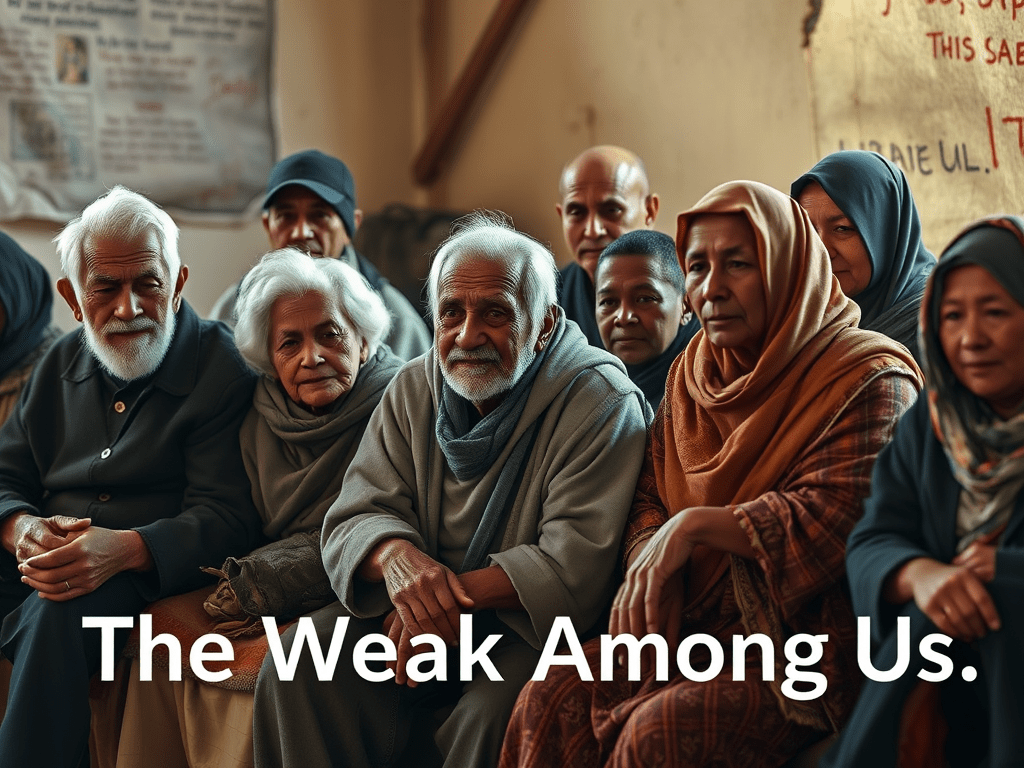
As a secular Franciscan, I strive to view the world through the lens of the Gospel, inspired by St. Francis of Assisi’s radical love for the poor and the teachings of the Catholic Church. Recently, President Trump’s remark, “Only the Weak will Fail,” made in response to a faltering stock market, caught my attention. On the surface, it suggests a harsh, survival-of-the-fittest approach—those who can’t weather economic storms are simply left behind. But from a Franciscan standpoint, this perspective clashes with the call to humility, compassion, and solidarity that defines our faith. Who are “the weak” in this context? How does the stock market’s instability affect them? And why does this mindset stand in opposition to Catholic values? This article seeks to answer these questions, extending the discussion to global relationships and offering a vision rooted in justice.
When economic tides turn, certain groups feel the sting more acutely—not because of personal weakness, but because of systemic realities that leave them exposed. Here’s a look at some of these vulnerable populations:
These aren’t “weak” people in character or will—they’re made vulnerable by an economy that often prioritizes profit over protection. Healthcare costs, housing instability, inadequate mental health support, and a debt-driven education system amplify their risks.
President Trump’s remark ties “the weak” to the stock market, implying that only those unable to endure its volatility will falter. For some, the connection is direct; for others, it’s a ripple effect:
The stock market isn’t just a number on a screen—it’s a force that can deepen existing vulnerabilities. To frame survival as a test of economic resilience ignores how much these groups depend on a system they can’t control.
The effects of a U.S. stock market drop don’t stop at our borders—they ripple worldwide, hitting vulnerable populations and testing global ties:
This interconnectedness reveals that caring for “the weak” is a global responsibility. The U.S. stock market’s sway makes our economic health a matter of international justice, not just domestic policy.
The “Only the Weak will Perish” mindset echoes a survival-of-the-fittest philosophy that Catholic teaching firmly rejects. Our faith offers a different vision, one that hears the cries of the poor and responds with compassion. The Psalmist captures this timeless plea:
“‘Because the poor are despoiled, because the needy groan, I will now rise up,’ says the Lord; ‘I will place them in the safety for which they long.’” (Psalm 12:5, NRSV)
This scripture bridges the struggles of the vulnerable with the spiritual call to action central to Catholic teaching. It underscores that the poor’s cry—whether from economic hardship, illness, or exclusion—is not ignored by God, urging us to mirror that divine compassion. Catholic principles further reinforce this:
Catholic teaching, grounded in Christ’s love for the outcast, sees the “weak” as deserving of support, not abandonment. It challenges us to build an economy that reflects God’s care for all.
We, as a people, are just barely recovered from COVID-19 and the loss of tens of thousands of our loved ones—parents, grandparents, friends—gone too soon, often without a proper goodbye. The economic fallout has been relentless: millions lost jobs, small businesses shuttered, and entire industries teetered on collapse. Families already stretched thin were pushed to the brink, and the uneven recovery has left many still struggling.
To hear, in this fragile moment, that “only the weak will perish” is more than an attack on our sensibilities—it’s a profound insult to our collective pain and resilience. It dismisses the suffering of the elderly couple who lost their savings, the farmer facing bankruptcy, or the single parent juggling mental health struggles and bills. These aren’t “weak” people; they’re caught in circumstances beyond their control, often worsened by systems that fail to protect them. The remark defies logic, reducing our post-COVID world—global supply chains, healthcare gaps, economic ties—to a simplistic, blame-the-victim trope. It’s not just cruel; it’s irrational, ignoring that a thriving economy depends on the health of our communities and the resilience of our most vulnerable.
This isn’t merely an understatement—it’s a betrayal of the compassion and solidarity that should define us after a crisis that tested us all. It challenges reason itself, brushing aside the need for collective action—policies that bolster healthcare, support small businesses, and protect the marginalized—in favor of a callous mindset that writes off the struggling as expendable.
“The weak”—whether seniors, farmers, the unhoused, those with mental health struggles, the uninsured sick, or debt-burdened youth—aren’t disposable. Their vulnerabilities stem from systemic gaps, not personal failures. The stock market’s fall lays bare these cracks, while globally, economic ties demand collective responsibility. Catholic teaching, echoing the cries of the poor through scripture and tradition, urges us to reject a survival-of-the-fittest approach and embrace solidarity, ensuring no one “perishes” amid hardship. True strength isn’t in enduring alone—it’s in lifting each other up with compassion and justice.
True recovery—emotional, economic, and social—demands better. It demands an economy and a society that value every life, not just the ones deemed “strong” enough to survive. We’ve been through too much to settle for less.
Peace, Mike
As a lifelong Michigander and a Canadian in spirit, I’ve been blessed to live a life woven into the cultures of both regions. Canadians aren’t distant neighbors to me—they’re family. Their warmth, resilience, and quiet kindness have shaped who I am. I love their towering forests, rugged mountains, tranquil lakes, and rolling plains. I love the Great Lakes that bind us, the rivers flowing like lifeblood through the land. Above all, I cherish the spiritual connection I feel here—a bond that transcends borders and whispers of something eternal.
Lately, though, that bond has been eclipsed by pain and grief. The U.S. government’s portrayal of Canada as a villain – an adversary to be threatened with violent takeover – cuts me to the core. It’s not just rhetoric; it’s a betrayal of a sacred relationship. Canada isn’t a faceless entity; it’s home, refuge, inspiration. To see it demonized is a personal wound, unraveling the unity I’ve built in my heart over a lifetime.
This isn’t just my sorrow—it’s a broader injustice. The United States, a democracy fraying with division and distrust, turns outward instead of inward. We target Canada, a peaceful neighbor lacking the strength to resist. It’s cowardice, not strength, to exploit our power against the vulnerable—a failing nation cloaking its greed in bravado. Worse, we repeat this aggression with Panama’s jungles. We threaten Mexico’s deserts and Greenland’s icy expanses. Each threat is a fresh stain on our conscience. And then there’s Ukraine. We’ve abandoned it to face overwhelming odds alone, flexing our muscles elsewhere while a desperate ally falters. I’m ashamed of who we’ve become: a nation that bullies the weak and forsakes the suffering as our own house crumbles.
What makes this greed galling is its clash with our self-proclaimed Christian identity. We claim to follow Jesus—his teachings of humility, compassion, love for our neighbors. Yet where’s the humility in menacing Canada with domination? Where’s the compassion in leaving Ukraine to its fate while we chase selfish ambitions? The Christ I know spoke of turning the other cheek, caring for the least among us, seeking peace over power. Our actions reek instead of a lust for control—a betrayal of every sermon we’ve preached about moral superiority. This isn’t Christianity; it’s hypocrisy draped in false piety.
Canada, Panama, Mexico, and Greenland aren’t geopolitical pawns; they’re nations of people deserving dignity, not domination. I’ve walked Canada’s land, marveled at its waters, been welcomed by its communities—none of it ours to claim. I recall a crisp morning on Lake Superior’s shore. The mist rose like a prayer. It reminded me that true strength lies in coexistence, not coercion. Yet our threats sow fear where trust should flourish, division where solidarity should reign. This narrative, driven by conflict over cooperation, betrays the human and spiritual values that have long sustained us.
The fragility of this moment deepens my grief. Bonds forged through shared history and humanity are precious but not unbreakable. Watching us abandon Ukraine shows how easily we can lose what matters most. We are also menacing neighbors who wish us no harm. Still, I refuse despair. I hold fast to the love that ties me to Canada. The people there have embraced me. The landscapes restore me. The waters reflect our shared existence. That love gives me the strength to stand with them. We must unite against the hatred and fear tearing us apart.
We have a moral duty to reject this aggression. A nation struggling to uphold its own ideals has no right to force its will on others—least of all neighbors like Canada, Panama, and Mexico, or distant Greenland, whose peace should inspire us. We have no right to turn from Ukraine while claiming superiority. Instead, let’s reclaim the peace and understanding that define our better selves—values that echo the faith we profess. Let’s demand a shift: policies that prioritize partnership, voices that amplify the vulnerable, a discourse that heals rather than divides. Our shared humanity dwarfs any boundary or power play.
Reflecting on Canada’s beauty—and the dignity of all we’ve threatened—I’m filled with quiet determination. I cling to hope that compassion and reason will prevail, that we’ll stop painting Canada as a villain, stop menacing the defenseless, stop abandoning the suffering. I envision a day when we walk alongside others—not as tyrants in pious disguise, but as kin on a journey toward something better. In adversity, I find solace in the people, the land, the waters, and the spiritual thread uniting us. Together, we can rise above this pain, grief, and shame, building a future worthy of our highest calling.

The Sacred Symphony of Creation
When St. Francis of Assisi penned The Canticle of the Creatures³, he praised Brother Sun, Sister Moon, and “our sister Mother Earth” as mirrors of divine love. Centuries later, science reveals a parallel truth: forests are not just collections of trees but interconnected communities, whispering secrets of survival through fungal networks¹². Peter Wohlleben’s The Hidden Life of Trees¹ and the Franciscan intellectual tradition—rooted in humility, kinship, and sacred stewardship—offer a profound lens for navigating today’s crises. In a world fractured by climate collapse, isolation, and relentless haste, these ancient and modern wisdoms remind us: We belong to each other.
Franciscan spirituality rejects the myth of individualism. St. Francis saw all creation as a family, declaring, *“Every creature is a glittering mirror of God’s beauty.”*³ Similarly, trees in a forest thrive through cooperation. Mycorrhizal networks¹² allow them to share nutrients, heal the wounded, and nurture seedlings—a living embodiment of communio⁴, the belief that all beings exist in sacred relationship.
Our Struggle: Modern life prizes hyper-independence, yet loneliness and polarization fester.
Franciscan Insight:
St. Francis embraced poverty not as deprivation but as liberation—a surrender to dependence on God and community³. Trees, too, survive storms by bending. Their strength lies in humility: shallow-rooted trees fall, while those anchored in deep, communal networks endure¹.
Our Struggle: Burnout, economic precarity, and climate disasters tempt us to despair.
Franciscan Insight:
The Franciscan tradition sees creation not as a resource to exploit but as a sacrament to cherish³. St. Francis called animals, rivers, and stars “brothers” and “sisters”³, urging humans to “preach the Gospel to all creation” through reverence. Trees, too, act as long-term stewards¹: they store carbon, shelter species, and build soil for future forests.
Our Struggle: Consumerism and short-term thinking accelerate ecological collapse.
Franciscan Insight:
St. Francis spent years in prayerful solitude before founding his order³. Trees, too, grow slowly¹—strengthening roots before reaching skyward. In a culture obsessed with speed, both remind us: Holiness thrives in unhurried attention.
Our Struggle: Productivity culture erodes our capacity for depth and joy.
Franciscan Insight:
Conclusion: Becoming a Forest of Saints
The secret life of trees¹ and the Franciscan tradition converge in a single truth: Life flourishes in communion. St. Clare of Assisi, Francis’s spiritual sister, called this *“the mirror of eternity”*⁹—a reflection of divine love in every leaf, root, and human heart.
As climate crises and social fractures deepen, we are summoned to rebuild the Wood Wide Web¹² of kinship. Let us:
Call to Action:
“Start by doing what is necessary, then what is possible, and suddenly you are doing the impossible.” —St. Francis of Assisi³
Inspired by Peter Wohlleben’s The Hidden Life of Trees¹ and the Franciscan intellectual tradition. Let’s keep the conversation rooted in love—
Wishing you Peace, Mike 🌍🌳️
Russia’s Strategic Ambitions: An Analysis from Peter Zeihan
Peter Zeihan, a renowned geopolitical strategist and author, has unveiled a comprehensive analysis of Russia’s strategic objectives targeting U.S. influence. In his detailed examination “The Russian Reach: Russia’s Wish List Part 1,” Zeihan exposes an ambitious agenda that extends far beyond conventional military aspirations.
According to Zeihan’s research, Russia’s strategic goals encompass several critical domains:
Military and Intelligence Operations
Media and Information Control
Economic Dependencies
Arctic Dominance
Industrial Investment
Zeihan’s analysis reveals the comprehensive nature of Russia’s ambitions, demonstrating their intent to reshape global power dynamics through multiple vectors of influence. His detailed breakdown provides crucial insights into the scale and scope of Russia’s strategic planning.
Note: This analysis is based on Zeihan’s expert assessment and published research in the field of geopolitical strategy.
Heather Cox Richardson, a distinguished historian and professor at Boston College, has emerged as a key voice in interpreting the actions of the Trump administration through a historical lens. Known for her Substack newsletter, Letters from an American, and her book Democracy Awakening, Richardson provides a compelling analysis of how the administration’s policies and behaviors are reshaping the U.S. government today. Her critiques focus on the erosion of democratic institutions, controversial foreign policy decisions, and efforts to dismantle government services—issues she views as existential threats to American democracy.
Undermining Democratic Institutions
Richardson argues that the Trump administration has pursued a deliberate strategy to weaken the foundational elements of American democracy. She has described its actions as “terrifying,” suggesting they elevate the president to a near-dictatorial level of power. Central to her critique are the administration’s attacks on independent institutions such as the press, the FBI, and the Department of Justice. These entities, designed to act as checks on executive authority, have faced relentless efforts to discredit or control them.
Drawing from history, Richardson compares the current climate to moments like the Civil War or the early 20th-century rise of authoritarianism. In Democracy Awakening, she explores how democracies become vulnerable when leaders exploit division and disinformation—a tactic she sees mirrored in the Trump administration’s reliance on misleading narratives. This erosion of trust in institutions and facts, she warns, jeopardizes the rule of law and the democratic process itself.
Foreign Policy: A Tilt Toward Authoritarianism
Richardson has been particularly vocal about the Trump administration’s foreign policy, especially its approach to Russia and Ukraine. She finds it alarming that the administration has appeared to favor Russian President Vladimir Putin over Ukrainian President Volodymyr Zelensky, a stance that has stunned both Americans and U.S. allies. This includes decisions like halting intelligence sharing with Ukraine, which she sees as emboldening Russian aggression and undermining a democratic ally.
This shift, Richardson argues, marks a departure from decades of U.S. policy aimed at supporting democratic nations against authoritarian regimes. She contends that such actions not only weaken global alliances but also signal a troubling retreat from America’s role as a champion of democratic values—a move with potentially destabilizing consequences for international order.
Dismantling Government Services
Another major concern for Richardson is the administration’s push to cut government services and privatize key functions. She highlights statements from Treasury Secretary Scott Bessent, who has advocated reducing the federal government’s scope and transferring responsibilities to the private sector. Richardson views this as a dangerous trend, one that echoes the Gilded Age, when corporate power and inequality soared at the expense of public welfare.
She argues that these cuts, often framed as efforts to eliminate “waste, fraud, and abuse,” disproportionately harm vulnerable populations and diminish the government’s capacity to serve its citizens. By prioritizing ideological goals over public good, the administration risks deepening inequality and weakening the social contract that underpins a functioning democracy.
A Call to Defend Democracy
Despite these challenges, Richardson remains cautiously optimistic. In Democracy Awakening, she emphasizes that America has weathered similar crises before and can do so again by recommitting to its core principles—chief among them, equality before the law and broad participation in governance. She sees the current moment as a turning point, urging citizens to actively defend democracy through voting, accountability, and civic engagement.
Richardson’s message is clear: democracy is not a given—it demands effort and vigilance. She believes that by confronting disinformation and holding leaders to account, Americans can reclaim their government from the forces of authoritarianism.
Conclusion
Heather Cox Richardson’s perspective on the Trump administration paints a picture of a government under siege from within. From its assaults on democratic institutions and its alignment with authoritarian powers to its efforts to shrink public services, she sees a pattern that threatens the very fabric of American democracy. Yet, her work also offers hope, rooted in historical resilience and a call to action. As Richardson reminds us, the future of our government depends on our willingness to fight for it—today and every day.
If you’re not reading Heather Cox Richardson’s Letters from an American, you need to start. This newsletter is an essential resource for anyone looking to understand the intersection of history and modern politics in the United States. Richardson, a renowned historian, offers a unique blend of historical insight and contemporary analysis, making complex political events more accessible and grounded in the lessons of the past. Whether you’re trying to make sense of current challenges—like the erosion of democratic institutions or shifts in government policy—her perspective is invaluable.
Psalm 1:
“Blessed is the man who does not walk in the counsel of the wicked, nor stand in the way of sinners, nor sit in company with scoffers.
Rather, the law of the Lord is his joy; and on his law he meditates day and night.
He is like a tree planted near streams of water, that yields its fruit in season; its leaves never wither; whatever he does prospers.
But not so are the wicked, not so! They are like chaff driven by the wind.
Therefore the wicked will not arise at the judgment, nor will sinners in the assembly of the just.
Because the Lord knows the way of the just, but the way of the wicked leads to ruin.”
A Franciscan and Ruttenberg-Inspired Reflection on Psalm 1: Finding Roots in a Time of Fear
Verse 1: Blessed is the man who does not walk in the counsel of the wicked, nor stand in the way of sinners, nor sit in company with scoffers.
As a Franciscan, I hear Brother Francis whispering through these words: step away from the noise of power and pride.^1 Today, in the U.S., fear grips us—fear of the other, fear of losing what we know, fear stoked by voices shouting division on screens and streets. The “wicked” aren’t just cartoonish evildoers; they’re the systems of greed, the policies that widen gaps, the cynicism that mocks hope.^2 Rabbi Ruttenberg might call this the unrepentant path—refusing to repair harm, whether to immigrants at our borders or the earth groaning under neglect.^3 Blessedness, for us, is choosing a different way: walking with the lepers of our time, the disenfranchised, the afraid, refusing to sit with those who scoff at compassion.
Verse 2: Rather, the law of the Lord is his joy; and on his law he meditates day and night.
Francis found joy in Sister Poverty and Brother Sun, seeing God’s law etched in creation and the Gospel’s call to love.^4 For Rabbi Ruttenberg, Torah isn’t static—it’s a sacred text we wrestle with, a guide to nurture the wow of life even when fear looms.^5 In this trembling moment—elections tearing us apart, climate disasters looming, rights under threat—meditating on God’s law means more than quiet prayer.^6 It’s active, like Francis rebuilding the Church stone by stone, or Ruttenberg urging us to repair what’s broken. We turn to love, justice, and mercy, day and night, to steady our shaking hands and hearts against the chaos.
Verse 3: He is like a tree planted near streams of water, that yields its fruit in season; its leaves never wither; whatever he does prospers.
Oh, how Francis would dance to this! A tree by the water—rooted in God’s grace, mirroring the Canticle’s praise for creation’s harmony.^7 Ruttenberg might see this as the fruit of ethical living, yielding repair in a fractured world.^8 But today, we feel uprooted—floods and fires threaten our homes, economic instability withers dreams, and fear whispers that nothing will prosper.^9 Yet, as Franciscans, we plant ourselves by the streams of solidarity: with the poor, the earth, each other. As Ruttenberg teaches, we nurture resilience, bearing fruit not for ourselves but for a hungry nation. Our leaves—our hope—won’t wither if we stay connected to the Source.
Verses 4-5: But not so are the wicked, not so! They are like chaff driven by the wind. Therefore the wicked will not arise at the judgment, nor will sinners in the assembly of the just.
Francis wept for sin’s emptiness, not to condemn but to call back.^10 The “wicked” here are like chaff—rootless, blown by fear’s gusts: the profiteers of division, the deniers of truth, the ones who’d rather burn bridges than build them.^11 Ruttenberg’s lens sharpens this: those who refuse repair drift away, unmoored from community.^12 In our fear—gun violence spiking, democracy wobbling, hate rising—we see this wind tearing at us. But judgment isn’t ours to wield; it’s God’s, and we pray, as Francis did, for conversion over collapse, trusting the just will stand together when the storm passes.
Verse 6: Because the Lord knows the way of the just, but the way of the wicked leads to ruin.
God knows us—intimately, as Francis knew the sparrows and the wolf.^13 Rabbi Ruttenberg might say God’s knowing is an invitation to align with Torah’s justice, to repair our way out of ruin.^14 Fear tells us ruin is near—cultural decay, ecological tipping points, a nation unraveling.^15 But the Franciscan heart clings to trust: God walks with the just, the peacemakers, the ones planting seeds in scorched soil. The wicked’s ruin isn’t our glee—it’s a warning to turn back, to choose life, to mend what fear has torn.
Tying It Together: A Prayer for Today
In this America of 2025, Psalm 1 is our lifeline.^16 As Franciscans, we stand with Francis, barefoot on the earth, refusing fear’s counsel—greed, hate, despair—and rooting ourselves in God’s law of love.^17 With Rabbi Ruttenberg’s wisdom, we see Torah and Gospel as tools to repair, to nurture, to flourish like trees even now.^18 Our fear—of loss, of violence, of an uncertain tomorrow—becomes a call: to meditate on what heals, to bear fruit for the weary, to trust God knows our trembling way. Together, we rebuild, not with walls but with bridges, singing peace to a frightened land.
Footnotes