Pax et bonum! Peace and All Good to you, fellow travelers on this wonderful, winding path we call life. As a Lay Franciscan, June always brings me particular reflection when the world celebrates Pride Month. As I see the vibrant colors and joyful expressions, my heart turns to the very core of what it means to follow in the footsteps of Saints Francis and Clare: radical love and welcome.
Our Franciscan tradition is rich with stories of encountering the “other.” No story is more poignant and transformative than that of St. Francis and the leper. Before his conversion, Francis found the sight of lepers repulsive. He would turn away, literally holding his nose. But then, the grace of God touched his heart, and he embraced the leper, exchanging a kiss of peace. In that act, Francis didn’t just overcome a personal aversion; he saw Christ in the least of his brothers. He saw the image of God, even in one whom society had cast out, deemed “unclean,” and marginalized.
This, my friends, is the essence of our call: to see the image of God in every person. Not just those who look like us, think like us, or believe exactly as we do, but every single human being, regardless of their background, choices, identity, or who they love.
During Pride Month, as we reflect on the experiences of our LGBTQ+ brothers and sisters, this Franciscan value resonates deeply. For too long, and in too many places, individuals within the LGBTQ+ community have been treated as “other,” cast out, or made to feel unwelcome, even within spaces that claim to preach love. But the spirit of Francis compels us to do differently. It compels us to open our hearts and doors, extend genuine hospitality, and affirm every individual’s inherent dignity and worth.
Just as Francis saw Christ in the leper, we are called to see Christ in the joyful, courageous, vulnerable, and beautiful diversity of our LGBTQ+ siblings. To truly offer “Peace and All Good” means extending a welcome that is not conditional, judgmental, or based on conformity to our preconceived notions. It’s a welcome rooted in the boundless love of God, a love that embraces all without exception.
So, as we move through June, let us remember St. Francis’ radical embrace. Let us challenge ourselves to step outside our comfort zones, listen with open hearts, and truly see the image of God in everyone we encounter. In welcoming the “other,” we truly welcome Christ and build a more peaceful and loving world for all.
Introduction: The Guiding Light of the Prologue and the Primacy of Article 1
The journey into the heart of the Secular Franciscan Order (OFS) and its Rule of Life commences not with its numbered articles, but with the luminous words of St. Francis himself in his Exhortation to the Brothers and Sisters of Penance. This text, dating from approximately 1209 to 1215 and known to Secular Franciscans as the Prologue, is far more than a mere preamble; it is the indispensable spiritual key, the very “lens through which the Rule of 1978 must be understood and interpreted”.1 It stands as the “primitive Rule,” articulating the foundational “form of life” that Francis envisioned for lay penitents who sought to live their baptismal commitment with profound intensity.1 The historical path leading to its inclusion in the modern Rule may be somewhat veiled, yet its presence is now widely regarded as “providential.” This divine foresight connects contemporary Secular Franciscans across centuries to their earliest spiritual forebears and to the authentic, resonant voice of Francis, the humble penitent from Assisi.1
The Prologue, in its essence, frames the core identity of those who would follow this path: to become “spouses, brothers, and mothers of our Lord Jesus Christ”.1 This identity is deeply embedded in a Trinitarian, Christocentric, and Catholic way of life, with its spiritual center being “penance.” However, “penance” in the Franciscan tradition is not primarily about external acts of mortification, but signifies the biblical concept of metanoia—a “radical interior change,” a continuous and transformative “conversion” of the heart towards God.1 This understanding of penance, as a dynamic process of spiritual growth, sets the spiritual atmosphere for approaching every article of the Rule, particularly the foundational Article 1. The Rule, therefore, is not a static code of conduct but a vibrant pathway to deep, personal transformation in Christ. The profession to live according to this Rule is not a singular event, but an embarkation upon a lifelong journey of being conformed to Christ, in the manner of St. Francis. The various actions of “doing penance” naturally flow from the interior state of “being penitent”.1 Furthermore, the Spirit’s guidance in incorporating the Prologue into the modern Rule ensures that, even as the Rule is adapted and applied in new historical contexts, its interpretation remains anchored to the “authentic voice and mind of Francis,” thereby preserving the Order’s spiritual integrity and its fidelity to the original charism.1
With this spiritual compass provided by the Prologue, Article 1 of the Rule of the Secular Franciscan Order emerges as the cornerstone, the foundational declaration of Secular Franciscan identity and mission. It articulates the Order’s genesis, its intrinsic nature, and the fundamental calling extended to its members. This exploration will unfold the rich layers of meaning encapsulated within Article 1. It will draw sustenance from the universal teachings of the Church. It will also delve into the profound depths of the Franciscan intellectual and spiritual heritage. Furthermore, it will rely on the vibrant, lived experience of the Order across the globe.2
Chapter 1
Within the Great Communion: The Church’s Call and the Spirit’s Gifts
The Universal Call to Holiness: The Bedrock of Every Christian Vocation
The vocation of a Secular Franciscan is, first and foremost, a Christian vocation, rooted in the fundamental call to holiness addressed to all the baptized. The Second Vatican Council, particularly in its Dogmatic Constitution on the Church, Lumen Gentium, powerfully reaffirmed this ancient truth: “All Christians in any state or walk of life are called to the fullness of Christian life and to the perfection of charity”.4 This summons to “Be perfect, as your heavenly Father is perfect” (Mt 5:48) is not an invitation extended to a select few, but the inherent destiny of every individual incorporated into Christ through baptism.4
The Catechism of the Catholic Church further illuminates this universal call, explaining that the path to holiness is paved by “using the strength dealt out to them by Christ’s gift, so that… doing the will of the Father in everything, they may wholeheartedly devote themselves to the glory of God and to the service of their neighbor”.4 This journey towards sanctity is one of spiritual progress, aiming for an ever more intimate union with Christ. It is a path that often “passes by way of the Cross” and invariably demands “renunciation and spiritual battle,” as well as the practices of “ascesis and mortification that gradually lead to living in the peace and joy of the Beatitudes”.4 Article 1 of the General Constitutions of the OFS echoes this foundational principle, stating, “All the faithful are called to holiness and have a right to follow their own spiritual way in communion with the Church”.2 Thus, Article 1 of the OFS Rule, by situating the Franciscan vocation squarely within the Church, builds upon this universal call. The Secular Franciscan Order does not present an alternative to this fundamental Christian vocation but offers a distinct and approved pathway for living it out with particular intensity and according to a specific charism.
The affirmation in the General Constitutions that all faithful “have a right to follow their own spiritual way in communion with the Church” 2 is particularly profound. It suggests a dynamic interplay where personal spiritual discernment and ecclesial communion are not mutually exclusive but are, in fact, mutually enriching. The universal call to holiness is a broad divine invitation, and “their own spiritual way” acknowledges the unique, personal response each individual makes to this call, guided by the promptings of the Holy Spirit. Simultaneously, the phrase “in communion with the Church” provides the indispensable context of orthodoxy, communal support, and shared mission. Consequently, the OFS Rule, as a spiritual path approved by the Church, offers a specific way that honors individual spiritual journeys while ensuring their harmonious integration within the Body of Christ. This implies that the OFS vocation, while possessing a common charism, is not a monolithic, “one-size-fits-all” model but allows for a rich diversity of personal expressions.
Spiritual Families: The Holy Spirit’s Diverse Expressions of Gospel Life within the Church
The Church, in her journey through history, is continually vivified and enriched by the Holy Spirit, who bestows a multiplicity of gifts and charisms for the building up of the Body of Christ. Among these gifts are the “many spiritual families… with different charisms”.2 These spiritual families, such as the Benedictines, Dominicans, Carmelites, and indeed the Franciscans, provide structured and time-tested ways for the faithful to pursue holiness according to specific spiritual traditions and insights into the Gospel. The Franciscan Family, as Article 1 of the Rule highlights, is “one among many spiritual families raised up by the Holy Spirit in the Church”.3
The existence of these diverse spiritual families underscores the boundless creativity of the Holy Spirit and the inherent catholicity—the universality and fullness—of the Church. It signifies that no single spirituality, however venerable or profound, holds an exclusive claim on the authentic living of the Gospel. The Franciscan way, therefore, is one valid and precious expression of Christian discipleship among others. This understanding fosters a spirit of humility and inter-charism collaboration rather than any sense of spiritual elitism. It encourages Secular Franciscans to appreciate and learn from the spiritual treasures of other traditions while remaining deeply rooted in and faithful to their own unique Franciscan calling. The Franciscan charism, and by extension the Secular Franciscan Order, is thus understood not as an isolated phenomenon but as an integral part of the Church’s rich spiritual patrimony, contributing its unique note to the symphony of praise and service offered to God.
Chapter II
The Franciscan Tapestry: One Family, Many Paths
The “Franciscan Family”: A Unique Spiritual Lineage
Article 1 of the Rule of the Secular Franciscan Order declares: “The Franciscan family, as one among many spiritual families raised up by the Holy Spirit in the Church, unites all members of the people of God—laity, religious, and priests—who recognize that they are called to follow Christ in the footsteps of St. Francis of Assisi”.3 This “family” is not merely a loose association but an “organic union” 2 of all Catholic fraternities and communities whose members, inspired by the Holy Spirit, commit themselves to live the Gospel in the manner of St. Francis, each according to their specific state of life and rule. It is a spiritual lineage characterized by a “common charism but varied expressions” 6, where all branches recognize St. Francis as their “father, inspiration, and model”.2 The concept of “family” is pivotal, implying shared spiritual DNA, mutual support, and a common inheritance, even amidst the diverse roles and lifestyles of its constituent parts—the First Order of friars, the Second Order of contemplative nuns (the Poor Clares), the Third Order Regular, and the Secular Franciscan Order.
St. Francis of Assisi: The “Seraphic Father” – Source, Inspiration, and Enduring Model
At the heart of this spiritual family stands St. Francis of Assisi, revered as the “father, inspiration, and model” for all its members.2 He is often invoked by the evocative title “Seraphic Father,” a designation rooted in the profound mystical experience on Mount Alverna. There, Francis beheld a vision of the crucified Savior enveloped by six incandescent seraph wings, an event that symbolized the “fiery intensity of God’s love” and culminated in his receiving the sacred stigmata, the wounds of Christ imprinted on his own body.7 St. Bonaventure, a towering figure in the Franciscan Intellectual Tradition, provides a deep theological interpretation of this pivotal event in his work, The Journey of the Mind into God. Bonaventure sees the vision of the six-winged Seraph not only as an account of Francis’s personal ecstatic union with the Crucified but also as “the road by which one might arrive at this contemplation”.9 The six wings symbolize “six levels of uplifting illuminations” or “steps or pathways” by which the soul is prepared to ascend towards peace through “ecstatic raptures of Christian wisdom.” This ascent, Bonaventure stresses, “can only go through the most burning love of the Crucified”.9 Francis, transformed by this love, is thus presented as an “example of perfect contemplation,” whose life, more than his words, serves as a guide for others.9
The title “Seraphic Father,” when understood through Bonaventure’s theological lens, reveals a crucial aspect of the Franciscan charism: it is fundamentally mystical and contemplative, even for those engaged in active apostolates or living secular lives. The “burning love of the Crucified,” which consumed St. Francis, is the wellspring from which all authentic Franciscan action flows. This implies that the life of a Secular Franciscan, even amidst the engagements and responsibilities of the world, must be animated by this profound interior union with Christ Crucified. Contemplation, therefore, is not an optional spiritual luxury but a foundational element of their calling, mirroring the seraphic ardor of their spiritual father. Francis is not merely a historical founder to be emulated in external ways; he is a living spiritual presence whose charism—that passionate, Christ-centered love—continues to animate the Order in every age.
The Core Call: “To follow Christ in the footsteps of St. Francis of Assisi”
This resonant phrase, “to follow Christ in the footsteps of St. Francis of Assisi,” encapsulates the unifying call for every member of the vast Franciscan family.3 St. Francis himself, as Article 4 of the OFS Rule beautifully articulates, “made Christ the inspiration and the center of his life with God and people”.10 His own writings, such as the Admonition “Of the Lord’s Body,” passionately exhort his followers to recognize Christ’s profound humility in the Holy Eucharist and in His daily self-emptying.11
Commentaries on the OFS Rule further illuminate this core call, describing it as a striving for an “intimate union with Christ,” echoing St. Paul’s cry, “the life I live now is not my own; Christ is living in me” (Gal 3:20).6 This following in the footsteps of Francis involves a multifaceted engagement with Christ: seeking Him in all spheres of life—in one’s brothers and sisters, in Sacred Scripture, in the Church, and preeminently in liturgical activity, especially the Eucharist; sharing in His mission of proclaiming the Good News through both word and example; undergoing a continual conversion of heart (metanoia); and making the worship of the Father, through, with, and in Christ, central to one’s existence.6 It is a life dedicated to loving God with one’s whole being and serving one’s neighbors, actively participating in the Eucharist as a source and summit of ecclesial togetherness, decisively rejecting sin, and striving to mirror Christ to the world.6
This call to “follow Christ in the footsteps of St. Francis” is not a summons to a mere historical reenactment of 13th-century life. Rather, it is an invitation to embody Francis’s spirit—his radical commitment to the Gospel, his profound Christ-centeredness, his poverty, humility, joy, and pursuit of peace—within the diverse and often challenging contexts of contemporary society. This demands ongoing creativity, discernment, and a willingness to translate the timeless values of the Poverello into actions and attitudes that are relevant and transformative today. It is about capturing the essence of Francis’s response to the Gospel, not a literalistic imitation of every detail of his historical life. This underscores the vital importance of robust ongoing formation and careful discernment for all Secular Franciscans as they seek to live their vocation authentically.
Chapter 3
The Secular Franciscan Order: A Distinctive Thread in the Franciscan Weave
The Specific Identity and Vital Place of the OFS within the Broader Franciscan Family
Article 1 of the Rule of the Secular Franciscan Order, when read in conjunction with the General Constitutions, clearly delineates the OFS’s unique position. The General Constitutions state that the OFS “is formed by the organic union of all the Catholic fraternities whose members, moved by the Holy Spirit, commit themselves through profession to live the Gospel in the manner of St. Francis, in their secular state, following the Rule approved by the Church”.2 This “organic union” signifies more than a loose affiliation; it points to a structured, worldwide communion with its own juridical personality within the Church.2 This structure, encompassing local, regional, national, and international levels of fraternity, is essential for fostering mutual support, ensuring sound governance (as seen in bodies like the International Council OFS (CIOFS) and National Councils 14), providing consistent formation, and enabling coordinated apostolic action on a global scale. The fraternal dimension, therefore, is not incidental but integral to the Secular Franciscan charism; the call is lived in and through this structured communion, which provides the necessary framework for a worldwide Order to function effectively and maintain its distinct identity.
The OFS has “always had its own proper place within the Franciscan Family” 2 and is recognized as a “public association in the Church”.2 This establishes the OFS as an official, Church-recognized Order with a distinct charism centered on living Franciscan spirituality within the ordinary circumstances of secular life, bound by a specific Rule and a formal profession.
“Moved by the Holy Spirit”: The Divine Initiative and Ongoing Guidance
The very genesis of a Secular Franciscan vocation lies in a divine initiative. Members are described as being “moved by the Holy Spirit” to commit themselves to this way of life.2 This crucial phrase underscores that embracing the OFS is not merely a matter of personal preference or human decision, but a response to a distinct call from God, a prompting of the Divine Spirit. It is the same Holy Spirit who, as the Rule itself acknowledges, raises up diverse spiritual families like the Franciscans within the Church.3 The paramount role of the Holy Spirit highlights the supernatural dimension of the OFS vocation. It is the Spirit who inspires the initial call, guides the individual through discernment and formation, and sustains them in their lifelong commitment to live the Gospel according to the spirit of St. Francis.
The Commitment of Profession: A Solemn Promise to Live the Gospel in the Manner of St. Francis
A defining moment in the life of a Secular Franciscan is the act of Profession. Through this solemn rite, members “commit themselves… to live the Gospel in the manner of St. Francis”.2 This profession is a profound spiritual act that renews and deepens the promises made at baptism and signifies a lifelong, public commitment to the OFS way of life.2 From that point forward, the Rule and the General Constitutions are intended to become a vital “point of reference in their daily lives,” shaping their choices, attitudes, and actions.2 While profession in the OFS is not a vow in the canonical sense that characterizes religious life (entailing poverty, chastity, and obedience lived in a community under a superior), it is nonetheless a solemn, Church-recognized commitment that profoundly shapes the identity and life of a Secular Franciscan. It is the formal acceptance of the Rule as their specific life plan, a dedicated path to holiness within their secular state.
Life “In Their Secular State”: Embracing the World as the Place of Sanctification and Apostolic Action
The defining characteristic of the Secular Franciscan vocation is the call to live the Gospel “in their secular state”.2 This means that their primary arena for Christian living and apostolic action is the world itself—their families, workplaces, social circles, and civic engagements. Echoing the vision of the Second Vatican Council’s document Lumen Gentium for the laity, Secular Franciscans are called to “seek the Kingdom of God by engaging in temporal affairs and by ordering them according to the plan of God”.17 They are to be the “salt of the earth” and the “leaven” in society, making the Church present and fruitful in those very places and circumstances where only through them can she effectively reach.17 Their specific vocation is to work for the sanctification of the world “from within”.17 This was precisely St. Francis’s counsel to the first lay people who were drawn to his way of life: he encouraged them “not to leave their families or abandon their work in the world, but to embrace the Gospel in the ordinary circumstances of their lives”.10
The “secular state,” therefore, is not viewed as a lesser state or a limitation on spiritual growth, but as the specific, God-given field for the Secular Franciscan’s mission and sanctification. It is a positive charism, distinct from religious life, yet equally demanding in its call to Gospel radicalism and holiness. The commitment to live the Gospel “in their secular state” according to a Church-approved Rule presents a unique and powerful model of what might be termed “consecrated laity.” While distinct from religious vows, the profession involves a profound, public, and life-shaping commitment to evangelical perfection lived out within the world. This combination of secular life with a formal, Rule-based dedication to striving for “perfect charity” 3 creates a distinct form of lay consecration. Secular Franciscans are thus called to be “witnesses of Christ… martyrs, in the original sense of the word,” not necessarily through the shedding of blood, but through the consistent and steadfast living of their baptismal promises, which are renewed and affirmed in their OFS Profession.2 This vocation offers a compelling example of how the universal call to holiness can be lived with radical dedication within the ordinary fabric of lay existence, challenging any notion that profound spiritual commitment is exclusive to clerical or religious states.
Adherence to the Rule Approved by the Church: The Guarantee of Ecclesial Communion and Authentic Charism
The commitment of Secular Franciscans is to live according to “the Rule approved by the Church”.2 The current Rule, which forms the basis of their life, was solemnly approved by Pope Paul VI on June 24, 1978, with the Apostolic Letter Seraphicus Patriarcha.20 This ecclesial approval is of paramount importance. It signifies that the Church herself consigns the Rule to the OFS as a “norm of life” 20 and, crucially, ensures its “fidelity… to the Franciscan charism, communion with the Church and union with the Franciscan family”.21 The Church’s approval provides an objective standard for living the Franciscan charism in the secular state, guarantees the Rule’s alignment with Catholic doctrine and the authentic spirit of St. Francis, and formally integrates the Secular Franciscan Order into the life, mission, and structure of the universal Church.
Chapter IV
Article 1 in Action: From Sacred Text to Lived Reality
The General Constitutions (Article 1): The Primary Authoritative Interpretation and Application of Rule Article 1
The General Constitutions of the Secular Franciscan Order serve as the primary and authoritative instrument for interpreting and applying the Rule. Specifically, Article 1 of the General Constitutions directly elaborates upon the foundational principles laid out in Article 1 of the Rule.2 It begins by reaffirming the universal call of all the faithful to holiness and their right to pursue their own spiritual path in communion with the Church. It then situates the Franciscan Family, with St. Francis as its father, inspiration, and model, among the many spiritual families raised up by the Holy Spirit. Crucially, it defines the Secular Franciscan Order as “the organic union of all the Catholic fraternities whose members, moved by the Holy Spirit, commit themselves through profession to live the Gospel in the manner of St. Francis, in their secular state, following the Rule approved by the Church”.2
The General Constitutions are explicitly intended to “apply the renewed Rule of 1978” and are presented as a “standard around which we build our lives in accord with the gospel”.2 They are designed to be a practical tool to help the Rule become “spirit and life” for each member and for the Order as a whole.2 Therefore, a thorough understanding of how the principles of Rule Article 1 are translated into the concrete structures, daily life, and missionary outreach of the OFS necessitates careful attention to the General Constitutions, which provide the normative interpretation and practical directives.
The Journey of Formation: Growing into the Vocation Described in Article 1
The call described in Article 1 of the Rule is not one that is embraced lightly or instantaneously. Admission into the Secular Franciscan Order is a gradual process, a journey of discernment and growth, typically involving distinct stages: an initial period of Orientation, followed by a more in-depth Inquiry, and then a period of Candidacy, all leading towards the solemn act of Profession.10 This structured formation process is meticulously designed to help individuals discern authentically whether “the Spirit is calling you to a Secular Franciscan vocation” as outlined in Article 1.10
Formation materials and programs within the OFS focus on immersing the candidate in the richness of the Franciscan tradition. Key areas of study and reflection include the lives and spirituality of St. Francis and St. Clare, the core elements of the Franciscan charism, Franciscan history, a deep dive into the Rule and General Constitutions, and a thorough exploration of what it means to be both “secular” and “Franciscan”.22 Resources such as “Signs of OFS Vocation” and various “Come and See Digests” on topics like Christ, Francis, Prayer, and Peace directly address the nature of this specific call.22 The overarching aim of this formative journey, as articulated in Article 10 of the General Constitutions, is to enable the members to “learn the purpose and the way in which they are to live, love and suffer” in the Franciscan spirit.2 Formation is the practical crucible where an individual internalizes the call defined in Article 1, moving from an initial attraction or curiosity to a mature, informed, and professed commitment. It is in this process that the “Franciscan radicalism, based on the gospel” 2, is cultivated and takes root in the life of the Secular Franciscan.
The structured nature of this formation process, coupled with the ongoing support of Spiritual Assistance, indicates that the OFS vocation, as delineated in Article 1, is not left to purely subjective interpretation. Instead, it is carefully nurtured, guided, and authenticated within the communion of the Church and the broader Franciscan family. This systematic approach ensures both the integrity and the continuity of the charism, safeguarding it from potential dilution and ensuring that members are adequately prepared and continually supported in their unique path to holiness. This reflects a harmonious balance between the personal movement of the Holy Spirit in the individual and the Order’s collective responsibility for the spiritual well-being and authentic living of its members.
The Ministry of Spiritual Assistance: Nurturing Fidelity to the Rule and the Franciscan Spirit
Recognizing the importance of ongoing spiritual guidance and connection to the broader Franciscan family, the Holy See has entrusted the pastoral care and spiritual assistance of the Secular Franciscan Order to the Franciscan First Order (comprising the Friars Minor, Friars Minor Conventual, and Friars Minor Capuchin) and the Third Order Regular (TOR).2 This spiritual oversight, termed altius moderamen (higher guidance), serves to “guarantee the fidelity of the OFS to the Franciscan charism, communion with the Church and union with the Franciscan family”.21
Spiritual Assistants, typically friars from these Orders, play a crucial role in the life of OFS fraternities. Their primary tasks are to “communicate Franciscan spirituality and to co-operate in the initial and continuing formation of the brothers and sisters”.21 They are called to be a living “witness of Franciscan spirituality” and a tangible “bond of communion” between their religious Order and the OFS.21 Their role is one of fraternal “assistance” rather than directive control, fostering the growth of Secular Franciscans in their understanding of and fidelity to the Rule and the authentic spirit of St. Francis.24 Spiritual Assistance is thus a vital support structure, ensuring that the living of Article 1 remains deeply rooted in the Franciscan tradition and harmoniously integrated within the life of the Church. It is a concrete expression of the “Franciscan Family” bond, providing a life-giving connection to the spiritual wellspring of the Order.
Witnesses to the World: How Secular Franciscans Embody Article 1 Through Their Diverse Apostolates, Ministries, and Daily Lives
The call inherent in Article 1 of the Rule finds its ultimate expression in the lived reality of Secular Franciscans. They are summoned to be “bearers of peace in their families and in society” 2, to actively serve victims of injustice 2, and to engage in a wide array of apostolates and ministries that reflect the Franciscan charism.12
The spectrum of these apostolic activities is broad and diverse, tailored to the needs of the local Church and society, and the gifts of the fraternity members. Examples include supporting campus ministry programs, assisting refugee families in their resettlement, actively participating in parish initiatives such as clothing and food drives for the poor and marginalized, organizing events like the Blessing of Animals around the Feast of St. Francis, holding Transitus services to commemorate his passing into eternal life, and educating young people and adults about the Franciscan way of life.26
Beyond specific organized apostolates, the primary witness of Secular Franciscans is often found in the fabric of their daily lives. Their work, whatever its nature, is seen as an opportunity to serve God and their neighbor, and as a means of personal development.6 Family life is recognized as “the first place in which to live their Christian commitment and Franciscan vocation”.12 They are called to cultivate a spirit of detachment from temporal goods, simplifying their needs to be in solidarity with the poor, and to promote justice, peace, and the care of creation.12 The expectation that Secular Franciscans will be “convincing witnesses of that gospel fire which burned so brightly in the lives of Francis and Clare” 2 and, indeed, “martyrs, in the original sense of the word” 2 through their consistent and steadfast living of their baptismal promises (renewed and amplified in their OFS Profession) elevates the “ordinary” secular life to a sphere of profound spiritual significance and potent evangelical power. This understanding transforms the mundane into a sacred arena for heroic virtue and compelling witness. The most profound impact of a Secular Franciscan may not always lie in extraordinary deeds visible to the world, but in the quiet, consistent, faith-filled living of their everyday secular responsibilities, thereby contributing to the sanctification of the world from within. This is a direct and powerful echo of Lumen Gentium‘s vision for the unique and indispensable role of the laity in the mission of the Church.17
Conclusion: Embracing the Call Anew
Article 1 of the Rule of the Secular Franciscan Order, when viewed through the illuminating lens of St. Francis’s Prologue and understood within the rich context of Church teaching and the Franciscan tradition, reveals itself as far more than a simple introductory statement. It is the very fountainhead of the Secular Franciscan vocation, a profound declaration of identity and mission. It anchors the Order firmly within the universal call to holiness that resounds throughout the Church, situates it as a vital branch of the great Franciscan spiritual family, and defines its unique calling: to live the Gospel of Jesus Christ in the manner of St. Francis, moved by the Holy Spirit, within the ordinary circumstances of secular life. This call is embraced through a solemn profession and lived out in communion with brothers and sisters in fraternity, under the guidance of a Rule approved by the Church.
The journey of a Secular Franciscan is one of ongoing conversion, a continuous striving to make Christ the center of life, drawing inspiration from the Poverello of Assisi. It is a path supported by dedicated formation, nurtured by spiritual assistance, and expressed through a multifaceted witness to the world—in family life, in the workplace, in service to the poor and marginalized, and in promoting justice, peace, and the integrity of creation.
This exploration of Article 1 invites all Secular Franciscans to continually rediscover and re-embrace this primary call with renewed joy, unwavering fidelity, and apostolic creativity. It is a call to see this foundational article not as a static definition confined to a page, but as a dynamic source of inspiration that breathes life into their daily commitments. By embracing this call anew each day, Secular Franciscans can indeed become courageous and consistent testimonies to the transformative power of the Gospel, contributing, as Pope John Paul II envisioned, to “the construction of a more fraternal and Gospel world for the realization of the Kingdom of God”.18 In a world yearning for meaning, hope, and authentic love, the Secular Franciscan, rooted in the wisdom of Article 1 and animated by the spirit of their Seraphic Father, is called to be a luminous sign of Christ’s presence in the heart of the Church and the world. The invitation of the Rule to “be creative and exercise co-responsibility” 20 remains ever pertinent as they seek to make the Gospel a lived reality in every time and place.
Seven Chapters Exploring the Heart of Secular Franciscan Spirituality
Chapter 1
The Heart of the Secular Franciscan Vocation
The call to live the Gospel in the world resonates deeply within the Christian tradition, and for centuries, the Franciscan charism has offered a distinctive path for answering this call. The Secular Franciscan Order (OFS) stands as a vibrant expression of this charism, inviting lay men and women, as well as diocesan clergy, to embrace a life dedicated to observing the Gospel of our Lord Jesus Christ in the spirit of St. Francis of Assisi.4 Originating within the lifetime of St. Francis himself, the OFS, historically known as the Third Order of St. Francis, is an “organic union of all Catholic fraternities scattered throughout the world.” Within these fraternities, members, whether married or single, “strive for perfect charity in their own secular state,” guided by the Holy Spirit.4 Their commitment is formalized by a profession to live the Gospel according to a Rule approved by the Church, the most recent of which was promulgated in 1978 after extensive worldwide consultation among Secular Franciscans.4
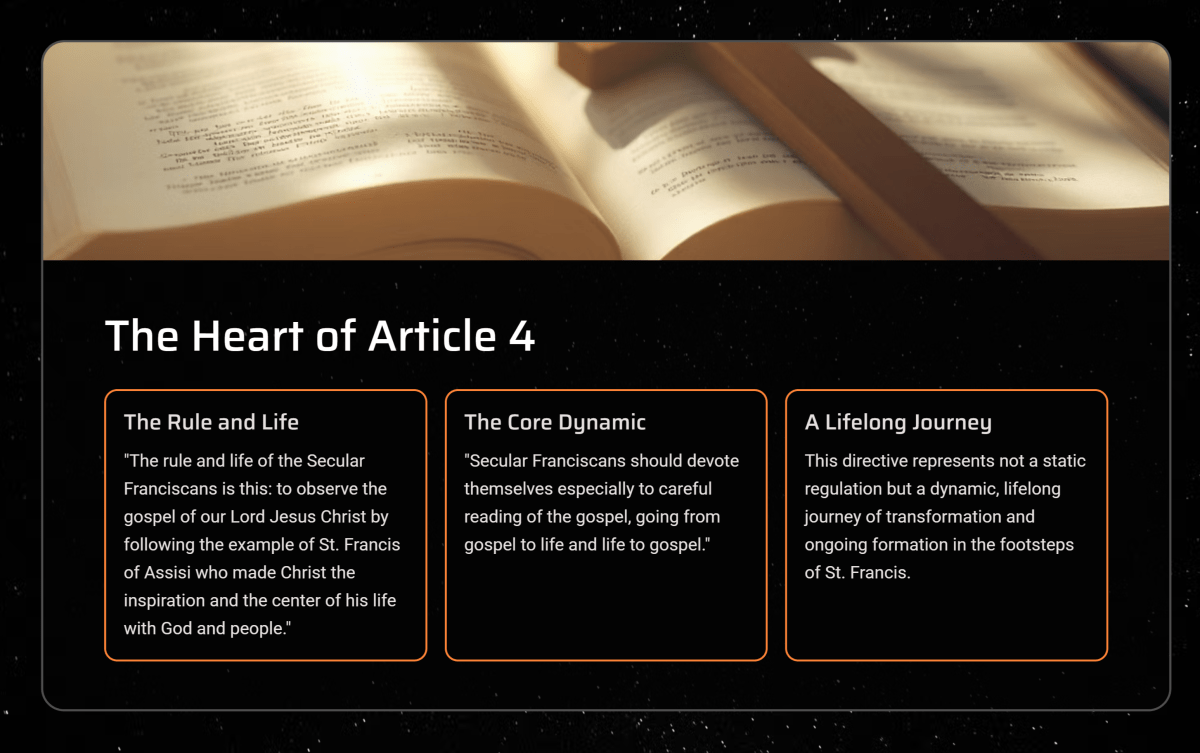
At the core of this Rule lies Article 4, a passage that encapsulates the essence of the Secular Franciscan way of life: “The rule and life of the Secular Franciscans is this: to observe the gospel of our Lord Jesus Christ by following the example of St. Francis of Assisi who made Christ the inspiration and the center of his life with God and people”.5 This foundational article further directs that “Secular Franciscans should devote themselves especially to careful reading of the gospel, going from gospel to life and life to gospel”.5 This report seeks to delve into the profound meaning and vital importance of this specific directive, exploring it not as a static regulation but as a dynamic, lifelong journey of transformation and ongoing formation.7
The journey of “going from Gospel to life and life back to the Gospel” is deeply rooted in the earliest Franciscan understanding of Christian living. The Prologue to the 1978 Rule is, in fact, St. Francis’ own Exhortation to the Brothers and Sisters of Penance, the original name for Secular Franciscans.4 This foundational text immediately establishes a spirit of “penance”—not primarily as acts of self-punishment, but as a continuous, heartfelt turning towards God. This understanding of penance is synonymous with what the Gospel itself terms “conversion” (μεταˊνοια, metanoia), a “radical interior change”.4 This ongoing conversion, this persistent reorienting of one’s life towards Christ, serves as the very engine driving the dynamic interplay between Gospel and life. The call to move from Gospel to life and then from life back to the Gospel is, therefore, lived within this fundamental framework of continuous conversion, a core element of Franciscan spirituality from its inception. It is not an optional extra but the very soil in which the Gospel dynamic is intended to flourish, shaping the Secular Franciscan’s response to God’s call in the midst of the world.
Chapter 2
Understanding “From Gospel to Life”: Letting the Word Shape Our World
The first movement in this vital spiritual dynamic, “from Gospel to life,” signifies the deliberate and consistent effort to take the Gospel of Jesus Christ as the primary source, inspiration, and guiding principle for every dimension of a Secular Franciscan’s existence.9 It is an active process of allowing the person, teachings, and values of Jesus, as revealed in the Gospels, to permeate and shape one’s thoughts, attitudes, decisions, and actions. Christ is acknowledged not merely as a historical figure but as “the way to him [the Father], the truth into which the Holy Spirit leads us, and the life which he has come to give abundantly”.5 The Gospel, therefore, is the privileged place where Secular Franciscans encounter this Christ and learn the path to abundant life.
Crucially, Article 4 of the Rule prefaces the directive “going from gospel to life” with an indispensable foundation: “Secular Franciscans should devote themselves especially to careful reading of the gospel”.5 This is not a suggestion for occasional or superficial engagement with Scripture but a call to a dedicated, prayerful, and sustained immersion in the sacred text. The purpose of this careful reading is to “seek to encounter the living and active person of Christ”.5 The sequential phrasing in Article 4—”careful reading of the gospel, going from gospel to life…”—is significant. It implies a necessary preparatory and ongoing discipline. A genuine and fruitful movement “from Gospel to life” is predicated upon this deep, personal, and continuous engagement with the Gospel text itself. It is not simply about aspiring to live a “good life” in an abstract sense, but about living a life specifically informed by, responsive to, and modeled on the person and teachings of Jesus Christ as encountered in the richness of Scripture. This careful reading anchors the subsequent “living” in the objective Word of God, preventing a purely subjective or uninformed approach to Christian discipleship.
When approached with such dedication, the Gospel becomes a comprehensive lens through which the Secular Franciscan views and engages with their secular reality. It offers “Perspectives for life. Values that guide our actions. For our inner spirit to grow. Attitudes on social issues and the judgments we make in daily life. In fact, nothing in our life is outside the reach of the Gospel of Jesus Christ”.9 The call is to “conform their thoughts and deeds to those of Christ”.4 This means actively applying Gospel values within their families, workplaces, social interactions, and civic responsibilities, transforming these everyday arenas into spaces where the Kingdom of God can be made manifest.2 The Rule itself provides concrete examples of how this “Gospel to life” movement takes shape:
Seeking a “proper spirit of detachment from temporal goods by simplifying their own material needs,” and understanding themselves as “stewards of the goods received for the benefit of God’s children” (Rule, Article 11).5
With a “gentle and courteous spirit accept all people as a gift of the Lord and an image of Christ,” placing themselves on an equal basis with all, especially “the lowly for whom they shall strive to create conditions of life worthy of people redeemed by Christ” (Rule, Article 13).5
Esteeming work “both as a gift and as a sharing in the creation, redemption, and service of the human community” (Rule, Article 16).5
Respecting “all creatures, animate and inanimate, which ‘bear the imprint of the Most High,'” and striving “to move from the temptation of exploiting creation to the Franciscan concept of universal kinship” (Rule, Article 18).5
In this endeavor, St. Francis of Assisi stands as the luminous exemplar. The Rule explicitly states that the observance of the Gospel is to be undertaken “by following the example of St. Francis of Assisi who made Christ the inspiration and the center of his life with God and people”.5 St. Francis’s life was a powerful testament to the possibility of taking the Gospel’s message with radical seriousness and joyful fidelity, translating its often-challenging demands into tangible, lived reality. His transformative encounter with the leper, his wholehearted embrace of poverty, his tireless preaching of peace and penance—all these flowed directly from his profound immersion in the Gospel and his unwavering desire to conform his life to Christ. St. Francis did not merely read or admire the Gospel; he sought to become a living reflection of it. For Secular Franciscans, therefore, the “Gospel to life” movement involves a similar striving for this spiritual transparency, where the love, compassion, and truth of Christ become visible through their own actions, attitudes, and priorities. The example of St. Francis provides not only profound inspiration but also a concrete methodology for making Christ the true center of one’s life, demonstrating how the Word can indeed become flesh in the ordinary circumstances of the world.10
Chapter 3:
Understanding “From Life back to the Gospel”: Finding Christ in Our Experiences
The second movement in this dynamic spiritual cycle, “from life back to the Gospel,” represents the equally crucial reflective dimension of the Secular Franciscan way. It involves the intentional practice of taking one’s daily experiences—the joys and sorrows, successes and failures, challenges and consolations—and bringing them back to the light of the Gospel for deeper understanding, discernment, and spiritual insight.9 This is not a retreat from life, but a prayerful engagement with life, asking critical questions: How do my lived realities resonate with, challenge, or affirm the teachings of Jesus Christ? Where is God present and active in these moments? What is the Spirit inviting me to learn or to change?
This reflective movement “from life back to the Gospel” is intrinsically linked to the unceasing call to daily conversion, or metanoia. Article 7 of the OFS Rule, drawing from the spirit of the Prologue, powerfully articulates this: “United by their vocation as ‘brothers and sisters of penance’ and motivated by the dynamic power of the Gospel, let them conform their thoughts and deeds to those of Christ by means of that radical interior change which the Gospel calls ‘conversion.’ Human frailty makes it necessary that this conversion be carried out daily”.4 The “life to Gospel” practice is essential for this daily conversion. By honestly examining their lived experiences through the clarifying lens of the Gospel, Secular Franciscans can identify areas in their lives that are not yet fully aligned with Christ’s teachings, recognize patterns of sin or uncharitable behavior, and discern the specific ways they are being called to transformation, repentance, and renewed commitment. The Sacrament of Reconciliation holds a privileged place in this ongoing journey of conversion, serving as a “privileged sign of the Father’s mercy and the source of grace” (Rule, Article 7).11
The Rule’s explicit acknowledgment that “human frailty makes it necessary that this conversion be carried out daily” imbues this principle with profound realism and compassion.9 It recognizes that the path of discipleship is not about achieving a static state of sinless perfection, but about a persistent, humble, and hopeful return to the Gospel whenever life’s experiences reveal personal shortcomings, weaknesses, or failures. This understanding prevents the Franciscan path from becoming a source of discouragement over imperfections; instead, it fosters a spirit of constant renewal, grounded in the mercy of God and a reliance on His grace rather than on one’s own strength. This realistic appraisal of the human condition encourages a gentle humility and a continuous openness to growth.
The movement “from life back to the Gospel” is not intended to be a solely individualistic or purely introspective exercise. It thrives on intentional reflection, wherein Secular Franciscans actively “seek to encounter the living and active person of Christ in their brothers and sisters, in Sacred Scripture, in the Church, and in liturgical activity” (Rule, Article 5).5 Life’s varied experiences, when prayerfully considered, become arenas for these encounters. The OFS fraternity plays an indispensable role in this process. As one source notes, “In fraternal gatherings we share insights and reflections for implementing the Gospel in everyday life”.9 Within the supportive environment of the fraternity, members “learn to share insights and failures, dreams and frustrations, excitements and disappointments, vision and action. We do not seek an escape from daily life”.9 This communal reflection is vital for discerning God’s will, for gaining new perspectives on how the Gospel speaks to contemporary challenges, and for receiving the mutual support and encouragement needed to align their lives more closely with Gospel values.4 The fraternity thus functions as a kind of hermeneutic community, where shared life experiences are collectively brought before the wisdom of the Gospel, and the Gospel’s light is, in turn, collectively brought to bear on those experiences. This shared journey of interpretation and application safeguards against purely subjective understandings and provides a network of accountability and spiritual companionship, making the call to daily conversion a more attainable and less isolating endeavor.
Chapter 4
The Indissoluble Link: The Dynamic Cycle of Faith in Action
The directive for Secular Franciscans to move “from Gospel to life and life to the Gospel” describes not two separate activities but two poles of a single, dynamic, and continuous process. It is “our Process of Formation; This is our Way of life”.7 This is not a linear progression with a definitive endpoint, but a cyclical interaction where each movement perpetually informs and energizes the other.9 The Gospel, carefully read and prayerfully pondered, illuminates the path for living; and lived experiences, when reflected upon through the prism of the Gospel, lead to a deeper, more nuanced understanding of the Gospel itself and a renewed commitment to its practice.
The practical outworking of this cycle can be seen in innumerable daily situations. For instance:
From Gospel to Life: A Secular Franciscan reads Jesus’ challenging call in the Sermon on the Mount to love one’s enemies and pray for those who persecute (Matthew 5:44). Consciously recalling this teaching, they then make a deliberate effort to show kindness, patience, or offer a prayer for a particularly difficult colleague at work or a family member with whom there is tension.
From Life back to the Gospel: The attempt to live out this Gospel call may meet with varying degrees of success. Perhaps the effort is met with continued hostility, leading to feelings of frustration or inadequacy. Or perhaps a small breakthrough occurs, a moment of unexpected grace or understanding. The Secular Franciscan then brings this concrete experience—the struggle, the failure, or the small victory—back to the Gospel. They might re-read Jesus’ words, meditate on His own example of forgiving His persecutors from the Cross, or recognize more acutely their own need for God’s grace and strength to love in such a radical way. This reflection, born from lived reality, then informs and strengthens their resolve for the next attempt to put the Gospel into action.
This dynamic interplay ensures that faith is not confined to the realm of the intellectual or the theoretical, nor does it become a static set of beliefs disconnected from the realities of daily existence. Instead, faith is lived, tested, refined, and deepened in the crucible of everyday life.10 This principle calls Secular Franciscans to be active participants with God in the ongoing work of creation and redemption, not passive observers of life. They are called to be “witnesses and instruments of her [the Church’s] mission among all people, proclaiming Christ by their life and words” (Rule, Article 6).5 Their work, in whatever form it takes, is to be esteemed as “a sharing in the creation, redemption, and service of the human community” (Rule, Article 16).5
The cyclical nature of “Gospel to Life and Life to Gospel” is inherently generative. It is designed to produce what the Prologue to the Rule, quoting St. Francis, calls “worthy fruits of penance”.11 This implies that the process is not solely for the purpose of personal sanctification, though that is a primary aim; it also has an outward, apostolic thrust. Each turn of the cycle—from hearing the Word, to striving to live it, to reflecting on that lived experience in light of the Word, and then returning to live it more fully—should ideally lead to a more authentic, effective, and visible Christian witness in the world.
To further clarify the distinct yet interconnected movements within this single dynamic, the following table offers a comparative overview:
The Dynamic Cycle of “Gospel to Life and Life to Gospel”
Feature
From Gospel to Life
From Life to Gospel
Starting Point/Focus
The Word of God (Sacred Scripture, teachings of Christ)
Application: Actively seeking to implement Gospel values and Christ’s example in life
Reflection: Examining life experiences through the lens of the Gospel
Direction of Movement
Scripture → Daily Living
Daily Living → Scripture
Key Question(s)
How can I live this Gospel truth today? What would Jesus do/teach in this situation?
What does this experience teach me about the Gospel? Where was Christ in this? How can I grow?
Primary Outcome/Goal
Conforming thoughts and deeds to Christ; living a Christ-centered life
Deeper understanding of the Gospel; ongoing conversion (metanoia); renewed commitment
Key OFS Rule Reference
“to observe the gospel… by following the example of St. Francis” (Art. 4) 5
“radical interior change which the gospel calls ‘conversion’…carried out daily” (Art. 7) 9
Role of St. Francis
Model of Gospel living
Exemplar of penitential life and continuous turning to God
Role of Fraternity
Mutual encouragement to live the Gospel; shared learning
Sharing insights, failures, discernment; collective wisdom in interpreting life & Gospel
This table visually distinguishes the two phases while underscoring their interdependence. The outcome of “Life to Gospel” (e.g., a renewed commitment or deeper understanding) becomes the enriched starting point for the next phase of “Gospel to Life,” thus perpetuating a spiral of growth in holiness and witness.
Chapter 5
The Profound Importance of This Principle for Secular Franciscans
The directive to move “from Gospel to life and life back to the Gospel” is far more than a mere suggestion or a pious exhortation; it lies at the very heart of what it means to be a Secular Franciscan. Its importance is multifaceted, touching upon the authenticity of their vocation, their journey towards Christ-likeness, the way they live their Rule, their witness to the world, and their overall spiritual vitality.
Theologian Michele Altmeyer underscores a critical aspect of this principle, stating: “From the Gospel, it means from Jesus, to life, and from life to the Gospel. Here the authenticity of our vocation and our commitment come into play”.10 The active, conscious, and continuous engagement in this dynamic cycle is not an optional extra for the committed Secular Franciscan; it is the very arena where the genuineness of their vocation is tested and demonstrated. Their solemn profession is a pledge “to live the gospel in the manner of Saint Francis” (Rule, Article 2).5 This pledge moves from a noble aspiration to a tangible reality precisely through the consistent practice of applying the Gospel to life’s circumstances and then bringing those circumstances back to the Gospel for illumination and
transformation. Without this dynamic interplay, the vocation risks becoming superficial, a mere label rather than a lived truth. This principle, therefore, is what gives substance, integrity, and authenticity to their Franciscan identity in the world.
The ultimate spiritual aspiration for any Christian, and particularly for a follower of St. Francis, is an ever-deepening “intimate union with Christ” 2, a state where, in the words of St. Paul, it is “no longer I who live, but Christ lives in me” (Galatians 2:20, referenced in 2). St. Francis himself “sought to know and live Christ in His total fullness… conforming himself, by grace, to Him to the point of being considered an alter Christus,” another Christ.10 The “Gospel to life” movement directly serves this profound goal of conformation, as it involves the deliberate effort to shape one’s thoughts, words, and deeds according to the mind and heart of Christ.4 The complementary “life to Gospel” movement then refines and deepens this process through the mechanism of ongoing, daily conversion, ensuring that the journey towards Christ-likeness is constantly renewed and readjusted in light of lived experience.
Furthermore, this principle is the key to truly living the Rule of the Secular Franciscan Order. The Rule is described as “spirit and life,” an “authentic treasure” in the hands of the Secular Franciscan.10 However, as Altmeyer cautions, “We cannot limit ourselves at just an intellectual adherence to the contents of the Rule, we must move on to its concrete implementation”.10 The “Gospel to life and life to Gospel” dynamic is the primary means by which this concrete implementation occurs. It transforms the Rule from a revered document into a lived, vibrant reality. It is through this active engagement that the “life-giving force of the Rule” is experienced, a force that “is the consequence of practicing it and not only of understanding it”.3 The deepest wisdom of the Rule, therefore, is not unlocked through academic study alone, however valuable that may be, but through the experiential knowledge gained in the daily effort to live its precepts. This practice is what makes the Rule truly “spirit and life” for the individual Secular Franciscan.
This inner transformation inevitably overflows into outward witness and evangelization. Secular Franciscans are explicitly called to “go forth as witnesses and instruments of her [the Church’s] mission among all people, proclaiming Christ by their life and words” (Rule, Article 6).5 By consistently striving to live “from Gospel to life,” they increasingly “become a living gospel for all to read”.2 Their transformed lives, characterized by Franciscan virtues such as peace, joy, simplicity, and compassion, become a powerful and attractive form of evangelization within their families, workplaces, and broader secular environments. As Kathryn Swegart, OFS, shared, “Gospel to life, life to Gospel makes you take a deeper dive into being a witness in the world, even in small ways”.1
Living this dynamic also fosters profound spiritual vitality and imbues life with deeper meaning. This practice “takes care of our vitality in order that it does not die out”.3 It helps individuals to give meaning to their daily actions, to internalize their experiences rather than living superficially, and to cultivate a strong sense of fellowship.3 This way of life leads to a “new kind of happiness,” one that comes from sharing in the Lord’s own life and mission.2 Numerous Secular Franciscans testify to how this path has strengthened their faith, brought them profound joy, and nurtured a closer, more personal relationship with God.1
Finally, the faithful living of this principle has implications that extend beyond the individual to the broader Church and society. Secular Franciscans are “called like Saint Francis to rebuild the Church” and, in pursuit of this, they “devote themselves energetically to living in full communion with the pope, bishops, and priests” (Rule, Article 6).5 The “rebuilding” St. Francis was called to was not merely about physical structures but about renewing the spiritual fervor and Gospel integrity of the Church. Secular Franciscans contribute to this ongoing mission primarily through the witness of their transformed lives lived in the heart of the world. Their commitment to peace, justice, the sanctity of family life, care for creation, and service to the poor and marginalized—all flowing from the “Gospel to life” dynamic—helps to infuse both the Church and secular society with the leaven of the Gospel.2 This personal transformation, driven by the constant interplay between Gospel and life, thus generates ripples that contribute to the healing and renewal of the wider human community.
Chapter 6
Living “Gospel to Life and Life to Gospel” Today: Practical Pathways
The call to journey “from Gospel to life and life back to the Gospel” is not an abstract ideal but a practical spirituality meant to be lived out in the concrete realities of daily life. Several pathways and supports are essential for Secular Franciscans seeking to faithfully embrace this transformative process.
At the forefront is the primacy of prayer and the sacramental life. The Rule exhorts: “As Jesus was the true worshipper of the Father, so let prayer and contemplation be the soul of all they are and do” (Rule, Article 8).11 A consistent life of personal and communal prayer, especially meditation on the Gospels, fuels the entire dynamic. Essential to this is active participation in the sacramental life of the Church, “above all the Eucharist” (Rule, Article 8).11 St. Francis’s profound Eucharistic faith, encapsulated in his declaration, “I see nothing bodily of the Most High Son of God in this world except His most holy body and blood,” is to be the inspiration and pattern for their own Eucharistic life (Rule, Article 5).5 Furthermore, Secular Franciscans are encouraged to express their “ardent love” for the Virgin Mary, “humble servant of the Lord… open to his every word and call,” by imitating her complete self-giving and by praying earnestly and confidently (Rule, Article 9).11
Integral to this way of life is the cultivation and practice of Franciscan virtues in everyday circumstances. These include:
Simplicity and Detachment: This involves “simplifying their own material needs” and recognizing themselves as “stewards of the goods received for the benefit of God’s children” (Rule, Article 11).5 Kay Spofford, OFS, emphasizes “the life of simplicity” as central to the Franciscan charism.1
Humility: St. Francis chose for himself and his mother “a poor and humble life” (Rule, Article 11).5 Kathryn Swegart, OFS, rightly calls humility a “huge word” in understanding Franciscan spirituality.1
Poverty of Spirit: This is the ongoing effort to purify their hearts “from every tendency and yearning for possession and power” (Rule, Article 11).5
Peace and Reconciliation: Following the example of St. Francis, who was a “messenger of true peace,” Secular Franciscans are to be “bearers of peace” in their families, workplaces, and communities, always seeking paths of reconciliation.
Respect for Creation and Universal Kinship: They are called to “respect all creatures, animate and inanimate,” and to strive to move from any temptation of exploiting creation towards the “Franciscan concept of universal kinship” (Rule, Article 18).5 This involves appreciating, as Kathryn Swegart notes, “the simplicity, the beauty of God’s creation,” seeing it as “the masterpiece of God”.1
The journey “from Gospel to life and life back to the Gospel” is not meant to be undertaken in isolation. The indispensable role of the OFS fraternity cannot be overstated. Local fraternities typically meet monthly for “prayer, ongoing formation in the Franciscan charism, and mutual support in living more deeply the good news of Jesus Christ”.4 The Rule itself states that “the entire community is engaged in the process of growth by its own manner of living” (Rule, Article 23).5 The fraternity provides a vital space for members to share their insights from Gospel reading, their struggles in applying it to life, and their experiences of bringing life back to the Gospel for discernment. This shared wisdom, mutual encouragement, and loving accountability make the journey less solitary and more resilient.9 Daniel Spofford, OFS, aptly describes the fraternity as having “become a family,” where members “love each other, and we help each other, not only in faith but in our life situations”.1
This inner transformation naturally flows outward into concrete acts of service and witness, often referred to as apostolates. While some fraternities may undertake corporate ministries, many Secular Franciscans assist other religious or civic groups in addressing urgent human needs that are often overlooked.4 The St. John the Baptist Fraternity in Maine, for example, has supported campus ministry, assisted refugee families, organized clothing drives for the poor, and conducted food drives for local pantries.1 These are tangible expressions of “Gospel to Life,” where faith inspires compassionate action. As Daniel Spofford, OFS, articulates their mission, “We seek to bring the light of Christ to others every day… try to sow peace in the world”.1
Finally, it is crucial to recognize that the dynamic of “Gospel to life and life to Gospel” is the very essence of ongoing formation, which is a lifelong commitment for the Secular Franciscan. The process of becoming a member involves a period of initiation, at least a year of initial formation, and then a permanent profession to live by the OFS Rule.4 This profession, however, marks not an end but a beginning of a “life-long commitment of ongoing formation to become Christ like through the values of St. Francis of Assisi”.6 Significantly, the phrase “Gospel to life; life to the Gospel” is explicitly identified as “our Process of Formation; This is our Way of life”.7 This underscores that this dynamic is not an advanced practice reserved for the spiritually mature, but the fundamental pedagogical method by which individuals are formed as Secular Franciscans from their earliest days of inquiry and candidacy. It is the path they walk from the moment they begin their journey and one that continues to shape them throughout their lives.
Chapter 7
Conclusion: Embracing the Journey of Transformation
The call embedded in Article 4 of the Secular Franciscan Rule—”to go from Gospel to Life and Life back to the Gospel”—is far more than a pithy slogan or a simple guideline. It is a profound summons to a dynamic, transformative, and lifelong discipleship in the footsteps of St. Francis of Assisi. This principle articulates the very method by which Secular Franciscans strive to make Christ truly “the inspiration and the center of his life with God and people”.4 It is the spiritual engine that drives their vocation, enabling them to live the Gospel authentically within the unique circumstances of their secular lives.
Embracing this journey requires perseverance in the daily effort of conversion. The recognition that “human frailty makes it necessary that this conversion be carried out daily” is not a cause for discouragement but an invitation to rely ever more deeply on the mercy and grace of God.9 While the path of conforming one’s life to Christ is undoubtedly demanding, it is, at its heart, a “response to the crucified love of Jesus” 10, a love that empowers and sustains.
The fruits of faithfully living this Gospel-centered dynamic are abundant and life-giving. They include a progressively deeper and more personal relationship with God 1, growth in “perfect charity” (Rule, Article 2) 5, and the experience of profound joy and peace, even amidst life’s challenges.1 Ultimately, this way of life enables Secular Franciscans to become, like St. Francis before them, a “living gospel for all to read” 2, radiating the light, love, and hope of Christ within their families, workplaces, and the wider world. The journey “from Gospel to life and life back to the Gospel,” while calling for constant effort and renewal, is fundamentally a path to spiritual freedom and the deep, abiding joy that is the hallmark of authentic Franciscan spirituality—a joy found in intimate union with Christ and in the wholehearted living of one’s God-given vocation.
2 Secular Franciscan Order – Australia, National Formation Commission. “Commentary on the Rule and Constitutions.” Franciscans.org.au. https://sfo.franciscans.org.au/rulesconst/commentary.htm (This citation corresponds to 2 in the previous version’s reference list)
A Reflection on the “Big, Beautiful Bill” and Our Call to Peace and Justice
Pace e Bene! Peace and All Good. This traditional Franciscan greeting invites reflection, calling us to a spirit of shared humanity and reconciliation. As followers of St. Francis, a revered “herald of peace” who made God’s love comprehensible to ordinary people, our lives are inspired by his profound religious experiences and deep concern for all creation.1 In these complex times, when significant legislative proposals are placed before our nation, we, as Catholics and especially lay Franciscans, must examine such measures through the lens of Gospel values and the comprehensive framework of Catholic Social Teaching.
This article explores the tensions that arise when public policy, such as the “big, beautiful bill” proposed by Republicans in the Senate 2, appears to diverge from the core tenets of Franciscan spirituality and broader Catholic Social Teaching. It is a moment for profound discernment, moving beyond partisan rhetoric to a faith-informed ethical analysis. The diverse political affiliations and beliefs among Catholics in the United States 4 underscore the necessity of this evaluation. While the Church guides moral principles for voting, it does not dictate specific choices.8 The fact that some Catholics may support policies that conflict with certain aspects of Church teaching 5 highlights an internal complexity within the Catholic community. This situation necessitates a deeper moral evaluation, providing a framework for applying faith to this policy. Responsible citizenship, an ethical obligation rooted in our baptismal commitment, demands that the moral convictions of well-formed consciences shape our participation in the political process 10 This report, therefore, seeks to illuminate the ethical implications of the bill, rather than merely its political alignment.
The Enduring Call of St. Francis: Simplicity, Solidarity, and Creation
The Franciscan way of life offers a profound lens through which to view the world and its challenges. It is centered on a deep love for God and creation, community, service, simplicity, peace, justice, and care for creation.11 These values, inspired by Saints Francis and Clare of Assisi, provide a radical counter-cultural ethic that often directly opposes prevailing societal norms.
A deep love for God and creation is at the heart of Franciscan spirituality. Franciscans strive to live by Gospel values, seeing in all of God’s creation a reflection of divine love.11 St. Francis’s “Canticle of the Creatures” beautifully expresses this interconnectedness, referring to all creation as “sister, brother, mother. “.13 This perspective emphasizes that nothing in this world is indifferent to us, and the harm inflicted upon creation is a reflection of the violence within human hearts.14
Simplicity and poverty are fundamental to the Franciscan charism. St. Francis renounced a life of privilege to embrace poverty and service.12 Franciscans avoid materialism and consumerism, focusing instead on relationships and spiritual growth.11 This commitment extends to shared ownership and equitable distribution of goods.11 The purpose of this poverty is not deprivation, but to remove the desire for wealth as an obstacle to faith 15 and to foster vulnerability, openness, and a deeper relationship with Christ found in the poor.16 This stance is a deliberate protest against a society that often embraces wealth and ostentatious power.15
Community and fraternity are central to the Franciscan way, emphasizing mutual support and shared values within fraternities and sororities.11 This communal living strengthens spiritual growth and collective mission, fostering deep relationships built on love, respect, and humility.11 This sense of fraternity extends beyond human relationships to a “cosmic fraternity,” where Francis used the names “brother” and “sister” for all creation, a novelty in his time.13
Franciscans are profoundly committed to service and “minority,” which means serving among and standing in solidarity with those on the margins.12 St. Francis actively reached out to the leper, the poor, and the marginalized, recognizing Christ’s presence in them.1 This “preferential option for the poor” is a core tenet, calling Franciscans to be with and identify with the poor and vulnerable in their struggle for dignity and rights.16
Promoting peace and justice is integral to the Franciscan mission.11 Franciscans are known as “heralds of peace, 1, advocating for nonviolence and conflict resolution through dialogue, understanding, and forgiveness.17 The pursuit of Justice, Peace, and Integrity of Creation (JPIC) is a chief priority, aiming to address the root causes of poverty, inequality, and violence.1
Finally, care for creation, or environmental stewardship, is a fundamental aspect of Franciscan spirituality. Rooted in Francis’s love for all creation, Franciscans advocate for sustainable living and ecological responsibility.17 Pope Francis’s encyclical Laudato Si’ draws heavily from St. Francis’s “Canticle of the Creatures,” reminding us that our common home is a “sister” and “mother” who “cries out to us because of the harm we have inflicted on her by our irresponsible use and abuse”.14 This teaching stresses that creation can never be treated merely as an object to be used, consumed, and discarded, but possesses its own intrinsic value.13
These Franciscan values are personal virtues and constitute a radical social ethic. They compel us to question fundamental policy: Does it foster simplicity, solidarity, peace, and genuine care for creation? Does it challenge or reinforce systems that create poverty, inequality, and environmental degradation? This framework provides a critical, faith-based standard against which the “big, beautiful bill” must be measured, immediately highlighting potential areas of tension.
Catholic Social Teaching: A Moral Compass for Public Life
Catholic Social Teaching (CST) provides a comprehensive framework for applying Gospel values to social, economic, and political life.20 It is fundamentally rooted in the inherent dignity of the human person, created in God’s image and likeness, a belief that forms the foundation of all its principles.7
Key principles of CST include:
Life and Dignity of the Human Person: This bedrock principle proclaims the sacredness of human life from conception to natural death, asserting that every person is precious.7 It calls for “Integral Human Development,” encompassing each person’s economic, political, social, ecological, and spiritual well-being.23
Call to Family, Community, and Participation: Human beings are inherently social. The organization of society—its economics, politics, and laws—directly impacts human dignity and the capacity for individuals to flourish in community. All people have a right and a duty to participate in society, working together for the common good.8
Rights and Responsibilities: Human dignity is protected and a healthy community is achieved only when human rights are upheld and corresponding responsibilities are met. Every person has a fundamental right to life and to those necessities for human decency, along with duties to one another, their families, and the broader society.22
Preferential Option for the Poor and Vulnerable: A fundamental moral test for any society is how its most vulnerable members are faring. This principle calls us to prioritize the needs of the poor and vulnerable, recognizing that their needs take precedence over the desires of the rich.7
The Dignity of Work and the Rights of Workers: The economy must serve people, not vice versa. This means respecting the fundamental rights of workers, including the right to productive work, decent and fair wages, and to organize.21
Solidarity: We are one human family, interconnected and interdependent, transcending national, racial, ethnic, economic, or ideological differences. Loving our neighbor has global dimensions and demands working for justice and peace, actively fighting the structural causes of poverty and inequality.22
Subsidiarity: This principle posits that the state should undertake only those tasks beyond the capacity of individuals or private groups acting independently.8 It cautions against unnecessary governmental intervention, emphasizing respect for the initiative and rights of individuals and local social units.24 The principle aims to empower individuals and smaller groups to fulfill societal roles.8
Care for God’s Creation: The Earth is sacred, a gift from God, possessing its intrinsic value. Humanity is responsible for protecting and cherishing the Earth’s ecological diversity and life-sustaining properties for future generations.17 This concern for nature is intrinsically linked to justice for the poor and commitment to society.13
These principles are not isolated tenets from which one can pick and choose; they are deeply interwoven and form a consistent ethic. For example, as articulated in Laudato Si’, environmental stewardship is intrinsically linked to justice for the poor.13 The tensions often observed within the Catholic community regarding political issues frequently stem from a selective application of these principles. Some Catholics may prioritize certain issues, such as abortion or religious liberty 7, while downplaying or overlooking others, such as social safety nets or environmental protection. This selective approach can lead to a fragmented understanding of the common good and result in political alignments that appear contradictory from a holistic CST perspective. The strong connection between Laudato Si’ and Franciscan spirituality 13 underscores that environmental issues are not secondary but fundamental aspects of social justice. Therefore, assessing any legislative proposal’s impact across all CST principles, not just those that align with a pre-existing political ideology, is crucial. This comprehensive view is essential for “forming a Catholic conscience” 7 and understanding why the Franciscan Movement, emphasizing the poor and creation, might find certain aspects of the bill deeply problematic, even if other Catholics support them. The challenge is to move beyond “single-issue voting” 9 to a comprehensive commitment to the common good and the dignity of everyone.
The “Big, Beautiful Bill” Through a Catholic-Franciscan Lens
The Republican legislative proposal, often referred to as the “big, beautiful bill,” is characterized by a focus on “cutting waste and government spending, reducing burdensome regulations, providing tax cuts that support families and small businesses, [and] supporting domestic energy”.2 It aims to extend the 2017 tax cuts, which are described as “skewed to the wealthy” 27, and includes “deep spending cuts to anti-poverty programs”.3 This approach has been identified as a “triple threat to low and moderate-income family well-being”.27
Economic Justice and the Poor
The bill proposes extending tax cuts that could avert a “$4 to $5 trillion tax increase”.2 However, these tax cuts are explicitly described as “skewed to the wealthy” 27, and analyses suggest they would “reduce the income of households in the bottom 60 percent” or even the “bottom 40 percent”.27 The current tax code already favors “upper class wealth-building over working class economic stability,” with corporations sometimes benefiting from “negative taxes” through subsidies.30
Concurrently, the bill calls for “enormous cuts in Medicaid, the Supplemental Nutrition Assistance Program (SNAP), student loan assistance and other vital sources of support”.3 These cuts are projected to result in millions losing health insurance 3 and nearly 11 million people losing “some or all SNAP benefits” due to increased paperwork requirements and reduced flexibility for states.3 Studies also show that adding work requirements to Medicaid results in “virtually no increase in employment, but huge decreases in participation by otherwise eligible people”.29
This approach stands in stark contrast to the CST principle of the “Preferential Option for the Poor” 22 and the Franciscan commitment to “serving the poor” and “standing in solidarity with those on the margins”.12 The United States Conference of Catholic Bishops (USCCB) has explicitly implored Congress to “protect programs such as Medicaid and SNAP and to expand the Child Tax Credit (CTC) to the most vulnerable children,” stating unequivocally that “Tax cuts that largely favor wealthier persons should not be made possible through cuts to healthcare and food for families struggling to make ends meet”.31 Catholic organizations like Catholic Charities USA and the Catholic Health Association have echoed this advocacy, emphasizing the essential nature of these programs for meeting basic human needs.31
The simultaneous proposal of tax cuts skewed to the wealthy and deep cuts to anti-poverty programs represents a moral inversion of the “Preferential Option for the Poor.” Instead of prioritizing the needs of the most vulnerable, the bill prioritizes wealth accumulation for those already possessing significant resources. This directly contradicts the Gospel message that “it is easier for a camel to go through the eye of a needle than for someone who is rich to enter the kingdom of God” 15 and the Franciscan call to identify with the poor and marginalized.16 It also undermines the fundamental CST principle that “The economy must serve people, not the other way around”.21 For Catholics, and especially Franciscans, who are called to “make justice their aim” 31 and to see Christ’s presence in the poor 1, supporting such a bill, even for other perceived benefits, would necessitate a profound moral reckoning with its direct and severe impact on the most vulnerable. This challenges the very “moral compass of our country and its people” 1 and creates a significant point of tension.
The potential human cost of this legislative package is substantial, impacting millions of families. The following table illustrates some of the projected impacts:
Projected Impacts of the “Big, Beautiful Bill” on Vulnerable Populations
Impact Category
National Estimate
Representative State/District Examples
Increase in Uninsured People by 2034 (due to Medicaid cuts and ACA changes)
Jobs at Risk by Terminating Clean Energy Tax Credits
Not specified nationally
California’s 22nd Congressional District: 5,193 3
This quantifiable data underscores the severity of the proposed cuts and their direct conflict with the Catholic commitment to human dignity and the common good.
Environmental Stewardship and Deregulation
The Republican agenda includes “reducing burdensome regulations” 2 and “unleashing American energy production”.2 This often involves efforts to roll back environmental protections, such as “dismantling the national parks system”.33 The bill also mentions eliminating “clean energy tax credits” 3, which could put jobs at risk.
This approach directly conflicts with the CST principle of “Care for God’s Creation” 22 and the deep Franciscan commitment to environmental stewardship.17 Pope Francis’s encyclical Laudato Si’13 emphasizes that our common home is a “sister” and “mother” who “cries out to us because of the harm we have inflicted on her by our irresponsible use and abuse of the goods with which God has endowed her”.14 It warns against treating creation as merely an object to be used, consumed, and discarded, stressing its intrinsic value.13 Franciscan Brother Jacek Orzechowski has described the Trump administration’s changes to environmental policy as “a colossal moral failure” and a “social sin which cries to heaven,” as well as “a profound affront to the Creator God”.33
The underlying tension here is the false dichotomy that frequently pits economic growth, often pursued through deregulation and resource exploitation, against ecological responsibility. Catholic Social Teaching, particularly as articulated in Laudato Si’, rejects this separation, advocating for an “integral ecology” where human and environmental well-being are intrinsically linked and inseparable.13 Treating nature as merely a resource to be exploited (“entitled to plunder her at will,” 14) is not just an economic choice but a “profound affront to the Creator God” 33 and undermines the common good, especially for future generations.19 For Franciscans, whose spirituality is deeply rooted in cosmic fraternity and a profound respect for all creation 13, policies that aggressively deregulate and exploit natural resources are seen as economic decisions and moral failings. This aspect of the bill directly challenges the Franciscan call to live in harmony with creation and to protect our common home, creating a clear and significant point of tension with those who prioritize economic models that disregard environmental impact.
Government’s Role, Accountability, and Civil Society
The bill’s stated goals include shrinking “a bloated federal bureaucracy” and addressing “runaway judicial activism.”.2 From a Catholic perspective, the principle of subsidiarity dictates that matters should be handled at the lowest competent level.8 This means the state should not “intervene unnecessarily” 24 or “crowd out private charity”.25 However, CST also recognizes that “legitimate and necessary governmental intervention for the common good is defended. “.24
A critical observation is that some large-scale problems, such as “water quality, air pollution, and climate change,” cannot be solved by local entities and require “collaboration and policy at the state, regional, and national level”.33 Furthermore, CST states that “society has a moral obligation, including governmental action where necessary, to assure opportunity, meet basic human needs, and pursue justice in economic life”.21 While Pope John Paul II criticized the “Welfare State” for fostering “governmental excesses and abuses” that led to a “reduced sense of social solidarity” and “loss of human initiative” 24, this critique is distinct from the Church’s strong support for federal “social safety net” programs. The USCCB explicitly supports programs like Medicaid and SNAP as “essential to helping many families meet basic human needs” 21, noting their effectiveness in lifting people out of poverty.29
While potentially framed as aligning with subsidiarity, the bill’s approach to government reduction and social program cuts directly contradicts the Church’s practical advocacy for federal safety nets and its recognition of the state’s necessary role in addressing large-scale societal problems. This reveals a common misinterpretation or selective application of subsidiarity. While CST promotes local initiative and warns against state overreach, it does not advocate for dismantling essential governmental functions that serve the common good or protect the vulnerable when smaller entities are incapable. The Church’s critique of the “welfare state” was aimed at excesses and abuses that undermined solidarity and human initiative, not at eliminating the state’s fundamental responsibility to ensure basic needs and justice where necessary.24 The “big, beautiful bill” appears to leverage the critique of “welfare state” bureaucracy to justify cuts that directly harm the poor, which the USCCB explicitly condemns.31 This is a crucial distinction: subsidiarity empowers lower levels, but it does not absolve higher levels of their responsibility for the common good, especially for issues beyond local capacity.
From a Catholic perspective, political authorities are “obliged to respect the fundamental rights of the human person” 35 and to practice “distributive justice wisely”.35 Citizens have both a right and, at times, a duty “to voice their just criticisms of that which seems harmful to the dignity of persons and to the good of the community”.35 True peace, according to Aquinas, is “a harmony that is based on free consent, in the reasoned acceptance of the truth,” not merely “forced concord”.36 The Church also emphasizes “ensuring the integrity of elections processes” and protecting “voting rights” as a “moral imperative for the common good” 38, highlighting the importance of citizen participation.10 The bill’s proposed changes to government structure and social programs, if enacted, could severely weaken the state’s ability to fulfill its moral obligation to the common good and the poor. This also impacts the ability to hold the current government and the Republicans and Catholics that support it accountable, as it shifts burdens onto already struggling families and communities, contrary to CST.
Navigating Tensions: Catholics, Politics, and Conscience
The American Catholic population is “diverse in its beliefs, its adherence to Church teaching, and its religious practices as well as its social and political views”.5 Many Catholics “deviate from the Church’s teachings on social and cultural issues that intersect with politics” 5, and political party affiliation can sometimes be more influential than religious teachings on certain issues.6 For instance, while white Catholics often favor the GOP, Hispanic Catholics tend to favor Democrats.6 There is also a trend of “political/religious sorting,” where conservatives and Republicans tend to be more religious, and Democrats and liberals less so.6
Catholics are called to participate in politics by voting with a “conscience informed by the truths of Church teaching”.7 This involves informing oneself responsibly about Church teachings and relevant issues, reflecting prayerfully, and then choosing confidently.8 Conscience is described as the “voice of God within” 7 and requires “serious attempts to make sound moral judgments based on the truths of our faith”.9 It is not merely a feeling or a justification for doing whatever one wants.7
While certain issues, such as abortion, euthanasia, and racist behavior, are considered “intrinsically evil acts” and “preeminent threats to human life and dignity” 7, the Church explicitly teaches that “Catholics are not single-issue voters”.9 A candidate’s position on a single issue is not sufficient to guarantee a voter’s support, though a position promoting an intrinsically evil act can legitimately disqualify a candidate.7 The complex moral dilemma of voting for a candidate who supports an intrinsically immoral act for “other morally grave reasons” is acknowledged, requiring “proportionate reasons.”.9
The documented diversity in Catholic political views, with some Catholics supporting policies like those in the “big, beautiful bill” that appear to contradict core CST principles, particularly the preferential option for the poor and care for creation, points to a deeper issue. The trend of “political/religious sorting” 6, where political affiliation seems to influence religious views, suggests a peril of ideological capture. This occurs when a political party’s platform, rather than the full, comprehensive breadth of CST, becomes the primary lens through which Catholics evaluate policy. When Catholics support a bill that, for example, makes deep cuts to programs for the poor 3, it suggests that other political priorities (e.g., tax cuts, deregulation, reducing government size) are being weighed more heavily than the direct and severe impact on human dignity and the common good, despite explicit and consistent Church teaching.31 This represents a failure of integral conscience formation if it leads to neglecting “fundamental moral truths”.10 The article must challenge readers to engage in an integral conscience formation, one that considers all CST principles holistically, not just those that align with a particular party’s platform. It is about “bringing together our principles and our political choices, our values and our votes”.10 The tension is therefore not just between different groups of Catholics, but within the conscience of individual Catholics who must strive to reconcile their faith with complex political realities. St. Francis himself was known for actively fostering reconciliation between warring parties.1 The Franciscan call to universal kinship 1 and to seek unity in truth, founded on love 37, transcends partisan divides and demands a consistent ethic of care for all people and creation, fostering unity in truth rather than false unity.37
Our Response: Living the Gospel in the Public Square
As Catholics, participation in the political process is a “moral obligation”.8 This involves more than just casting a vote on Election Day; it requires “ongoing participation in the continuing political and legislative process”.10 We are called to “communicate our concerns and positions to elected officials” 10 and to engage in public life “shaped by the moral convictions of well-formed consciences and focused on the dignity of every human being, the pursuit of the common good, and the protection of the weak and the vulnerable”.10
Beyond policy advocacy, Franciscans are called to “transform our lifestyles, particularly in the U.S., where our per capita carbon emissions are among the highest in the world”.33 This includes engaging in “local grassroots advocacy” through “Franciscan Justice Circles” 18 and embracing the spirit of St. Francis: “Start by doing what’s necessary; then do what’s possible; and suddenly you are doing the impossible”.16 This translates into concrete actions such as supporting the poor, advocating for asylum seekers, and combating environmental racism.16
The Church’s social mission is embodied and advanced through various organizations that serve as concrete expressions of its commitment to justice. These include:
United States Conference of Catholic Bishops (USCCB): This official body advocates for policies protecting human life and dignity, strengthening families, and preserving the social safety net.21 They directly engage Congress on budget issues, social safety nets (Medicaid, SNAP, Child Tax Credit), and human rights.21
Catholic Charities USA: A major provider of direct services, including food, shelter, and counseling, and a vocal advocate for policies essential to families’ basic human needs.31
Catholic Health Association of the United States: This organization advocates for healthcare access, particularly protecting and supporting the Medicaid program.31
Franciscan Action Network (FAN): A collective Franciscan voice that seeks to transform U.S. public policy related to peacemaking, care for creation, poverty, and human rights.16
NETWORK Lobby for Catholic Social Justice: Founded by Catholic Sisters, this organization focuses on lobbying and grassroots advocacy for federal policies that support the flourishing of all, with a commitment to centering racial justice and equity.20
Catholic Relief Services (CRS): As an official agency of the U.S. Catholic Church, CRS works globally to meet basic needs and advocate for solutions to injustice, embodying Catholic social and moral teaching.39
Catholic Campaign for Human Development (CCHD): The official anti-poverty agency of the U.S. bishops, CCHD funds community-based, grassroots-led organizations that empower poor and marginalized people to address local problems and systemic issues.40
These organizations demonstrate a crucial interplay between direct service (charity), systemic advocacy (justice), and spiritual transformation (personal conversion). It is insufficient to provide charity if systemic injustices persist.20 Similarly, advocating for policy change without personal conversion and a lifestyle that reflects Gospel values risks becoming hollow.12 The Franciscan tradition, with its emphasis on “being with and identifying with the poor” 16 and its deep contemplative roots 12, offers a powerful model for this integral approach. The tensions discussed throughout this article often arise when one of these essential dimensions is prioritized to the exclusion or detriment of others, or when the spiritual grounding is lost in the fervor of political engagement. For lay Franciscans, responding to the “big, beautiful bill” means analyzing its policy implications and discerning how their lives reflect the values it challenges or upholds. It implies a call to active, informed citizenship and a deeper spiritual practice that fuels their commitment to justice and peace. This holistic response is the path to “transforming the party to which we belong” rather than being transformed by it 10, ultimately contributing to a more just and peaceful world.
Finally, all service and action flows from prayer.12 Building understanding and fostering true peace happens first by “contemplative study and prayerful embrace of the truths of our faith”.37 This spiritual grounding ensures that activism remains rooted in Gospel values and avoids becoming merely partisan.
Conclusion: Towards a More Just and Peaceful World
The Franciscan vision calls us to universal fraternity 1 and integral human development 13, recognizing that “Everything is interconnected” – our common home and all its inhabitants.13 Our pursuit of justice must reflect this profound unity.
The “big, beautiful bill,” with its proposed tax cuts skewed to the wealthy and deep reductions in vital social safety net programs, presents a significant challenge to this vision. It prioritizes economic models that exacerbate inequality and disregard environmental stewardship, creating a moral inversion of the preferential option for the poor and a profound affront to creation. While the principle of subsidiarity is valuable, its misapplication to justify dismantling essential governmental functions that serve the common good and protect the vulnerable contradicts the Church’s consistent advocacy.
Despite political divisions and the formidable challenges posed by policies that contradict faith values, we maintain a tone of hope rooted in God’s providence and the Gospel’s transformative power. Pursuing justice and peace is an ongoing journey, requiring perseverance and a commitment to “continue to act for justice” even when faced with resistance.38 We are called to faithful citizenship, engaging in the political process with a well-formed conscience that considers all principles of Catholic Social Teaching. This means actively advocating for policies that uphold human dignity, protect the vulnerable, and care for our common home, while also transforming our own lives and supporting organizations that embody these Gospel values through both charity and justice.
Pace e Bene. May peace and all good be with us as we strive to be instruments of God’s peace and justice in the world, embodying Christ’s love in every aspect of our lives.
Please be advised that the views and opinions expressed in my writings are solely my own and do not necessarily reflect the official positions, doctrines, or teachings of the Catholic Church or the Franciscan movement. These writings are the product of my personal reflection and understanding.
The Jubilee Year is a sacred time of grace, transformation, and renewal, rooted in the biblical tradition of Leviticus 25:10, which calls for a year to “proclaim liberty throughout the land.” In the Catholic Church, the Jubilee is a moment to forgive debts, restore relationships, and embrace God’s mercy. Pope Francis, in his Bull of Indiction Spes Non Confundit (May 9, 2024), declares the 2025 Jubilee as a “Holy Year of hope,” inviting the faithful to renew their commitment to reconciliation and justice (Spes Non Confundit, ). For Secular Franciscans, the Jubilee resonates deeply with our vocation of conversion and peacemaking. It echoes St. Francis’ call to encounter Christ in the poor, in creation, and in every brother and sister. As Spes Non Confundit urges, this is a time to “return to the heart of what is essential” (Spes Non Confundit, 5), stripping away excess and embracing Gospel simplicity.
A Time for Renewal and Reconciliation
The Jubilee is a call to action, not nostalgia. Spes Non Confundit challenges us to heal wounds, address injustices, and foster reconciliation within our communities and the world (Spes Non Confundit, 10). As Franciscans, we are summoned to live as instruments of peace, reconciling not only with God but with neighbors and creation itself. This Holy Year demands our living witness—our lives must proclaim hope and mercy.
The Voice of the Shepherd: Pope’s Message to the Diplomatic Corps
The Pastoral Heart of Diplomacy
In his Address to the Diplomatic Corps accredited to the Holy See on May 16, 2025, Pope Leo XIV described papal diplomacy as “an expression of the very catholicity of the Church,” inspired by a pastoral outreach that seeks not privileges but opportunities to serve humanity. He emphasized that peace, justice, and truth are the pillars of the Church’s mission, engaging diplomats to build bridges through dialogue (Address to the Diplomatic Corps, 2025). Every Franciscan is a diplomat in this sense, not with treaties but with open hearts. Our daily interactions—whether with family, neighbors, or online communities—become opportunities to embody the “pastoral heart” of the Gospel, as Pope Leo XIV urges (Address to the Diplomatic Corps, 2025).
A Vision Rooted in Service to Humanity
Pope Leo XIV’s address focused on the dignity of all, particularly the vulnerable, calling for societies to invest in families and respect every person, from the unborn to the elderly. He addressed global challenges like migration and conflict, advocating for a diplomacy rooted in human and spiritual values (Address to the Diplomatic Corps, 2025). This mirrors Fratelli Tutti, where Pope Francis writes, “Peace is built through genuine relationships rooted in truth and justice” (Fratelli Tutti, 229). As Franciscans, we are called to be beacons of this vision, living out the Church’s social teaching in a world craving authentic encounter. Our fraternity becomes a living witness to the common good.
The First Pillar – Peace: A Franciscan Path to Inner and Outer Harmony
Peace Begins in the Heart
True peace is more than the absence of war—it is a gift born in the heart and radiated outward. In Fratelli Tutti, Pope Francis teaches that peace requires “eliminating vindictiveness and carefully choosing our words” (Fratelli Tutti, 243). St. Francis’ greeting, Pace e Bene, was a lifestyle of inner conversion, as Gaudium et Spes affirms: “Peace is the fruit of an order implanted in human society by its divine Founder” (Gaudium et Spes, 78). Pope Leo XIV emphasized that peace is “the first gift of Christ,” an active and demanding gift that begins in the heart by eliminating pride and vindictiveness (Address to the Diplomatic Corps, 2025). As Franciscans, we sow peace in daily encounters, choosing harmony over division in our families, workplaces, and communities.
Humility and Dialogue in a Fragmented World
Humility is the doorway to peace. Fratelli Tutti calls for a “culture of encounter” that listens before speaking and forgives even in pain (Fratelli Tutti, 216). In a world fractured by ideologies, Franciscan humility is revolutionary, building bridges through small acts—a shared meal, a kind word, or a letter to a policymaker. Pope Leo XIV warned that “words too, not only weapons, can wound and even kill,” urging careful speech to foster peace (Address to the Diplomatic Corps, 2025). As Franciscans, we are called to foster dialogue that holds space for others, reflecting the Secular Franciscan Rule’s call to “seek ways of unity through dialogue” (Rule, Art. 19).
Disarmament and the Call for Multilateral Cooperation
In his address, Pope Leo XIV called for a halt to the production of “instruments of destruction and death,” quoting Pope Francis’ final Urbi et Orbi message: “No peace is possible without true disarmament” (Address to the Diplomatic Corps, 2025). This includes disarming hearts of pride and prejudice. Multilateral cooperation, he argued, is essential for global challenges like climate change and war (Address to the Diplomatic Corps, 2025). Franciscans, though not at global tables, influence local communities through peace vigils, interfaith dialogue, and acts of reconciliation, embodying Spes Non Confundit’s call to hope-filled action (Spes Non Confundit, 12).
The Second Pillar – Justice: The Fabric of a Just Society
Dignity Through Work and Social Cohesion
Justice is the foundation of peace, as Pope Francis teaches in Fratelli Tutti: “Working for peace requires acting justly to overcome inequalities” (Fratelli Tutti, 235). In his address, Pope Leo XIV called for societies to build harmony by investing in families and ensuring respect for the dignity of all, addressing imbalances that lead to unworthy working conditions (Address to the Diplomatic Corps, 2025). Gaudium et Spes reinforces this: “Human labor is the key to social progress” (Gaudium et Spes, 67). Franciscans advocate for the marginalized, ensuring no one is left behind. As urged by the Secular Franciscan Rule (Art. 15), our simple lifestyle is a prophetic stand against consumerism, fostering social cohesion where all belong.
The Family as a Cornerstone of Justice
The family is a “domestic church” and a cornerstone of justice. Spes Non Confundit emphasizes supporting families as an act of mercy (Spes Non Confundit, 8). Pope Leo XIV, in his address, called for investment in families “founded upon the stable union between a man and a woman” to resolve inequalities and divisions, citing Rerum Novarum (Address to the Diplomatic Corps, 2025). Franciscans must support families within our fraternities, addressing their struggles and advocating for just policies, reflecting Fratelli Tutti’s vision of a society rooted in solidarity (Fratelli Tutti, 116).
Caring for the Vulnerable and Marginalized
A just society is measured by its care for the vulnerable. Pope Francis, echoing Laudato Si’, insists that justice includes migrants, the poor, and the elderly (Laudato Si’, 25). St. Francis embraced lepers, and we are called to walk with today’s outcasts—refugees, the homeless, those with mental illness. The Secular Franciscan Constitutions urge us to “create conditions worthy of humanity” (Constitutions, Art. 22). In this Jubilee Year, Spes Non Confundit invites us to widen our tent, serving the forgotten through volunteering, advocacy, or simply listening (Spes Non Confundit, 10).
The Third Pillar – Truth: The Foundation of Authentic Relationship
Speaking Truth with Charity
Truth, spoken in charity, is essential for authentic relationships. In Fratelli Tutti, Pope Francis writes, “Truly peaceful relationships cannot be built apart from truth” (Fratelli Tutti, 226). Pope Leo XIV warned that “the Church can never be exempted from speaking the truth about humanity and the world, resorting whenever necessary to blunt language” (Address to the Diplomatic Corps, 2025). Franciscans live truth through integrity, ensuring our actions match our words, as the Secular Franciscan Rule urges us to “accept all people as a gift of the Lord” (Rule, Art. 13). Speaking truth prophetically, with love, wins hearts—the Franciscan way.
Challenges of Virtual Realities and Disinformation
As Pope Leo XIV noted, the digital age distorts truth: “In a world where reality is often distorted, especially online,” the Church must speak truth with charity (Address to the Diplomatic Corps, 2025). This erodes trust and dialogue, a crisis Fratelli Tutti addresses: “Truth is an inseparable companion of justice and mercy” (Fratelli Tutti, 227). Franciscans must promote media literacy and model respectful online dialogue, ensuring our digital presence reflects Christ’s clarity.
Ethical Discernment in an Age of AI and Climate Crisis
Pope Leo XIV highlighted AI and climate change as ethical challenges requiring truth (Address to the Diplomatic Corps, 2025). web:1 Laudato Si’ calls environmental destruction a moral issue, disproportionately harming the poor (Laudato Si’, 48). AI risks bias and dehumanization, demanding discernment about what it means to be human. Franciscans, lovers of creation, must advocate for sustainable policies and ethical technology, living Laudato Si’’s call to care for our common home (Laudato Si’, 13).
A Franciscan Response: Living Out the Pillars
Embracing Simplicity and Fraternity
Simplicity and fraternity are Franciscan hallmarks. Simplicity, as Laudato Si’ teaches, resists consumerism, focusing on God and others (Laudato Si’, 222). Fraternity reflects St. Francis’ vision of all as brothers and sisters, fostering unity in a divided world (Fratelli Tutti, 8). In this Jubilee Year, Spes Non Confundit calls us to deepen these commitments, living as signs of hope (Spes Non Confundit, 15).
Advocacy Through Gospel Living
Gospel living is advocacy. Our choices—ethical purchases, time spent serving, voices raised for the voiceless—proclaim justice and truth. Fratelli Tutti urges us to be “Good Samaritans” in our communities (Fratelli Tutti, 77). Fraternities can amplify this by sharing resources and supporting advocacy, embodying Spes Non Confundit’s call to action (Spes Non Confundit, 12).
Walking with the Poor and the Forgotten
St. Francis lived among the poor, and Spes Non Confundit echoes this: “The poor are at the heart of the Jubilee” (Spes Non Confundit, 8). We walk with migrants, the homeless, and the lonely through presence—listening, sharing meals, or accompanying in hardship. This is our identity, reflecting Laudato Si’’s call to hear “the cry of the earth and the cry of the poor” (Laudato Si’, 49).
The Jubilee as a Call to Hope and Mission
Renewing Our Commitment as Secular Franciscans
The Jubilee is a commissioning. Spes Non Confundit invites us to renew our Franciscan vows relationally—with God, each other, and the world (Spes Non Confundit, 16). This means revitalizing fraternities, strengthening formation, and inviting others to join our joyful mission. The Holy Year is a springboard for lasting renewal.
Working for Peace in a Wounded World
In a world wounded by war and division, Fratelli Tutti calls us to be “artisans of peace” (Fratelli Tutti, 228). Through interfaith dialogue, peace vigils, or personal forgiveness, we light candles in the darkness, empowered by the Jubilee’s grace (Spes Non Confundit, 14).
Conclusion: A World Reimagined Through Peace, Justice, and Truth
The 2025 Jubilee Year, proclaimed by Spes Non Confundit, calls every Franciscan to live peace, justice, and truth. Pope Leo XIV’s Address to the Diplomatic Corps and teachings in Fratelli Tutti and Laudato Si’ inspire us to be instruments of renewal. Inspired by St. Francis and united as a fraternity, let us proclaim with our lives that a world built on Gospel values is possible—one of hope, mercy, and love.
The news of Pope Francis’s death, arriving as it did on Easter Monday, sent tremors through my spirit. As a Secular Franciscan, this grief is more than ecclesial. It’s personal. We have lost a soul-anchored shepherd, a spiritual rebel whose entire papacy was a holy defiance against indifference. That he passed just before Earth Day feels like no coincidence—it is a punctuation mark from the divine, underscoring his lifelong refrain: care for our common home.
This Earth Day, grief stretches far beyond the biosphere. Our tears join with the wounded oceans, the scorched forests, and the displaced peoples of the world. Pope Francis stood unflinching in the face of greed, condemning environmental destruction as sin, and daring to tether climate justice to Gospel fidelity. His departure feels less like an ending and more like a consecrated invitation—to rise in his stead, to continue the song of the Earth.
His death resonates with particular urgency in the United States, a nation drowning in political exhaustion, cultural fragmentation, and ecological crisis. Amid all this, Francis stood in fragile defiance: elderly, soft-spoken, yet razor-sharp in his Gospel clarity. He insisted that Christianity must never be comfortable with apathy. He challenged us to wake up—not in panic, but in love. And to be, without apology, joyfully and radically woke. That word has been hijacked, mangled in our discourse. But in Franciscan terms, it simply means to be spiritually alive, heartbreakingly attentive—to God, to the cry of creation, to the wounds of our neighbor.
Franciscan Vigilance in a Sleeping World
To be woke in the spirit of St. Francis is to be allergic to numbness. It is to live with your heart peeled open to both agony and wonder. Our founder heard the whisper of the trees and the lament of the leper. He challenged the idols of his day not with violence, but with a love so bold it scandalized the powerful.
Those who deride the word “woke” miss its sacred ancestry. St. Francis was woke. Pope Francis, too, was awake in the deepest sense. Their awareness wasn’t performative—it was transformative. They refused to coast through life anesthetized by privilege or dulled by doctrine. For them, being awake meant inhabiting the margins, shedding comfort, and choosing kinship over control.
But awareness that ends in contemplation alone is incomplete. It is the pairing of attention and action that births holiness. Pope Francis didn’t just theorize justice—he embodied it. He issued papal documents, yes—but he also kissed disfigured faces, washed the feet of inmates, and welcomed refugees. His was a holiness in motion.
In the American landscape, saturated with distractions and despair, his example feels prophetic. Our greatest danger isn’t outrage—it’s apathy. We are drowning in a sea of indifference, numbed by noise, and dulled by consumerism. Being woke, then, isn’t a fad or a fight—it’s a Gospel mandate. It’s how we keep our soul intact in a world that profits from our sleep.
A Franciscan’s Grief and Benediction
When Cardinal Jorge Mario Bergoglio chose the name Francis, it wasn’t for effect—it was for transformation. He did not want to reign. He wanted to walk, like the saint from Assisi, among the wounded and the poor, with nothing but the Gospel and a fierce tenderness.
To us Secular Franciscans, Pope Francis was more than a pontiff. He was a mirror to our vocation—humble, disruptive, and tender. His life radiated the values of our Rule: fraternity, peace, ecological reverence, and the refusal to separate spiritual depth from worldly concern. He reminded the Church—and each of us—that authentic holiness does not flee from suffering. It leans in, with hands ready to serve and hearts wide open to break.
History will remember his bold critiques of capitalism, his theological courage in Laudato Si’, and his unwavering focus on the peripheries. But what lingers deepest in my soul is his relentless mercy. He led not from marble thrones but from eye-level—with those cast out, cast down, and cast aside.
His passing calls us to more than mourning. It demands that we incarnate his legacy—not with statues or slogans, but with our lives.
Earth Day as Sacred Alarm
This Earth Day, the atmosphere feels heavier. The planet groans under human excess, and disasters no longer feel distant—they are our new neighbors. Floods in the basement. Wildfires across the skyline. Poisoned water at the tap. And yet, within this rising tide of despair lies the possibility of rebirth.
Earth Day, for Franciscans, is not a secular holiday—it is a moment of sacred reckoning. It is a global pause in which even the disenchanted are tempted to dream differently. It is our cue to live louder—not in words, but in witness. Not with guilt, but with gratitude. It’s not about shame—it’s about sacred responsibility.
The timing of Pope Francis’s death just before this Earth Day turns it into a holy threshold. One road continues toward detachment, devastation, and denial. The other calls for restoration, repentance, and renewal. For us, creation is not a talking point—it is a sacrament. It’s not a resource to be consumed, but a relative to be cherished. When we exploit the Earth, we violate the Body of Christ. When we protect it, we enter into prayer.
Living the Rule in a Wounded World
The Rule of the Secular Franciscan Order offers no escape clause. It insists that we labor for a world that reflects the heart of the Gospel—one marked by fraternity and peace. That means our discipleship cannot be cordoned off from our ecological, economic, or political lives. Everything counts. Every purchase, every meal, every click, every dollar, every silence. It’s all either Eucharist or desecration.
Our call is not to perform holiness but to live it—to compost our faith into action. The Earth does not need more pundits—it needs prophets in the pews, and Pope Francis modeled that beautifully. While we continue to treasure the prophetic voice of the papacy, the moment calls each of us to rise in harmony—to become a grassroots chorus echoing the Gospel in the rhythms of our daily lives. Let us rise as teachers, nurses, mechanics, musicians, and marchers who insist that sacredness saturates the soil beneath our feet.
Reclaiming the Sacredness of “Woke”
In America, “woke” has been weaponized—mocked, distorted, misused. But we know better. To be woke, in the deepest Christian sense, is to be like Jesus. It is to notice the unseen, love the unloved, and speak where others are silent. To be woke is to remember that the Beatitudes are not metaphors but marching orders.
We cannot cede this word to mockery. We claim it as holy, as Franciscan, as Gospel. In a time when truth is twisted and compassion is vilified, we are not called to be agreeable. We are called to be light.
Pope Francis showed us what holy courage looks like. He confronted fossil fuel giants and border walls. He refused to flatter the powerful or abandon the poor. In doing so, he reminded us that the Gospel is never neutral—it always takes sides—not politically but prophetically.
To be proudly woke is to refuse selective justice. It means standing with the immigrant, the unborn, the Black and Brown, the LGBTQ+ youth, the hungry, and yes, the Earth. It means knowing that love doesn’t cherry-pick—it encompasses.
Earth Day as Liturgy and Liberation
This Earth Day, we are not passive mourners. We are sacred agitators. Let grief become fuel. Let sorrow birth solidarity. Light a vigil. Plant a tree. Teach Laudato Si’. Write your legislators. Pray with your feet. Make your parish a greenhouse of hope.
This is not a time for silence—it is a time for sacred disruption. And joy? Joy is our resistance. Joy that dances in protest. Joy that refuses to be extinguished.
Parishes can lead the way. A zero-waste liturgy, a composting ministry, a Laudato Si’ Circle, solar panels, or green building initiatives are not pipe dreams. They are the seeds of renewal.
Pope Francis and the American Conscience
Pope Francis offered a different way in a nation divided by skin color, ballot box, income bracket, and theology. He did not dilute the Gospel—he distilled it. He saw humanity not as a war zone but as a mosaic. He embodied the paradox of radical mercy and prophetic fire.
Franciscan spirituality holds space for that paradox. We do not have to choose between being devout and bold. In fact, we cannot separate the two. Authentic faith always disrupts injustice and draws near to pain.
His passing is not the end of the story—it is the passing of the torch. We carry it now.
The Path Forward: A Green Gospel Still Unfolding
Pope Francis died on the eve of Earth Day. That’s not an accident. That’s liturgical poetry. That’s a sermon. A final breath that says: The Earth still cries. Will you answer?
He has finished his race. The baton now rests in our calloused, trembling, hopeful hands. We are not called to nostalgia. We are called to resurrection.
A Franciscan America is not fantasy. It is the slow, aching, beautiful unfolding of a people committed to simplicity, justice, kinship, and creation. It is possible—if we dare to stay awake. If we continue to choose love over convenience, solidarity over comfort, and sacred responsibility over idle despair.
Because Pope Francis was right. This world can change. But only if we do.
A Personal Reflection from a Secular Franciscan in the Face of State Violence and Ecclesial Silence
“They dress the wound of my people as though it were not serious. ‘Peace, peace,’ they say, when there is no peace.” —Jeremiah 6:14
April 20, 2025 Today marks a sobering anniversary: the birthday of Adolf Hitler. A day that should remain buried in shame now pulses with renewed relevance. In a world increasingly seduced by authoritarianism, cruelty, and control, the shadows of fascism stretch once more across our public life. That I must even name this date as spiritually significant speaks to the depth of our descent.
I am no longer in a moment of political disagreement. I am living in a season of moral collapse. And far too much of the Church is whispering when it should be weeping, shouting, and standing in the streets.
As a Secular Franciscan, I am called to live the Gospel—a Gospel that embraces the poor, confronts the powerful, and walks with the crucified. And today, in 2025, that Gospel is being mocked, co-opted, and buried under the rubble of authoritarianism.
I write this reflection with grief, clarity, and holy defiance.
I. I Lament What Is Happening
I lament the loss of my faith in justice and the Supreme Court’s moral integrity. Once a symbol of balance and accountability, the Supreme Court now appears as a political instrument, elevating ideology over impartiality and power over principle. I no longer trust that the highest court in the land serves the common good. Instead, I see decisions that deepen inequality, roll back civil rights, and dismantle long-held protections for the vulnerable. My faith in justice is wounded.
I lament the disintegration of democracy and the renewed assault on voting rights. Through legislation like the SAVE Act (H.R. 22), restrictive ID laws, purges of voter rolls, and gerrymandered districts, this coordinated effort targets people of color, women, the poor, and the young. What is done in the name of “election integrity” is, in truth, an attempt to silence the very voices that most need to be heard. It is not only a civic crisis, but a spiritual one.
I lament the dismantling of Diversity, Equity, and Inclusion (DEI) initiatives across our institutions and military. This is not about neutrality or fairness. It is a strategic retreat into exclusion and a calculated rejection of justice. The dismantling of DEI is the legitimization of racism, cloaked in the language of “colorblindness” and “merit.” It denies the lived realities of Black, Indigenous, and People of Color and silences those who have long been pushed to the margins.
I lament the growing machinery of mass deportation. Masked, unnamed agents remove neighbors in pre-dawn raids. ICE interrogates children in schools. Detention centers expand. Venezuelan asylum seekers are deported to third-party countries with no legal standing. These are not isolated acts but a system of fear and erasure.
I lament the destruction of the Public School System. A sacred trust is being dismantled through budget cuts, censorship, gun violence, and ideological surveillance. I lament the book bans, the attacks on teachers, and the rise of ICE presence in schools. I mourn the inequity between districts and the criminal neglect of poor, disabled, immigrant, and LGBTQ+ students.
And I lament that in this moment of crisis, the loudest educational priority from many bishops is school voucher expansion—a policy that accelerates the abandonment of public education while ignoring its collapse.
I lament the silence of our bishops. They speak boldly about abortion, but remain mute on the sufferings of the immigrant, the worker, the prisoner, the mother in poverty—the very people Christ placed at the center of His Gospel.
I lament the desecration of creation. Our national forests are being stripped by deregulation. Environmental protections are gutted. The cry of the Earth is ignored as the vulnerable suffer first and most.
I lament the collapse of the public health system. Public health infrastructure is being dismantled just as crises mount. The mentally ill, the poor, and the chronically ill are left behind.
I lament the betrayal of workers. Workplace safety protections, including NIOSH funding, are being rolled back, sacrificing lives for profit.
I lament the criminalization of dissent. Protestors, journalists, and whistleblowers are surveilled, silenced, and smeared as threats to the state.
II. I Proclaim What I Believe
I believe that the Gospel of Jesus Christ is incompatible with authoritarianism, cruelty, and the exploitation of religion for power.
I believe in the dignity of all life, not only the unborn, but the poor, the sick, the undocumented, the incarcerated, and the forgotten.
I believe that Catholic Social Teaching demands not silence, but action—justice, solidarity, and mercy in public life.
I believe that Saint Francis would not bless these systems. He would be among the undocumented, the deforested, the evicted, and the dying. So must I.
III. I Commit to a Franciscan Path of Resistance
I will not be a chaplain to empire. I will not remain neutral in the face of terror. I will not trade truth for access. I will not confuse the Cross with a flag.
Instead, I commit:
To protect immigrant families through accompaniment and sanctuary.
To name injustice—especially when done in Christ’s name.
To organize my fraternity as a space of resistance and healing.
To pray without ceasing and act without delay.
To weep when others shrug. To rise when others retreat.
I may not be able to stop what is unfolding. But I will not be complicit. I will not let the Gospel be gagged.
This is not just about politics. This is about faithfulness. This is about the soul of the Church. This is about who I will be when history remembers me.
I am a Secular Franciscan. I walk with the wounded Christ. And I will not look away.
God’s not ‘up there.’ He’s in your coffee, your chaos. We find the divine in all. Live simply, love fiercely, fight for justice. #FranciscanVibes #GodInTheDetails
What Is Franciscan Spirituality?
Franciscan spirituality is a radical way of living that sees God not as distant, but deeply present in the everyday. Rooted in the life of St. Francis of Assisi, it’s about embracing simplicity, finding beauty in creation, and loving fiercely—especially the poor and forgotten. It says God isn’t confined to churches or mountaintop experiences. He’s in your coffee. He’s in your chaos. He’s in every breath.
The Legacy of St. Francis
St. Francis wasn’t born holy—he was wealthy, rebellious, and worldly. But after encountering suffering and hearing God’s call, he gave up everything to live in radical simplicity. He loved the earth, embraced lepers, and called even the sun and moon his siblings. His life was a holy rebellion against greed and indifference, and his vision still speaks today.
God in the Ordinary
Franciscan spirituality teaches us to find the sacred in the small—washing dishes, walking the dog, listening to a friend. These aren’t distractions from spirituality—they are spirituality. God is present in your real life, not just your quiet times. Your morning coffee isn’t just caffeine—it’s communion. Your messy moments aren’t godless—they’re divine appointments.
Nature Is Sacred
To Francis, the earth was more than scenery—it was family. He preached to birds and praised Brother Wind. Today, that legacy reminds us that environmental care is not just activism—it’s worship. When we honor creation, we honor the Creator.
Simplicity as Freedom
Francis embraced poverty not as punishment, but as liberation. In a world obsessed with more, he chose less. Simplicity clears the clutter from our souls. It makes room for wonder. It reminds us that joy doesn’t come from stuff, but from presence and purpose.
Love Without Conditions
Franciscan love doesn’t ask who deserves it. It simply gives. This love hugs the leper, forgives enemies, and welcomes the stranger. It’s raw. It’s bold. It doesn’t just talk—it acts. It’s the kind of love that makes people stop and say, “That must be what God looks like.”
Justice as a Sacred Duty
Francis didn’t just feed the poor—he lived among them. He challenged the systems that kept people down. Today, Franciscan spirituality pushes us to go beyond charity and fight for justice. Whether it’s standing with the oppressed, protecting the earth, or speaking up for the voiceless—justice is love made public.
Peace Begins Inside
Franciscans are peacemakers—not because it’s easy, but because it’s necessary. In a divided world, they choose dialogue over dominance, forgiveness over vengeance. Peace isn’t passive—it’s a brave act of faith. It begins with calming the storm inside ourselves so we can help calm the storms in others.
Living It Daily
You don’t need a monastery to live this out. You need awareness. Gratitude. Small moments of pause. Reflect on where you saw God today. Notice the beauty in a leaf, the kindness of a friend, or the grace in your own failures. These moments, repeated daily, form the heartbeat of Franciscan spirituality.
Community and Connection
Francis built a community—people who shared life, pain, joy, and purpose. You’re invited into that same kind of community. It’s not about perfection. It’s about walking together in love, lifting each other up, and seeing Christ in every face you meet.
A Final Word: Find God in the Details
Here’s your invitation: Find God in something ordinary today—your lunch, a deep breath, a kind word. Let that moment be your sanctuary. Let that awareness change the way you live.
Because God’s not “up there.” The Divine is right here.
The Sacred Symphony of Creation When St. Francis of Assisi penned The Canticle of the Creatures³, he praised Brother Sun, Sister Moon, and “our sister Mother Earth” as mirrors of divine love. Centuries later, science reveals a parallel truth: forests are not just collections of trees but interconnected communities, whispering secrets of survival through fungal networks¹². Peter Wohlleben’s The Hidden Life of Trees¹ and the Franciscan intellectual tradition—rooted in humility, kinship, and sacred stewardship—offer a profound lens for navigating today’s crises. In a world fractured by climate collapse, isolation, and relentless haste, these ancient and modern wisdoms remind us: We belong to each other.
1. Communion, Not Competition: The Franciscan Vision of Interconnectedness
Franciscan spirituality rejects the myth of individualism. St. Francis saw all creation as a family, declaring, *“Every creature is a glittering mirror of God’s beauty.”*³ Similarly, trees in a forest thrive through cooperation. Mycorrhizal networks¹² allow them to share nutrients, heal the wounded, and nurture seedlings—a living embodiment of communio⁴, the belief that all beings exist in sacred relationship.
Our Struggle: Modern life prizes hyper-independence, yet loneliness and polarization fester.
Franciscan Insight:
“Brother Tree, Sister Soil”: Embrace St. Francis’s radical kinship³. See relationships—human and non-human—as sacramental.
Restore the Civitas Amoris (City of Love): Build communities where gifts are shared, as in a forest. Franciscan theologian St. Bonaventure wrote, *“The universe is a web of… divine footprints.”*⁴ Actively seek God in your neighbor, your enemy, and the soil beneath your feet.
2. Poverty and Resilience: Bending Without Breaking
St. Francis embraced poverty not as deprivation but as liberation—a surrender to dependence on God and community³. Trees, too, survive storms by bending. Their strength lies in humility: shallow-rooted trees fall, while those anchored in deep, communal networks endure¹.
Our Struggle: Burnout, economic precarity, and climate disasters tempt us to despair.
Franciscan Insight:
“Holy Vulnerability”: Franciscans believe weakness is where grace blooms. Like a tree scarred by lightning, our wounds can become conduits for empathy.
Solidarity in Suffering: Franciscan theologian John Duns Scotus taught that Christ’s incarnation binds God to all suffering creation⁵. When we support others—as trees share resources¹²—we participate in divine solidarity.
3. Stewardship: Caring for Our Sister Mother Earth
The Franciscan tradition sees creation not as a resource to exploit but as a sacrament to cherish³. St. Francis called animals, rivers, and stars “brothers” and “sisters”³, urging humans to “preach the Gospel to all creation” through reverence. Trees, too, act as long-term stewards¹: they store carbon, shelter species, and build soil for future forests.
Our Struggle: Consumerism and short-term thinking accelerate ecological collapse.
Franciscan Insight:
“Use Without Ownership”: Franciscan poverty rejects hoarding. As Pope Francis writes in *Laudato Si’*⁶ (rooted in Franciscan thought), “The Earth is a gift… to be cultivated and safeguarded.”
Plant for the Seventh Generation⁷: Like trees planning centuries ahead, Franciscans prioritize legacy over profit. Support regenerative agriculture, circular economies, and policies honoring integral ecology⁶.
4. Contemplative Growth: The Slow Wisdom of Il Poverello
St. Francis spent years in prayerful solitude before founding his order³. Trees, too, grow slowly¹—strengthening roots before reaching skyward. In a culture obsessed with speed, both remind us: Holiness thrives in unhurried attention.
Our Struggle: Productivity culture erodes our capacity for depth and joy.
Franciscan Insight:
“Otium Sanctum (Holy Leisure)”⁸: Franciscans practice contemplation as resistance. Walk in the woods¹¹, not to “achieve” mindfulness, but to marvel—as Francis did—at the *“first taste of eternity”*³ in a bird’s song.
Poverty of Spirit: Let go of the need to control outcomes. Like a seed trusting the soil, surrender to slow, unseen growth.
Conclusion: Becoming a Forest of Saints The secret life of trees¹ and the Franciscan tradition converge in a single truth: Life flourishes in communion. St. Clare of Assisi, Francis’s spiritual sister, called this *“the mirror of eternity”*⁹—a reflection of divine love in every leaf, root, and human heart.
As climate crises and social fractures deepen, we are summoned to rebuild the Wood Wide Web¹² of kinship. Let us:
Pray with our feet (advocate for climate justice)⁶,
Love like mother trees (nurture the marginalized)¹²,
Grow in Franciscan humility (recognizing we are part of creation, not its masters)³.
Call to Action:
**Practice Laudato Si’⁶: Join a community garden or conservation effort.
Embrace “Sister Poverty”: Donate to environmental or social justice causes.
Share the Canticle³: Teach a child St. Francis’s hymn of creation.
“Start by doing what is necessary, then what is possible, and suddenly you are doing the impossible.” —St. Francis of Assisi³
Inspired by Peter Wohlleben’s The Hidden Life of Trees¹ and the Franciscan intellectual tradition. Let’s keep the conversation rooted in love—
Wishing you Peace, Mike 🌍🌳️
Footnotes
Peter Wohlleben, The Hidden Life of Trees: What They Feel, How They Communicate, trans. Jane Billinghurst (Vancouver: Greystone Books, 2016).
Scientific basis for tree communication via mycorrhizal networks and forest interdependence.
Suzanne W. Simard et al., “Net Transfer of Carbon Between Ectomycorrhizal Tree Species in the Field,” Nature 388, no. 6642 (1997): 579–582; Suzanne Simard, Finding the Mother Tree: Discovering the Wisdom of the Forest (New York: Alfred A. Knopf, 2021).
Foundational studies on the “Wood Wide Web” and nutrient-sharing among trees.
Francis of Assisi, “Canticle of the Creatures” (1225), in Francis of Assisi: Early Documents, Volume 1, ed. Regis J. Armstrong et al. (New York: New City Press, 1999), 113–114.
Original source for Francis’s praise of creation as kin (e.g., “Brother Sun,” “Sister Moon”).
Bonaventure, The Soul’s Journey into God, trans. Ewert Cousins (Mahwah, NJ: Paulist Press, 1978).
Discusses creation as a “web of divine footprints” (Prologue, §2).
Richard Cross, Duns Scotus (New York: Oxford University Press, 1999).
Explores Scotus’s view of Christ’s incarnation as binding God to all creation.
Francis, Laudato Si’: On Care for Our Common Home (Vatican: Libreria Editrice Vaticana, 2015).
Modern Franciscan-inspired teaching on ecological stewardship (§11–12, 159).
Oren Lyons, “Native Peoples and Sustainability,” Cultural Survival Quarterly Magazine 16, no. 4 (1992).
Ilia Delio, The Humility of God: A Franciscan Perspective (Cincinnati: Franciscan Media, 2005).
Examines contemplation as resistance to modern productivity culture.
Clare of Assisi, The Letters to Agnes of Prague, in Clare of Assisi: Early Documents, ed. Regis J. Armstrong (New York: New City Press, 2006), 45–70.
Clare’s mysticism linking creation to divine reflection.
Martin Luther King Jr., “Conquering Self-Centeredness” (sermon, Dexter Avenue Baptist Church, Montgomery, AL, August 11, 1957).
Contextualizes the spiritual value of nature.
Qing Li, Forest Bathing: How Trees Can Help You Find Health and Happiness (New York: Viking, 2018).
Studies on nature’s psychological and physiological benefits.
Additional Resources for Further Reading
Franciscan Ecology: Boff, Leonardo. Francis of Assisi: A Model for Human Liberation. Translated by John W. Diercksmeier. Maryknoll, NY: Orbis Books, 2006.
Tree Neurobiology: Mancuso, Stefano. The Revolutionary Genius of Plants: A New Understanding of Plant Intelligence and Behavior. New York: Atria Books, 2018.
Integral Ecology: Edwards, Denis. Christian Understandings of Creation: The Historical Trajectory. Minneapolis: Fortress Press, 2017.
“Blessed is the man who does not walk in the counsel of the wicked, nor stand in the way of sinners, nor sit in company with scoffers.
Rather, the law of the Lord is his joy; and on his law he meditates day and night.
He is like a tree planted near streams of water, that yields its fruit in season; its leaves never wither; whatever he does prospers.
But not so are the wicked, not so! They are like chaff driven by the wind.
Therefore the wicked will not arise at the judgment, nor will sinners in the assembly of the just.
Because the Lord knows the way of the just, but the way of the wicked leads to ruin.”
A Franciscan and Ruttenberg-Inspired Reflection on Psalm 1: Finding Roots in a Time of Fear
Verse 1: Blessed is the man who does not walk in the counsel of the wicked, nor stand in the way of sinners, nor sit in company with scoffers. As a Franciscan, I hear Brother Francis whispering through these words: step away from the noise of power and pride.^1 Today, in the U.S., fear grips us—fear of the other, fear of losing what we know, fear stoked by voices shouting division on screens and streets. The “wicked” aren’t just cartoonish evildoers; they’re the systems of greed, the policies that widen gaps, the cynicism that mocks hope.^2 Rabbi Ruttenberg might call this the unrepentant path—refusing to repair harm, whether to immigrants at our borders or the earth groaning under neglect.^3 Blessedness, for us, is choosing a different way: walking with the lepers of our time, the disenfranchised, the afraid, refusing to sit with those who scoff at compassion.
Verse 2: Rather, the law of the Lord is his joy; and on his law he meditates day and night. Francis found joy in Sister Poverty and Brother Sun, seeing God’s law etched in creation and the Gospel’s call to love.^4 For Rabbi Ruttenberg, Torah isn’t static—it’s a sacred text we wrestle with, a guide to nurture the wow of life even when fear looms.^5 In this trembling moment—elections tearing us apart, climate disasters looming, rights under threat—meditating on God’s law means more than quiet prayer.^6 It’s active, like Francis rebuilding the Church stone by stone, or Ruttenberg urging us to repair what’s broken. We turn to love, justice, and mercy, day and night, to steady our shaking hands and hearts against the chaos.
Verse 3: He is like a tree planted near streams of water, that yields its fruit in season; its leaves never wither; whatever he does prospers. Oh, how Francis would dance to this! A tree by the water—rooted in God’s grace, mirroring the Canticle’s praise for creation’s harmony.^7 Ruttenberg might see this as the fruit of ethical living, yielding repair in a fractured world.^8 But today, we feel uprooted—floods and fires threaten our homes, economic instability withers dreams, and fear whispers that nothing will prosper.^9 Yet, as Franciscans, we plant ourselves by the streams of solidarity: with the poor, the earth, each other. As Ruttenberg teaches, we nurture resilience, bearing fruit not for ourselves but for a hungry nation. Our leaves—our hope—won’t wither if we stay connected to the Source.
Verses 4-5: But not so are the wicked, not so! They are like chaff driven by the wind. Therefore the wicked will not arise at the judgment, nor will sinners in the assembly of the just. Francis wept for sin’s emptiness, not to condemn but to call back.^10 The “wicked” here are like chaff—rootless, blown by fear’s gusts: the profiteers of division, the deniers of truth, the ones who’d rather burn bridges than build them.^11 Ruttenberg’s lens sharpens this: those who refuse repair drift away, unmoored from community.^12 In our fear—gun violence spiking, democracy wobbling, hate rising—we see this wind tearing at us. But judgment isn’t ours to wield; it’s God’s, and we pray, as Francis did, for conversion over collapse, trusting the just will stand together when the storm passes.
Verse 6: Because the Lord knows the way of the just, but the way of the wicked leads to ruin. God knows us—intimately, as Francis knew the sparrows and the wolf.^13 Rabbi Ruttenberg might say God’s knowing is an invitation to align with Torah’s justice, to repair our way out of ruin.^14 Fear tells us ruin is near—cultural decay, ecological tipping points, a nation unraveling.^15 But the Franciscan heart clings to trust: God walks with the just, the peacemakers, the ones planting seeds in scorched soil. The wicked’s ruin isn’t our glee—it’s a warning to turn back, to choose life, to mend what fear has torn.
Tying It Together: A Prayer for Today In this America of 2025, Psalm 1 is our lifeline.^16 As Franciscans, we stand with Francis, barefoot on the earth, refusing fear’s counsel—greed, hate, despair—and rooting ourselves in God’s law of love.^17 With Rabbi Ruttenberg’s wisdom, we see Torah and Gospel as tools to repair, to nurture, to flourish like trees even now.^18 Our fear—of loss, of violence, of an uncertain tomorrow—becomes a call: to meditate on what heals, to bear fruit for the weary, to trust God knows our trembling way. Together, we rebuild, not with walls but with bridges, singing peace to a frightened land.
Footnotes
Regis J. Armstrong, et al., Francis of Assisi: Early Documents (New York: New City Press, 1999) – Historical accounts of St. Francis’ life, informing the Franciscan lens on simplicity and solidarity.
Psalm 1:1, New American Bible Revised Edition (NABRE) (Washington, DC: USCCB, 2011) – The scriptural text quoted, from the official Catholic translation.
Danya Ruttenberg, On Repentance and Repair: Making Amends in an Unapologetic World (Boston: Beacon Press, 2022) – Ruttenberg’s work on ethical repair, applied to the wicked as unrepentant.
Francis of Assisi, The Canticle of the Creatures, ca. 1225 – St. Francis’ praise of creation, resonating with God’s law in nature.
Danya Ruttenberg, Nurture the Wow: Finding Spirituality in the Frustration, Boredom, Tears, Poop, Desperation, Wonder, and Radical Amazement of Parenting (New York: Flatiron Books, 2016) – Her reflections on Torah as a nurturing guide.
Psalm 1:2, New American Bible Revised Edition (NABRE) (Washington, DC: USCCB, 2011) – Specific verse cited for meditation on God’s law.
Francis of Assisi, The Canticle of the Creatures, ca. 1225 – Cited for its harmony with the tree imagery.
Danya Ruttenberg, On Repentance and Repair (Boston: Beacon Press, 2022) – Ethical living yielding repair, tied to the tree’s fruit.
Psalm 1:3, New American Bible Revised Edition (NABRE) (Washington, DC: USCCB, 2011) – Specific verse for the tree imagery.
Bonaventure, The Life of St. Francis (1263) – Biography highlighting Francis’ compassion and approach to sin.
Psalm 1:4-5, New American Bible Revised Edition (NABRE) (Washington, DC: USCCB, 2011) – Verses cited for the chaff and judgment imagery.
Danya Ruttenberg, On Repentance and Repair (Boston: Beacon Press, 2022) – Those who refuse repair drift away, sharpening the chaff metaphor.
Francis of Assisi, The Little Flowers of St. Francis, ca. 14th century – Stories of Francis’ intimacy with creation (e.g., sparrows, wolf).
Danya Ruttenberg, Life is a Sacred Text, Substack, ongoing – Her writings on aligning with Torah’s justice and repair.
Psalm 1:6, New American Bible Revised Edition (NABRE) (Washington, DC: USCCB, 2011) – Verse cited for God’s knowing and the wicked’s ruin.
Psalm 1, New American Bible Revised Edition (NABRE) (Washington, DC: USCCB, 2011) – Full psalm as the reflection’s lifeline.
Regis J. Armstrong, et al., Francis of Assisi: Early Documents (New York: New City Press, 1999) – Francis’ barefoot simplicity and love as a model.
Danya Ruttenberg, On Repentance and Repair (Boston: Beacon Press, 2022) – Torah and Gospel as tools for repair and flourishing.