

: A Call to Justice for Missing and Murdered Indigenous Women
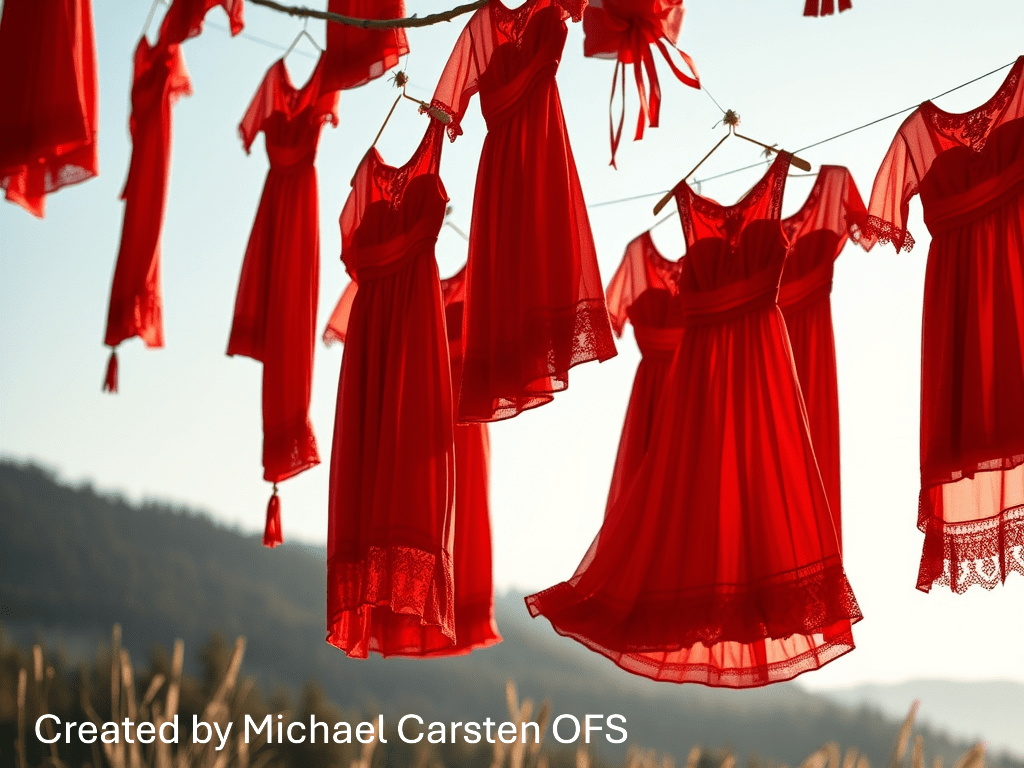
On May 5th, red dresses hang across the United States—empty, yet vibrant with the call of spirits, as envisioned by Métis artist Jaime Black’s REDress Project. Red Dress Day, aligned with the U.S. National Day of Awareness for Missing and Murdered Indigenous Women (MMIW), confronts a crisis of violence against Indigenous women and girls, rooted in colonial legacies, including the Catholic Church’s role in Indian boarding schools. As Secular Franciscans, inspired by Pope Francis’s call to care for the marginalized and seek reconciliation, we are summoned to lament this injustice, pursue healing, and demand a continued U.S. response to protect Indigenous women. In 2025, Red Dress Day is our call to live the Gospel by standing with Indigenous communities.
A Crisis Rooted in Historical Wounds
The statistics are staggering: Indigenous women in the U.S. face murder rates up to 10 times the national average, with 5,712 missing cases reported in 2016, though only 116 were logged in the Department of Justice’s database. Over 84% of American Indian and Alaska Native women experience violence in their lifetime, including 56% facing sexual violence. On some reservations, murder rates for Indigenous women are over 10 times the national average. This crisis, described as a “silent epidemic,” stems from systemic issues—colonization, racism, and intergenerational trauma.
The Catholic Church’s historical role amplifies this crisis. From the late 19th century to the mid-20th century, Catholic-run Indian boarding schools, like St. Boniface in California, forcibly assimilated Indigenous children, inflicting abuse and trauma. A 2022 Department of the Interior report estimated thousands of deaths at these schools, with Catholic institutions heavily implicated. This trauma fractured families, eroded traditional gender roles, and left generations vulnerable to poverty and violence—key risk factors for MMIW. Pope Francis, in his 2022 apology for the Church’s role in Canada’s residential schools, called for “concrete actions” to address such harms, a reminder that applies to the U.S. context. He urged Catholics to confront ongoing injustices, like MMIW, with humility and action.
As Secular Franciscans, we heed Pope Francis’s call that “the poor and the excluded are the living image of Christ” (Fratelli Tutti, 2020). The MMIW crisis demands we acknowledge the Church’s historical wrongs, seek forgiveness, and support justice for Indigenous women and girls.
The U.S. Response to MMIW
Red Dress Day, observed as the National Day of Awareness for MMIW on May 5th, honors victims like Hanna Harris, a Northern Cheyenne woman murdered in 2013, whose case sparked a 2017 Senate resolution. The red dress, symbolizing absence and resilience, calls us to support the U.S. response, which includes legislative, grassroots, and community efforts, though gaps remain.
- Legislative Action: The U.S. has taken steps to address MMIW. The 2020 Savanna’s Act, named for Savanna LaFontaine-Greywind, murdered in 2017, improves data collection and law enforcement protocols for MMIW cases. The Not Invisible Act, also passed in 2020, created a commission of tribal leaders, survivors, and federal partners to recommend solutions, complementing Savanna’s Act. The 2013 Violence Against Women Act (VAWA) reauthorization restored tribal jurisdiction over certain domestic violence crimes, expanded in 2022 to cover sexual violence and trafficking. In 2021, Interior Secretary Deb Haaland established the Missing and Murdered Unit within the Bureau of Indian Affairs to investigate cases, a first-of-its-kind effort. Yet, implementation lags due to underfunding and jurisdictional complexities, with only 40% of Savanna’s Act’s protocols fully enacted by 2023.
- Grassroots Movements: Indigenous-led advocacy drives progress. The National Indigenous Women’s Resource Center (NIWRC) organizes the National Week of Action for MMIW (May 5-9), amplifying family voices and pushing for policy reform. Groups like MMIW-TX, led by Jody Voice, provide resources and safety workshops in urban Native communities. The red hand over the mouth, a symbol of silenced voices, and the hashtag #NoMoreStolenSisters galvanize public awareness. In states like Washington, a 2023 MMIWP Cold Case Unit, the nation’s first, investigates unresolved cases with tribal consent.
- Ongoing Challenges: Despite progress, systemic issues persist. Jurisdictional gaps between tribal, state, and federal authorities hinder investigations, with 71% of Native Americans living in urban areas facing limited culturally specific resources. Underreporting and racial misclassification skew data, minimizing the crisis’s scale. Police often dismiss cases as “runaways,” as Sheri Hill of Browning, Montana, notes, delaying critical action. Pope Francis’s call to “build a culture of encounter” (Fratelli Tutti) urges us to challenge these failures and advocate for systemic reform.
A Call to Action
Pope Francis reminds us, “We are called to be instruments of God for the liberation and promotion of the poor” (Evangelii Gaudium, 2013). As Secular Franciscans, Red Dress Day is our mandate to support the U.S. response to MMIW:
- Learn with Humility: Read the 2022 Department of the Interior’s boarding school report or NIWRC’s MMIW resources. Reflect on the Church’s role in trauma, praying for forgiveness, as Pope Francis modeled in 2022.
- Listen to Indigenous Voices: Follow groups like NIWRC or MMIW USA on social media. Share their stories in your fraternity or parish to amplify their calls for justice.
- Advocate for Justice: Urge Congress to fully fund Savanna’s Act and the Not Invisible Act. Support VAWA’s tribal provisions. Write to officials or join rallies, as Pope Francis encourages, to “walk together” with the marginalized.
- Serve the Marginalized: Donate to organizations like MMIW-TX or NIWRC. Attend vigils or events during the National Week of Action (May 5-9, 2025), listed on NIWRC’s website.
- Build Peace: Challenge stereotypes rooted in colonial history, including missionary teachings, in your community. Share Red Dress Day’s significance, fostering dialogue, as Pope Francis calls for in Fratelli Tutti.
Rebuilding with Love
Red Dress Day is a cry for justice, echoing Pope Francis’s plea that “every human being has the right to live with dignity” (Laudato Si’, 2015). Rosalie Fish, an MMIW activist and athlete, runs to honor victims, saying, “I run for those who can’t.” Each red dress is a call to rebuild—with prayer, action, and solidarity. In 2025, let us wear red, hang dresses, and pray at vigils, but also commit to supporting the U.S. response—legislative, grassroots, and spiritual—to end the violence and restore safety for Indigenous women and girls.
For support, contact the National Indigenous Women’s Resource Center at 1-855-649-7299.
Sources:
- U.S. Department of the Interior, Federal Indian Boarding School Initiative Investigative Report (2022)
- Urban Indian Health Institute, Missing and Murdered Indigenous Women & Girls (2018)
- National Indigenous Women’s Resource Center, MMIWR Resources
- Bureau of Indian Affairs, Missing and Murdered Indigenous People Crisis
- Native Hope, Missing and Murdered Indigenous Women (2024)
- Pope Francis, Fratelli Tutti (2020), Evangelii Gaudium (2013), Laudato Si’ (2015), Apostolic Journey to Canada (2022)
