

Finding Roots: Psalm 1 Reflection for Today

Psalm 1:

“Blessed is the man who does not walk in the counsel of the wicked, nor stand in the way of sinners, nor sit in company with scoffers.

Rather, the law of the Lord is his joy; and on his law he meditates day and night.

He is like a tree planted near streams of water, that yields its fruit in season; its leaves never wither; whatever he does prospers.

But not so are the wicked, not so! They are like chaff driven by the wind.

Therefore the wicked will not arise at the judgment, nor will sinners in the assembly of the just.

Because the Lord knows the way of the just, but the way of the wicked leads to ruin.”


A Franciscan and Ruttenberg-Inspired Reflection on Psalm 1: Finding Roots in a Time of Fear


Verse 1: Blessed is the man who does not walk in the counsel of the wicked, nor stand in the way of sinners, nor sit in company with scoffers.
As a Franciscan, I hear Brother Francis whispering through these words: step away from the noise of power and pride.^1 Today, in the U.S., fear grips us—fear of the other, fear of losing what we know, fear stoked by voices shouting division on screens and streets. The “wicked” aren’t just cartoonish evildoers; they’re the systems of greed, the policies that widen gaps, the cynicism that mocks hope.^2 Rabbi Ruttenberg might call this the unrepentant path—refusing to repair harm, whether to immigrants at our borders or the earth groaning under neglect.^3 Blessedness, for us, is choosing a different way: walking with the lepers of our time, the disenfranchised, the afraid, refusing to sit with those who scoff at compassion.

Verse 2: Rather, the law of the Lord is his joy; and on his law he meditates day and night.
Francis found joy in Sister Poverty and Brother Sun, seeing God’s law etched in creation and the Gospel’s call to love.^4 For Rabbi Ruttenberg, Torah isn’t static—it’s a sacred text we wrestle with, a guide to nurture the wow of life even when fear looms.^5 In this trembling moment—elections tearing us apart, climate disasters looming, rights under threat—meditating on God’s law means more than quiet prayer.^6 It’s active, like Francis rebuilding the Church stone by stone, or Ruttenberg urging us to repair what’s broken. We turn to love, justice, and mercy, day and night, to steady our shaking hands and hearts against the chaos.

Verse 3: He is like a tree planted near streams of water, that yields its fruit in season; its leaves never wither; whatever he does prospers.
Oh, how Francis would dance to this! A tree by the water—rooted in God’s grace, mirroring the Canticle’s praise for creation’s harmony.^7 Ruttenberg might see this as the fruit of ethical living, yielding repair in a fractured world.^8 But today, we feel uprooted—floods and fires threaten our homes, economic instability withers dreams, and fear whispers that nothing will prosper.^9 Yet, as Franciscans, we plant ourselves by the streams of solidarity: with the poor, the earth, each other. As Ruttenberg teaches, we nurture resilience, bearing fruit not for ourselves but for a hungry nation. Our leaves—our hope—won’t wither if we stay connected to the Source.

Verses 4-5: But not so are the wicked, not so! They are like chaff driven by the wind. Therefore the wicked will not arise at the judgment, nor will sinners in the assembly of the just.
Francis wept for sin’s emptiness, not to condemn but to call back.^10 The “wicked” here are like chaff—rootless, blown by fear’s gusts: the profiteers of division, the deniers of truth, the ones who’d rather burn bridges than build them.^11 Ruttenberg’s lens sharpens this: those who refuse repair drift away, unmoored from community.^12 In our fear—gun violence spiking, democracy wobbling, hate rising—we see this wind tearing at us. But judgment isn’t ours to wield; it’s God’s, and we pray, as Francis did, for conversion over collapse, trusting the just will stand together when the storm passes.

Verse 6: Because the Lord knows the way of the just, but the way of the wicked leads to ruin.
God knows us—intimately, as Francis knew the sparrows and the wolf.^13 Rabbi Ruttenberg might say God’s knowing is an invitation to align with Torah’s justice, to repair our way out of ruin.^14 Fear tells us ruin is near—cultural decay, ecological tipping points, a nation unraveling.^15 But the Franciscan heart clings to trust: God walks with the just, the peacemakers, the ones planting seeds in scorched soil. The wicked’s ruin isn’t our glee—it’s a warning to turn back, to choose life, to mend what fear has torn.

Tying It Together: A Prayer for Today
In this America of 2025, Psalm 1 is our lifeline.^16 As Franciscans, we stand with Francis, barefoot on the earth, refusing fear’s counsel—greed, hate, despair—and rooting ourselves in God’s law of love.^17 With Rabbi Ruttenberg’s wisdom, we see Torah and Gospel as tools to repair, to nurture, to flourish like trees even now.^18 Our fear—of loss, of violence, of an uncertain tomorrow—becomes a call: to meditate on what heals, to bear fruit for the weary, to trust God knows our trembling way. Together, we rebuild, not with walls but with bridges, singing peace to a frightened land.


Footnotes

  1. Regis J. Armstrong, et al., Francis of Assisi: Early Documents (New York: New City Press, 1999) – Historical accounts of St. Francis’ life, informing the Franciscan lens on simplicity and solidarity.
  2. Psalm 1:1, New American Bible Revised Edition (NABRE) (Washington, DC: USCCB, 2011) – The scriptural text quoted, from the official Catholic translation.
  3. Danya Ruttenberg, On Repentance and Repair: Making Amends in an Unapologetic World (Boston: Beacon Press, 2022) – Ruttenberg’s work on ethical repair, applied to the wicked as unrepentant.
  4. Francis of Assisi, The Canticle of the Creatures, ca. 1225 – St. Francis’ praise of creation, resonating with God’s law in nature.
  5. Danya Ruttenberg, Nurture the Wow: Finding Spirituality in the Frustration, Boredom, Tears, Poop, Desperation, Wonder, and Radical Amazement of Parenting (New York: Flatiron Books, 2016) – Her reflections on Torah as a nurturing guide.
  6. Psalm 1:2, New American Bible Revised Edition (NABRE) (Washington, DC: USCCB, 2011) – Specific verse cited for meditation on God’s law.
  7. Francis of Assisi, The Canticle of the Creatures, ca. 1225 – Cited for its harmony with the tree imagery.
  8. Danya Ruttenberg, On Repentance and Repair (Boston: Beacon Press, 2022) – Ethical living yielding repair, tied to the tree’s fruit.
  9. Psalm 1:3, New American Bible Revised Edition (NABRE) (Washington, DC: USCCB, 2011) – Specific verse for the tree imagery.
  10. Bonaventure, The Life of St. Francis (1263) – Biography highlighting Francis’ compassion and approach to sin.
  11. Psalm 1:4-5, New American Bible Revised Edition (NABRE) (Washington, DC: USCCB, 2011) – Verses cited for the chaff and judgment imagery.
  12. Danya Ruttenberg, On Repentance and Repair (Boston: Beacon Press, 2022) – Those who refuse repair drift away, sharpening the chaff metaphor.
  13. Francis of Assisi, The Little Flowers of St. Francis, ca. 14th century – Stories of Francis’ intimacy with creation (e.g., sparrows, wolf).
  14. Danya Ruttenberg, Life is a Sacred Text, Substack, ongoing – Her writings on aligning with Torah’s justice and repair.
  15. Psalm 1:6, New American Bible Revised Edition (NABRE) (Washington, DC: USCCB, 2011) – Verse cited for God’s knowing and the wicked’s ruin.
  16. Psalm 1, New American Bible Revised Edition (NABRE) (Washington, DC: USCCB, 2011) – Full psalm as the reflection’s lifeline.
  17. Regis J. Armstrong, et al., Francis of Assisi: Early Documents (New York: New City Press, 1999) – Francis’ barefoot simplicity and love as a model.
  18. Danya Ruttenberg, On Repentance and Repair (Boston: Beacon Press, 2022) – Torah and Gospel as tools for repair and flourishing.

It’s come to this

Elie Wiesel, a Holocaust survivor and Nobel Peace Prize laureate, offered profound insights that resonate with today’s experiences in the United States. His words, shaped by his survival of unimaginable atrocities, speak to themes of justice, human rights, and the moral imperative to act against oppression—issues that remain deeply relevant amid the nation’s current challenges, including racial injustice, political polarization, and debates over equality.

One of his most powerful statements, delivered in his 1986 Nobel Peace Prize acceptance speech, is:

“We must take sides. Neutrality helps the oppressor, never the victim. Silence encourages the tormentor, never the tormented.”

This quote urges individuals to reject indifference and actively oppose injustice. In the context of today’s USA, it serves as a call to action—whether addressing systemic inequalities, advocating for marginalized communities, or confronting division. Wiesel’s message underscores that silence or neutrality in the face of wrongdoing empowers those who perpetuate harm, a reminder that feels particularly poignant in the current social and political climate.

Wiesel’s wisdom encourages reflection on our collective responsibility. His experiences taught him that memory, compassion, and courage are essential to prevent history’s darkest lessons from repeating. As the USA navigates its present struggles, his words inspire us to speak out, take a stand, and work toward a more just society.

Peace Mike

Mahmoud Khalil


Demanding the Release of Mahmoud Khalil: A Call for Justice and Human Dignity


In the spirit of St. Francis of Assisi, who tirelessly advocated for peace, justice, and the dignity of every human being, we raise our voices to demand the immediate release of Mahmoud Khalil. As Franciscans, we are called to stand with the oppressed and to be a voice for those who are silenced. The unjust detention of Mahmoud Khalil is not merely an individual tragedy—it is a violation of human rights and a wound to the collective conscience of all who seek peace and justice.


The Cry for Justice

Mahmoud Khalil, like so many others who suffer from oppression, is more than just a name in a headline—he is a human being created in the image of God, endowed with dignity and deserving of justice. His detention represents the ongoing struggles faced by countless individuals who find themselves imprisoned for political, religious, or ideological reasons. As followers of Christ and inspired by the teachings of the Franciscan tradition, we cannot remain silent in the face of such injustice.


A Franciscan Response

St. Francis of Assisi teaches us to walk humbly with the poor and the persecuted. Our Rule as Secular Franciscans calls us to work toward justice and peace, not only through prayer but also through action. We must advocate for Mahmoud Khalil’s release, not just as an act of mercy but as an imperative of justice.

Pope Francis reminds us that “the dignity of each human person and the pursuit of the common good are concerns which ought to shape all economic and political decisions” (Laudato Si’, 156). To detain an individual unjustly is to trample on their dignity and deny their fundamental rights.


A Call to Action

We urge all people of goodwill—religious leaders, human rights advocates, and policymakers—to join in demanding the immediate release of Mahmoud Khalil. Silence in the face of injustice is complicity. We must raise our voices in prayer, in protest, and in advocacy until justice is served.

Let us write to those in power, sign petitions, and spread awareness so that Mahmoud Khalil is not forgotten. Above all, let us keep him and all unjustly detained persons in our prayers, trusting that God, who is the source of all justice, will bring forth righteousness and peace.


May our actions be guided by the words of the Prophet Isaiah:


“Learn to do good; seek justice, correct oppression; bring justice to the fatherless, plead the widow’s cause.” (Isaiah 1:17)

“Prayer and Contemplation as the Soul of All We Are and Do”


A Franciscan Vision Rooted in Life, Love, and the OFS Rule


Scriptural Foundation: Sirach 38:24–34 (NABRE)

“They maintain the fabric of the world, and their prayer is in the practice of their trade. … Not so the one who devotes himself to the study of the law of the Most High; he sets his heart on rising early to seek the Lord who made him.”


The Rule’s Imperative: Prayer as the Soul of Secular Franciscan Life

The Rule of the Secular Franciscan Order (Article 8) declares:
“Let them [Secular Franciscans] participate in the sacramental life of the Church, above all the Eucharist. Let them join in liturgical prayer in one of the forms proposed by the Church… Let prayer and contemplation be the soul of all they are and do.”

This command is not a call to monastic rigor but an invitation to infuse every moment of life with the spirit of prayer. For laypeople immersed in the rhythms of family, community, and daily responsibilities, this means recognizing that prayer is not an activity to add to their day but the soul that animates their very being.


I. Sirach’s Wisdom and the Rule’s Vision

Sirach’s contrast between laborers and scholars is not a division but a harmony. The laborer’s life is prayer (38:34), while the scholar’s study seeks God (38:31). For Secular Franciscans, the Rule’s call to make prayer the “soul” of all they do means:

  • Life as Contemplation: The parent, the caregiver, or the volunteer prays through their actions when they serve with love.
  • Contemplation as Life: The intellectual or retiree engages through their mind when they study and intercede.

The Rule does not demand equal time for both but insists that all actions—physical, mental, or relational—be rooted in a contemplative heart.


II. Vatican II: Sanctifying the “Soul” of Daily Life

The Council’s teachings affirm the OFS Rule’s vision:

  • Lumen Gentium 34“The laity… make the Church present and operative in those places and circumstances where only through them it can become the salt of the earth.”
  • Gaudium et Spes 43“Let there be no false opposition between professional and social activities on the one part, and religious life on the other.”

For Secular Franciscans, this means:

  • The “soul” of their life is the love and intentionality with which they live it.
  • The “soul” of their prayer is the awareness that God is present even in exhaustion, joy, or routine.

III. Reclaiming the Rule’s Flexibility

The Rule’s wording is deliberate: “Let prayer and contemplation be the soul of all they are and do” (Article 8). Key implications:

  1. “Soul” Over Schedule:
    Prayer is not a checklist but the animating principle of existence. A caregiver’s patience, a neighbor’s kindness, or a moment of rest becomes a “contemplative act” when offered to God.
  2. “All They Are and Do”:
    The Rule does not distinguish between “sacred” and “secular” moments. Cooking meals, commuting, or comforting a friend become prayer when done for love of God and neighbor.
  3. Liturgical Prayer as a Means, Not an End:
    The call to “join in liturgical prayer” (Article 8) is not a rigid law but a tool to deepen communion with God. When formal prayer is impossible, the liturgy of life itself becomes worship.

IV. A Franciscan Model: Life as Embodied Contemplation

St. Francis lived the Rule’s ideal long before it was written. His Earlier Rule (1221) states:
“Let all brothers, however, preach by their deeds.”

For Francis, life and prayer were inseparable. Secular Franciscans inherit this legacy:

  • Prayer is not confined to words but expressed in how we live: patiently, justly, and generously.
  • Contemplation is not withdrawal but seeing God in the ordinary: a shared meal, a walk in nature, a quiet moment of rest.

V. Practical Living of the Rule

For those overwhelmed by formal prayer obligations:

  1. Morning Offering:
    “Lord, let my life today be my prayer. Be the soul of all I am and do.”
  2. Micro-Moments of Awareness:
    • Pause before a task: “For You, Jesus.”
    • Offer frustration: “I unite this to Your Cross.”
  3. Family as Fraternity:
    Simple rituals like bedtime gratitude or a hug offered as a prayer sanctify daily life.
  4. Fraternity Support:
    Meetings should prioritize sharing how God is found in daily life over rigid recitations.

Conclusion: The Soul of Our Vocation

The OFS Rule’s call to make prayer the “soul” of all we are and do is not a burden but a liberation. It frees us to see our entire life as a liturgy of love:

When a parent listens patiently, they are contemplative.
When a friend forgives quickly, they are praying.
When a stranger is welcomed, they are chanting Vespers.

This is the “soul” St. Francis envisioned: a spirituality where prayer is not something we do but who we are.

Peace and all good!


Citations

  1. The Rule of the Secular Franciscan Order (1978), Article 8.
  2. The Book of Sirach (Ecclesiasticus), New American Bible Revised Edition (NABRE).
  3. Lumen Gentium (Dogmatic Constitution on the Church), Second Vatican Council (1964).
  4. Gaudium et Spes (Pastoral Constitution on the Church in the Modern World), Second Vatican Council (1965).
  5. St. Francis of Assisi, The Earlier Rule (1221).

Encountering the Divine: Ramadan, Yom Kippur, and Lent

In the heart of every sacred tradition lies a hidden truth: the Divine is not distant, but intimately woven into the fabric of existence—and into the faces of those around us. Ramadan, Yom Kippur, and Lent, three pillars of Abrahamic faiths, are often seen as seasons of abstinence, repentance, or ritual. Yet through the lens of mysticism, they reveal a deeper invitation: to transcend the self and encounter God in the very act of loving, serving, and forgiving one another.

Ramadan: Fasting as a Mirror of the Heart

In Islam, Ramadan is a month of fasting, prayer, and Quranic reflection. Mystics like Rumi and Ibn Arabi remind us of the true fast. It is not merely abstaining from food and drink but freeing ourselves from the ego’s tyranny. When we empty our bodies, we create space for the Divine light to illuminate our souls. Hunger becomes a teacher, humbling us and awakening compassion for those who hunger every day.

The mystic’s Ramadan is not solitary. The nightly Taraweeh prayers recited in unison, dissolve individuality into a collective heartbeat. Breaking the fast (iftar) with others—strangers, neighbors, the marginalized—transforms a meal into a sacrament. “Whoever feeds a fasting person earns the same reward as them,” says the Prophet Muhammad (peace be upon him). In this act, we glimpse the Divine in the shared bread, the laughter, the hands that serve. To fast is to see God in the faces of the hungry.

Yom Kippur: Atonement as Cosmic Reunion

Yom Kippur, the Day of Atonement in Judaism, is a solemn fast of repentance. Yet Jewish mysticism (Kabbalah) teaches that this day is not about punishment, but reunion. The Hebrew word teshuvah means “return”—a return to God, our true selves, and harmony with all creation.

The liturgy of Yom Kippur emphasizes that sins against others cannot be forgiven by God until we first seek forgiveness from those we’ve harmed. The mystical truth blazes here: God dwells in the “other.” When we repair relationships, we restore the shattered vessels of the Divine presence (Shekhinah). The Kol Nidre prayer, chanted at twilight, is a collective vow to release the bonds of ego. As we stand together in vulnerability, we become mirrors reflecting the Infinite One back to each other.

Lent: Sacrifice as an Embrace of the Wounded

In Christianity, Lent is a 40-day fasting, prayer, and almsgiving journey that mirrors Christ’s wilderness sojourn. Mystics like St. John of the Cross and Julian of Norwich saw Lent not as deprivation but as a path to divine union. By stripping away comforts, we confront our illusions and meet God in the desert of our hearts.

Yet Christ’s ultimate teaching—”Whatever you did for the least of these, you did for me” (Matthew 25:40)—anchors Lent in community. When we give alms, we touch the hands of Christ in the poor. When we forgive, we meet God in the wounds of the broken. The Lenten fast is a doorway to solidarity, where the boundary between “I” and “you” dissolves. Meister Eckhart wrote, “The eye through which I see God is the same eye through which God sees me.”

The Thread That Binds: Love as the Ultimate Fast

Across these traditions, a common thread emerges: asceticism is not an end but a means to awaken love. Fasting from food, pride, or distractions clears the debris from our souls so we might finally see. When the ego diminishes, the Divine presence in others becomes unmistakable.

The Sufi poet Hafez writes, “I am a hole in a flute that the Christ’s breath moves through—listen to this music!” Ramadan, Yom Kippur, and Lent are each a flute, hollowed by sacrifice, through which the breath of the Divine flows. The music they create is the sound of humanity, remembering its sacred unity.

This year, as we observe these holy seasons, let us ask: How might my fast soften my heart to the stranger? How might my repentance heal a fractured relationship? How might my sacrifice become sustenance for another? For in the eyes of the one across from us—whether at the iftar table, the synagogue, or the soup kitchen—we meet the gaze of the Beloved.

La illaha illa Allah. Sh’ma Yisrael. Thy Kingdom come.
The names differ, but the call is one:
Encounter God here, now, in each other.


Michael Carsten OFS is a professed member of the Secular Franciscan Order and editor of Chasing the Wild Goose Blog. This article reflects his personal discernment and does not represent official OFS positions in Local, Regional, or National Fraternity. Contact Mike @ mikeofs@ofsmike.com


A Personal Ethic of Kinship: Rooted in the Gospel and the secular Franciscan Rule

By Michael Carsten OFS


A Pilgrimage of Faith and Justice

“I have done what is mine to do; may Christ teach you what is yours.” These words of St. Francis guide my journey as a Secular Franciscan. Bound by the Rule of the Secular Franciscan Order, I am called to “live the Gospel” (Article 4). I do this through humility, peace, and radical kinship with the marginalized. As an Ecumenical and Inter-religious Animator, I am tasked with building bridges across faiths. This mirrors Francis’s fearless meeting with Sultan Malik al-Kamil. Yet, in a world obsessed with political labels, I reject the false binaries of left and right. My ethic flows from a deeper well. Christ’s teachings and the Franciscan charism guide me. They demand a politics rooted not in ideology but in love, justice, and the sacredness of every life.

This is my creed—a way of being in the world that refuses to sever faith from action.


Foundations: Gospel and Franciscan Non-Negotiables

My convictions spring from two fonts: the Gospel and the Rule of the Secular Franciscan Order. They anchor four pillars of my ethic:

  1. Human Dignity as Divine Imprint
    “Whoever harms the poor insults their Maker” (Proverbs 14:31). The secular Franciscan Rule commands me to “respect all people” (Article 13). I see Christ in the migrant, the prisoner, and the religious “other.” I oppose policies that dehumanize—xenophobic borders, exploitative labor, or environmental degradation that treats creation as disposable. Justice begins with reverence.
  2. The Poor are the First Teachers
    Jesus’ declaration is my litmus test for policy. “Whatever you did for the least of these, you did for me” (Matthew 25:40). Francis stripped himself of wealth to stand with outcasts. I support universal healthcare, living wages, and affordable housing not as partisan agendas but as moral imperatives. Charity soothes symptoms; justice dismantles systems that trap generations in poverty.
  3. Subsidiarity is about Sacred Humility.
    The secular Franciscan Rule encourages us to live by going from the Gospel to life. It also inspires us to bring life to the Gospel. Solutions must arise locally—in families, parishes, and neighborhoods—where human dignity outweighs ideology. While the government must protect rights, centralized power (corporate or bureaucratic) often stifles the Spirit’s work. Communities, guided by conscience, must lead.
  4. Nonviolence as Prophetic Witness
    “Blessed are the peacemakers” (Matthew 5:9). Francis confronted the Crusades’ brutality with dialogue, not swords. I reject rhetoric that demonizes opponents, militarism that sacrifices the vulnerable, and economics that plunder creation. Peacemaking, for me, demands restorative justice, climate reparations, and relentless dialogue.

Engaging Political Systems: Respect and Caution

My creed engages political frameworks without captivity:

  • Social Democracy
    Respect: Its fight against poverty and healthcare gaps aligns with Christ’s healing call.
    Caution: Centralized programs risk sidelining local wisdom. Welfare should empower—not replace—parish food banks, worker co-ops, and interfaith clinics.
  • Capitalism
    Respect: Innovation lifts communities when tempered by ethics.
    Caution: Profit-driven systems commodify life. I demand fair wages, eco-stewardship, and businesses that honor workers as siblings, not labor costs.
  • Socialism
    Respect: Its critique of exploitation echoes Amos’ cry: “Let justice roll like a river” (Amos 5:24).
    Caution: Material equality alone risks reducing humans to economic units. True justice restores kinship—seeing the poor as brothers, not statistics.
  • Libertarianism
    Respect: Its skepticism of state overreach aligns with subsidiarity.
    Caution: Freedom without solidarity abandons the marginalized. “Personal responsibility” can’t absolve collective sin.

My Stance: No system is sinless. I borrow tools (policy, protest, partnership) to serve the Kingdom’s ends: dignity, kinship, and peace.


The Beatitudes: My Blueprint for Political Engagement

The Beatitudes (Matthew 5:3-12) reframe politics as sacred service:

  • “Blessed are the poor in spirit”: I reject consumerism’s lie that worth comes from wealth.
  • “Blessed are the meek”: I advocate policies that uplift the vulnerable, not entrench the powerful.
  • “Blessed are the peacemakers”: I labor for interfaith coalitions, knowing solidarity heals a fractured world.

For me, politics is not a battle for power but a pilgrimage of love.


The Tension of Witness

Living this ethic is a daily crucifixion:

  1. Misunderstood
    Progressives question my faith; conservatives scorn my critique of greed. Francis was called a fool for kissing lepers. I embrace the title.
  2. The Risk of Hypocrisy
    I fail often. I cling to the Rule’s call to “continual conversion” (Article 7).
  3. The Weight of Despair
    Wars rage, forests burn, children starve. Yet Francis rebuilt the Church stone by stone. I choose stubborn hope.

Conclusion: An Invitation to Kinship

This is not a manifesto. It is my flawed attempt to live the Gospel without dilution. To those who share this hunger, I offer no program—only a challenge:

  • See sacramentally: The Eucharist teaches that God dwells in the broken. So look for the divine in the “other”—the refugee, the rival, the ruined earth.
  • Act incarnationally: Start small. Partner with a mosque to house the homeless. Join a union fighting for fair wages. Plant a parish garden to feed the hungry.
  • Risk love: Francis kissed the leper. Who—or what—have we been taught to fear that God calls us to embrace?

St. Francis did not set out to change the world. He set out to live the Gospel, and the world changed around him. May we have the courage to do the same.

Pax et bonum.

Defending Pluralism Against Christian Nationalism


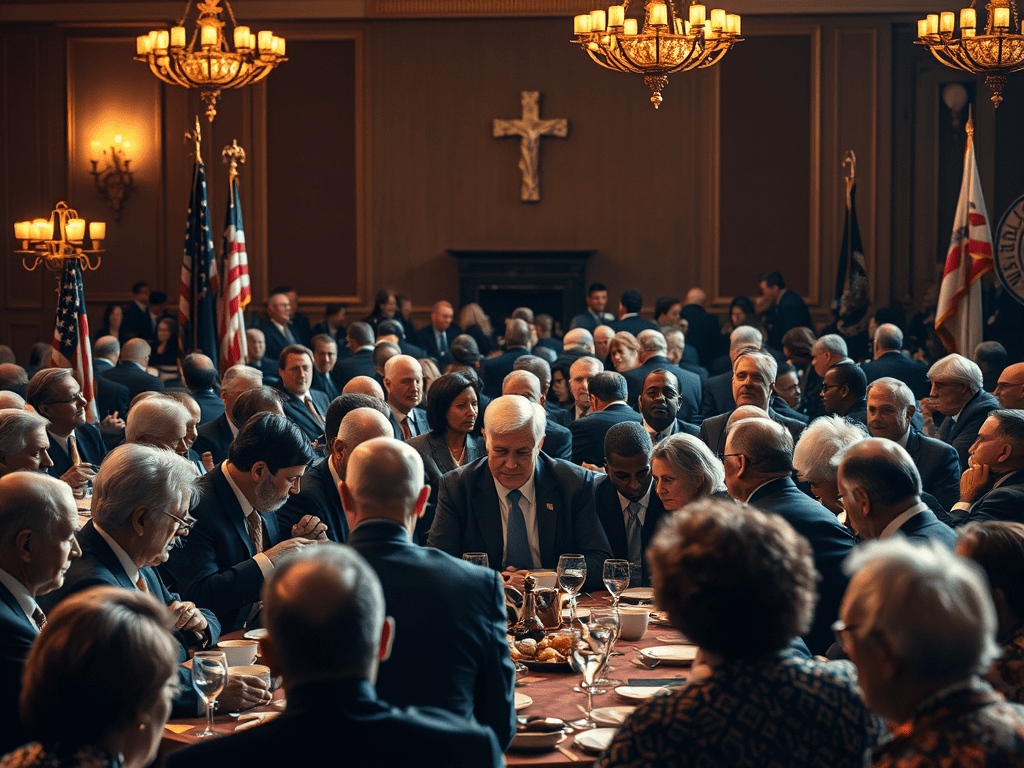
As a lay adherent of the Franciscan tradition, I am profoundly unsettled. The ethical and societal ramifications of President Trump’s explicit commitment to embolden Christian Nationalism demand scrutiny. Who orchestrates this movement? What are the veiled intricacies of the purported “three steps” he vows to enact? And why do so many, despite its glaring perils, welcome this agenda with open arms? These queries penetrate the very marrow of our national identity. The National Prayer Breakfast—once a solemn space for reflection and unity—has been repurposed into a pulpit for a divisive, exclusionary vision of America, one that subverts the foundational principles of religious liberty and democratic pluralism.

As the Washington Prayer Breakfast convenes once more, I am compelled to voice my dissent. What should be a sanctuary of humility and interfaith dialogue has metamorphosed into a clarion call for those who seek to enshrine an insular, rigid interpretation of Christianity as the guiding force of national policy. The reverberations of Trump’s 2025 address—his advocacy for a “faith office,” a commission on religious liberty, and an investigative force to root out so-called “anti-Christian bias”—persist, serving as a stark reminder of the dangers inherent in conflating faith with political hegemony.

Christian Nationalism, as propagated by Trump and his cohorts, is not a summons to authentic faith. Instead, it is a consolidation of power under the guise of religious zeal. It aims to impose a single spiritual identity. This is attempted on a nation deliberately founded upon the principles of religious diversity and freedom. As a Franciscan, my spiritual vocation demands that I resist this gross misrepresentation of the Gospel. It distorts Christ’s radical love and inclusivity into an apparatus of control. This article is grounded in the social doctrine of the Catholic Church. It embodies the ethos of Franciscan spirituality. It exhorts us to safeguard the vulnerable. It urges opposition to theocratic encroachments and a restoration of the genuine essence of faith.

The gravity of the moment cannot be overstated. From the corrosion of the constitutional separation of church and state to the marginalization of minority faith communities, this trajectory imperils the very architecture of democracy. However, despair is not our calling. As Franciscans, we are summoned to action. The Washington Prayer Breakfast serves not merely as a testament to our present tribulations, but as a rallying point—a summons to defend justice, pluralism, and the sacred dignity of all human beings.


1. The National Prayer Breakfast: A Corrupted Tradition

Since its inauguration in 1953, the National Prayer Breakfast has symbolized bipartisan dialogue and spiritual contemplation. Yet, under Trump, it has devolved into a platform for Christian Nationalist dogma—an ideology that seeks to overwrite America’s diverse religious landscape with a rigid theological hierarchy. This is not the Gospel; it is a manipulation of faith for dominion.

Catholic teaching repudiates the instrumentalization of faith for worldly power. In Evangelii Gaudium, Pope Francis denounces “spiritual worldliness,” cautioning against reducing religion to a “pursuit of power, prestige, pleasure, or economic security” (Paragraph 93). A gathering that once embodied unity now teeters on the precipice of becoming an altar for this corruption.


2. Trump’s 2025 Address: A Rallying Cry for Christian Supremacy

During the 2025 National Prayer Breakfast, Trump unveiled an ominous blueprint for America’s future—one shackled by Christian Nationalist edicts. He proposed:

  • A presidential commission on religious liberty purportedly safeguarding “Christian values” while systematically sidelining other faith traditions.
  • A White House ‘faith office,’ integrating Christian ideology into the scaffolding of federal governance.
  • A task force spearheaded by Attorney General Pam Bondi, charged with eradicating “anti-Christian bias” within governmental institutions.

While Trump framed these measures as fortifications of religious liberty, their underlying intent is unmistakable—a calculated stride toward theocratic dominion. As a Franciscan, I discern in this not a call to spiritual renewal, but a declaration of war against justice, inclusivity, and the Gospel’s call to serve the disenfranchised.

The Catechism of the Catholic Church (CCC 2108) affirms that “the right to religious liberty is neither a moral license to adhere to error, nor a supposed right to error.” True religious freedom does not bestow privilege upon one faith; it enshrines the dignity of all.


3. Christian Nationalism: A Perilous Counterfeit of Christianity

Christian Nationalism is not Christianity—it is a perversion that interlaces national identity with a rigid, exclusionary religious dogma. It obliterates the rich mosaic of beliefs that constitute this nation, supplanting them with a hegemonic, state-sanctioned faith. It seeks legislative and cultural supremacy, forsaking the Gospel’s commandment to love and uplift all.

Pope Francis, in Fratelli Tutti, exhorts that “authentic faith does not engender intolerance” (Paragraph 249). Christian Nationalism, conversely, festers division and exclusion, warping the Church’s sacred mission to embody a “sacrament of unity” (CCC 775).


4. The Betrayal of Justice: Trump’s Theocratic Agenda

Trump’s Christian Nationalism manifests through legislative oppression:

  • Judicial Manipulation – Appointing judges who subordinate constitutional law to theological dogma.
  • Religious Exemptions – Granting broad allowances that enable businesses, hospitals, and organizations to deny services to certain individuals under the pretense of “religious conscience.”
  • Educational Indoctrination – Promoting school policies that funnel taxpayer funds into Christian institutions while censoring curricula that acknowledge America’s diverse religious and cultural history.

Such policies are not merely political; they are moral transgressions. They exploit religious sentiment to entrench authoritarianism, forsaking the most vulnerable in the process. Catholic doctrine underscores that “the dignity of the human person is the foundation of a moral vision for society” (USCCB, Forming Consciences for Faithful Citizenship). Policies that degrade the marginalized violate this principle.


5. The Legal and Constitutional Abyss

The First Amendment enshrines freedom of religion—not the establishment of a state religion. Trump’s initiatives erode this boundary, resulting in:

  • Legal Precarity – Policies favoring Christianity stand on precarious constitutional footing.
  • Social Fractures – Elevating one faith above others imperils communal harmony, sowing discord in a society predicated on pluralism.

Catholic teaching maintains that “the political community and the Church are autonomous and independent of each other” (Gaudium et Spes, Paragraph 76). Trump’s agenda flouts this tenet, coalescing state and ecclesiastical power in pursuit of dominion.


6. A Franciscan Call to Action

Trump’s Christian Nationalism is not merely a political maneuver—it is a theological crisis. As Franciscans, we are summoned to:

  • Organize – Forge interfaith alliances that repudiate Christian Nationalism.
  • Educate – Dispel the myths that underpin theocratic ambitions.
  • Advocate – Champion policies that protect religious liberty for all traditions.
  • Serve – Stand in radical solidarity with the marginalized, embodying Christ’s boundless love.
  • Resist – Reject policies that enshrine religious supremacy.

For Franciscans, the imperative is clear: We must denounce the heresy of Christian Nationalism and reclaim a faith that “does not seek to dominate, but to serve” (Evangelii Gaudium, Paragraph 197). The fate of both our democracy and the integrity of our faith hinges upon our response.

Embracing the Secular Franciscan Order: A Path to Transformation

“The Franciscan Journey” By Lester Bach OFM Cap.

A commentary:

In the late 90s, my journey intertwined with Lester Bach—a mentor, visionary, and steadfast guardian of the Franciscan spirit, as a Regional Minister, National Councilor, and later a student and teacher of his transformative Spiritual Assistant formation program. I witnessed firsthand his profound devotion to the Secular Franciscan Order. Lester was more than a colleague; he was a compass for our community, steering us through turbulent waters with a rare blend of wisdom, humility, and unshakable integrity. His love for the Franciscan way of life was contagious, and his legacy lingers in the quiet spaces where I still find myself wishing for his counsel or the calm certainty he brought to every challenge.

Now, as our fraternity opens a new chapter of Inquiry—a time of discovery for those drawn to the Franciscan path—Lester’s teachings echo louder than ever. His belief in formation as a journey of the heart, not just the mind, inspires me daily as I join our formation team, eager inquirers, and the broader community in this sacred work. Together, we honor his memory not through words but by nurturing the seeds of curiosity, service, and fraternity he spent decades cultivating.

I step forward with gratitude for the past and hope for the future. Chapter One begins now—and every voice, question, and story has its place here.

Chapter 1: Orientation in the Secular Franciscan Order (OFS)

Introduction to the Franciscan Way of Life

Chapter 1 of Lester Bach’s The Franciscan Journey serves as both a doorway and a blueprint for those drawn to the Secular Franciscan Order (OFS). Bach frames the OFS not merely as an institution but as a living, breathing call to embody Franciscan spirituality in the grit and grace of everyday life. With clarity and warmth, he emphasizes that Secular Franciscans are not bound by traditional vows of poverty, chastity, and obedience. Instead, they align their lives with the radical spirit of the Beatitudes—Jesus’ teachings in the Gospels that call followers to humility, mercy, peacemaking, and solidarity with the marginalized.

The chapter also sets clear expectations: commitment to the OFS is not a passive affiliation but a call to ongoing conversion. Members are invited to deepen their prayer life, nurture fraternal bonds within their local community, and actively engage in works of mercy and ecological care—all while embodying the joyful, countercultural hope of the Gospel.

The chapter also acts as a gentle yet honest bridge for newcomers, demystifying the commitments of the Franciscan path. Bach underscores that embracing this vision demands more than admiration—it requires a willingness to let go of ego, prioritize community over individualism, and engage in ongoing conversion of heart. Formation, he suggests, is not a checklist but a lifelong dance between contemplation and action, where the Rule of the OFS becomes a compass rather than a rigid map.

By grounding lofty ideals in practical steps—prayer, simplicity, service—Bach assures readers that the Franciscan journey is neither solitary nor static. It is an invitation to walk alongside others, fueled by the same fire that animated St. Francis: a love that transforms the ordinary into the extraordinary.

Integration of Franciscan Values

Bach emphasizes that embracing the Secular Franciscan Order (OFS) is not about acquiring knowledge for its own sake. It is about weaving Franciscan spirituality into the very fabric of daily life. For newcomers, this means moving beyond intellectual understanding to a lived experience. The principles of the OFS shape not only actions but also attitudes. They influence relationships and worldviews as well.

This integration is deeply practical, touching every aspect of existence. It calls for a shift in how one engages with others, approaches challenges, and finds meaning in the ordinary. Franciscan values like simplicity, humility, and service are not abstract ideals to admire from afar. They invite us to live differently. We are called to see the divine in the marginalized. We find joy in letting go of excess. We serve others with a heart free of self-interest.

Such a transformation aligns with the radical vision of St. Francis of Assisi, who didn’t just preach the Gospel but embodied it in every breath. Bach reminds us that the Franciscan journey is not a passive observance but an active commitment—a call to “become the Gospel” in a world hungry for authenticity and compassion.

Formation Process

Bach frames Franciscan formation not as a program to complete. Instead, it is a pilgrimage of the heart. This journey is a dynamic, lifelong immersion into the charism that defined St. Francis. The process is designed to awaken more than knowledge; it seeks to transform seekers into living witnesses of Franciscan spirituality.

Central to this journey are three intertwined practices. Readings root individuals in the rich soil of Franciscan history and theology. Reflections bridge ancient wisdom to modern struggles. Active participation in a community allows faith to be lived out loud. Formation here is not passive—it demands hands, heart, and mind. Through shared prayer, service, and dialogue, members learn to “see with the eyes of the Gospel” and respond to the world’s fractures with healing presence.

Crucially, Bach reminds readers that formation never truly ends. A rhythm of study, prayer, and action deepens, calling individuals to continual conversion. Like St. Francis, who spent a lifetime relearning how to love, we are invited to embrace growth. It should be seen not as a burden but as a sacred unfolding—one step, one choice, one act of radical love at a time.

Church Documents and Franciscan Sources

  1. The Word of The Church

The Secular Franciscan Order’s Rule bridges 13th-century Franciscan roots and modern magisterial teachings. St. Francis’s Letter to All the Faithful (1221) laid an early foundation. Nicholas IV’s Supra montem (1289) formalized lay Franciscan life. Vatican II emphasized lay holiness. Paul VI approved the modern Rule (1978). Through these events, the OFS remains a dynamic vocation. It calls members to embody Gospel simplicity, serve the marginalized, and transform society, guided by centuries of Church wisdom and Franciscan charism.

The OFS Rule, rooted in these magisterial texts, unites the Franciscan charism (Seraphicus Patriarcha) with Vatican II’s vision of lay holiness (Lumen Gentium) and evangelization (Evangelii Nuntiandi). From Leo XIII’s social emphasis to John Paul II’s call for communion, these documents guide Secular Franciscans to live as “leaven” in the world, balancing prayer, conversion, and service.

2. Francis of Assisi: Early Documents (13th-Century Texts)

The Early Documents—including Thomas of Celano’s First and Second Life of St. Francis, St. Bonaventure’s Major Legend, and the poignant Legend of the Three Companions—offer an unfiltered window into the radicality of St. Francis’ life and mission. These texts, written by those who knew him intimately, reveal a man who embodied the Gospel with unsettling intensity. They recount his rejection of wealth to embrace “Lady Poverty,” his daring peacemaking during the Crusades, and his revolutionary ethic of kinship that extended even to “Brother Wolf” and “Sister Moon.”
The documents highlight Francis’ belief that peace is not passive but requires active justice: he rebuilt ruined churches, confronted greed in the marketplace, and dialogued with Sultan Al-Kamil amid interfaith hostility. He loved creation, famously exemplified in his preaching to birds. This was not sentimentalism but a theological conviction. All beings reflect the divine. For modern Franciscans, these texts go beyond being historical records. They are provocations to live with the same “holy boldness.” They encourage turning ideals of mercy, humility, and ecological care into tangible action.

3. The Rule of the Secular Franciscan Order (OFS Rule, Church-Approved)

The Rule of the Secular Franciscan Order, formally approved by Pope Paul VI in 1978, distills the essence of Franciscan spirituality into a roadmap for laypeople living in the world. Grounded in the Gospels and the charism of St. Francis, the Rule is not a list of obligations but an invitation to “go from Gospel to life, and life to Gospel” (Article 4). It outlines three pillars:
Prayer: Daily communion with God through liturgy, meditation, and the Psalms, fostering a heart attuned to divine grace.
Fraternity: Active participation in local OFS communities, where members support one another in joy and struggle, embodying Francis’ ideal of “being brothers and sisters to all.”
Apostolic Mission: Engagement in works of justice, peace, and care for creation, driven by the conviction that “they must strive to bring joy and hope to others” (Article 14).
The Rule also emphasizes ongoing conversion, urging members to regularly examine their lives through the lens of Franciscan values. For example, its call to “simplicity of heart” challenges consumerism, while its mandate to “respect all creatures” demands ecological accountability.
Together, these texts form a living tapestry of Franciscan identity. The Early Documents preserve the fire of his original vision, and the OFS Rule provides the structure to incarnate that vision today. Collectively, they affirm that Franciscanism is not a relic of the past but a dynamic call to rebuild the Church—stone by stone, heart by heart—in every generation.


Candlemas and Ramadan: A Shared Light of Hope


A Franciscan Reflection

In the quiet glow of a candle or the warm radiance of a lantern, we encounter a universal truth: light transcends boundaries. It is a symbol cherished across faiths, cultures, and histories—a reminder of divine presence, guidance, and hope. As a Franciscan, I am called to be a bearer of peace and unity. I find profound kinship in the shared symbolism of light between Candlemas and Ramadan. These are two sacred observances that invite us to kindle flames and bridges of understanding.

Candlemas: The Light That Waits

Celebrated on February 2nd, Candlemas marks the Presentation of the Lord in the Temple, where the aged Simeon recognized the infant Jesus as the “light for revelation to the Gentiles” (Luke 2:32). This moment, awaited for generations, fulfills the longing for a Messiah who would illuminate a world shrouded in spiritual shadows. On this day, candles are blessed. Their flickering flames symbolize Christ as the Light of the World. They serve as a beacon of hope, piercing the darkness of despair.

For Franciscans, Candlemas echoes our charism of humble waiting and joyful discovery. Like Simeon, we are called to recognize the sacred in the ordinary, to hold space for divine encounters in the rhythms of daily life. The candle’s light is both a promise and a challenge: to carry Christ’s radiance into a fractured world.

Ramadan: The Light That Refines

In Islam, the month of Ramadan is a journey of spiritual refinement. Through fasting, prayer, and acts of compassion, Muslims seek to draw nearer to Allah, purifying their hearts and renewing their purpose. The pre-dawn meal (suhoor) and the nightly breaking of the fast (iftar) are framed by lantern light, symbolizing the divine guidance that “is like a niche in which there is a lamp” (Quran 24:35). The pinnacle, Laylat al-Qadr (Night of Power), commemorates the revelation of the Quran—a light descending to dispel ignorance.

Ramadan’s discipline mirrors the Franciscan call to simplicity and solidarity. Just as fasting cultivates empathy for the hungry, our Rule urges us to “serve the Lord in poverty and humility,” recognizing the sacred dignity of every person. The lanterns of Ramadan, like Candlemas candles, remind us that spiritual growth requires both inward reflection and outward generosity.

Shared Light, Common Ground

Though distinct in theology, these traditions converge in their reverence for light as a metaphor for divine encounter. Both Candlemas and Ramadan emphasize:

  • Illumination: Christ and the Quran are celebrated as revelations that guide humanity.
  • Purification: Fasting (Ramadan) and the Presentation’s rituals (Candlemas) cleanse the soul to receive grace.
  • Community: Light is shared—whether in candlelit processions or communal iftars—to strengthen bonds of kinship.

Here, the Franciscan vocation to build bridges finds fertile ground. St. Francis’s daring dialogue with Sultan Al-Kamil in 1219 exemplifies this spirit. Amid the Crusades’ violence, Francis chose encounter over enmity, discovering in the Sultan not an adversary but a brother seeking truth. Their meeting whispers across centuries: when we approach others with humility, light can soften even the deepest divides.

A Call to Kindling

As Candlemas and Ramadan occasionally overlap in winter’s twilight, let us seize this cosmic invitation. Imagine Christians and Muslims gathering to share stories of light—how the Christ child’s presentation or the Quran’s revelation has shaped their journeys. Imagine joint initiatives feeding the hungry, sheltering the marginalized, or advocating for peace, embodying the shared ethic of mercy both faiths cherish.

St. Clare of Assisi once wrote, “We become what we love, and who we love shapes what we become.” If we love the Light—in all its names and forms—we become artisans of hope, mending the world’s fractures one flame at a time.

This is the interfaith promise of Candlemas and Ramadan. It is not to blur differences, but to let our distinct luminosities blend into a greater glow. For as the Quran teaches, “Had God willed, He would have made you one community” (5:48). Diversity, then, is no accident but an invitation to collaboration—a chance to “preach the Gospel always, and when necessary, use words” (attributed to St. Francis).

In lighting candles and lanterns, may we illuminate paths to peace. In building bridges, may we become living testimonies to the Light that unites us all.

Franciscan Values vs. Project 2025

By Mike Carsten OFS, Secular Franciscan


Introduction: A Franciscan Lens
As a secular (lay) Franciscan, I strive to live in the spirit of St. Francis of Assisi—a man who kissed lepers. He preached to birds. He rebuilt the Church not with power but with humility and love. Central to our charism is the conviction that all creation is sacred. Every person reflects God. Solidarity with the poor and marginalized is non-negotiable. I use this perspective to reflect on Project 2025. It is a sweeping policy proposal, which in my humble opinion, is currently being used to reshape the U.S. federal government. Some of its goals may align with certain values. However, many of its provisions clash profoundly with Catholic Social Teaching (CST) and the radical Gospel witness of St. Francis. Here’s why.


1. Care for Creation: “Praised Be You, My Lord, Through Sister Earth”

St. Francis’s Canticle of the Creatures reminds us that the Earth is our sister, not a commodity. Yet Project 2025 seeks to:

  • Withdraw from the Paris Climate Agreement 
  • Expand fossil fuel extraction 
  • Dismantle the EPA 

Franciscan Response:
Pope Francis’s Laudato Si’—a letter deeply rooted in Franciscan spirituality—calls climate action a “moral imperative.” To abandon global climate commitments, pollute rivers, and rank profit over stewardship isn’t just bad policy—it’s sacrilege. St. Francis would weep at the poisoning of Sister Water and the exploitation of Brother Wind. As Franciscans, we are called to “ecological conversion”—to defend our common home through advocacy, sustainable living, and holding leaders accountable.


2. Solidarity with the Marginalized: “Who Are My Mother and My Brothers?” (Mark 3:33)

Jesus’ question challenges us to expand our circles of kinship. Project 2025, however, proposes:

  • Mass deportations 
  • Reviving the “Remain in Mexico” policy
  • Ending birthright citizenship 

Franciscan Response:
St. Francis crossed battle lines to meet a sultan; he saw Christ in the “other.” Pope Francis echoes this in Fratelli Tutti“We cannot be indifferent to suffering; we cannot allow anyone to go through life as an outcast.” Forcing asylum seekers into danger, splitting families through deportation, or denying children their dignity violates the heart of the Gospel. Franciscans are called to welcome migrants, volunteer at shelters, and challenge policies that prioritize fear over compassion.


3. Preferential Option for the Poor: “Blessed Are the Poor”

St. Francis kissed the leper, embraced poverty, and called money “dung.” Project 2025’s economic agenda includes:

  • Corporate tax cuts 
  • Privatizing Social Security 
  • Defunding the IRS 

Franciscan Response:
CST teaches that the economy must serve people, not the other way around. When tax systems favor the wealthy, when retirees are left to market whims, and when healthcare is stripped from the poor (Item 13), we betray Christ in the marginalized. Pope Francis warns in Evangelii Gaudium“How can it be that it is not a news item when an elderly homeless person dies of exposure, but it is news when the stock market loses two points?” Franciscans must advocate for policies that lift the poor—not deepen inequality.


4. Justice and Peace: “Lord, Make Me an Instrument of Your Peace”

St. Francis prayed for peace in a time of crusades. Project 2025 prioritizes:

  • Increasing military spending 
  • Conditional NATO commitments 
  • Harsh criminal justice reforms 

Franciscan Response:
Peace is not won through walls or weapons but through justice and reconciliation. The Church has long taught that militarism and mass incarceration are signs of societal failure. St. Francis would ask: Why fund bombs instead of bread? Why build prisons instead of schools? As Franciscans, we are called to pray and work for a world where “swords are beaten into plowshares” (Isaiah 2:4).


5. Human Dignity and Religious Freedom: “All Creatures Are Our Family”

Project 2025’s social policies include:

  • Reversing LGBTQ+ protections 
  • Banning DEI training 
  • Expanding “conscience rights” to deny care 

Franciscan Response:
True religious freedom never justifies discrimination. St. Francis embraced the leper—the ultimate outcast of his day—and called him brother. Pope Francis urges us to “accompany, not condemn” LGBTQ+ persons. Banning DEI efforts or allowing healthcare denial in the name of “conscience” weaponizes faith, turning it from a bridge to a barrier. Franciscans are called to see God’s face in every person—no exceptions.


6. A Nuanced Pro-Life Witness

While Project 2025 pushes a national abortion ban (Item 20), the Franciscan pro-life ethic demands more than legality. St. Francis didn’t just preach—he fed the hungry, healed the sick, and rebuilt communities. A ban without universal healthcare, childcare, and support for mothers is hollow. As Pope Francis teaches: “It is not ‘progressive’ to resolve problems by eliminating a human life.” But neither is it “pro-life” to ignore systemic poverty or environmental violence.


Conclusion: Rebuilding the Church, Brick by Brick

St. Francis heard God’s call: “Rebuild my Church.” Today, that means rebuilding policies to reflect mercy, justice, and love for creation. Project 2025, in many ways, seeks to dismantle rather than rebuild—to centralize power, exclude the vulnerable, and plunder the Earth.

As Franciscans, our task is clear:

  • Pray for leaders and courage.
  • Advocate for the marginalized.
  • Live simply, rejecting the idolatry of wealth and power.
  • Build bridges in a culture of walls.

Let us ask ourselves: What would St. Francis do? He would kneel in the dirt and plant a garden where others see waste. He would remind the powerful: “Where there is hatred, let us sow love.”


Prayer for the Journey
Lord, make me an instrument of your peace.
Where there is inequality, let me sow justice;
Where there is exclusion, let me build community;
Where there is despair, let me bear hope.
May I never tire of defending the poor, the migrant, and our sister Earth.
Amen.