I have lived in Michigan my entire life. Like many of you, I grew up with the rhythm of the seasons—the crisp air of October, the quiet of the woods, and the anticipation of deer season. I am a lifelong gun owner and a hunter. I respect firearms for what they are: tools that require responsibility, training, and deep respect.
But I am also a Secular Franciscan.
A few years ago, Br. George OFM Cap asked me a question that has stuck with me ever since. He asked about the possibility of the Secular Franciscan Order (OFS) being more aggressive in the area of gun control legislation and regulation. At the time, I gave a thoughtful answer, but looking at where we are today—in late 2025—I feel compelled to give a more public, urgent response.
The answer is yes. It is time for us to be aggressive. And as a gun owner, I am telling you that the agenda currently moving through Lansing is not the enemy of the Second Amendment; it is the ally of the Gospel.
The Myth of the “Anti-Gun” Agenda
There is a narrative often pushed by groups like Great Lakes Gun Rights that any regulation is a slippery slope to confiscation. As a hunter, I find this disingenuous. The legislation we are seeing in 2025 targets specific, modern threats that have nothing to do with my ability to fill a freezer with venison.
Take Senate Bills 331 and 332, for example. These bills seek to ban “ghost guns”—firearms built from kits or 3D-printed at home without serial numbers. These weapons bypass background checks entirely. They are designed for one purpose: to evade the law. No ethical hunter needs a ghost gun. Yet, these bills are currently stalled in the State House, with leadership threatening they are “dead on arrival”. Why? Why should we tolerate untraceable weapons flooding our streets in the name of “freedom”?
Similarly, we recently saw the passage of Public Act 157, which prohibits firearms in polling places. Critics screamed about disarmament, but the law actually includes an exemption for CPL holders to carry concealed. It strikes a balance: it prevents the intimidation of open carry at the ballot box while respecting the rights of licensed carriers. This is sensible policy, not tyranny.
The Task Force Report: A Public Health Roadmap
What strikes me most, however, is the courage shown by the Governor’s Gun Violence Prevention Task Force, led by Dr. Natasha Bagdasarian. On November 24, they released a report that treats gun violence not as a political football, but as a public health crisis—similar to how we tackled car accidents in the 20th century.
Their recommendations go beyond the “safe” political choices. They are calling for:
A ban on assault weapons: Weapons of war have no place in our communities.
Raising the minimum purchase age to 21: The data shows that young brains are still developing impulse control. Raising the age saves lives, particularly regarding suicide.
Closing the CPL loophole: Ensuring that every firearm purchase includes a background check, even for license holders, so that those who have become prohibited persons since getting their license can’t slip through the cracks.
Universal Waiting Periods: A “cooling-off” period to prevent impulsive acts of violence and self-harm.
As a hunter, none of these proposals threaten my way of life. But as a Franciscan, they align perfectly with our Rule.
A Pro-Life Stance
We Franciscans are called to “create conditions of life worthy of people redeemed by Christ” (OFS Rule, Art. 13). We cannot claim to build a culture of life if we ignore the instruments of death that kill over 40,000 Americans a year.
The U.S. Bishops have consistently called for a ban on assault weapons and stricter controls on handguns. The Franciscan Action Network has declared gun violence a “pro-life issue and a moral issue”. When Br. George asked me about the OFS being more aggressive, he was tapping into a deep truth: our silence is complicity.
We often hear the argument that “guns don’t kill people, people kill people.” But as Franciscans, we know that we are influenced by the world around us. A society awash in military-grade weaponry is a society that has normalized violence. By regulating the tools of violence, we can help shape the heart of the culture.
My Response to Br. George
So, here is my response to Br. George, and my plea to my fellow Michigan gun owners:
We can support these laws. We must support these laws. Supporting a ban on ghost guns or assault weapons does not make you a “bad” gun owner; it makes you a responsible citizen. It makes you a neighbor who cares more about the safety of children in classrooms than the convenience of hobbyists.
The legislative path is hard. The bills banning ghost guns and bump stocks are stuck in the House, blocked by partisan gridlock. But we have a voice. I urge you to contact your representatives. Tell them you are a gun owner, a person of faith, and that you support the Task Force recommendations.
: A Call to Justice for Missing and Murdered Indigenous Women
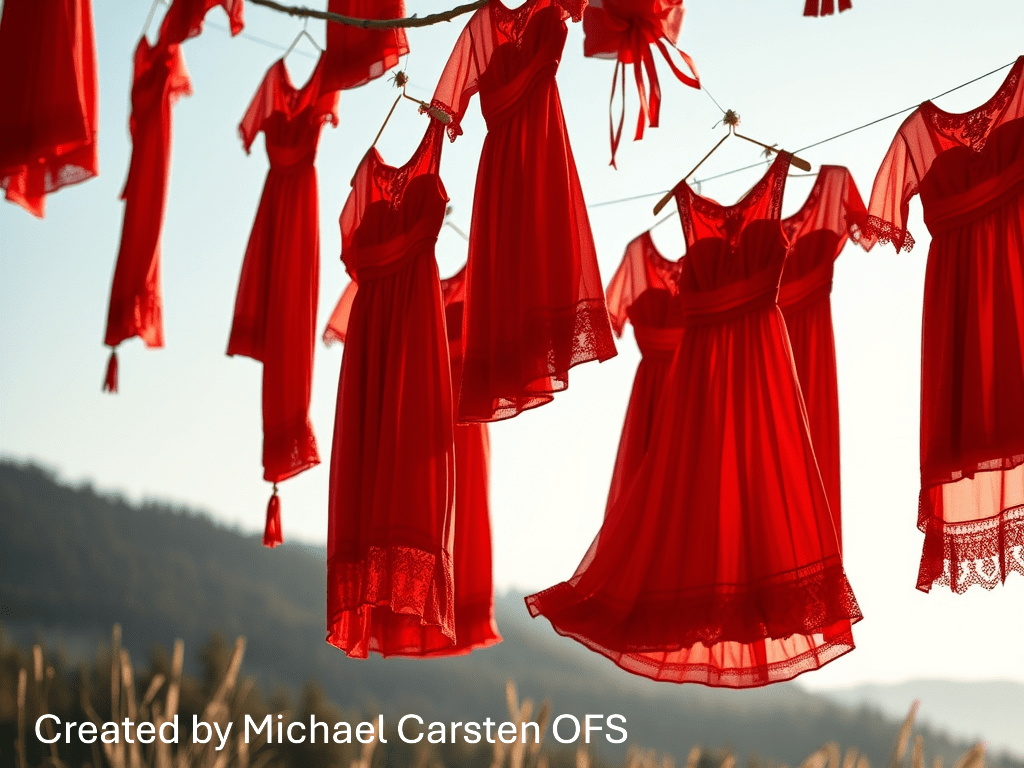
On May 5th, red dresses hang across the United States—empty, yet vibrant with the call of spirits, as envisioned by Métis artist Jaime Black’s REDress Project. Red Dress Day, aligned with the U.S. National Day of Awareness for Missing and Murdered Indigenous Women (MMIW), confronts a crisis of violence against Indigenous women and girls, rooted in colonial legacies, including the Catholic Church’s role in Indian boarding schools. As Secular Franciscans, inspired by Pope Francis’s call to care for the marginalized and seek reconciliation, we are summoned to lament this injustice, pursue healing, and demand a continued U.S. response to protect Indigenous women. In 2025, Red Dress Day is our call to live the Gospel by standing with Indigenous communities.
A Crisis Rooted in Historical Wounds
The statistics are staggering: Indigenous women in the U.S. face murder rates up to 10 times the national average, with 5,712 missing cases reported in 2016, though only 116 were logged in the Department of Justice’s database. Over 84% of American Indian and Alaska Native women experience violence in their lifetime, including 56% facing sexual violence. On some reservations, murder rates for Indigenous women are over 10 times the national average. This crisis, described as a “silent epidemic,” stems from systemic issues—colonization, racism, and intergenerational trauma.
The Catholic Church’s historical role amplifies this crisis. From the late 19th century to the mid-20th century, Catholic-run Indian boarding schools, like St. Boniface in California, forcibly assimilated Indigenous children, inflicting abuse and trauma. A 2022 Department of the Interior report estimated thousands of deaths at these schools, with Catholic institutions heavily implicated. This trauma fractured families, eroded traditional gender roles, and left generations vulnerable to poverty and violence—key risk factors for MMIW. Pope Francis, in his 2022 apology for the Church’s role in Canada’s residential schools, called for “concrete actions” to address such harms, a reminder that applies to the U.S. context. He urged Catholics to confront ongoing injustices, like MMIW, with humility and action.
As Secular Franciscans, we heed Pope Francis’s call that “the poor and the excluded are the living image of Christ” (Fratelli Tutti, 2020). The MMIW crisis demands we acknowledge the Church’s historical wrongs, seek forgiveness, and support justice for Indigenous women and girls.
The U.S. Response to MMIW
Red Dress Day, observed as the National Day of Awareness for MMIW on May 5th, honors victims like Hanna Harris, a Northern Cheyenne woman murdered in 2013, whose case sparked a 2017 Senate resolution. The red dress, symbolizing absence and resilience, calls us to support the U.S. response, which includes legislative, grassroots, and community efforts, though gaps remain.
Legislative Action: The U.S. has taken steps to address MMIW. The 2020 Savanna’s Act, named for Savanna LaFontaine-Greywind, murdered in 2017, improves data collection and law enforcement protocols for MMIW cases. The Not Invisible Act, also passed in 2020, created a commission of tribal leaders, survivors, and federal partners to recommend solutions, complementing Savanna’s Act. The 2013 Violence Against Women Act (VAWA) reauthorization restored tribal jurisdiction over certain domestic violence crimes, expanded in 2022 to cover sexual violence and trafficking. In 2021, Interior Secretary Deb Haaland established the Missing and Murdered Unit within the Bureau of Indian Affairs to investigate cases, a first-of-its-kind effort. Yet, implementation lags due to underfunding and jurisdictional complexities, with only 40% of Savanna’s Act’s protocols fully enacted by 2023.
Grassroots Movements: Indigenous-led advocacy drives progress. The National Indigenous Women’s Resource Center (NIWRC) organizes the National Week of Action for MMIW (May 5-9), amplifying family voices and pushing for policy reform. Groups like MMIW-TX, led by Jody Voice, provide resources and safety workshops in urban Native communities. The red hand over the mouth, a symbol of silenced voices, and the hashtag #NoMoreStolenSisters galvanize public awareness. In states like Washington, a 2023 MMIWP Cold Case Unit, the nation’s first, investigates unresolved cases with tribal consent.
Ongoing Challenges: Despite progress, systemic issues persist. Jurisdictional gaps between tribal, state, and federal authorities hinder investigations, with 71% of Native Americans living in urban areas facing limited culturally specific resources. Underreporting and racial misclassification skew data, minimizing the crisis’s scale. Police often dismiss cases as “runaways,” as Sheri Hill of Browning, Montana, notes, delaying critical action. Pope Francis’s call to “build a culture of encounter” (Fratelli Tutti) urges us to challenge these failures and advocate for systemic reform.
A Call to Action
Pope Francis reminds us, “We are called to be instruments of God for the liberation and promotion of the poor” (Evangelii Gaudium, 2013). As Secular Franciscans, Red Dress Day is our mandate to support the U.S. response to MMIW:
Learn with Humility: Read the 2022 Department of the Interior’s boarding school report or NIWRC’s MMIW resources. Reflect on the Church’s role in trauma, praying for forgiveness, as Pope Francis modeled in 2022.
Listen to Indigenous Voices: Follow groups like NIWRC or MMIW USA on social media. Share their stories in your fraternity or parish to amplify their calls for justice.
Advocate for Justice: Urge Congress to fully fund Savanna’s Act and the Not Invisible Act. Support VAWA’s tribal provisions. Write to officials or join rallies, as Pope Francis encourages, to “walk together” with the marginalized.
Serve the Marginalized: Donate to organizations like MMIW-TX or NIWRC. Attend vigils or events during the National Week of Action (May 5-9, 2025), listed on NIWRC’s website.
Build Peace: Challenge stereotypes rooted in colonial history, including missionary teachings, in your community. Share Red Dress Day’s significance, fostering dialogue, as Pope Francis calls for in Fratelli Tutti.
Rebuilding with Love
Red Dress Day is a cry for justice, echoing Pope Francis’s plea that “every human being has the right to live with dignity” (Laudato Si’, 2015). Rosalie Fish, an MMIW activist and athlete, runs to honor victims, saying, “I run for those who can’t.” Each red dress is a call to rebuild—with prayer, action, and solidarity. In 2025, let us wear red, hang dresses, and pray at vigils, but also commit to supporting the U.S. response—legislative, grassroots, and spiritual—to end the violence and restore safety for Indigenous women and girls.
For support, contact the National Indigenous Women’s Resource Center at 1-855-649-7299.
Sources:
U.S. Department of the Interior, Federal Indian Boarding School Initiative Investigative Report (2022)
Urban Indian Health Institute, Missing and Murdered Indigenous Women & Girls (2018)
National Indigenous Women’s Resource Center, MMIWR Resources
Bureau of Indian Affairs, Missing and Murdered Indigenous People Crisis
Native Hope, Missing and Murdered Indigenous Women (2024)
Pope Francis, Fratelli Tutti (2020), Evangelii Gaudium (2013), Laudato Si’ (2015), Apostolic Journey to Canada (2022)
As a lifelong Michigander and a Canadian in spirit, I’ve been blessed to live a life woven into the cultures of both regions. Canadians aren’t distant neighbors to me—they’re family. Their warmth, resilience, and quiet kindness have shaped who I am. I love their towering forests, rugged mountains, tranquil lakes, and rolling plains. I love the Great Lakes that bind us, the rivers flowing like lifeblood through the land. Above all, I cherish the spiritual connection I feel here—a bond that transcends borders and whispers of something eternal.
Lately, though, that bond has been eclipsed by pain and grief. The U.S. government’s portrayal of Canada as a villain – an adversary to be threatened with violent takeover – cuts me to the core. It’s not just rhetoric; it’s a betrayal of a sacred relationship. Canada isn’t a faceless entity; it’s home, refuge, inspiration. To see it demonized is a personal wound, unraveling the unity I’ve built in my heart over a lifetime.
This isn’t just my sorrow—it’s a broader injustice. The United States, a democracy fraying with division and distrust, turns outward instead of inward. We target Canada, a peaceful neighbor lacking the strength to resist. It’s cowardice, not strength, to exploit our power against the vulnerable—a failing nation cloaking its greed in bravado. Worse, we repeat this aggression with Panama’s jungles. We threaten Mexico’s deserts and Greenland’s icy expanses. Each threat is a fresh stain on our conscience. And then there’s Ukraine. We’ve abandoned it to face overwhelming odds alone, flexing our muscles elsewhere while a desperate ally falters. I’m ashamed of who we’ve become: a nation that bullies the weak and forsakes the suffering as our own house crumbles.
What makes this greed galling is its clash with our self-proclaimed Christian identity. We claim to follow Jesus—his teachings of humility, compassion, love for our neighbors. Yet where’s the humility in menacing Canada with domination? Where’s the compassion in leaving Ukraine to its fate while we chase selfish ambitions? The Christ I know spoke of turning the other cheek, caring for the least among us, seeking peace over power. Our actions reek instead of a lust for control—a betrayal of every sermon we’ve preached about moral superiority. This isn’t Christianity; it’s hypocrisy draped in false piety.
Canada, Panama, Mexico, and Greenland aren’t geopolitical pawns; they’re nations of people deserving dignity, not domination. I’ve walked Canada’s land, marveled at its waters, been welcomed by its communities—none of it ours to claim. I recall a crisp morning on Lake Superior’s shore. The mist rose like a prayer. It reminded me that true strength lies in coexistence, not coercion. Yet our threats sow fear where trust should flourish, division where solidarity should reign. This narrative, driven by conflict over cooperation, betrays the human and spiritual values that have long sustained us.
The fragility of this moment deepens my grief. Bonds forged through shared history and humanity are precious but not unbreakable. Watching us abandon Ukraine shows how easily we can lose what matters most. We are also menacing neighbors who wish us no harm. Still, I refuse despair. I hold fast to the love that ties me to Canada. The people there have embraced me. The landscapes restore me. The waters reflect our shared existence. That love gives me the strength to stand with them. We must unite against the hatred and fear tearing us apart.
We have a moral duty to reject this aggression. A nation struggling to uphold its own ideals has no right to force its will on others—least of all neighbors like Canada, Panama, and Mexico, or distant Greenland, whose peace should inspire us. We have no right to turn from Ukraine while claiming superiority. Instead, let’s reclaim the peace and understanding that define our better selves—values that echo the faith we profess. Let’s demand a shift: policies that prioritize partnership, voices that amplify the vulnerable, a discourse that heals rather than divides. Our shared humanity dwarfs any boundary or power play.
Reflecting on Canada’s beauty—and the dignity of all we’ve threatened—I’m filled with quiet determination. I cling to hope that compassion and reason will prevail, that we’ll stop painting Canada as a villain, stop menacing the defenseless, stop abandoning the suffering. I envision a day when we walk alongside others—not as tyrants in pious disguise, but as kin on a journey toward something better. In adversity, I find solace in the people, the land, the waters, and the spiritual thread uniting us. Together, we can rise above this pain, grief, and shame, building a future worthy of our highest calling.
As a Lay Franciscan, a retired carpenter, a husband, father, and grandfather, I carry a heavy heart filled with sorrow and indignation as I witness the violence—both literal and figurative—being inflicted on the people of the United States. This pain is not the act of some distant enemy; it is our own family, our friends, and our neighbors who play roles in this destruction. Our politicians, pastors, and even our Bishops contribute to the suffering. They are tearing at the fabric of our nation, attacking the very idea of self-government and independence that defines us as a people.
I struggle to understand how those who have sworn an oath to defend the Constitution—including our Supreme Court Justices and military officers—can remain passive as these acts of violence are carried out. Instead of protecting the ideals entrusted to them, they allow the dismantling of government programs, the mass layoffs of workers, and the dismantling of structures meant to serve the common good.
The assault is profound: on our government, on our community, and on the hope, we hold for our future as a nation united. It leaves a deep wound in the soul of our country, affecting not just policies but lives—our lives and the lives of generations yet to come. It is a profoundly personal act of violence, eroding trust and solidarity, and forcing families like mine to confront the disheartening reality of what we are becoming. This pain is devastating, and as a man of faith and principle, I cannot remain silent while watching the principles of self-determination and the dignity of governance undermined in such an aggressive and calculated way.
Reflection on the Violence Inflicted on the American People by the Government of the United States.
As of 03:44 PM PDT on Friday, March 14, 2025, the Trump administration’s aggressive agenda to dismantle parts of the federal government has sparked significant concern and sorrow among observers and affected individuals. This reflection, written from the perspective of a concerned citizen, expresses deep sadness at the violence—both emotional and social—being inflicted upon the American people, particularly through the closure of government programs and mass layoffs. The analysis is informed by recent news articles, policy documents, and personal accounts, highlighting the deliberate nature of these actions to overwhelm and cause pain.
Background and Context
The Trump administration, in its second term starting January 2025, has pursued an agenda to reduce the size and scope of the federal government, often referred to as dismantling the administrative state. This effort, driven by executive orders, budget cuts, and policy proposals like Project 2025, overseen by figures like Elon Musk through the Department of Government Efficiency (DOGE), targets both domestic and international operations. By March 14, 2025, confirmed actions include rescinding 78 Biden-era executive orders, eliminating DEI programs, halting UNRWA funding, and firing 5,400 civilian employees in the Department of Defense, among others An agency-by-agency look at Trump’s plan to overhaul government. Planned actions, such as closing the Department of Education and integrating USAID into the Department of State, are pending, with potential further reductions in military spending and overseas operations.
Confirmed Actions and Their Impact
By March 14, 2025, the administration has implemented closures and stoppages, directly affecting American citizens:
Executive Office of the President (EOP): Rescinded 78 Biden-era executive orders on January 20, 2025, impacting climate, immigration, and equity policies An agency-by-agency look at Trump’s plan to overhaul government. Eliminated DEI programs across government on the same date, halting training and offices Trump administration ends government diversity programs and takes aim at DEI nationwide. Instituted a non-military hiring freeze and canceled $181M in DEI training contracts by January 29, 2025, based on an X post (Trump), though unverified. These actions have sent a message of exclusion, particularly affecting marginalized communities, deepening social divides.
Department of State (DOS) and USAID: Halted UNRWA funding on January 20, 2025, stopping US contributions to Palestinian refugee aid Up First briefing: government shutdown; Trump at DOJ; federal layoffs, and paused foreign development assistance, impacting USAID-managed programs like global health and disaster relief. Specific actions include canceling $45M in Burma diversity scholarships and $50M for Gaza condoms by January 29, 2025, based on an X post (Trump, Trump), though unverified. While primarily affecting global populations, these cuts indirectly impact American security and economy through reduced global stability, as noted by advocacy groups. The Impact of the New Trump Administration on USAID: Cuts, Closures, and Controversy.
Department of Justice (DOJ): Attempted to end birthright citizenship on January 20, 2025, via an executive order, blocked by a judge around January 23, 2025, affecting immigrant communities and their access to rights. A Look at the Upcoming Trump Administration’s Policy Priorities.
Environmental Protection Agency (EPA): Stopped Clean Power Plan enforcement and NEPA climate reviews on January 20, 2025, ending carbon emissions rules for power plants and mandatory climate impact assessments. A Look at the Upcoming Trump Administration’s Policy Priorities. Rolled back Clean Water Act wetlands protections in February 2025, reducing federal oversight of wetlands, potentially affecting environmental justice communities.
Department of Agriculture (USDA), Energy (DOE), Transportation (DOT), Interior (DOI), Homeland Security (DHS): Various freezes and rollbacks, such as halting climate-related farm subsidies, renewable energy projects, and infrastructure funding, have disrupted services affecting rural communities, energy consumers, and border security, respectively. The 2,600 Federal Programs Under Scrutiny by Trump’s OMB.
Personal Stories and Emotional Toll
The human cost of these actions is profound, with personal stories highlighting the emotional and social violence inflicted. For instance, a federal worker, fearing retaliation, described feeling “completely blindsided” by a layoff notice after over 10 years of service, stating, “It’s devastating”. ‘You lose all hope’: Federal workers gripped by mental health distress amid Trump cuts.
These accounts reflect the financial and mental health crises, with reports of overwhelming stress, rapid weight loss, and panic attacks among federal workers.
Past government shutdowns, like in 2019, provide a precedent, with an estimated 800,000 federal workers missing paychecks, leading to missed rent, spoiled credit ratings, and food emergencies, particularly affecting African Americans in federal employment. America shuts down: how the federal government closure is impacting millions.
Hypothetical actions, like 8% annual budget cuts to the Department of Defense, could lead to further layoffs, affecting mainland and overseas operations. Trump’s dramatic plan to cut the federal workforce.
These potential changes add to the uncertainty and fear among Americans.
Design and Intent
It is my belief that these actions are “by design. Designed to overwhelm and cause pain” is supported by critics and legal experts. Democratic Senator Ron Wyden confirmed that doctors in all 50 states were unable to secure Medicaid payments during the funding freeze, highlighting the disruption. Trump aid freeze stirs chaos before it is blocked in court.
The Leadership Conference on Civil and Human Rights described the first week as “Chaos, Confusion, & Abuse of Power,” with executive orders targeting civil rights and attempting to dismantle diversity efforts. Chaos, Confusion, & Abuse of Power: Trump’s First Week Back in Office.
Legal scholars, like Steven Smith from Arizona State University, argued that the OMB memo’s breadth has no precedent, suggesting a deliberate strategy to bypass congressional authority. Fact check: What might Trump’s federal funding freeze stop?.
Anxiety among those reliant on health insurance, disrupted care
OMB
Halted federal financial assistance, partially rescinded
Confusion, disrupted state services, affected education centers
USDA, DOE, DOT, DOI, DHS
Various freezes and rollbacks
Disrupted rural services, energy access, border security
Conclusion
The violence inflicted upon the American people through these government closures is real and tangible, manifesting as financial hardship, mental health crises, and disrupted services. It is designed to overwhelm and cause pain, as evidenced by the deliberate nature of the actions and the reactions from affected individuals and critics. This reflection expresses my own deep sorrow for the suffering endured, but also a resolve to resist and work towards a future where government serves all with compassion and equity.
Introduction: A Catholic Perspective on World Interfaith Harmony Week
As Catholics, we may hesitate when initiatives like World Interfaith Harmony Week come up. Questions arise: Does this compromise our faith? Is it promoting a blending of religions? These concerns are valid and come from wanting to stay faithful to the Gospel. But rest assured, World Interfaith Harmony Week is not about diminishing our Catholic identity. Instead, it offers a powerful opportunity to live out one of the most fundamental aspects of our faith: building peace and loving our neighbors as Christ taught us.
The Catholic Church has long supported interfaith dialogue. The Second Vatican Council’s declaration, Nostra Aetate, reminds us that we must respect and work alongside people of all faiths. It acknowledges that God’s presence is evident in different cultures and religions, planting seeds of truth and goodness. This dialogue is not about compromise but humility, understanding, and collaboration for the common good.
As Franciscans, we are especially drawn to this mission of interfaith harmony. St. Francis of Assisi exemplified this beautifully when he met Sultan Malik al-Kamil during the Fifth Crusade. He approached the encounter with humility, respect, and a desire for peace. He modeled the very essence of what World Interfaith Harmony Week represents. Participating in such initiatives doesn’t mean abandoning our beliefs but living out Christ’s call to be peacemakers. In this spirit, let us explore what World Interfaith Harmony Week is, its goals, and how we, as Catholics, can engage with it confidently and faithfully.
What is World Interfaith Harmony Week?
World Interfaith Harmony Week is a United Nations initiative observed annually from February 1 to February 7. It aims to foster mutual understanding, respect, and collaboration among people of different faiths and belief systems. This week encourages individuals and communities worldwide to focus on shared values and work together toward global peace and harmony.
The initiative’s key message—”Love of God and Love of the Neighbor,” later extended to “Love of the Good and Love of the Neighbor”—is rooted in universal principles of compassion and mutual respect. It provides a framework for people of all faiths (and even those with no religious affiliation) to unite for the betterment of society.
Origins of the Initiative
World Interfaith Harmony Week was proposed in 2010 by King Abdullah II of Jordan, a leader known for advocating peace and dialogue among religions. He recognized the challenges of religious division and misunderstanding in the modern world and presented the idea at the United Nations General Assembly. His vision was to create a global interfaith dialogue platform fostering collaboration and unity. The UN unanimously adopted the resolution, making it an official initiative observed every February.
King Abdullah II’s efforts were rooted in earlier initiatives, such as the Amman Message of 2004, which sought to clarify Islam’s core teachings and promote interfaith dialogue. His leadership highlights how individuals from different faith traditions can take meaningful steps toward peace and understanding.
The Catholic Connection: A Foundation for Dialogue
The Catholic Church has consistently recognized the importance of interfaith harmony. In Nostra Aetate (1965), the Church officially encouraged dialogue with other religions, emphasizing that we share many core values, including the pursuit of truth, justice, and peace. Pope Francis has also made interfaith dialogue a cornerstone of his papacy, frequently engaging with leaders of other faiths and calling for collaboration on issues like poverty, climate change, and human rights.
World Interfaith Harmony Week aligns with these Catholic principles. It offers a platform to live out our call to love God and neighbor. By participating, we do not compromise our faith but bear witness to it in the spirit of humility and service.
Goals of World Interfaith Harmony Week
Promoting Dialogue Across Faiths One of the initiative’s primary goals is to create opportunities for meaningful conversations between people of different religions. Dialogue builds understanding, dispels stereotypes, and fosters mutual respect.
Encouraging Love and Respect At its heart, World Interfaith Harmony Week emphasizes love—love of God, love of neighbor, and love of the good. This message transcends specific doctrines, inviting all people to focus on what unites them rather than what divides them.
Addressing Discrimination and Misinformation Religious discrimination and ignorance are significant barriers to peace. The initiative aims to combat these issues by promoting education, awareness, and mutual understanding.
Why World Interfaith Harmony Week Matters
Uniting Communities Around Shared Values While religious traditions vary, most share common values such as compassion, justice, and the pursuit of peace. Focusing on these shared values helps unite communities and inspire collective action.
Addressing Global Challenges Many global issues, from poverty to climate change, require collaboration across religious and cultural boundaries. Interfaith harmony provides a foundation for addressing these challenges together.
A Witness to Catholic Faith in Action Participating in interfaith initiatives allows Catholics to live out the Gospel. We demonstrate Christ’s teachings by engaging with others in a spirit of love. This approach respects others and communicates His message to the world.
How Catholics Can Participate
If you’re wondering how to get involved in World Interfaith Harmony Week, here are some ideas:
Organize or Attend Events Join your area’s interfaith prayer gatherings, seminars, or community service projects. These events provide a space for dialogue and connection.
Engage in Meaningful Conversations Take time to learn about the beliefs of others and share your own faith story with humility and respect.
Educate Yourself and Others Read about other religions, attend workshops, or invite speakers to your parish. Understanding others helps build bridges of trust and understanding.
Conclusion: Living as Peacemakers in a Divided World
World Interfaith Harmony Week is not a threat to our Catholic identity—it’s an invitation to live it out more thoroughly. As Franciscans and Catholics, we are called to be peacemakers, bridge-builders, and witnesses to Christ’s love in a divided world. By engaging in interfaith dialogue, we follow in the footsteps of St. Francis of Assisi, who demonstrated that peace and respect transcend differences.
Through this initiative, we can help create a world that reflects God’s kingdom—a kingdom of justice, love, and peace. Let’s step forward with confidence, knowing that our faith calls us to be instruments of harmony in a world that so desperately needs it.
FAQs
What is the primary goal of World Interfaith Harmony Week? To foster mutual understanding, respect, and collaboration among people of different faiths.
How does this initiative align with Catholic teachings? It aligns with the Church’s call to interfaith dialogue, as emphasized in Nostra Aetate, by promoting peace, respect, and shared values.
Why is interfaith dialogue critical? It helps build bridges of understanding, dispels stereotypes, and unites communities in addressing global challenges.
Who started World Interfaith Harmony Week? King Abdullah II of Jordan proposed the initiative, which was adopted by the United Nations in 2010.
How can Catholics participate? Catholics can participate by attending interfaith events, engaging in meaningful conversations, and promoting education and understanding in their communities.