When we sit on our porch in Detroit and feel the cool breeze, or watch a butterfly flutter by, what are we really seeing? Is it just air molecules and a tiny insect, or something more? For us as Secular Franciscans, our hearts tell us it’s something infinitely more profound.
Science often describes the world in a beautiful yet impersonal way. It talks about physics, chemistry, and biology. Yet, our faith reminds us that behind all the laws and all the atoms is a profound and loving presence. This isn’t a new idea; it’s the very heart of the Franciscan way.
Beyond a Creator, to a Presence
For our founder, St. Francis of Assisi, God wasn’t just a powerful being far away in the heavens. God was intimately present in every part of creation. St. Francis didn’t just see the sun as a star; he called it “Brother Sun.” He didn’t just see water as H₂O; he called it “Sister Water,” for its beauty and utility.
This is because the universe is not just a creation, but a divine poem. A poem isn’t just words on a page; it’s a window into the mind and heart of the poet. In the same way, the universe isn’t just matter and energy. It’s a profound and beautiful expression of God’s wisdom, love, and divine conscience.
This is a simple truth that anyone can grasp, yet it is so profound. It asks us to look at a cloud, a tree, or even our spouse, Kathleen, and see not just what they are, but whose they are.
Living with a Cosmic Conscience
If the universe is a reflection of a divine conscience, then our own conscience is a spark of that same light. Our inner voice that tells us to do good and to love isn’t just a random feeling. It’s a small part of God’s own self-awareness that resides within us.
This understanding directly connects to our Franciscan life. Caring for creation isn’t just a “green” initiative; it’s a sacred duty. It’s about honoring the divine reality present in all things, just as we would praise God Himself. To harm creation is to harm the very expression of God’s goodness.
So, let’s go out and live with a cosmic conscience. Let’s pause to truly see the world around us. Let’s find God in the everyday, in the small moments of wonder and in the simple, loving acts we perform for one another. It’s in this that we honor the divine poem and live out our call as brothers and sisters of St. Francis.
The great Franciscan family, a spiritual tree with many branches, springs from a single, powerful seed: the call to do penance. This was the life St. Francis of Assisi embraced after his conversion, a life of turning completely from sin and self to follow the poor and crucified Christ in the Gospel. This fundamental call to metanoia—a radical, ongoing conversion of heart—is the shared spiritual DNA of every man and woman who follows the Poverello. From this common root, two major branches of the Third Order grew, each a distinct and beautiful expression of the same charism. The Secular Franciscan Order (OFS) represents the original vision for lay men and women to live the Gospel in the heart of the world, while the many congregations of the Third Order Regular (TOR) represent the desire for a vowed, communal expression of the same penitential spirit.
The two modern Rules that govern these Orders—the Rule of the OFS, Seraphicus Patriarcha, approved by Pope St. Paul VI in 1978, and the Rule of the TOR, Franciscanum Vitae Propositum, approved by Pope St. John Paul II in 1982—are not competing documents but spiritual siblings. They are parallel flowerings from the same root, each updated after the Second Vatican Council to speak with fresh clarity to the modern world. For a professed Secular Franciscan, the TOR Rule is not a foreign text. It is a family heirloom, a mirror reflecting the radical heart of the Franciscan vocation in its most concentrated form. This article serves as a comprehensive guide for the Secular Franciscan who wishes to explore this shared heritage. It will trace the historical and juridical journey that led to two distinct paths and conduct a deep comparative analysis of the two Rules. This exploration is an invitation to see the two Rules not as a division, but as a dialogue that reveals the immense breadth and depth of the one call to observe the Holy Gospel in the footsteps of St. Francis of Assisi.
1: A Shared Root, Two Distinct Branches: The Historical and Juridical Journey
To understand the relationship between the Secular Franciscan Order and the Third Order Regular, one must first grasp their shared history. Their divergence was not a schism over doctrine but an organic development responding to the varied ways the Holy Spirit called people to live the Franciscan charism. The OFS is not a “lesser” version of the TOR; it is the original lay expression of the penitential life, from which the TOR later branched off to form a new mode of consecrated religious life. This historical reality affirms the equal dignity and distinct purpose of each vocation within the one Franciscan family.
1.1 The Common Genesis: The Brothers and Sisters of Penance
The Franciscan movement began with St. Francis himself, but it quickly attracted followers from every state of life. Around the year 1221, Francis established what was originally called the “Brothers and Sisters of Penance”. This was his answer for the many married men and women, diocesan priests, and other laypeople who were inspired by his radical living of the Gospel but who, because of their existing commitments, could not join the Friars Minor (the First Order) or the Poor Ladies (the Second Order).
The “primitive rule” for this lay movement was Francis’s own Letter to All the Faithful (also known as the Earlier Exhortation to the Brothers and Sisters of Penance). This document was not a legal code but a powerful spiritual exhortation, a “form of life” calling the laity to a profound interior conversion. Its core tenets were simple and drawn directly from the Gospel: to love God with one’s whole being and one’s neighbor as oneself; to turn away from sin; to receive the Body and Blood of Christ; and to produce “worthy fruits of penance” through acts of charity and forgiveness. The inclusion of this very letter as the Prologue to the modern OFS Rule, and its partial inclusion in the TOR Rule, serves as a testament to the direct lineage both Orders trace back to the founder’s original inspiration.
This burgeoning lay movement soon required a more formal structure. With the help of Cardinal Ugolino (the future Pope Gregory IX), a formal Rule known as the Memoriale Propositi was approved by Pope Honorius III in 1221, giving canonical status to the Order of Penance. This marked the official birth of what would become the Third Order.
1.2 The Fork in the Road: Community Life and the Birth of the Third Order Regular
Within the widespread Order of Penance, a new spiritual desire began to emerge. Some tertiaries, both men and women, felt called to a more intense and structured form of penitential life. Organically, without a single founder, they began to gather into small groups, living in common either as hermits or in communities dedicated to prayer and works of mercy. This development created a natural “fork in the road.” While the majority of tertiaries continued to live the Franciscan charism in their homes and workplaces, these new communities began to move toward a more formal, consecrated life.
This new expression of Franciscan life eventually adopted the traditional religious vows of poverty, chastity, and obedience. For over two centuries, these communities grew and developed in various regions, particularly in Italy, the Netherlands, and Germany, often in isolation from one another. The Church recognized the authenticity of this new form of life and, in 1447, Pope Nicholas V issued the apostolic letter Pastoralis officii. This landmark document effectively organized these disparate communities of vowed tertiaries into a new, independent mendicant order: the Third Order Regular of St. Francis of Penance. This moment marks the official juridical separation of the TOR from its secular counterpart, establishing two distinct but related branches from the same trunk.
1.3 Parallel Paths of Renewal: The Evolution of the Rules to the Modern Era
Following their formal separation, the two branches continued on parallel paths of development and renewal, with the Church periodically updating their respective Rules to meet the needs of the times.
The Rule for the secular branch was revised and confirmed by Pope Nicholas IV in 1289 with the bull Supra montem and again by Pope Leo XIII in 1883 with Misericors Dei Filius, which adapted the Order to the challenges of the 19th century. The most recent and current Rule is Seraphicus Patriarcha, promulgated by Pope St. Paul VI in 1978.
The Third Order Regular also saw its Rule evolve. Pope Leo X provided a significant unifying Rule in 1521 with the bull Inter cetera to bring uniformity to the many congregations. This and other statutes guided the TOR for centuries until, like the OFS, it underwent a period of post-Vatican II renewal. This process culminated in the approval of the current Rule, Franciscanum Vitae Propositum, by Pope St. John Paul II in 1982.
It is crucial to recognize that both modern Rules—1978 for the OFS and 1982 for the TOR—were born from the same spirit of aggiornamento (updating) that swept the Church after the Second Vatican Council. Both sought to return to the primitive inspiration and authentic charism of St. Francis while courageously adapting their way of life to the realities of the contemporary world.
1.4 A Family Reunited: Understanding Autonomy and “Vital Reciprocity”
The modern era has brought a mature and clear definition of the relationship between the Franciscan Orders. The 1978 Rule established the Secular Franciscan Order as a fully autonomous Order within the Church. It is not a subsidiary or “third-class” part of the Franciscan family, but an equal member, alongside the First and Second Orders, with its own international governance.
This autonomy, however, does not imply isolation. The Church, recognizing the profound family bond, has formally codified the relationship under the principle of “vital reciprocity” (vitalis reciprocatio). The Holy See has entrusted the spiritual and pastoral assistance of the OFS to the friars of the First Order and the Third Order Regular. This is not a relationship of juridical control but of fraternal service and spiritual animation. The friars are tasked with guaranteeing the fidelity of the OFS to the Franciscan charism and fostering communion within the entire family. This arrangement is a beautiful expression of the Church’s wisdom. After centuries of varied and sometimes inconsistent levels of engagement between the branches, “vital reciprocity” establishes a relationship of equals who are spiritually interdependent. For a Secular Franciscan, this means the TOR is not just another religious order; it is a designated spiritual resource, an elder sibling in the faith, and a living witness to the same charism.
2: The Rules in Dialogue: A Comparative Spiritual Analysis
While rooted in a common history, the Rule of the Secular Franciscan Order (OFS) and the Rule of the Third Order Regular (TOR) are distinct documents tailored to different ways of life. A careful comparison reveals a shared heart but different modes of expression, reflecting their unique roles within the Church. The TOR Rule, steeped in the founder’s own words, aims to form the religious by direct immersion in the source. The OFS Rule, integrating the language of Vatican II, aims to form the laity by connecting the Franciscan charism to their universal call to holiness and mission in the world. Understanding these differences in pedagogy and focus is key to appreciating the unique gift of each Rule.
2.1 Foundational Principle: To Observe the Holy Gospel
The bedrock of both Rules is identical: a life dedicated to observing the Holy Gospel in the footsteps of St. Francis of Assisi. This shared foundation is the source of their profound spiritual unity.
OFS Rule, Article 4: “The rule and life of the Secular Franciscans is this: to observe the gospel of our Lord Jesus Christ by following the example of St. Francis of Assisi who made Christ the inspiration and the center of his life with God and people”.
TOR Rule, Chapter I, Article 1: “The form of life of the Brothers and Sisters of the Third Order Regular of Saint Francis is this: to observe the Holy Gospel of Our Lord Jesus Christ by living in obedience, in poverty and in chastity”.
Both Orders see St. Francis not as the end, but as the model, the one who shows them how to make Christ the center of everything. This Christocentric, Gospel-driven life is the non-negotiable core of their shared identity.
2.2 The Nature of Commitment: Profession in the World vs. Vows in Community
The most significant and defining difference between the two Orders lies in the nature of their public commitment and the state of life it entails.
Members of the Third Order Regular are consecrated religious. They profess the three public, evangelical vows of poverty, chastity, and obedience and live a common life in a fraternal community, such as a friary or convent. Their life is structurally set apart from the world to be a specific sign within the Church.
Members of the Secular Franciscan Order, by contrast, live their vocation in their own secular state. They make a public profession—a solemn promise, not a canonical vow—to live according to their Rule for their entire life. They can be married or single, laypeople or diocesan clergy, and they live in their own homes, work in secular jobs, and raise families.
This fundamental distinction shapes the entire content and structure of each Rule. The TOR Rule must necessarily legislate for the practicalities of a common life, while the OFS Rule provides guiding principles for living the Franciscan charism within the vast and varied circumstances of secular life.
2.3 The Arena of Life: The World as Cloister
Flowing directly from the nature of their commitment is the difference in their primary “arena” of life and apostolate.
For the TOR, life is centered in and flows from the religious house. Their apostolic works, whether in education, parish ministry, or social justice, are typically undertaken as a community and are an extension of their common life.
For the OFS, the world itself is their cloister. As Pope St. John Paul II affirmed, their vocation is to live the Gospel in saeculo—in the world. Their family, their workplace, their neighborhood, and their parish are the primary fields where they are called to plant the seeds of the Gospel. The OFS Rule is explicitly designed to be adaptable, meeting the “needs and expectations of the Holy Church in the conditions of changing times”, recognizing that the secular context is not an obstacle to their vocation but the very place it is meant to be lived.
2.4 A Tale of Two Texts: Spiritual Tone and Guiding Influences
While both Rules are deeply spiritual, they have a different texture and draw from different primary sources, revealing their distinct pedagogical aims.
The TOR Rule is almost entirely spiritual and ascetical in its tone. It is a beautiful mosaic composed largely of direct quotations from the writings of St. Francis and St. Clare of Assisi. A comparative analysis shows it contains 92 references to Francis’s writings and 12 to Clare’s. Reading it feels like receiving a direct exhortation from the founders themselves.
The OFS Rule is rooted in Franciscan sources, with 21 references to Francis’s writings. However, it is profoundly shaped by the theology of the laity that emerged from the Second Vatican Council. It contains 18 references to Vatican II documents. It specifically highlights Lumen Gentium (Dogmatic Constitution on the Church). It also emphasizes Gaudium et Spes (Pastoral Constitution on the Church in the Modern World). Its language about the lay apostolate promotes justice. It speaks about building a more fraternal world and emphasizes the dignity of the family. These points echo the council’s vision for the mission of the laity.
This difference in source material is not accidental. It reveals a specific intention for the formation of the members. The TOR Rule aims to form the religious by immersing them directly in the founders’ teachings. This immersion is suitable for a life lived in a dedicated Franciscan environment. The OFS Rule seeks to form the laity by explicitly connecting the Franciscan charism to the universal call to holiness. It connects this charism to the specific mission of the laity in the Church and the world. This connection is defined by the most recent ecumenical council. The OFS Rule, thus, acts as a bridge. It links the specific Franciscan path to the great highway of the Church’s life in the modern age.
Conclusion: One Family, One Charism, Many Paths
The journey through the Rules of the Secular Franciscan Order and the Third Order Regular reveals a profound and beautiful truth: the Franciscan charism is a single, vibrant reality expressed in a plurality of forms. The OFS and the TOR are not rival systems but complementary vocations, two authentic paths for living the one Gospel life revealed to St. Francis of Assisi. They share a common origin in the penitential movement, a common goal of conformity to Christ, and a common mission to rebuild the Church from within.
The differences between them are not of essence but of application. The TOR, with its public vows and community life, offers a concentrated, prophetic witness to the evangelical counsels. Its Rule, steeped in the very words of Francis and Clare, is a powerful call to radical self-renunciation for the sake of the kingdom. The OFS, with its profession made in the world, offers a leavening witness, demonstrating that a life of deep conversion and apostolic love is possible within the ordinary circumstances of family, work, and society. Its Rule, in dialogue with the modern Church, provides a bridge between the Franciscan ideal and the universal call to holiness for all the baptized.
Ultimately, to study the two Rules in parallel is to listen to a conversation within one’s own spiritual family. It is to see the same fire of love for Christ burning in a different hearth, revealing the immense breadth and depth of the one call to observe the Holy Gospel in the footsteps of their common Seraphic Father, St. Francis.
Introduction: The Guiding Light of the Prologue and the Primacy of Article 1
The journey into the heart of the Secular Franciscan Order (OFS) and its Rule of Life commences not with its numbered articles, but with the luminous words of St. Francis himself in his Exhortation to the Brothers and Sisters of Penance. This text, dating from approximately 1209 to 1215 and known to Secular Franciscans as the Prologue, is far more than a mere preamble; it is the indispensable spiritual key, the very “lens through which the Rule of 1978 must be understood and interpreted”.1 It stands as the “primitive Rule,” articulating the foundational “form of life” that Francis envisioned for lay penitents who sought to live their baptismal commitment with profound intensity.1 The historical path leading to its inclusion in the modern Rule may be somewhat veiled, yet its presence is now widely regarded as “providential.” This divine foresight connects contemporary Secular Franciscans across centuries to their earliest spiritual forebears and to the authentic, resonant voice of Francis, the humble penitent from Assisi.1
The Prologue, in its essence, frames the core identity of those who would follow this path: to become “spouses, brothers, and mothers of our Lord Jesus Christ”.1 This identity is deeply embedded in a Trinitarian, Christocentric, and Catholic way of life, with its spiritual center being “penance.” However, “penance” in the Franciscan tradition is not primarily about external acts of mortification, but signifies the biblical concept of metanoia—a “radical interior change,” a continuous and transformative “conversion” of the heart towards God.1 This understanding of penance, as a dynamic process of spiritual growth, sets the spiritual atmosphere for approaching every article of the Rule, particularly the foundational Article 1. The Rule, therefore, is not a static code of conduct but a vibrant pathway to deep, personal transformation in Christ. The profession to live according to this Rule is not a singular event, but an embarkation upon a lifelong journey of being conformed to Christ, in the manner of St. Francis. The various actions of “doing penance” naturally flow from the interior state of “being penitent”.1 Furthermore, the Spirit’s guidance in incorporating the Prologue into the modern Rule ensures that, even as the Rule is adapted and applied in new historical contexts, its interpretation remains anchored to the “authentic voice and mind of Francis,” thereby preserving the Order’s spiritual integrity and its fidelity to the original charism.1
With this spiritual compass provided by the Prologue, Article 1 of the Rule of the Secular Franciscan Order emerges as the cornerstone, the foundational declaration of Secular Franciscan identity and mission. It articulates the Order’s genesis, its intrinsic nature, and the fundamental calling extended to its members. This exploration will unfold the rich layers of meaning encapsulated within Article 1. It will draw sustenance from the universal teachings of the Church. It will also delve into the profound depths of the Franciscan intellectual and spiritual heritage. Furthermore, it will rely on the vibrant, lived experience of the Order across the globe.2
Chapter 1
Within the Great Communion: The Church’s Call and the Spirit’s Gifts
The Universal Call to Holiness: The Bedrock of Every Christian Vocation
The vocation of a Secular Franciscan is, first and foremost, a Christian vocation, rooted in the fundamental call to holiness addressed to all the baptized. The Second Vatican Council, particularly in its Dogmatic Constitution on the Church, Lumen Gentium, powerfully reaffirmed this ancient truth: “All Christians in any state or walk of life are called to the fullness of Christian life and to the perfection of charity”.4 This summons to “Be perfect, as your heavenly Father is perfect” (Mt 5:48) is not an invitation extended to a select few, but the inherent destiny of every individual incorporated into Christ through baptism.4
The Catechism of the Catholic Church further illuminates this universal call, explaining that the path to holiness is paved by “using the strength dealt out to them by Christ’s gift, so that… doing the will of the Father in everything, they may wholeheartedly devote themselves to the glory of God and to the service of their neighbor”.4 This journey towards sanctity is one of spiritual progress, aiming for an ever more intimate union with Christ. It is a path that often “passes by way of the Cross” and invariably demands “renunciation and spiritual battle,” as well as the practices of “ascesis and mortification that gradually lead to living in the peace and joy of the Beatitudes”.4 Article 1 of the General Constitutions of the OFS echoes this foundational principle, stating, “All the faithful are called to holiness and have a right to follow their own spiritual way in communion with the Church”.2 Thus, Article 1 of the OFS Rule, by situating the Franciscan vocation squarely within the Church, builds upon this universal call. The Secular Franciscan Order does not present an alternative to this fundamental Christian vocation but offers a distinct and approved pathway for living it out with particular intensity and according to a specific charism.
The affirmation in the General Constitutions that all faithful “have a right to follow their own spiritual way in communion with the Church” 2 is particularly profound. It suggests a dynamic interplay where personal spiritual discernment and ecclesial communion are not mutually exclusive but are, in fact, mutually enriching. The universal call to holiness is a broad divine invitation, and “their own spiritual way” acknowledges the unique, personal response each individual makes to this call, guided by the promptings of the Holy Spirit. Simultaneously, the phrase “in communion with the Church” provides the indispensable context of orthodoxy, communal support, and shared mission. Consequently, the OFS Rule, as a spiritual path approved by the Church, offers a specific way that honors individual spiritual journeys while ensuring their harmonious integration within the Body of Christ. This implies that the OFS vocation, while possessing a common charism, is not a monolithic, “one-size-fits-all” model but allows for a rich diversity of personal expressions.
Spiritual Families: The Holy Spirit’s Diverse Expressions of Gospel Life within the Church
The Church, in her journey through history, is continually vivified and enriched by the Holy Spirit, who bestows a multiplicity of gifts and charisms for the building up of the Body of Christ. Among these gifts are the “many spiritual families… with different charisms”.2 These spiritual families, such as the Benedictines, Dominicans, Carmelites, and indeed the Franciscans, provide structured and time-tested ways for the faithful to pursue holiness according to specific spiritual traditions and insights into the Gospel. The Franciscan Family, as Article 1 of the Rule highlights, is “one among many spiritual families raised up by the Holy Spirit in the Church”.3
The existence of these diverse spiritual families underscores the boundless creativity of the Holy Spirit and the inherent catholicity—the universality and fullness—of the Church. It signifies that no single spirituality, however venerable or profound, holds an exclusive claim on the authentic living of the Gospel. The Franciscan way, therefore, is one valid and precious expression of Christian discipleship among others. This understanding fosters a spirit of humility and inter-charism collaboration rather than any sense of spiritual elitism. It encourages Secular Franciscans to appreciate and learn from the spiritual treasures of other traditions while remaining deeply rooted in and faithful to their own unique Franciscan calling. The Franciscan charism, and by extension the Secular Franciscan Order, is thus understood not as an isolated phenomenon but as an integral part of the Church’s rich spiritual patrimony, contributing its unique note to the symphony of praise and service offered to God.
Chapter II
The Franciscan Tapestry: One Family, Many Paths
The “Franciscan Family”: A Unique Spiritual Lineage
Article 1 of the Rule of the Secular Franciscan Order declares: “The Franciscan family, as one among many spiritual families raised up by the Holy Spirit in the Church, unites all members of the people of God—laity, religious, and priests—who recognize that they are called to follow Christ in the footsteps of St. Francis of Assisi”.3 This “family” is not merely a loose association but an “organic union” 2 of all Catholic fraternities and communities whose members, inspired by the Holy Spirit, commit themselves to live the Gospel in the manner of St. Francis, each according to their specific state of life and rule. It is a spiritual lineage characterized by a “common charism but varied expressions” 6, where all branches recognize St. Francis as their “father, inspiration, and model”.2 The concept of “family” is pivotal, implying shared spiritual DNA, mutual support, and a common inheritance, even amidst the diverse roles and lifestyles of its constituent parts—the First Order of friars, the Second Order of contemplative nuns (the Poor Clares), the Third Order Regular, and the Secular Franciscan Order.
St. Francis of Assisi: The “Seraphic Father” – Source, Inspiration, and Enduring Model
At the heart of this spiritual family stands St. Francis of Assisi, revered as the “father, inspiration, and model” for all its members.2 He is often invoked by the evocative title “Seraphic Father,” a designation rooted in the profound mystical experience on Mount Alverna. There, Francis beheld a vision of the crucified Savior enveloped by six incandescent seraph wings, an event that symbolized the “fiery intensity of God’s love” and culminated in his receiving the sacred stigmata, the wounds of Christ imprinted on his own body.7 St. Bonaventure, a towering figure in the Franciscan Intellectual Tradition, provides a deep theological interpretation of this pivotal event in his work, The Journey of the Mind into God. Bonaventure sees the vision of the six-winged Seraph not only as an account of Francis’s personal ecstatic union with the Crucified but also as “the road by which one might arrive at this contemplation”.9 The six wings symbolize “six levels of uplifting illuminations” or “steps or pathways” by which the soul is prepared to ascend towards peace through “ecstatic raptures of Christian wisdom.” This ascent, Bonaventure stresses, “can only go through the most burning love of the Crucified”.9 Francis, transformed by this love, is thus presented as an “example of perfect contemplation,” whose life, more than his words, serves as a guide for others.9
The title “Seraphic Father,” when understood through Bonaventure’s theological lens, reveals a crucial aspect of the Franciscan charism: it is fundamentally mystical and contemplative, even for those engaged in active apostolates or living secular lives. The “burning love of the Crucified,” which consumed St. Francis, is the wellspring from which all authentic Franciscan action flows. This implies that the life of a Secular Franciscan, even amidst the engagements and responsibilities of the world, must be animated by this profound interior union with Christ Crucified. Contemplation, therefore, is not an optional spiritual luxury but a foundational element of their calling, mirroring the seraphic ardor of their spiritual father. Francis is not merely a historical founder to be emulated in external ways; he is a living spiritual presence whose charism—that passionate, Christ-centered love—continues to animate the Order in every age.
The Core Call: “To follow Christ in the footsteps of St. Francis of Assisi”
This resonant phrase, “to follow Christ in the footsteps of St. Francis of Assisi,” encapsulates the unifying call for every member of the vast Franciscan family.3 St. Francis himself, as Article 4 of the OFS Rule beautifully articulates, “made Christ the inspiration and the center of his life with God and people”.10 His own writings, such as the Admonition “Of the Lord’s Body,” passionately exhort his followers to recognize Christ’s profound humility in the Holy Eucharist and in His daily self-emptying.11
Commentaries on the OFS Rule further illuminate this core call, describing it as a striving for an “intimate union with Christ,” echoing St. Paul’s cry, “the life I live now is not my own; Christ is living in me” (Gal 3:20).6 This following in the footsteps of Francis involves a multifaceted engagement with Christ: seeking Him in all spheres of life—in one’s brothers and sisters, in Sacred Scripture, in the Church, and preeminently in liturgical activity, especially the Eucharist; sharing in His mission of proclaiming the Good News through both word and example; undergoing a continual conversion of heart (metanoia); and making the worship of the Father, through, with, and in Christ, central to one’s existence.6 It is a life dedicated to loving God with one’s whole being and serving one’s neighbors, actively participating in the Eucharist as a source and summit of ecclesial togetherness, decisively rejecting sin, and striving to mirror Christ to the world.6
This call to “follow Christ in the footsteps of St. Francis” is not a summons to a mere historical reenactment of 13th-century life. Rather, it is an invitation to embody Francis’s spirit—his radical commitment to the Gospel, his profound Christ-centeredness, his poverty, humility, joy, and pursuit of peace—within the diverse and often challenging contexts of contemporary society. This demands ongoing creativity, discernment, and a willingness to translate the timeless values of the Poverello into actions and attitudes that are relevant and transformative today. It is about capturing the essence of Francis’s response to the Gospel, not a literalistic imitation of every detail of his historical life. This underscores the vital importance of robust ongoing formation and careful discernment for all Secular Franciscans as they seek to live their vocation authentically.
Chapter 3
The Secular Franciscan Order: A Distinctive Thread in the Franciscan Weave
The Specific Identity and Vital Place of the OFS within the Broader Franciscan Family
Article 1 of the Rule of the Secular Franciscan Order, when read in conjunction with the General Constitutions, clearly delineates the OFS’s unique position. The General Constitutions state that the OFS “is formed by the organic union of all the Catholic fraternities whose members, moved by the Holy Spirit, commit themselves through profession to live the Gospel in the manner of St. Francis, in their secular state, following the Rule approved by the Church”.2 This “organic union” signifies more than a loose affiliation; it points to a structured, worldwide communion with its own juridical personality within the Church.2 This structure, encompassing local, regional, national, and international levels of fraternity, is essential for fostering mutual support, ensuring sound governance (as seen in bodies like the International Council OFS (CIOFS) and National Councils 14), providing consistent formation, and enabling coordinated apostolic action on a global scale. The fraternal dimension, therefore, is not incidental but integral to the Secular Franciscan charism; the call is lived in and through this structured communion, which provides the necessary framework for a worldwide Order to function effectively and maintain its distinct identity.
The OFS has “always had its own proper place within the Franciscan Family” 2 and is recognized as a “public association in the Church”.2 This establishes the OFS as an official, Church-recognized Order with a distinct charism centered on living Franciscan spirituality within the ordinary circumstances of secular life, bound by a specific Rule and a formal profession.
“Moved by the Holy Spirit”: The Divine Initiative and Ongoing Guidance
The very genesis of a Secular Franciscan vocation lies in a divine initiative. Members are described as being “moved by the Holy Spirit” to commit themselves to this way of life.2 This crucial phrase underscores that embracing the OFS is not merely a matter of personal preference or human decision, but a response to a distinct call from God, a prompting of the Divine Spirit. It is the same Holy Spirit who, as the Rule itself acknowledges, raises up diverse spiritual families like the Franciscans within the Church.3 The paramount role of the Holy Spirit highlights the supernatural dimension of the OFS vocation. It is the Spirit who inspires the initial call, guides the individual through discernment and formation, and sustains them in their lifelong commitment to live the Gospel according to the spirit of St. Francis.
The Commitment of Profession: A Solemn Promise to Live the Gospel in the Manner of St. Francis
A defining moment in the life of a Secular Franciscan is the act of Profession. Through this solemn rite, members “commit themselves… to live the Gospel in the manner of St. Francis”.2 This profession is a profound spiritual act that renews and deepens the promises made at baptism and signifies a lifelong, public commitment to the OFS way of life.2 From that point forward, the Rule and the General Constitutions are intended to become a vital “point of reference in their daily lives,” shaping their choices, attitudes, and actions.2 While profession in the OFS is not a vow in the canonical sense that characterizes religious life (entailing poverty, chastity, and obedience lived in a community under a superior), it is nonetheless a solemn, Church-recognized commitment that profoundly shapes the identity and life of a Secular Franciscan. It is the formal acceptance of the Rule as their specific life plan, a dedicated path to holiness within their secular state.
Life “In Their Secular State”: Embracing the World as the Place of Sanctification and Apostolic Action
The defining characteristic of the Secular Franciscan vocation is the call to live the Gospel “in their secular state”.2 This means that their primary arena for Christian living and apostolic action is the world itself—their families, workplaces, social circles, and civic engagements. Echoing the vision of the Second Vatican Council’s document Lumen Gentium for the laity, Secular Franciscans are called to “seek the Kingdom of God by engaging in temporal affairs and by ordering them according to the plan of God”.17 They are to be the “salt of the earth” and the “leaven” in society, making the Church present and fruitful in those very places and circumstances where only through them can she effectively reach.17 Their specific vocation is to work for the sanctification of the world “from within”.17 This was precisely St. Francis’s counsel to the first lay people who were drawn to his way of life: he encouraged them “not to leave their families or abandon their work in the world, but to embrace the Gospel in the ordinary circumstances of their lives”.10
The “secular state,” therefore, is not viewed as a lesser state or a limitation on spiritual growth, but as the specific, God-given field for the Secular Franciscan’s mission and sanctification. It is a positive charism, distinct from religious life, yet equally demanding in its call to Gospel radicalism and holiness. The commitment to live the Gospel “in their secular state” according to a Church-approved Rule presents a unique and powerful model of what might be termed “consecrated laity.” While distinct from religious vows, the profession involves a profound, public, and life-shaping commitment to evangelical perfection lived out within the world. This combination of secular life with a formal, Rule-based dedication to striving for “perfect charity” 3 creates a distinct form of lay consecration. Secular Franciscans are thus called to be “witnesses of Christ… martyrs, in the original sense of the word,” not necessarily through the shedding of blood, but through the consistent and steadfast living of their baptismal promises, which are renewed and affirmed in their OFS Profession.2 This vocation offers a compelling example of how the universal call to holiness can be lived with radical dedication within the ordinary fabric of lay existence, challenging any notion that profound spiritual commitment is exclusive to clerical or religious states.
Adherence to the Rule Approved by the Church: The Guarantee of Ecclesial Communion and Authentic Charism
The commitment of Secular Franciscans is to live according to “the Rule approved by the Church”.2 The current Rule, which forms the basis of their life, was solemnly approved by Pope Paul VI on June 24, 1978, with the Apostolic Letter Seraphicus Patriarcha.20 This ecclesial approval is of paramount importance. It signifies that the Church herself consigns the Rule to the OFS as a “norm of life” 20 and, crucially, ensures its “fidelity… to the Franciscan charism, communion with the Church and union with the Franciscan family”.21 The Church’s approval provides an objective standard for living the Franciscan charism in the secular state, guarantees the Rule’s alignment with Catholic doctrine and the authentic spirit of St. Francis, and formally integrates the Secular Franciscan Order into the life, mission, and structure of the universal Church.
Chapter IV
Article 1 in Action: From Sacred Text to Lived Reality
The General Constitutions (Article 1): The Primary Authoritative Interpretation and Application of Rule Article 1
The General Constitutions of the Secular Franciscan Order serve as the primary and authoritative instrument for interpreting and applying the Rule. Specifically, Article 1 of the General Constitutions directly elaborates upon the foundational principles laid out in Article 1 of the Rule.2 It begins by reaffirming the universal call of all the faithful to holiness and their right to pursue their own spiritual path in communion with the Church. It then situates the Franciscan Family, with St. Francis as its father, inspiration, and model, among the many spiritual families raised up by the Holy Spirit. Crucially, it defines the Secular Franciscan Order as “the organic union of all the Catholic fraternities whose members, moved by the Holy Spirit, commit themselves through profession to live the Gospel in the manner of St. Francis, in their secular state, following the Rule approved by the Church”.2
The General Constitutions are explicitly intended to “apply the renewed Rule of 1978” and are presented as a “standard around which we build our lives in accord with the gospel”.2 They are designed to be a practical tool to help the Rule become “spirit and life” for each member and for the Order as a whole.2 Therefore, a thorough understanding of how the principles of Rule Article 1 are translated into the concrete structures, daily life, and missionary outreach of the OFS necessitates careful attention to the General Constitutions, which provide the normative interpretation and practical directives.
The Journey of Formation: Growing into the Vocation Described in Article 1
The call described in Article 1 of the Rule is not one that is embraced lightly or instantaneously. Admission into the Secular Franciscan Order is a gradual process, a journey of discernment and growth, typically involving distinct stages: an initial period of Orientation, followed by a more in-depth Inquiry, and then a period of Candidacy, all leading towards the solemn act of Profession.10 This structured formation process is meticulously designed to help individuals discern authentically whether “the Spirit is calling you to a Secular Franciscan vocation” as outlined in Article 1.10
Formation materials and programs within the OFS focus on immersing the candidate in the richness of the Franciscan tradition. Key areas of study and reflection include the lives and spirituality of St. Francis and St. Clare, the core elements of the Franciscan charism, Franciscan history, a deep dive into the Rule and General Constitutions, and a thorough exploration of what it means to be both “secular” and “Franciscan”.22 Resources such as “Signs of OFS Vocation” and various “Come and See Digests” on topics like Christ, Francis, Prayer, and Peace directly address the nature of this specific call.22 The overarching aim of this formative journey, as articulated in Article 10 of the General Constitutions, is to enable the members to “learn the purpose and the way in which they are to live, love and suffer” in the Franciscan spirit.2 Formation is the practical crucible where an individual internalizes the call defined in Article 1, moving from an initial attraction or curiosity to a mature, informed, and professed commitment. It is in this process that the “Franciscan radicalism, based on the gospel” 2, is cultivated and takes root in the life of the Secular Franciscan.
The structured nature of this formation process, coupled with the ongoing support of Spiritual Assistance, indicates that the OFS vocation, as delineated in Article 1, is not left to purely subjective interpretation. Instead, it is carefully nurtured, guided, and authenticated within the communion of the Church and the broader Franciscan family. This systematic approach ensures both the integrity and the continuity of the charism, safeguarding it from potential dilution and ensuring that members are adequately prepared and continually supported in their unique path to holiness. This reflects a harmonious balance between the personal movement of the Holy Spirit in the individual and the Order’s collective responsibility for the spiritual well-being and authentic living of its members.
The Ministry of Spiritual Assistance: Nurturing Fidelity to the Rule and the Franciscan Spirit
Recognizing the importance of ongoing spiritual guidance and connection to the broader Franciscan family, the Holy See has entrusted the pastoral care and spiritual assistance of the Secular Franciscan Order to the Franciscan First Order (comprising the Friars Minor, Friars Minor Conventual, and Friars Minor Capuchin) and the Third Order Regular (TOR).2 This spiritual oversight, termed altius moderamen (higher guidance), serves to “guarantee the fidelity of the OFS to the Franciscan charism, communion with the Church and union with the Franciscan family”.21
Spiritual Assistants, typically friars from these Orders, play a crucial role in the life of OFS fraternities. Their primary tasks are to “communicate Franciscan spirituality and to co-operate in the initial and continuing formation of the brothers and sisters”.21 They are called to be a living “witness of Franciscan spirituality” and a tangible “bond of communion” between their religious Order and the OFS.21 Their role is one of fraternal “assistance” rather than directive control, fostering the growth of Secular Franciscans in their understanding of and fidelity to the Rule and the authentic spirit of St. Francis.24 Spiritual Assistance is thus a vital support structure, ensuring that the living of Article 1 remains deeply rooted in the Franciscan tradition and harmoniously integrated within the life of the Church. It is a concrete expression of the “Franciscan Family” bond, providing a life-giving connection to the spiritual wellspring of the Order.
Witnesses to the World: How Secular Franciscans Embody Article 1 Through Their Diverse Apostolates, Ministries, and Daily Lives
The call inherent in Article 1 of the Rule finds its ultimate expression in the lived reality of Secular Franciscans. They are summoned to be “bearers of peace in their families and in society” 2, to actively serve victims of injustice 2, and to engage in a wide array of apostolates and ministries that reflect the Franciscan charism.12
The spectrum of these apostolic activities is broad and diverse, tailored to the needs of the local Church and society, and the gifts of the fraternity members. Examples include supporting campus ministry programs, assisting refugee families in their resettlement, actively participating in parish initiatives such as clothing and food drives for the poor and marginalized, organizing events like the Blessing of Animals around the Feast of St. Francis, holding Transitus services to commemorate his passing into eternal life, and educating young people and adults about the Franciscan way of life.26
Beyond specific organized apostolates, the primary witness of Secular Franciscans is often found in the fabric of their daily lives. Their work, whatever its nature, is seen as an opportunity to serve God and their neighbor, and as a means of personal development.6 Family life is recognized as “the first place in which to live their Christian commitment and Franciscan vocation”.12 They are called to cultivate a spirit of detachment from temporal goods, simplifying their needs to be in solidarity with the poor, and to promote justice, peace, and the care of creation.12 The expectation that Secular Franciscans will be “convincing witnesses of that gospel fire which burned so brightly in the lives of Francis and Clare” 2 and, indeed, “martyrs, in the original sense of the word” 2 through their consistent and steadfast living of their baptismal promises (renewed and amplified in their OFS Profession) elevates the “ordinary” secular life to a sphere of profound spiritual significance and potent evangelical power. This understanding transforms the mundane into a sacred arena for heroic virtue and compelling witness. The most profound impact of a Secular Franciscan may not always lie in extraordinary deeds visible to the world, but in the quiet, consistent, faith-filled living of their everyday secular responsibilities, thereby contributing to the sanctification of the world from within. This is a direct and powerful echo of Lumen Gentium‘s vision for the unique and indispensable role of the laity in the mission of the Church.17
Conclusion: Embracing the Call Anew
Article 1 of the Rule of the Secular Franciscan Order, when viewed through the illuminating lens of St. Francis’s Prologue and understood within the rich context of Church teaching and the Franciscan tradition, reveals itself as far more than a simple introductory statement. It is the very fountainhead of the Secular Franciscan vocation, a profound declaration of identity and mission. It anchors the Order firmly within the universal call to holiness that resounds throughout the Church, situates it as a vital branch of the great Franciscan spiritual family, and defines its unique calling: to live the Gospel of Jesus Christ in the manner of St. Francis, moved by the Holy Spirit, within the ordinary circumstances of secular life. This call is embraced through a solemn profession and lived out in communion with brothers and sisters in fraternity, under the guidance of a Rule approved by the Church.
The journey of a Secular Franciscan is one of ongoing conversion, a continuous striving to make Christ the center of life, drawing inspiration from the Poverello of Assisi. It is a path supported by dedicated formation, nurtured by spiritual assistance, and expressed through a multifaceted witness to the world—in family life, in the workplace, in service to the poor and marginalized, and in promoting justice, peace, and the integrity of creation.
This exploration of Article 1 invites all Secular Franciscans to continually rediscover and re-embrace this primary call with renewed joy, unwavering fidelity, and apostolic creativity. It is a call to see this foundational article not as a static definition confined to a page, but as a dynamic source of inspiration that breathes life into their daily commitments. By embracing this call anew each day, Secular Franciscans can indeed become courageous and consistent testimonies to the transformative power of the Gospel, contributing, as Pope John Paul II envisioned, to “the construction of a more fraternal and Gospel world for the realization of the Kingdom of God”.18 In a world yearning for meaning, hope, and authentic love, the Secular Franciscan, rooted in the wisdom of Article 1 and animated by the spirit of their Seraphic Father, is called to be a luminous sign of Christ’s presence in the heart of the Church and the world. The invitation of the Rule to “be creative and exercise co-responsibility” 20 remains ever pertinent as they seek to make the Gospel a lived reality in every time and place.
As I stand beneath the night sky, I gaze at the myriad stars that adorn the heavens. I am struck by the profound mystery of the universe. Each twinkling light represents a distant galaxy, a testament to the vastness and complexity of creation. In this moment of awe, I ponder the physical nature of the cosmos and its potential for consciousness. Could the universe be a conscious entity, aware of its existence and perhaps even of us within it?
The idea that the universe might possess consciousness is not new. Philosophers and scientists have explored this concept through various theories. One such theory is panpsychism, which suggests that consciousness is a fundamental aspect of reality. It is inherent in all matter. More specifically, cosmopsychism posits that the universe as a whole is conscious, a grand mind encompassing all that exists.
If the universe is conscious, what does this mean for our understanding of God? In traditional theistic views, God is often seen as a separate, transcendent being who created the universe. However, if the universe itself is conscious, might this consciousness be what we refer to as God?
This brings us to pantheism, the belief that God and the universe are identical. In this view, the conscious universe is God, and everything within it is a manifestation of the divine. Such a perspective encourages us to see the sacred in all things. It helps us to recognize that every star, planet, and living being is part of God.
There is also panentheism. It holds that while the universe is part of God, God is more than the universe. God encompasses and interpenetrates the universe but also transcends it. In this framework, the conscious universe is within God, the ultimate source of all consciousness.
Some propose that God is the field of consciousness within which the universe exists. Others suggest that the universe is a projection of God’s thoughts. Others see consciousness as a fundamental principle that drives the universe’s evolution, countering the entropy that leads to disorder.
These diverse perspectives highlight the complexity of the relationship between God, consciousness, and the universe. They challenge us to expand our understanding of the divine, to consider that God might be intimately connected to, or even identical with, the cosmos.
But what are the implications of such beliefs? If the universe is conscious and divine, does that mean it has intentions or purposes? Does it care about us, or is its consciousness so vast? Is it different from ours that it remains indifferent to our existence?
Moreover, how does this align with scientific understanding? While theories and hypotheses suggest the possibility of universal consciousness, it remains a topic of debate and speculation. Science has yet to provide conclusive evidence for or against this idea, leaving it in the realm of philosophy and theology.
As I reflect on these questions, I am reminded of Albert Einstein’s words, who spoke of a “cosmic religious feeling,” a sense of awe and wonder at the order and beauty of the universe. Perhaps this feeling is a glimpse into the consciousness of the cosmos, a connection to something greater than ourselves.
Ultimately, whether the universe is conscious or not, the night sky inspires and humbles me. It invites me to contemplate the mysteries of existence. I seek understanding and remain open to the possibility. The divine might be woven into the very fabric of reality.
This piece is a personal reflection inspired by Franciscan spirituality. This reflection is not meant to present official Catholic doctrine. It aims to share personal thoughts and questions about faith and the universe. For authoritative teachings, please refer to the Catholic Church’s Catechism or consult a qualified theologian.
God’s not ‘up there.’ He’s in your coffee, your chaos. We find the divine in all. Live simply, love fiercely, fight for justice. #FranciscanVibes #GodInTheDetails
What Is Franciscan Spirituality?
Franciscan spirituality is a radical way of living that sees God not as distant, but deeply present in the everyday. Rooted in the life of St. Francis of Assisi, it’s about embracing simplicity, finding beauty in creation, and loving fiercely—especially the poor and forgotten. It says God isn’t confined to churches or mountaintop experiences. He’s in your coffee. He’s in your chaos. He’s in every breath.
The Legacy of St. Francis
St. Francis wasn’t born holy—he was wealthy, rebellious, and worldly. But after encountering suffering and hearing God’s call, he gave up everything to live in radical simplicity. He loved the earth, embraced lepers, and called even the sun and moon his siblings. His life was a holy rebellion against greed and indifference, and his vision still speaks today.
God in the Ordinary
Franciscan spirituality teaches us to find the sacred in the small—washing dishes, walking the dog, listening to a friend. These aren’t distractions from spirituality—they are spirituality. God is present in your real life, not just your quiet times. Your morning coffee isn’t just caffeine—it’s communion. Your messy moments aren’t godless—they’re divine appointments.
Nature Is Sacred
To Francis, the earth was more than scenery—it was family. He preached to birds and praised Brother Wind. Today, that legacy reminds us that environmental care is not just activism—it’s worship. When we honor creation, we honor the Creator.
Simplicity as Freedom
Francis embraced poverty not as punishment, but as liberation. In a world obsessed with more, he chose less. Simplicity clears the clutter from our souls. It makes room for wonder. It reminds us that joy doesn’t come from stuff, but from presence and purpose.
Love Without Conditions
Franciscan love doesn’t ask who deserves it. It simply gives. This love hugs the leper, forgives enemies, and welcomes the stranger. It’s raw. It’s bold. It doesn’t just talk—it acts. It’s the kind of love that makes people stop and say, “That must be what God looks like.”
Justice as a Sacred Duty
Francis didn’t just feed the poor—he lived among them. He challenged the systems that kept people down. Today, Franciscan spirituality pushes us to go beyond charity and fight for justice. Whether it’s standing with the oppressed, protecting the earth, or speaking up for the voiceless—justice is love made public.
Peace Begins Inside
Franciscans are peacemakers—not because it’s easy, but because it’s necessary. In a divided world, they choose dialogue over dominance, forgiveness over vengeance. Peace isn’t passive—it’s a brave act of faith. It begins with calming the storm inside ourselves so we can help calm the storms in others.
Living It Daily
You don’t need a monastery to live this out. You need awareness. Gratitude. Small moments of pause. Reflect on where you saw God today. Notice the beauty in a leaf, the kindness of a friend, or the grace in your own failures. These moments, repeated daily, form the heartbeat of Franciscan spirituality.
Community and Connection
Francis built a community—people who shared life, pain, joy, and purpose. You’re invited into that same kind of community. It’s not about perfection. It’s about walking together in love, lifting each other up, and seeing Christ in every face you meet.
A Final Word: Find God in the Details
Here’s your invitation: Find God in something ordinary today—your lunch, a deep breath, a kind word. Let that moment be your sanctuary. Let that awareness change the way you live.
Because God’s not “up there.” The Divine is right here.
The Sacred Symphony of Creation When St. Francis of Assisi penned The Canticle of the Creatures³, he praised Brother Sun, Sister Moon, and “our sister Mother Earth” as mirrors of divine love. Centuries later, science reveals a parallel truth: forests are not just collections of trees but interconnected communities, whispering secrets of survival through fungal networks¹². Peter Wohlleben’s The Hidden Life of Trees¹ and the Franciscan intellectual tradition—rooted in humility, kinship, and sacred stewardship—offer a profound lens for navigating today’s crises. In a world fractured by climate collapse, isolation, and relentless haste, these ancient and modern wisdoms remind us: We belong to each other.
1. Communion, Not Competition: The Franciscan Vision of Interconnectedness
Franciscan spirituality rejects the myth of individualism. St. Francis saw all creation as a family, declaring, *“Every creature is a glittering mirror of God’s beauty.”*³ Similarly, trees in a forest thrive through cooperation. Mycorrhizal networks¹² allow them to share nutrients, heal the wounded, and nurture seedlings—a living embodiment of communio⁴, the belief that all beings exist in sacred relationship.
Our Struggle: Modern life prizes hyper-independence, yet loneliness and polarization fester.
Franciscan Insight:
“Brother Tree, Sister Soil”: Embrace St. Francis’s radical kinship³. See relationships—human and non-human—as sacramental.
Restore the Civitas Amoris (City of Love): Build communities where gifts are shared, as in a forest. Franciscan theologian St. Bonaventure wrote, *“The universe is a web of… divine footprints.”*⁴ Actively seek God in your neighbor, your enemy, and the soil beneath your feet.
2. Poverty and Resilience: Bending Without Breaking
St. Francis embraced poverty not as deprivation but as liberation—a surrender to dependence on God and community³. Trees, too, survive storms by bending. Their strength lies in humility: shallow-rooted trees fall, while those anchored in deep, communal networks endure¹.
Our Struggle: Burnout, economic precarity, and climate disasters tempt us to despair.
Franciscan Insight:
“Holy Vulnerability”: Franciscans believe weakness is where grace blooms. Like a tree scarred by lightning, our wounds can become conduits for empathy.
Solidarity in Suffering: Franciscan theologian John Duns Scotus taught that Christ’s incarnation binds God to all suffering creation⁵. When we support others—as trees share resources¹²—we participate in divine solidarity.
3. Stewardship: Caring for Our Sister Mother Earth
The Franciscan tradition sees creation not as a resource to exploit but as a sacrament to cherish³. St. Francis called animals, rivers, and stars “brothers” and “sisters”³, urging humans to “preach the Gospel to all creation” through reverence. Trees, too, act as long-term stewards¹: they store carbon, shelter species, and build soil for future forests.
Our Struggle: Consumerism and short-term thinking accelerate ecological collapse.
Franciscan Insight:
“Use Without Ownership”: Franciscan poverty rejects hoarding. As Pope Francis writes in *Laudato Si’*⁶ (rooted in Franciscan thought), “The Earth is a gift… to be cultivated and safeguarded.”
Plant for the Seventh Generation⁷: Like trees planning centuries ahead, Franciscans prioritize legacy over profit. Support regenerative agriculture, circular economies, and policies honoring integral ecology⁶.
4. Contemplative Growth: The Slow Wisdom of Il Poverello
St. Francis spent years in prayerful solitude before founding his order³. Trees, too, grow slowly¹—strengthening roots before reaching skyward. In a culture obsessed with speed, both remind us: Holiness thrives in unhurried attention.
Our Struggle: Productivity culture erodes our capacity for depth and joy.
Franciscan Insight:
“Otium Sanctum (Holy Leisure)”⁸: Franciscans practice contemplation as resistance. Walk in the woods¹¹, not to “achieve” mindfulness, but to marvel—as Francis did—at the *“first taste of eternity”*³ in a bird’s song.
Poverty of Spirit: Let go of the need to control outcomes. Like a seed trusting the soil, surrender to slow, unseen growth.
Conclusion: Becoming a Forest of Saints The secret life of trees¹ and the Franciscan tradition converge in a single truth: Life flourishes in communion. St. Clare of Assisi, Francis’s spiritual sister, called this *“the mirror of eternity”*⁹—a reflection of divine love in every leaf, root, and human heart.
As climate crises and social fractures deepen, we are summoned to rebuild the Wood Wide Web¹² of kinship. Let us:
Pray with our feet (advocate for climate justice)⁶,
Love like mother trees (nurture the marginalized)¹²,
Grow in Franciscan humility (recognizing we are part of creation, not its masters)³.
Call to Action:
**Practice Laudato Si’⁶: Join a community garden or conservation effort.
Embrace “Sister Poverty”: Donate to environmental or social justice causes.
Share the Canticle³: Teach a child St. Francis’s hymn of creation.
“Start by doing what is necessary, then what is possible, and suddenly you are doing the impossible.” —St. Francis of Assisi³
Inspired by Peter Wohlleben’s The Hidden Life of Trees¹ and the Franciscan intellectual tradition. Let’s keep the conversation rooted in love—
Wishing you Peace, Mike 🌍🌳️
Footnotes
Peter Wohlleben, The Hidden Life of Trees: What They Feel, How They Communicate, trans. Jane Billinghurst (Vancouver: Greystone Books, 2016).
Scientific basis for tree communication via mycorrhizal networks and forest interdependence.
Suzanne W. Simard et al., “Net Transfer of Carbon Between Ectomycorrhizal Tree Species in the Field,” Nature 388, no. 6642 (1997): 579–582; Suzanne Simard, Finding the Mother Tree: Discovering the Wisdom of the Forest (New York: Alfred A. Knopf, 2021).
Foundational studies on the “Wood Wide Web” and nutrient-sharing among trees.
Francis of Assisi, “Canticle of the Creatures” (1225), in Francis of Assisi: Early Documents, Volume 1, ed. Regis J. Armstrong et al. (New York: New City Press, 1999), 113–114.
Original source for Francis’s praise of creation as kin (e.g., “Brother Sun,” “Sister Moon”).
Bonaventure, The Soul’s Journey into God, trans. Ewert Cousins (Mahwah, NJ: Paulist Press, 1978).
Discusses creation as a “web of divine footprints” (Prologue, §2).
Richard Cross, Duns Scotus (New York: Oxford University Press, 1999).
Explores Scotus’s view of Christ’s incarnation as binding God to all creation.
Francis, Laudato Si’: On Care for Our Common Home (Vatican: Libreria Editrice Vaticana, 2015).
Modern Franciscan-inspired teaching on ecological stewardship (§11–12, 159).
Oren Lyons, “Native Peoples and Sustainability,” Cultural Survival Quarterly Magazine 16, no. 4 (1992).
Ilia Delio, The Humility of God: A Franciscan Perspective (Cincinnati: Franciscan Media, 2005).
Examines contemplation as resistance to modern productivity culture.
Clare of Assisi, The Letters to Agnes of Prague, in Clare of Assisi: Early Documents, ed. Regis J. Armstrong (New York: New City Press, 2006), 45–70.
Clare’s mysticism linking creation to divine reflection.
Martin Luther King Jr., “Conquering Self-Centeredness” (sermon, Dexter Avenue Baptist Church, Montgomery, AL, August 11, 1957).
Contextualizes the spiritual value of nature.
Qing Li, Forest Bathing: How Trees Can Help You Find Health and Happiness (New York: Viking, 2018).
Studies on nature’s psychological and physiological benefits.
Additional Resources for Further Reading
Franciscan Ecology: Boff, Leonardo. Francis of Assisi: A Model for Human Liberation. Translated by John W. Diercksmeier. Maryknoll, NY: Orbis Books, 2006.
Tree Neurobiology: Mancuso, Stefano. The Revolutionary Genius of Plants: A New Understanding of Plant Intelligence and Behavior. New York: Atria Books, 2018.
Integral Ecology: Edwards, Denis. Christian Understandings of Creation: The Historical Trajectory. Minneapolis: Fortress Press, 2017.
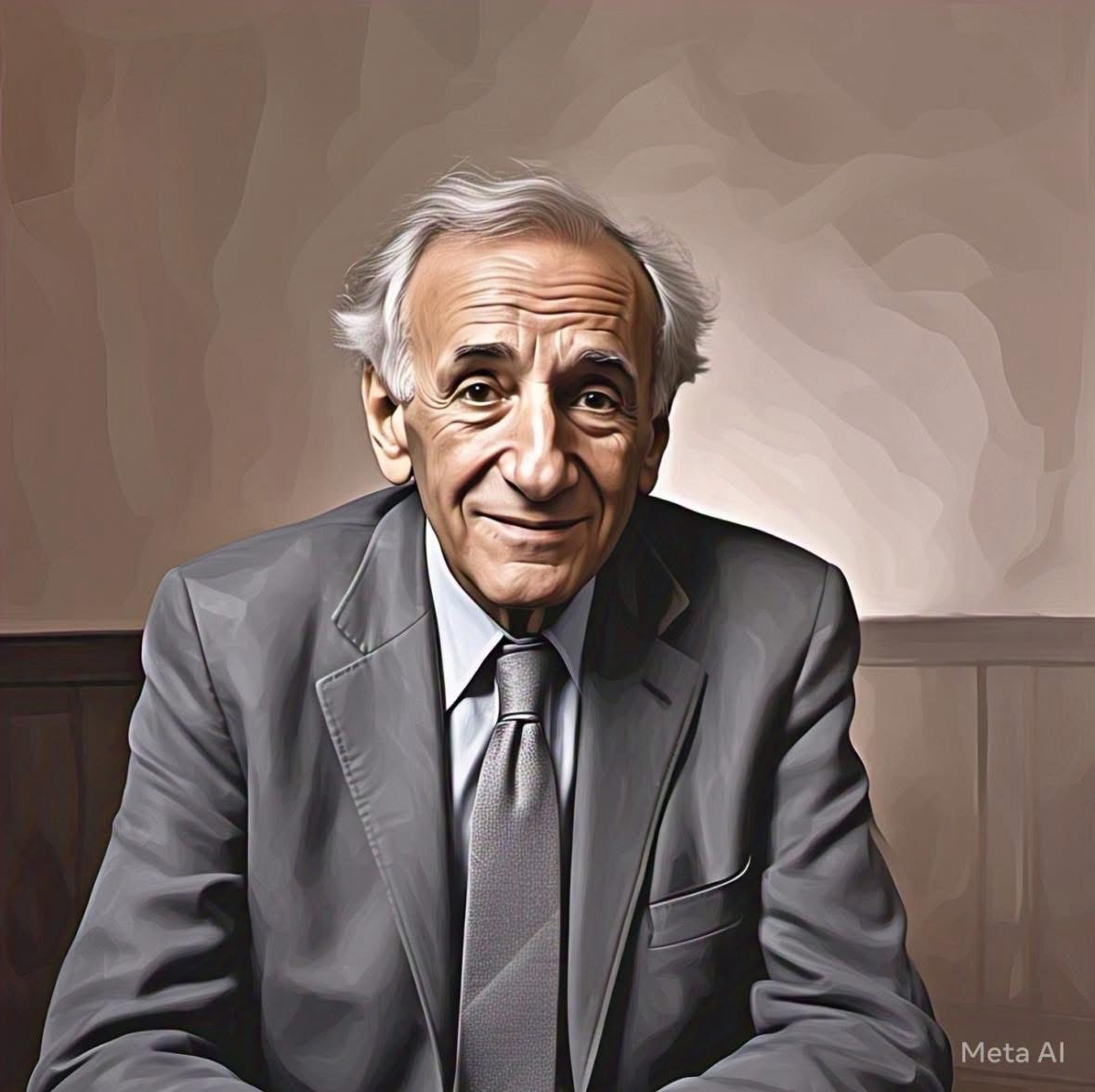
Elie Wiesel, a Holocaust survivor and Nobel Peace Prize laureate, offered profound insights that resonate with today’s experiences in the United States. His words, shaped by his survival of unimaginable atrocities, speak to themes of justice, human rights, and the moral imperative to act against oppression—issues that remain deeply relevant amid the nation’s current challenges, including racial injustice, political polarization, and debates over equality.
One of his most powerful statements, delivered in his 1986 Nobel Peace Prize acceptance speech, is:
“We must take sides. Neutrality helps the oppressor, never the victim. Silence encourages the tormentor, never the tormented.”
This quote urges individuals to reject indifference and actively oppose injustice. In the context of today’s USA, it serves as a call to action—whether addressing systemic inequalities, advocating for marginalized communities, or confronting division. Wiesel’s message underscores that silence or neutrality in the face of wrongdoing empowers those who perpetuate harm, a reminder that feels particularly poignant in the current social and political climate.
Wiesel’s wisdom encourages reflection on our collective responsibility. His experiences taught him that memory, compassion, and courage are essential to prevent history’s darkest lessons from repeating. As the USA navigates its present struggles, his words inspire us to speak out, take a stand, and work toward a more just society.
For Sister Wind, who hums through turbines, her breath a hymn of renewable grace, turning steel arms in sacred dance, she fuels our lights and lifts our gaze— Praised be You, restless and uncontained, in every gust that heals what we have strained.
For Brother Fire, both forge and flame, who warms our homes and razes forests bare, teach us to temper power with care, to kindle justice, not despair— Praised be You, spark of innovation, ignite in us a truer transformation.
For Sister Water, life’s first cry, now choked with plastic, acid, greed, may we unlearn the sin of waste, and let your currents run clean and free— Praised be You, river, rain, and sea, in every drop, the hope of equity.
For Brother Concrete, city-builder, your grids and towers, dense and tall, remind us: shelter is a right, not luck, let no one sleep outside your walls— Praised be You, but break our walls of fear, until all roofs whisper, “You are welcome here.”
For Sister Web, the pulse unseen, connecting voices across the void, may your threads bind truth, not lies, and mend the fractures we exploit— Praised be You, digital and vast, let no algorithm eclipse the outcast.
For the Stranger, the Queer, the Undocumented, whose bodies bear the weight of scorn, teach us to see our shared reflection— no life profane, no breath “ill-born”— Praised be You, mosaic of the whole, in every face, the fingerprint of soul.
For Sister Silence, rarest gift, drowned out by screens and endless noise, unmute our hearts to hear the earth’s lament, to pause, and choose, and breathe, and mend— Praised be You, still and small, where love begins, and systems fall.
And for Sister Death, who walks unseen, her shadow cast by plague and war, we plead: disarm her cruelest blows, until your sting is feared no more— Praised be You, though none embrace your call, teach us to live so none are left to fall.
Let every creature, wired and wild, code, carbon, dream, or DNA, awaken us to sacred ties— no thing, no them, only us, entwined. Praise crescendos in the act of repair, and grace is found in what we dare to share.
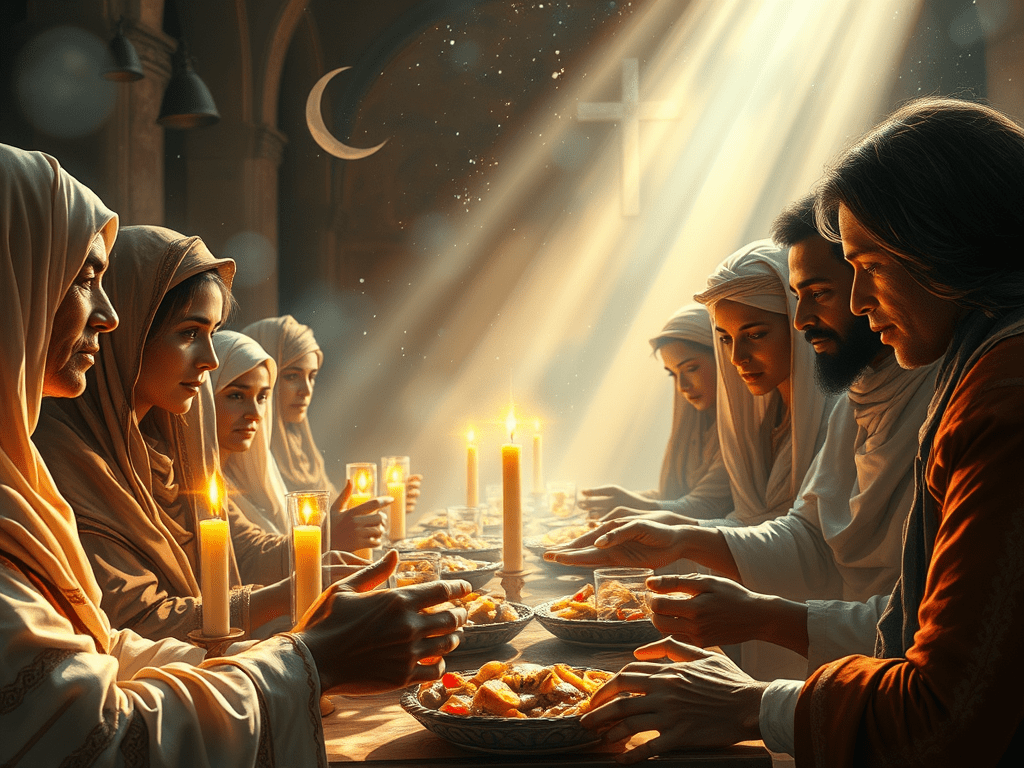
In the heart of every sacred tradition lies a hidden truth: the Divine is not distant, but intimately woven into the fabric of existence—and into the faces of those around us. Ramadan, Yom Kippur, and Lent, three pillars of Abrahamic faiths, are often seen as seasons of abstinence, repentance, or ritual. Yet through the lens of mysticism, they reveal a deeper invitation: to transcend the self and encounter God in the very act of loving, serving, and forgiving one another.
Ramadan: Fasting as a Mirror of the Heart
In Islam, Ramadan is a month of fasting, prayer, and Quranic reflection. Mystics like Rumi and Ibn Arabi remind us of the true fast. It is not merely abstaining from food and drink but freeing ourselves from the ego’s tyranny. When we empty our bodies, we create space for the Divine light to illuminate our souls. Hunger becomes a teacher, humbling us and awakening compassion for those who hunger every day.
The mystic’s Ramadan is not solitary. The nightly Taraweeh prayers recited in unison, dissolve individuality into a collective heartbeat. Breaking the fast (iftar) with others—strangers, neighbors, the marginalized—transforms a meal into a sacrament. “Whoever feeds a fasting person earns the same reward as them,” says the Prophet Muhammad (peace be upon him). In this act, we glimpse the Divine in the shared bread, the laughter, the hands that serve. To fast is to see God in the faces of the hungry.
Yom Kippur: Atonement as Cosmic Reunion
Yom Kippur, the Day of Atonement in Judaism, is a solemn fast of repentance. Yet Jewish mysticism (Kabbalah) teaches that this day is not about punishment, but reunion. The Hebrew word teshuvah means “return”—a return to God, our true selves, and harmony with all creation.
The liturgy of Yom Kippur emphasizes that sins against others cannot be forgiven by God until we first seek forgiveness from those we’ve harmed. The mystical truth blazes here: God dwells in the “other.” When we repair relationships, we restore the shattered vessels of the Divine presence (Shekhinah). The Kol Nidre prayer, chanted at twilight, is a collective vow to release the bonds of ego. As we stand together in vulnerability, we become mirrors reflecting the Infinite One back to each other.
Lent: Sacrifice as an Embrace of the Wounded
In Christianity, Lent is a 40-day fasting, prayer, and almsgiving journey that mirrors Christ’s wilderness sojourn. Mystics like St. John of the Cross and Julian of Norwich saw Lent not as deprivation but as a path to divine union. By stripping away comforts, we confront our illusions and meet God in the desert of our hearts.
Yet Christ’s ultimate teaching—”Whatever you did for the least of these, you did for me” (Matthew 25:40)—anchors Lent in community. When we give alms, we touch the hands of Christ in the poor. When we forgive, we meet God in the wounds of the broken. The Lenten fast is a doorway to solidarity, where the boundary between “I” and “you” dissolves. Meister Eckhart wrote, “The eye through which I see God is the same eye through which God sees me.”
The Thread That Binds: Love as the Ultimate Fast
Across these traditions, a common thread emerges: asceticism is not an end but a means to awaken love. Fasting from food, pride, or distractions clears the debris from our souls so we might finally see. When the ego diminishes, the Divine presence in others becomes unmistakable.
The Sufi poet Hafez writes, “I am a hole in a flute that the Christ’s breath moves through—listen to this music!” Ramadan, Yom Kippur, and Lent are each a flute, hollowed by sacrifice, through which the breath of the Divine flows. The music they create is the sound of humanity, remembering its sacred unity.
This year, as we observe these holy seasons, let us ask: How might my fast soften my heart to the stranger? How might my repentance heal a fractured relationship? How might my sacrifice become sustenance for another? For in the eyes of the one across from us—whether at the iftar table, the synagogue, or the soup kitchen—we meet the gaze of the Beloved.
La illaha illa Allah. Sh’ma Yisrael. Thy Kingdom come. The names differ, but the call is one: Encounter God here, now, in each other.
Michael Carsten OFS is a professed member of the Secular Franciscan Order and editor of Chasing the Wild Goose Blog. This article reflects his personal discernment and does not represent official OFS positions in Local, Regional, or National Fraternity. Contact Mike @ mikeofs@ofsmike.com
“I have done what is mine to do; may Christ teach you what is yours.” These words of St. Francis guide my journey as a Secular Franciscan. Bound by the Rule of the Secular Franciscan Order, I am called to “live the Gospel” (Article 4). I do this through humility, peace, and radical kinship with the marginalized. As an Ecumenical and Inter-religious Animator, I am tasked with building bridges across faiths. This mirrors Francis’s fearless meeting with Sultan Malik al-Kamil. Yet, in a world obsessed with political labels, I reject the false binaries of left and right. My ethic flows from a deeper well. Christ’s teachings and the Franciscan charism guide me. They demand a politics rooted not in ideology but in love, justice, and the sacredness of every life.
This is my creed—a way of being in the world that refuses to sever faith from action.
Foundations: Gospel and Franciscan Non-Negotiables
My convictions spring from two fonts: the Gospel and the Rule of the Secular Franciscan Order. They anchor four pillars of my ethic:
Human Dignity as Divine Imprint “Whoever harms the poor insults their Maker” (Proverbs 14:31). The secular Franciscan Rule commands me to “respect all people” (Article 13). I see Christ in the migrant, the prisoner, and the religious “other.” I oppose policies that dehumanize—xenophobic borders, exploitative labor, or environmental degradation that treats creation as disposable. Justice begins with reverence.
The Poor are the First Teachers Jesus’ declaration is my litmus test for policy. “Whatever you did for the least of these, you did for me” (Matthew 25:40). Francis stripped himself of wealth to stand with outcasts. I support universal healthcare, living wages, and affordable housing not as partisan agendas but as moral imperatives. Charity soothes symptoms; justice dismantles systems that trap generations in poverty.
Subsidiarity is about Sacred Humility. The secular Franciscan Rule encourages us to live by going from the Gospel to life. It also inspires us to bring life to the Gospel. Solutions must arise locally—in families, parishes, and neighborhoods—where human dignity outweighs ideology. While the government must protect rights, centralized power (corporate or bureaucratic) often stifles the Spirit’s work. Communities, guided by conscience, must lead.
Nonviolence as Prophetic Witness “Blessed are the peacemakers” (Matthew 5:9). Francis confronted the Crusades’ brutality with dialogue, not swords. I reject rhetoric that demonizes opponents, militarism that sacrifices the vulnerable, and economics that plunder creation. Peacemaking, for me, demands restorative justice, climate reparations, and relentless dialogue.
Engaging Political Systems: Respect and Caution
My creed engages political frameworks without captivity:
Social Democracy Respect: Its fight against poverty and healthcare gaps aligns with Christ’s healing call. Caution: Centralized programs risk sidelining local wisdom. Welfare should empower—not replace—parish food banks, worker co-ops, and interfaith clinics.
Capitalism Respect: Innovation lifts communities when tempered by ethics. Caution: Profit-driven systems commodify life. I demand fair wages, eco-stewardship, and businesses that honor workers as siblings, not labor costs.
Socialism Respect: Its critique of exploitation echoes Amos’ cry: “Let justice roll like a river” (Amos 5:24). Caution: Material equality alone risks reducing humans to economic units. True justice restores kinship—seeing the poor as brothers, not statistics.
Libertarianism Respect: Its skepticism of state overreach aligns with subsidiarity. Caution: Freedom without solidarity abandons the marginalized. “Personal responsibility” can’t absolve collective sin.
My Stance: No system is sinless. I borrow tools (policy, protest, partnership) to serve the Kingdom’s ends: dignity, kinship, and peace.
The Beatitudes: My Blueprint for Political Engagement
The Beatitudes (Matthew 5:3-12) reframe politics as sacred service:
“Blessed are the poor in spirit”: I reject consumerism’s lie that worth comes from wealth.
“Blessed are the meek”: I advocate policies that uplift the vulnerable, not entrench the powerful.
“Blessed are the peacemakers”: I labor for interfaith coalitions, knowing solidarity heals a fractured world.
For me, politics is not a battle for power but a pilgrimage of love.
The Tension of Witness
Living this ethic is a daily crucifixion:
Misunderstood Progressives question my faith; conservatives scorn my critique of greed. Francis was called a fool for kissing lepers. I embrace the title.
The Risk of Hypocrisy I fail often. I cling to the Rule’s call to “continual conversion” (Article 7).
The Weight of Despair Wars rage, forests burn, children starve. Yet Francis rebuilt the Church stone by stone. I choose stubborn hope.
Conclusion: An Invitation to Kinship
This is not a manifesto. It is my flawed attempt to live the Gospel without dilution. To those who share this hunger, I offer no program—only a challenge:
See sacramentally: The Eucharist teaches that God dwells in the broken. So look for the divine in the “other”—the refugee, the rival, the ruined earth.
Act incarnationally: Start small. Partner with a mosque to house the homeless. Join a union fighting for fair wages. Plant a parish garden to feed the hungry.
Risk love: Francis kissed the leper. Who—or what—have we been taught to fear that God calls us to embrace?
St. Francis did not set out to change the world. He set out to live the Gospel, and the world changed around him. May we have the courage to do the same.