

By a Secular Franciscan Observer
When I arrived in Baltimore for the National Chapter meeting, I expected fellowship, prayer, and peace—and I found all of that. Yet I also encountered something unexpected: a quiet spiritual tension.
As I walked the grounds of the places we visited, I carried with me certain difficult truths I had come to know beforehand. They became part of my inner dialogue throughout the gathering. Two sites—each beautiful, each steeped in history—led me into a deeper reflection on what it means to live our Catholic and Franciscan vocation with honesty and compassion.
A Peaceful Place That Stirred a Deep Memory
Our meeting was held at a serene retreat center owned by the Sisters of Bon Secours. The setting was peaceful, and our time together was filled with moments of grace—especially when Carolyn Towns received the annual Justice, Peace, and Integrity of Creation (JPIC) Award.
While nothing was said about the past, I found myself quietly recalling something I had previously learned about the Bon Secours Mother and Baby Homes in Ireland. There, long ago, vulnerable women were placed in institutions where many served without pay, and many of their children died and were buried in unmarked graves.
No one spoke of this at the retreat, nor did I expect them to. It was simply something that came with me, unbidden, as I walked the grounds—a reminder of how our Church’s history holds both great love and real sorrow. That awareness did not diminish the beauty of the place or the kindness of the sisters who welcomed us. It simply deepened my prayer, making it more tender.
Echoes Across Continents
Those quiet thoughts also called to mind similar histories closer to home, such as the Indian residential schools in Canada and the United States, where Indigenous children were taken from their families, stripped of their identities, and often never returned. These stories, too, are part of our shared Catholic past.
They reminded me how easily institutions created to nurture can also cause harm—and how healing begins with honest remembrance. This was not part of our gathering, yet it was part of what I carried in my heart as I prayed for peace and justice.
A Quiet Moment of Honesty at the Shrine
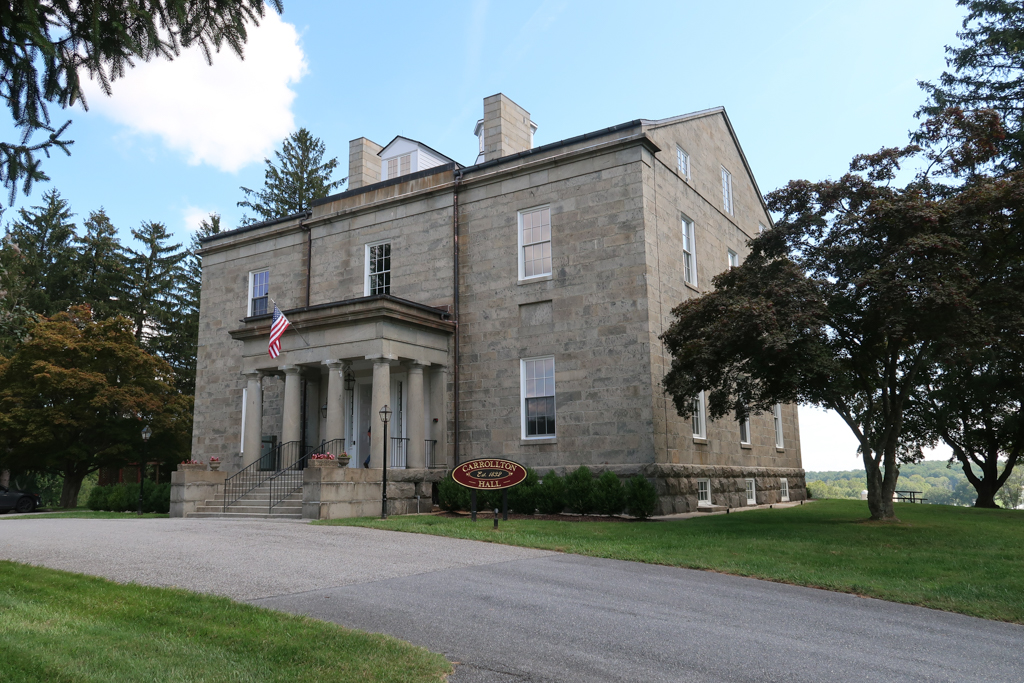
Later in the week, we visited the St. Anthony Shrine. The shrine stands on land once owned by Charles Carroll of Carrollton—the largest Catholic slaveholder in U.S. history and the only Catholic signer of the Declaration of Independence.
Our tour included not only the grounds but also the interior of the complex, which has been cared for by the Conventual Franciscan Friars since they purchased the property in the 1920s. Inside, there was abundant evidence of our rich Franciscan heritage—statues, devotional artwork, and architectural details that spoke to nearly a century of prayer and ministry by the friars.
Yet as I walked through the buildings and grounds, something quietly stirred in me. I saw no visible remembrance or images of the enslaved people who had lived and labored there long before the friars arrived—no pictorial history of the slave quarters once on the property, no mention of the slave cemetery that has since been discovered, and no acknowledgment of the enslaved people who are believed to have built at least one of the original structures still standing.
This absence was not something I took as neglect or erasure; rather, it simply struck me as a silence. It reminded me that these stories often remain hidden unless we choose to seek them out and name them. And it deepened the impact of what came next.
In a quiet and heartfelt moment, our guide Ray, a fellow Secular Franciscan, gently pointed to a distant field where the enslaved once lived and, after I asked about the history of the land, he told me that a cemetery had been discovered there. It was a simple act of truth-telling. Hearing the story spoken aloud in that beautiful space felt like a small act of healing—acknowledging that our sacred places can hold both sorrow and grace, and that remembering is itself a form of love.
The Franciscan Call to Hold Truth Gently
What stayed with me most from both sites is this: as Franciscans, we are not called to turn away from the world’s pain, nor to condemn, but to hold the whole truth gently—in prayer, in humility, and with hope.
The Sisters of Bon Secours offered us gracious hospitality. The shrine offered quiet beauty and reverence. And my heart brought its own history to both places. That mix of grace and sorrow, welcome and memory, reminded me that true peace begins when we dare to see all of it, and still choose love.