As a lay adherent of the Franciscan tradition, I am profoundly unsettled. The ethical and societal ramifications of President Trump’s explicit commitment to embolden Christian Nationalism demand scrutiny. Who orchestrates this movement? What are the veiled intricacies of the purported “three steps” he vows to enact? And why do so many, despite its glaring perils, welcome this agenda with open arms? These queries penetrate the very marrow of our national identity. The National Prayer Breakfast—once a solemn space for reflection and unity—has been repurposed into a pulpit for a divisive, exclusionary vision of America, one that subverts the foundational principles of religious liberty and democratic pluralism.
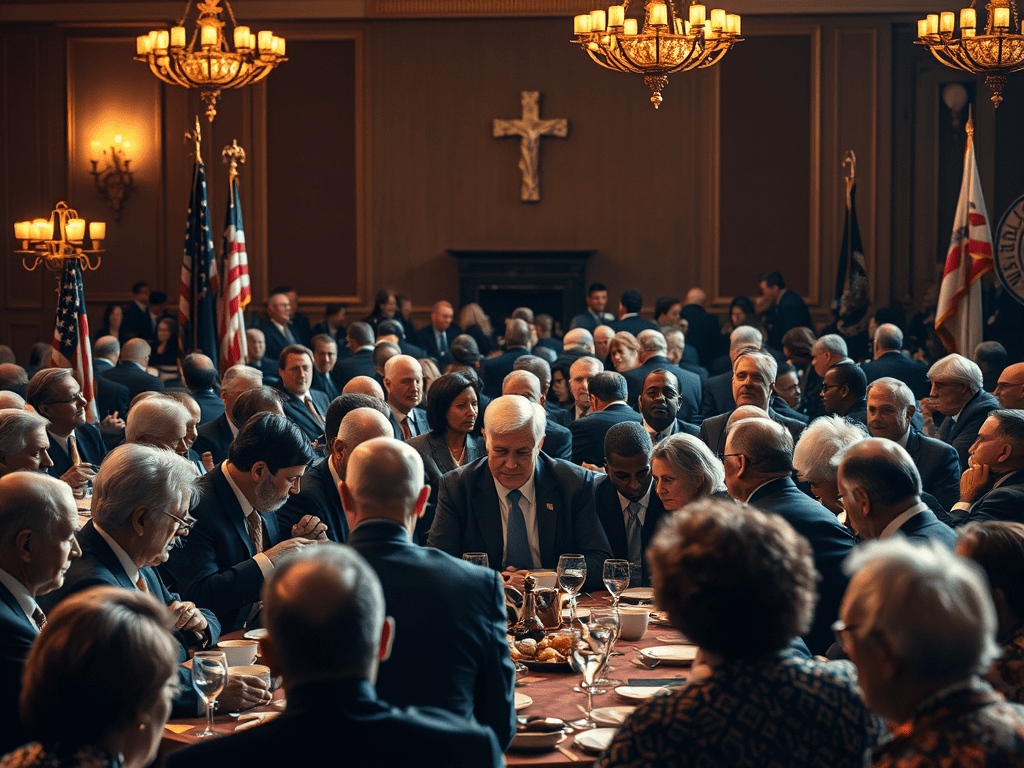
As the Washington Prayer Breakfast convenes once more, I am compelled to voice my dissent. What should be a sanctuary of humility and interfaith dialogue has metamorphosed into a clarion call for those who seek to enshrine an insular, rigid interpretation of Christianity as the guiding force of national policy. The reverberations of Trump’s 2025 address—his advocacy for a “faith office,” a commission on religious liberty, and an investigative force to root out so-called “anti-Christian bias”—persist, serving as a stark reminder of the dangers inherent in conflating faith with political hegemony.
Christian Nationalism, as propagated by Trump and his cohorts, is not a summons to authentic faith. Instead, it is a consolidation of power under the guise of religious zeal. It aims to impose a single spiritual identity. This is attempted on a nation deliberately founded upon the principles of religious diversity and freedom. As a Franciscan, my spiritual vocation demands that I resist this gross misrepresentation of the Gospel. It distorts Christ’s radical love and inclusivity into an apparatus of control. This article is grounded in the social doctrine of the Catholic Church. It embodies the ethos of Franciscan spirituality. It exhorts us to safeguard the vulnerable. It urges opposition to theocratic encroachments and a restoration of the genuine essence of faith.
The gravity of the moment cannot be overstated. From the corrosion of the constitutional separation of church and state to the marginalization of minority faith communities, this trajectory imperils the very architecture of democracy. However, despair is not our calling. As Franciscans, we are summoned to action. The Washington Prayer Breakfast serves not merely as a testament to our present tribulations, but as a rallying point—a summons to defend justice, pluralism, and the sacred dignity of all human beings.
1. The National Prayer Breakfast: A Corrupted Tradition
Since its inauguration in 1953, the National Prayer Breakfast has symbolized bipartisan dialogue and spiritual contemplation. Yet, under Trump, it has devolved into a platform for Christian Nationalist dogma—an ideology that seeks to overwrite America’s diverse religious landscape with a rigid theological hierarchy. This is not the Gospel; it is a manipulation of faith for dominion.
Catholic teaching repudiates the instrumentalization of faith for worldly power. In Evangelii Gaudium, Pope Francis denounces “spiritual worldliness,” cautioning against reducing religion to a “pursuit of power, prestige, pleasure, or economic security” (Paragraph 93). A gathering that once embodied unity now teeters on the precipice of becoming an altar for this corruption.
2. Trump’s 2025 Address: A Rallying Cry for Christian Supremacy
During the 2025 National Prayer Breakfast, Trump unveiled an ominous blueprint for America’s future—one shackled by Christian Nationalist edicts. He proposed:
- A presidential commission on religious liberty purportedly safeguarding “Christian values” while systematically sidelining other faith traditions.
- A White House ‘faith office,’ integrating Christian ideology into the scaffolding of federal governance.
- A task force spearheaded by Attorney General Pam Bondi, charged with eradicating “anti-Christian bias” within governmental institutions.
While Trump framed these measures as fortifications of religious liberty, their underlying intent is unmistakable—a calculated stride toward theocratic dominion. As a Franciscan, I discern in this not a call to spiritual renewal, but a declaration of war against justice, inclusivity, and the Gospel’s call to serve the disenfranchised.
The Catechism of the Catholic Church (CCC 2108) affirms that “the right to religious liberty is neither a moral license to adhere to error, nor a supposed right to error.” True religious freedom does not bestow privilege upon one faith; it enshrines the dignity of all.
3. Christian Nationalism: A Perilous Counterfeit of Christianity
Christian Nationalism is not Christianity—it is a perversion that interlaces national identity with a rigid, exclusionary religious dogma. It obliterates the rich mosaic of beliefs that constitute this nation, supplanting them with a hegemonic, state-sanctioned faith. It seeks legislative and cultural supremacy, forsaking the Gospel’s commandment to love and uplift all.
Pope Francis, in Fratelli Tutti, exhorts that “authentic faith does not engender intolerance” (Paragraph 249). Christian Nationalism, conversely, festers division and exclusion, warping the Church’s sacred mission to embody a “sacrament of unity” (CCC 775).
4. The Betrayal of Justice: Trump’s Theocratic Agenda
Trump’s Christian Nationalism manifests through legislative oppression:
- Judicial Manipulation – Appointing judges who subordinate constitutional law to theological dogma.
- Religious Exemptions – Granting broad allowances that enable businesses, hospitals, and organizations to deny services to certain individuals under the pretense of “religious conscience.”
- Educational Indoctrination – Promoting school policies that funnel taxpayer funds into Christian institutions while censoring curricula that acknowledge America’s diverse religious and cultural history.
Such policies are not merely political; they are moral transgressions. They exploit religious sentiment to entrench authoritarianism, forsaking the most vulnerable in the process. Catholic doctrine underscores that “the dignity of the human person is the foundation of a moral vision for society” (USCCB, Forming Consciences for Faithful Citizenship). Policies that degrade the marginalized violate this principle.
5. The Legal and Constitutional Abyss
The First Amendment enshrines freedom of religion—not the establishment of a state religion. Trump’s initiatives erode this boundary, resulting in:
- Legal Precarity – Policies favoring Christianity stand on precarious constitutional footing.
- Social Fractures – Elevating one faith above others imperils communal harmony, sowing discord in a society predicated on pluralism.
Catholic teaching maintains that “the political community and the Church are autonomous and independent of each other” (Gaudium et Spes, Paragraph 76). Trump’s agenda flouts this tenet, coalescing state and ecclesiastical power in pursuit of dominion.
6. A Franciscan Call to Action
Trump’s Christian Nationalism is not merely a political maneuver—it is a theological crisis. As Franciscans, we are summoned to:
- Organize – Forge interfaith alliances that repudiate Christian Nationalism.
- Educate – Dispel the myths that underpin theocratic ambitions.
- Advocate – Champion policies that protect religious liberty for all traditions.
- Serve – Stand in radical solidarity with the marginalized, embodying Christ’s boundless love.
- Resist – Reject policies that enshrine religious supremacy.
For Franciscans, the imperative is clear: We must denounce the heresy of Christian Nationalism and reclaim a faith that “does not seek to dominate, but to serve” (Evangelii Gaudium, Paragraph 197). The fate of both our democracy and the integrity of our faith hinges upon our response.
Discover more from Chasing The Wild Goose
Subscribe to get the latest posts sent to your email.


I don’t understand where you are coming from, do you agree with the way the Democrats treated Christian’s especially the Catholic faith? Taking care of the poor the way the Democrats took from the poor of the United States to pay for criminals, child trafficking and I could go on and on about the abuse of tax money going to instill horrible consequences in America. This administration and agreed with by three of the latest Popes that it is our Government s duty to take care of their boarders and protect their country. We accept and should take care of our poor first and legal immigrants we have always taken care of as good Franciscans.
You use a lot of big words that sound like you are not giving the administration a chance and agreeing with the faith hating evil ways of the past administration. if you would use words we all could read without a dictionary and explain a true CATHOLIC faith reality it would be helpful.
I read your writing about immigration and as a Franciscan myself I don’t think you have checked and read up on the true facts of what the Church feels about open boarders no mater what country you live in.
Check your facts before you write such biased information.
nary
LikeLike
Dear Rose,
Thank you for your heartfelt engagement. Let me speak plainly, as a fellow Franciscan, to address your concerns and clarify where I’m coming from.
1. Faith Over Politics
My goal isn’t to defend Democrats or Republicans but to follow Jesus and the Church’s teaching. The Church calls us to care for the poor (Matthew 25:40), defend human dignity, and welcome strangers (Leviticus 19:34). But she also teaches that governments have a duty to protect their people and steward resources wisely (CCC 2241). I agree: no policy is perfect. When tax dollars are wasted or used for evil—like funding abortion or trafficking—we must speak out. That’s not partisan; it’s pro-life. But we can’t let failures in governance become excuses to stop helping those in need.
2. Caring for the Poor—Here and Beyond
You’re right—Franciscans are called to serve “our own” first. But who is “our own”? For St. Francis, every person was a brother or sister. The Church teaches that loving our neighbor includes both local communities and refugees fleeing violence (Fratelli Tutti, 121). Yes, governments must secure borders to protect citizens (CCC 2241), but they must also treat migrants with dignity. This isn’t about “open borders.” It’s about balancing justice and mercy. Even Pope Francis, while urging compassion, says nations have a right to regulate immigration (Fratelli Tutti, 130).
3. When Politics Hurts Faith
I share your anger when faith is mocked or ignored by leaders. Catholics have faced attacks—like mandates forcing nuns to fund birth control or laws threatening religious schools. These are wrong. But Christian Nationalism worries me too. It risks turning faith into a weapon for power, not a path of service. Jesus didn’t seek political control (John 18:36). He washed feet. The Church warns against using faith to “dominate” others (Evangelii Gaudium, 197).
4. Fixing What’s Broken Without Abandoning the Gospel
If tax dollars are misused, we should demand better. But cutting aid to the poor isn’t the answer. St. Francis gave to beggars even when others called them “frauds.” Why? Because love isn’t a calculation. The Church teaches that helping the vulnerable is non-negotiable—even if some take advantage (Deuteronomy 15:11). Let’s fight corruption fiercely, but never stop feeding the hungry.
5. A Franciscan Way Forward
Final Thought
Being Catholic isn’t about left or right. It’s about Jesus. Let’s avoid tribal politics and focus on what unites us: love for God and neighbor. St. Francis rebuilt the Church by living the Gospel without compromise—not by winning elections. Let’s do the same.
Peace and all good,
A Fellow Franciscan
LikeLike
your answer was not consistent with your first article, your not defending either party but you tried to destroy the party in office. This party is only trying to get rid of the corrupt people who are taking from the poor , Trump is using the money to help those in need. Our Nation was founded under God and Trump wants us to return to God not start a state religion. You sound so Franciscan you can’t see the forest for the trees.
I certainly do not want to judge your spiritual journey but think about how your articles are drawing you towards trying to be superior to God. You are not being true to the humility of our calling.
God is in Control
with prayers and love of Christ
Rose
LikeLike