

The Humble Christmas
By Mike Carsten OFS
Introduction
Christmas is a very special time for Franciscans. It’s about celebrating the birth of Jesus Christ and remembering God’s humility and love. St. Francis of Assisi, who started the Franciscan Movement, had a unique way of celebrating Christmas that still inspires people today. In 1223, he created the first Nativity scene in Greccio, Italy. This story will explore why Greccio was necessary, the meaning of the altar, and how Christ is reborn in our hearts, using the writings of St. Francis and thoughts from modern thinkers.
The First Nativity Scene in Greccio
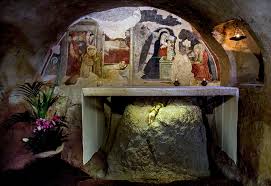
In 1223, St. Francis wanted to bring the story of Jesus’s birth to life. He chose the small town of Greccio, Italy, to create the first Nativity scene. He used a manger, an ox, and a donkey to show what it might have looked like when Jesus was born. This wasn’t just a display; it was meant to help people feel the humility and poverty that Jesus experienced when he came into the world.
Greccio is a small town in the Rieti Valley. Francis often visited there and was touched by the kindness of the local people. The Nativity scene in Greccio wasn’t just a historical event; it was a spiritual awakening for many. According to tradition, a man there saw a vision of the baby Jesus coming to life, showing that Christ can be reborn in our hearts.
The Altar and the Birth of Christ
For Franciscans, the altar is more than just a place for the Eucharist (Holy Communion). It symbolizes the rebirth of Christ in our lives. Each Mass reminds us of the Incarnation when God became human in Jesus. The church is decorated during Christmas with the Nativity scene, helping us reflect on how Christ is born anew in our hearts daily. This rebirth is not just a one-time event but a continuous process of spiritual growth.
St. Francis placed the altar above the manger scene to show the connection between Jesus’s birth and the Eucharist. By celebrating Mass over the manger, Francis highlighted the mystery of the Incarnation and the presence of Christ in the Eucharist. This act reminded everyone that Jesus’s humble birth is linked to the love and sacrifice remembered in the Mass.
Insights from Ancient Franciscan Writers and Biographers
Early writers about St. Francis, like Thomas of Celano and St. Bonaventure, give us detailed accounts of his life and spirituality. Thomas of Celano, in his “First Life of St. Francis,” describes the scene in Greccio with great detail. He talks about the joy and reverence of the people who saw the Nativity scene and felt closer to their Savior.
In his “Major Life of St. Francis,” St. Bonaventure explains the deeper meaning of the Nativity scene. He says that Francis’s actions were like a living sermon, teaching people about humility and poverty. Bonaventure also mentions the mystical experiences of those who participated in the Greccio celebration, showing that the Nativity scene was more than just a reenactment; it was a moment of divine encounter.
Thoughts from St. Francis and Modern Theologians
St. Francis wrote a lot about the humility and poverty of Christ. In his “Letter to All the Faithful,” he marvels at the Incarnation: “The Word of the Father—so worthy, so holy and glorious—came down into the womb of the Virgin Mary, from which he received the flesh of our humanity and our frailty.” This mystery deeply moved Francis and inspired his actions.
Modern theologians also learn from Francis’s insights. Pope Francis, for example, talks about the importance of humility and simplicity, echoing St. Francis’s teachings. He reminds us that God chose to come into the world in a simple manger, inviting us to be humble in our own lives.
A Franciscan Perspective on Why Jesus Came to Us
From a Franciscan perspective, Jesus becoming human wasn’t just about fixing human sin. It was a profound expression of God’s love and desire to be close to us. Theologians like St. Bonaventure and Blessed John Duns Scotus believed that the Incarnation was part of God’s original plan, even if Adam had not sinned.
St. Bonaventure taught that God’s main reason for becoming human was love and the desire to share divine life with us. He believed that even without sin, God would have become human to unite with creation. This shifts the focus from sin to love and communion.
Blessed John Duns Scotus added that the Incarnation was the greatest act of God’s love. He argued that Christ is the center of God’s plan for creation, and everything was made with Christ in mind. This view shows that the Incarnation is the ultimate expression of God’s desire to be with us and share in our humanity.
Conclusion
From a Franciscan perspective, Christmas celebrates God’s immense love and humility. The Nativity scene in Greccio reminds us of the profound mystery of the Incarnation. As we gather around the altar, we are called to experience the rebirth of Christ in our hearts, inspired by the teachings of St. Francis and modern Franciscan theologians. This Christmas, let’s embrace the humility of the manger and allow the love of Christ to transform our lives.
May the peace and joy of Christ’s birth fill your hearts this Christmas season.
Glory to God in the highest, and on earth peace to people of good will.
Discover more from Chasing The Wild Goose
Subscribe to get the latest posts sent to your email.

