

By Michael Carsten OFS
The Catholic Church, with its 2,000-year history, is a living mosaic of spiritual traditions, movements, and communities. From the contemplative silence of Trappist monasteries to the bustling soup kitchens of the Catholic Worker Movement, from the intellectual rigor of the Jesuits to the fervent Marian devotion of the Blue Army of Fátima, the Church encompasses a breathtaking array of charisms. Among these, the Secular Franciscan Order (OFS) stands as a testament to the radical call to live the Gospel in the heart of the world, bridging contemplation and action, humility, and mission. Yet this very diversity—rooted in the universal call to holiness—can also feel like fragmentation. In an era marked by polarization, both within the Church and beyond, it is easy to perceive these differences as fractures. But what if this diversity is not a flaw to be lamented, but a gift to be celebrated? What if our varied ways of living the Gospel are not obstacles to unity, but threads in a divine tapestry woven by the Holy Spirit?
The Beauty of “Both/And”
Catholicism has always been a faith of “both/and,” not “either/or.” It is sacramental and scriptural, traditional and evolving, mystical and practical. This tension is mirrored in its countless groups and movements:
- Controversial and contemplative: Opus Dei’s emphasis on sanctifying daily work coexists with the Legion of Christ’s reparative spirituality, even as both face scrutiny.
- Service and advocacy: The Knights of Columbus’ charity flourishes alongside the Catholic Worker Movement’s radical hospitality and political activism.
- Ancient and modern: Benedictine monks preserving Gregorian chant share the Church with tech-savvy Jesuits engaging artificial intelligence ethics.
- Secular and sacred: The Secular Franciscans, bound by their Rule approved by Pope Paul VI in 1978, embody this “both/and” uniquely. They are neither cloistered nor ordained, yet their Constitutions call them to “go from Gospel to life and life to the Gospel” (OFS Rule, Art. 4), transforming workplaces, families, and communities through the lens of Franciscan humility, joy, and solidarity with the marginalized.
These groups, though distinct in focus, all flow from the same baptismal waters. The Carmelite nun praying in cloistered silence and the Sister of Mercy advocating for healthcare reform both embody Christ’s love—they simply do so in different dialects of the same spiritual language.
The Scandal of Particularity
Human beings crave uniformity. We gravitate toward communities that mirror our values, cultures, and politics. Yet Catholicism, by its very nature, resists this homogenization. It is a global faith, incarnated in every culture and context. This “scandal of particularity” can unsettle us:
- Political divides: In the U.S., Catholics are split between progressive advocates for immigration reform and traditionalists prioritizing religious liberty. Organizations like the Napa Institute and the Catholic Campaign for Human Development (CCHD) embody these divergent priorities.
- Liturgical preferences: Tensions flare between devotees of the Latin Mass (SSPX) and proponents of contemporary worship.
- Social justice vs. personal piety: The Focolare Movement’s focus on unity contrasts with the Carmelites’ introspective mysticism.
- Radical simplicity in the world: Secular Franciscans, following the example of St. Francis, embrace a Rule that demands “a life of conversion” (OFS Rule, Art. 7)—not in monasteries but in suburban homes, corporate offices, and homeless shelters. Their Constitutions urge them to be “instruments of peace” (General Constitutions, Art. 13.1), challenging both consumerism and despair through small, daily acts of mercy and justice.
These differences are not signs of failure but proof of the Church’s universality. A Church that can cradle both the silent adoration of the Poor Clares and the street-level activism of the St. Vincent de Paul Society is a Church large enough to hold humanity in all its complexity.
The Gift of Diversity
Diversity is not a problem to solve but a reality to embrace. Consider:
- Body: Catholic health ministries like the Little Sisters of the Poor and the Order of Malta heal physical suffering. Groups like the Catholic Land Movement reconnect people to the earth through sustainable farming. secular Franciscans, in their Rule’s call to “respect all creatures” (OFS Rule, Art. 18), advocate for environmental justice and dignified labor, seeing care for creation as an extension of their Franciscan vocation.
- Mind: The Society of Catholic Scientists bridges faith and reason. The Dominican Order’s intellectual tradition pursues truth through theology and philosophy. The OFS is rooted in Francis’s embrace of “Lady Poverty.” It critiques materialism not through academic treatises. Instead, it offers lives of intentional simplicity. This provides a silent witness to Gospel priorities.
- Spirit: The Legion of Mary’s rosary processions offer a path to God. The Ignatian retreats of the Jesuits provide another distinct path. Secular Franciscans, gathering in fraternities for prayer and formation (General Constitutions, Art. 30.1), embody a spirituality of encounter—seeing Christ in the poor, the stranger, and even in “Sister Death” (Canticle of the Creatures).
This pluralism reflects the boundless creativity of the Holy Spirit. As St. Paul writes, “There are varieties of gifts, but the same Spirit” (1 Cor 12:4). A monochromatic Church would be poorer, smaller, and less capable of meeting the world’s needs.
The Challenge of Communion
Yet diversity without unity becomes discord. The Church’s history is marred by schisms, rivalries, and ideological battles. Today, debates over liturgy, social justice, and authority often devolve into tribalism. How do we navigate this?
- Anchor in the Essentials: The Creed, sacraments, and moral imperatives (e.g., the dignity of life, care for the poor) form our common ground. Disputes over prudential matters (political strategies, liturgical styles) need not fracture communion.
- Listen with Humility: The Focolare Movement’s emphasis on dialogue shows how to engage differences with charity. The Sant’Egidio Community’s peacemaking work also provides a model for this. Secular Franciscans, per their Rule, “exercise their responsibilities in the Church in communion with all” (OFS Rule, Art. 6), modeling a humility that prioritizes reconciliation over division.
- Celebrate Complementary Charisms: The Church needs both the Trappist’s contemplative witness and the Catholic Worker’s prophetic activism. The OFS, as part of the broader Franciscan family, complements the friars’ apostolic work and the Poor Clares’ cloistered prayer, proving that holiness thrives in the “middle ground” of everyday life.
- Reject Ideological Idolatry: No movement—traditionalist or progressive—owns the full truth. As St. John Henry Newman warned, “To live is to change, and to be perfect is to have changed often.” The OFS Rule, emphasizing “ongoing conversion” (Art. 7), reminds us that all charisms must remain open to the Spirit’s unsettling grace.
A Call to Let the Spirit Breathe
The Holy Spirit, like the wind, “blows where it chooses” (John 3:8). It stirs the quiet prayers of cloistered nuns, ignites the zeal of lay evangelists, and hums in the labs of Catholic scientists. It breathes through Secular Franciscans as they kneel in parish pews, advocate for just wages, or comfort a dying neighbor—small, hidden acts that embody Francis’s vision of “rebuilding the Church.” Our task is not to control this Spirit but to cooperate with it—to “get out of the way,.”
This requires trust. Trust that the same Spirit guiding the Magisterium also inspires the charismatic renewal. Trust that the elderly woman praying at an unapproved Marian site and the young activist advocating for climate justice are both responding to God’s call. Trust that the Secular Franciscan, tethered to a Rule yet free to serve in the world, is as vital to the Church’s mission as the theologian or the mystic.
Conclusion: Unity in Mission
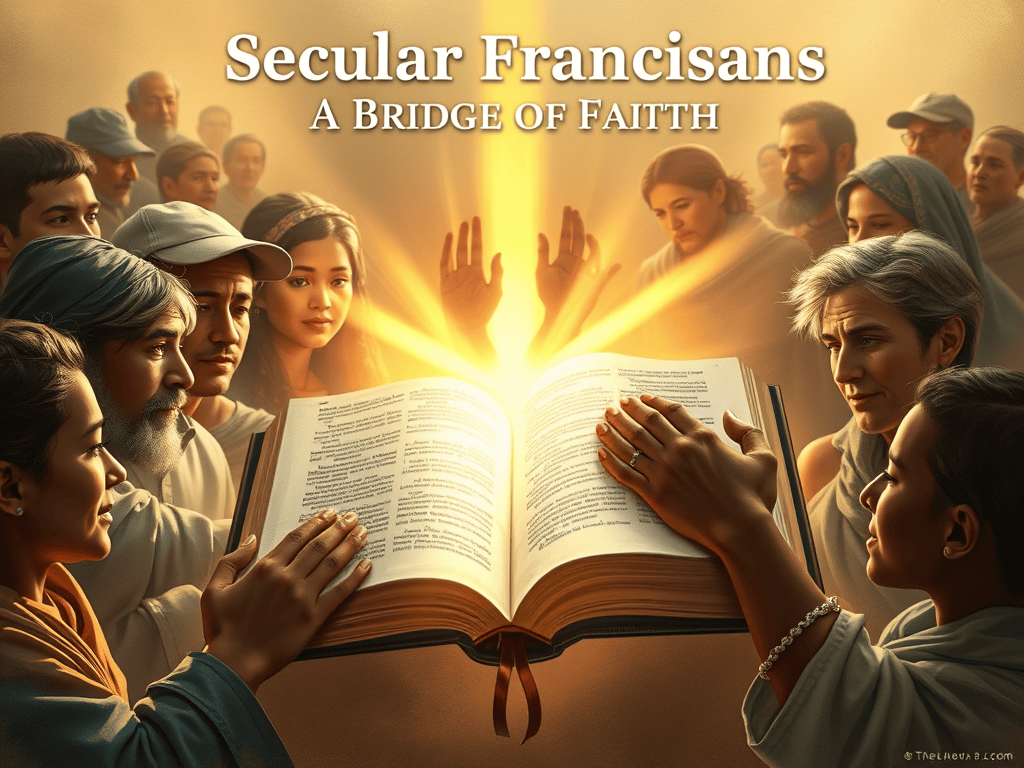
We do not need to see eye to eye to walk hand in hand. The early Church thrived amid cultural clashes between Jewish and Gentile Christians. Today, our “clashes” are over liturgy, politics, and pastoral approaches. Yet the Secular Franciscan Order, with its 800-year history, stands as a quiet reminder that unity is not uniformity. Their Constitutions state plainly: “The fraternity is a community of love” (Art. 22.1)—a love that transcends differences, not by erasing them, but by binding them to a shared mission.
Let us stop fearing diversity and start cherishing it. Let the traditionalist kneel beside the social justice advocate in adoration. Let the Franciscan friar and the tech professional share wisdom. Let the Secular Franciscan, in their apron or business suit, testify that holiness is not a distant ideal but a daily choice to “preach the Gospel always, and when necessary, use words” (attributed to St. Francis).
In the end, we are not called to uniformity but to unity—a unity that transcends our limited perspectives, a unity forged not by our compromises but by Christ’s prayer: “That they may all be one” (John 17:21). The path to that unity begins when we recognize that our differences are not obstacles but gifts—and that the Spirit’s tapestry is more glorious than any single thread.
Let us go forward in love, not in spite of our diversity, but because of it. For in the words of St. Augustine: “In essentials, unity; in non-essentials, liberty; in all things, charity.”
Pax et bonum!
Discover more from Chasing The Wild Goose
Subscribe to get the latest posts sent to your email.

