

Celebrating the Jubilee Year

The Jubilee Year and Its Significance

What Is the Jubilee Year?


The Jubilee Year is a sacred time of grace, transformation, and renewal, rooted in the biblical tradition of Leviticus 25:10, which calls for a year to “proclaim liberty throughout the land.” In the Catholic Church, the Jubilee is a moment to forgive debts, restore relationships, and embrace God’s mercy. Pope Francis, in his Bull of Indiction Spes Non Confundit (May 9, 2024), declares the 2025 Jubilee as a “Holy Year of hope,” inviting the faithful to renew their commitment to reconciliation and justice (Spes Non Confundit, ). For Secular Franciscans, the Jubilee resonates deeply with our vocation of conversion and peacemaking. It echoes St. Francis’ call to encounter Christ in the poor, in creation, and in every brother and sister. As Spes Non Confundit urges, this is a time to “return to the heart of what is essential” (Spes Non Confundit, 5), stripping away excess and embracing Gospel simplicity.

A Time for Renewal and Reconciliation

The Jubilee is a call to action, not nostalgia. Spes Non Confundit challenges us to heal wounds, address injustices, and foster reconciliation within our communities and the world (Spes Non Confundit, 10). As Franciscans, we are summoned to live as instruments of peace, reconciling not only with God but with neighbors and creation itself. This Holy Year demands our living witness—our lives must proclaim hope and mercy.

The Voice of the Shepherd: Pope’s Message to the Diplomatic Corps

The Pastoral Heart of Diplomacy

In his Address to the Diplomatic Corps accredited to the Holy See on May 16, 2025, Pope Leo XIV described papal diplomacy as “an expression of the very catholicity of the Church,” inspired by a pastoral outreach that seeks not privileges but opportunities to serve humanity. He emphasized that peace, justice, and truth are the pillars of the Church’s mission, engaging diplomats to build bridges through dialogue (Address to the Diplomatic Corps, 2025). Every Franciscan is a diplomat in this sense, not with treaties but with open hearts. Our daily interactions—whether with family, neighbors, or online communities—become opportunities to embody the “pastoral heart” of the Gospel, as Pope Leo XIV urges (Address to the Diplomatic Corps, 2025).

A Vision Rooted in Service to Humanity

Pope Leo XIV’s address focused on the dignity of all, particularly the vulnerable, calling for societies to invest in families and respect every person, from the unborn to the elderly. He addressed global challenges like migration and conflict, advocating for a diplomacy rooted in human and spiritual values (Address to the Diplomatic Corps, 2025). This mirrors Fratelli Tutti, where Pope Francis writes, “Peace is built through genuine relationships rooted in truth and justice” (Fratelli Tutti, 229). As Franciscans, we are called to be beacons of this vision, living out the Church’s social teaching in a world craving authentic encounter. Our fraternity becomes a living witness to the common good.

The First Pillar – Peace: A Franciscan Path to Inner and Outer Harmony

Peace Begins in the Heart

True peace is more than the absence of war—it is a gift born in the heart and radiated outward. In Fratelli Tutti, Pope Francis teaches that peace requires “eliminating vindictiveness and carefully choosing our words” (Fratelli Tutti, 243). St. Francis’ greeting, Pace e Bene, was a lifestyle of inner conversion, as Gaudium et Spes affirms: “Peace is the fruit of an order implanted in human society by its divine Founder” (Gaudium et Spes, 78). Pope Leo XIV emphasized that peace is “the first gift of Christ,” an active and demanding gift that begins in the heart by eliminating pride and vindictiveness (Address to the Diplomatic Corps, 2025). As Franciscans, we sow peace in daily encounters, choosing harmony over division in our families, workplaces, and communities.

Humility and Dialogue in a Fragmented World

Humility is the doorway to peace. Fratelli Tutti calls for a “culture of encounter” that listens before speaking and forgives even in pain (Fratelli Tutti, 216). In a world fractured by ideologies, Franciscan humility is revolutionary, building bridges through small acts—a shared meal, a kind word, or a letter to a policymaker. Pope Leo XIV warned that “words too, not only weapons, can wound and even kill,” urging careful speech to foster peace (Address to the Diplomatic Corps, 2025). As Franciscans, we are called to foster dialogue that holds space for others, reflecting the Secular Franciscan Rule’s call to “seek ways of unity through dialogue” (Rule, Art. 19).

Disarmament and the Call for Multilateral Cooperation

In his address, Pope Leo XIV called for a halt to the production of “instruments of destruction and death,” quoting Pope Francis’ final Urbi et Orbi message: “No peace is possible without true disarmament” (Address to the Diplomatic Corps, 2025). This includes disarming hearts of pride and prejudice. Multilateral cooperation, he argued, is essential for global challenges like climate change and war (Address to the Diplomatic Corps, 2025). Franciscans, though not at global tables, influence local communities through peace vigils, interfaith dialogue, and acts of reconciliation, embodying Spes Non Confundit’s call to hope-filled action (Spes Non Confundit, 12).

The Second Pillar – Justice: The Fabric of a Just Society

Dignity Through Work and Social Cohesion

Justice is the foundation of peace, as Pope Francis teaches in Fratelli Tutti: “Working for peace requires acting justly to overcome inequalities” (Fratelli Tutti, 235). In his address, Pope Leo XIV called for societies to build harmony by investing in families and ensuring respect for the dignity of all, addressing imbalances that lead to unworthy working conditions (Address to the Diplomatic Corps, 2025). Gaudium et Spes reinforces this: “Human labor is the key to social progress” (Gaudium et Spes, 67). Franciscans advocate for the marginalized, ensuring no one is left behind. As urged by the Secular Franciscan Rule (Art. 15), our simple lifestyle is a prophetic stand against consumerism, fostering social cohesion where all belong.

The Family as a Cornerstone of Justice

The family is a “domestic church” and a cornerstone of justice. Spes Non Confundit emphasizes supporting families as an act of mercy (Spes Non Confundit, 8). Pope Leo XIV, in his address, called for investment in families “founded upon the stable union between a man and a woman” to resolve inequalities and divisions, citing Rerum Novarum (Address to the Diplomatic Corps, 2025). Franciscans must support families within our fraternities, addressing their struggles and advocating for just policies, reflecting Fratelli Tutti’s vision of a society rooted in solidarity (Fratelli Tutti, 116).

Caring for the Vulnerable and Marginalized

A just society is measured by its care for the vulnerable. Pope Francis, echoing Laudato Si’, insists that justice includes migrants, the poor, and the elderly (Laudato Si’, 25). St. Francis embraced lepers, and we are called to walk with today’s outcasts—refugees, the homeless, those with mental illness. The Secular Franciscan Constitutions urge us to “create conditions worthy of humanity” (Constitutions, Art. 22). In this Jubilee Year, Spes Non Confundit invites us to widen our tent, serving the forgotten through volunteering, advocacy, or simply listening (Spes Non Confundit, 10).

The Third Pillar – Truth: The Foundation of Authentic Relationship

Speaking Truth with Charity

Truth, spoken in charity, is essential for authentic relationships. In Fratelli Tutti, Pope Francis writes, “Truly peaceful relationships cannot be built apart from truth” (Fratelli Tutti, 226). Pope Leo XIV warned that “the Church can never be exempted from speaking the truth about humanity and the world, resorting whenever necessary to blunt language” (Address to the Diplomatic Corps, 2025). Franciscans live truth through integrity, ensuring our actions match our words, as the Secular Franciscan Rule urges us to “accept all people as a gift of the Lord” (Rule, Art. 13). Speaking truth prophetically, with love, wins hearts—the Franciscan way.

Challenges of Virtual Realities and Disinformation

As Pope Leo XIV noted, the digital age distorts truth: “In a world where reality is often distorted, especially online,” the Church must speak truth with charity (Address to the Diplomatic Corps, 2025). This erodes trust and dialogue, a crisis Fratelli Tutti addresses: “Truth is an inseparable companion of justice and mercy” (Fratelli Tutti, 227). Franciscans must promote media literacy and model respectful online dialogue, ensuring our digital presence reflects Christ’s clarity.

Ethical Discernment in an Age of AI and Climate Crisis

Pope Leo XIV highlighted AI and climate change as ethical challenges requiring truth (Address to the Diplomatic Corps, 2025). web:1 Laudato Si’ calls environmental destruction a moral issue, disproportionately harming the poor (Laudato Si’, 48). AI risks bias and dehumanization, demanding discernment about what it means to be human. Franciscans, lovers of creation, must advocate for sustainable policies and ethical technology, living Laudato Si’’s call to care for our common home (Laudato Si’, 13).

A Franciscan Response: Living Out the Pillars

Embracing Simplicity and Fraternity

Simplicity and fraternity are Franciscan hallmarks. Simplicity, as Laudato Si’ teaches, resists consumerism, focusing on God and others (Laudato Si’, 222). Fraternity reflects St. Francis’ vision of all as brothers and sisters, fostering unity in a divided world (Fratelli Tutti, 8). In this Jubilee Year, Spes Non Confundit calls us to deepen these commitments, living as signs of hope (Spes Non Confundit, 15).

Advocacy Through Gospel Living

Gospel living is advocacy. Our choices—ethical purchases, time spent serving, voices raised for the voiceless—proclaim justice and truth. Fratelli Tutti urges us to be “Good Samaritans” in our communities (Fratelli Tutti, 77). Fraternities can amplify this by sharing resources and supporting advocacy, embodying Spes Non Confundit’s call to action (Spes Non Confundit, 12).

Walking with the Poor and the Forgotten

St. Francis lived among the poor, and Spes Non Confundit echoes this: “The poor are at the heart of the Jubilee” (Spes Non Confundit, 8). We walk with migrants, the homeless, and the lonely through presence—listening, sharing meals, or accompanying in hardship. This is our identity, reflecting Laudato Si’’s call to hear “the cry of the earth and the cry of the poor” (Laudato Si’, 49).

The Jubilee as a Call to Hope and Mission

Renewing Our Commitment as Secular Franciscans

The Jubilee is a commissioning. Spes Non Confundit invites us to renew our Franciscan vows relationally—with God, each other, and the world (Spes Non Confundit, 16). This means revitalizing fraternities, strengthening formation, and inviting others to join our joyful mission. The Holy Year is a springboard for lasting renewal.

Working for Peace in a Wounded World

In a world wounded by war and division, Fratelli Tutti calls us to be “artisans of peace” (Fratelli Tutti, 228). Through interfaith dialogue, peace vigils, or personal forgiveness, we light candles in the darkness, empowered by the Jubilee’s grace (Spes Non Confundit, 14).

Conclusion: A World Reimagined Through Peace, Justice, and Truth

The 2025 Jubilee Year, proclaimed by Spes Non Confundit, calls every Franciscan to live peace, justice, and truth. Pope Leo XIV’s Address to the Diplomatic Corps and teachings in Fratelli Tutti and Laudato Si’ inspire us to be instruments of renewal. Inspired by St. Francis and united as a fraternity, let us proclaim with our lives that a world built on Gospel values is possible—one of hope, mercy, and love.

Pax et Bonum

Mike

A Franciscans Reflection

God’s Reality in a Conscious Universe

As I stand beneath the night sky, I gaze at the myriad stars that adorn the heavens. I am struck by the profound mystery of the universe. Each twinkling light represents a distant galaxy, a testament to the vastness and complexity of creation. In this moment of awe, I ponder the physical nature of the cosmos and its potential for consciousness. Could the universe be a conscious entity, aware of its existence and perhaps even of us within it?

The idea that the universe might possess consciousness is not new. Philosophers and scientists have explored this concept through various theories. One such theory is panpsychism, which suggests that consciousness is a fundamental aspect of reality. It is inherent in all matter. More specifically, cosmopsychism posits that the universe as a whole is conscious, a grand mind encompassing all that exists.

If the universe is conscious, what does this mean for our understanding of God? In traditional theistic views, God is often seen as a separate, transcendent being who created the universe. However, if the universe itself is conscious, might this consciousness be what we refer to as God?

This brings us to pantheism, the belief that God and the universe are identical. In this view, the conscious universe is God, and everything within it is a manifestation of the divine. Such a perspective encourages us to see the sacred in all things. It helps us to recognize that every star, planet, and living being is part of God.

There is also panentheism. It holds that while the universe is part of God, God is more than the universe. God encompasses and interpenetrates the universe but also transcends it. In this framework, the conscious universe is within God, the ultimate source of all consciousness.

Some propose that God is the field of consciousness within which the universe exists. Others suggest that the universe is a projection of God’s thoughts. Others see consciousness as a fundamental principle that drives the universe’s evolution, countering the entropy that leads to disorder.

These diverse perspectives highlight the complexity of the relationship between God, consciousness, and the universe. They challenge us to expand our understanding of the divine, to consider that God might be intimately connected to, or even identical with, the cosmos.

But what are the implications of such beliefs? If the universe is conscious and divine, does that mean it has intentions or purposes? Does it care about us, or is its consciousness so vast? Is it different from ours that it remains indifferent to our existence?

Moreover, how does this align with scientific understanding? While theories and hypotheses suggest the possibility of universal consciousness, it remains a topic of debate and speculation. Science has yet to provide conclusive evidence for or against this idea, leaving it in the realm of philosophy and theology.

As I reflect on these questions, I am reminded of Albert Einstein’s words, who spoke of a “cosmic religious feeling,” a sense of awe and wonder at the order and beauty of the universe. Perhaps this feeling is a glimpse into the consciousness of the cosmos, a connection to something greater than ourselves.

Ultimately, whether the universe is conscious or not, the night sky inspires and humbles me. It invites me to contemplate the mysteries of existence. I seek understanding and remain open to the possibility. The divine might be woven into the very fabric of reality.

This piece is a personal reflection inspired by Franciscan spirituality. This reflection is not meant to present official Catholic doctrine. It aims to share personal thoughts and questions about faith and the universe. For authoritative teachings, please refer to the Catholic Church’s Catechism or consult a qualified theologian.


Red Dress Day

: A Call to Justice for Missing and Murdered Indigenous Women

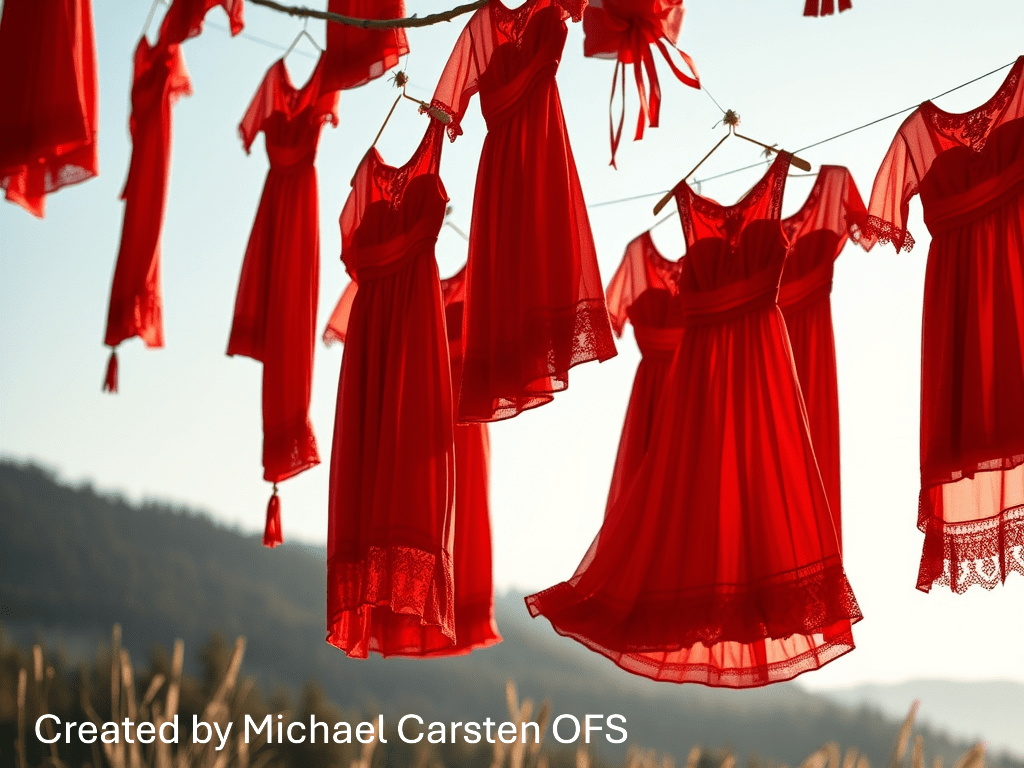
On May 5th, red dresses hang across the United States—empty, yet vibrant with the call of spirits, as envisioned by Métis artist Jaime Black’s REDress Project. Red Dress Day, aligned with the U.S. National Day of Awareness for Missing and Murdered Indigenous Women (MMIW), confronts a crisis of violence against Indigenous women and girls, rooted in colonial legacies, including the Catholic Church’s role in Indian boarding schools. As Secular Franciscans, inspired by Pope Francis’s call to care for the marginalized and seek reconciliation, we are summoned to lament this injustice, pursue healing, and demand a continued U.S. response to protect Indigenous women. In 2025, Red Dress Day is our call to live the Gospel by standing with Indigenous communities.

A Crisis Rooted in Historical Wounds

The statistics are staggering: Indigenous women in the U.S. face murder rates up to 10 times the national average, with 5,712 missing cases reported in 2016, though only 116 were logged in the Department of Justice’s database. Over 84% of American Indian and Alaska Native women experience violence in their lifetime, including 56% facing sexual violence. On some reservations, murder rates for Indigenous women are over 10 times the national average. This crisis, described as a “silent epidemic,” stems from systemic issues—colonization, racism, and intergenerational trauma.

The Catholic Church’s historical role amplifies this crisis. From the late 19th century to the mid-20th century, Catholic-run Indian boarding schools, like St. Boniface in California, forcibly assimilated Indigenous children, inflicting abuse and trauma. A 2022 Department of the Interior report estimated thousands of deaths at these schools, with Catholic institutions heavily implicated. This trauma fractured families, eroded traditional gender roles, and left generations vulnerable to poverty and violence—key risk factors for MMIW. Pope Francis, in his 2022 apology for the Church’s role in Canada’s residential schools, called for “concrete actions” to address such harms, a reminder that applies to the U.S. context. He urged Catholics to confront ongoing injustices, like MMIW, with humility and action.

As Secular Franciscans, we heed Pope Francis’s call that “the poor and the excluded are the living image of Christ” (Fratelli Tutti, 2020). The MMIW crisis demands we acknowledge the Church’s historical wrongs, seek forgiveness, and support justice for Indigenous women and girls.

The U.S. Response to MMIW

Red Dress Day, observed as the National Day of Awareness for MMIW on May 5th, honors victims like Hanna Harris, a Northern Cheyenne woman murdered in 2013, whose case sparked a 2017 Senate resolution. The red dress, symbolizing absence and resilience, calls us to support the U.S. response, which includes legislative, grassroots, and community efforts, though gaps remain.

  • Legislative Action: The U.S. has taken steps to address MMIW. The 2020 Savanna’s Act, named for Savanna LaFontaine-Greywind, murdered in 2017, improves data collection and law enforcement protocols for MMIW cases. The Not Invisible Act, also passed in 2020, created a commission of tribal leaders, survivors, and federal partners to recommend solutions, complementing Savanna’s Act. The 2013 Violence Against Women Act (VAWA) reauthorization restored tribal jurisdiction over certain domestic violence crimes, expanded in 2022 to cover sexual violence and trafficking. In 2021, Interior Secretary Deb Haaland established the Missing and Murdered Unit within the Bureau of Indian Affairs to investigate cases, a first-of-its-kind effort. Yet, implementation lags due to underfunding and jurisdictional complexities, with only 40% of Savanna’s Act’s protocols fully enacted by 2023.
  • Grassroots Movements: Indigenous-led advocacy drives progress. The National Indigenous Women’s Resource Center (NIWRC) organizes the National Week of Action for MMIW (May 5-9), amplifying family voices and pushing for policy reform. Groups like MMIW-TX, led by Jody Voice, provide resources and safety workshops in urban Native communities. The red hand over the mouth, a symbol of silenced voices, and the hashtag #NoMoreStolenSisters galvanize public awareness. In states like Washington, a 2023 MMIWP Cold Case Unit, the nation’s first, investigates unresolved cases with tribal consent.
  • Ongoing Challenges: Despite progress, systemic issues persist. Jurisdictional gaps between tribal, state, and federal authorities hinder investigations, with 71% of Native Americans living in urban areas facing limited culturally specific resources. Underreporting and racial misclassification skew data, minimizing the crisis’s scale. Police often dismiss cases as “runaways,” as Sheri Hill of Browning, Montana, notes, delaying critical action. Pope Francis’s call to “build a culture of encounter” (Fratelli Tutti) urges us to challenge these failures and advocate for systemic reform.

A Call to Action

Pope Francis reminds us, “We are called to be instruments of God for the liberation and promotion of the poor” (Evangelii Gaudium, 2013). As Secular Franciscans, Red Dress Day is our mandate to support the U.S. response to MMIW:

  • Learn with Humility: Read the 2022 Department of the Interior’s boarding school report or NIWRC’s MMIW resources. Reflect on the Church’s role in trauma, praying for forgiveness, as Pope Francis modeled in 2022.
  • Listen to Indigenous Voices: Follow groups like NIWRC or MMIW USA on social media. Share their stories in your fraternity or parish to amplify their calls for justice.
  • Advocate for Justice: Urge Congress to fully fund Savanna’s Act and the Not Invisible Act. Support VAWA’s tribal provisions. Write to officials or join rallies, as Pope Francis encourages, to “walk together” with the marginalized.
  • Serve the Marginalized: Donate to organizations like MMIW-TX or NIWRC. Attend vigils or events during the National Week of Action (May 5-9, 2025), listed on NIWRC’s website.
  • Build Peace: Challenge stereotypes rooted in colonial history, including missionary teachings, in your community. Share Red Dress Day’s significance, fostering dialogue, as Pope Francis calls for in Fratelli Tutti.

Rebuilding with Love

Red Dress Day is a cry for justice, echoing Pope Francis’s plea that “every human being has the right to live with dignity” (Laudato Si’, 2015). Rosalie Fish, an MMIW activist and athlete, runs to honor victims, saying, “I run for those who can’t.” Each red dress is a call to rebuild—with prayer, action, and solidarity. In 2025, let us wear red, hang dresses, and pray at vigils, but also commit to supporting the U.S. response—legislative, grassroots, and spiritual—to end the violence and restore safety for Indigenous women and girls.


For support, contact the National Indigenous Women’s Resource Center at 1-855-649-7299.

Sources:

  • U.S. Department of the Interior, Federal Indian Boarding School Initiative Investigative Report (2022)
  • Urban Indian Health Institute, Missing and Murdered Indigenous Women & Girls (2018)
  • National Indigenous Women’s Resource Center, MMIWR Resources
  • Bureau of Indian Affairs, Missing and Murdered Indigenous People Crisis
  • Native Hope, Missing and Murdered Indigenous Women (2024)
  • Pope Francis, Fratelli Tutti (2020), Evangelii Gaudium (2013), Laudato Si’ (2015), Apostolic Journey to Canada (2022)

Grieving Together: Pope Francis and Earth Day’s Call to Action

A Prophet Departs Amid a Crying Earth

The news of Pope Francis’s death, arriving as it did on Easter Monday, sent tremors through my spirit. As a Secular Franciscan, this grief is more than ecclesial. It’s personal. We have lost a soul-anchored shepherd, a spiritual rebel whose entire papacy was a holy defiance against indifference. That he passed just before Earth Day feels like no coincidence—it is a punctuation mark from the divine, underscoring his lifelong refrain: care for our common home.

This Earth Day, grief stretches far beyond the biosphere. Our tears join with the wounded oceans, the scorched forests, and the displaced peoples of the world. Pope Francis stood unflinching in the face of greed, condemning environmental destruction as sin, and daring to tether climate justice to Gospel fidelity. His departure feels less like an ending and more like a consecrated invitation—to rise in his stead, to continue the song of the Earth.

His death resonates with particular urgency in the United States, a nation drowning in political exhaustion, cultural fragmentation, and ecological crisis. Amid all this, Francis stood in fragile defiance: elderly, soft-spoken, yet razor-sharp in his Gospel clarity. He insisted that Christianity must never be comfortable with apathy. He challenged us to wake up—not in panic, but in love. And to be, without apology, joyfully and radically woke. That word has been hijacked, mangled in our discourse. But in Franciscan terms, it simply means to be spiritually alive, heartbreakingly attentive—to God, to the cry of creation, to the wounds of our neighbor.

Franciscan Vigilance in a Sleeping World

To be woke in the spirit of St. Francis is to be allergic to numbness. It is to live with your heart peeled open to both agony and wonder. Our founder heard the whisper of the trees and the lament of the leper. He challenged the idols of his day not with violence, but with a love so bold it scandalized the powerful.

Those who deride the word “woke” miss its sacred ancestry. St. Francis was woke. Pope Francis, too, was awake in the deepest sense. Their awareness wasn’t performative—it was transformative. They refused to coast through life anesthetized by privilege or dulled by doctrine. For them, being awake meant inhabiting the margins, shedding comfort, and choosing kinship over control.

But awareness that ends in contemplation alone is incomplete. It is the pairing of attention and action that births holiness. Pope Francis didn’t just theorize justice—he embodied it. He issued papal documents, yes—but he also kissed disfigured faces, washed the feet of inmates, and welcomed refugees. His was a holiness in motion.

In the American landscape, saturated with distractions and despair, his example feels prophetic. Our greatest danger isn’t outrage—it’s apathy. We are drowning in a sea of indifference, numbed by noise, and dulled by consumerism. Being woke, then, isn’t a fad or a fight—it’s a Gospel mandate. It’s how we keep our soul intact in a world that profits from our sleep.

A Franciscan’s Grief and Benediction

When Cardinal Jorge Mario Bergoglio chose the name Francis, it wasn’t for effect—it was for transformation. He did not want to reign. He wanted to walk, like the saint from Assisi, among the wounded and the poor, with nothing but the Gospel and a fierce tenderness.

To us Secular Franciscans, Pope Francis was more than a pontiff. He was a mirror to our vocation—humble, disruptive, and tender. His life radiated the values of our Rule: fraternity, peace, ecological reverence, and the refusal to separate spiritual depth from worldly concern. He reminded the Church—and each of us—that authentic holiness does not flee from suffering. It leans in, with hands ready to serve and hearts wide open to break.

History will remember his bold critiques of capitalism, his theological courage in Laudato Si’, and his unwavering focus on the peripheries. But what lingers deepest in my soul is his relentless mercy. He led not from marble thrones but from eye-level—with those cast out, cast down, and cast aside.

His passing calls us to more than mourning. It demands that we incarnate his legacy—not with statues or slogans, but with our lives.

Earth Day as Sacred Alarm

This Earth Day, the atmosphere feels heavier. The planet groans under human excess, and disasters no longer feel distant—they are our new neighbors. Floods in the basement. Wildfires across the skyline. Poisoned water at the tap. And yet, within this rising tide of despair lies the possibility of rebirth.

Earth Day, for Franciscans, is not a secular holiday—it is a moment of sacred reckoning. It is a global pause in which even the disenchanted are tempted to dream differently. It is our cue to live louder—not in words, but in witness. Not with guilt, but with gratitude. It’s not about shame—it’s about sacred responsibility.

The timing of Pope Francis’s death just before this Earth Day turns it into a holy threshold. One road continues toward detachment, devastation, and denial. The other calls for restoration, repentance, and renewal. For us, creation is not a talking point—it is a sacrament. It’s not a resource to be consumed, but a relative to be cherished. When we exploit the Earth, we violate the Body of Christ. When we protect it, we enter into prayer.

Living the Rule in a Wounded World

The Rule of the Secular Franciscan Order offers no escape clause. It insists that we labor for a world that reflects the heart of the Gospel—one marked by fraternity and peace. That means our discipleship cannot be cordoned off from our ecological, economic, or political lives. Everything counts. Every purchase, every meal, every click, every dollar, every silence. It’s all either Eucharist or desecration.

Our call is not to perform holiness but to live it—to compost our faith into action. The Earth does not need more pundits—it needs prophets in the pews, and Pope Francis modeled that beautifully. While we continue to treasure the prophetic voice of the papacy, the moment calls each of us to rise in harmony—to become a grassroots chorus echoing the Gospel in the rhythms of our daily lives. Let us rise as teachers, nurses, mechanics, musicians, and marchers who insist that sacredness saturates the soil beneath our feet.

Reclaiming the Sacredness of “Woke”

In America, “woke” has been weaponized—mocked, distorted, misused. But we know better. To be woke, in the deepest Christian sense, is to be like Jesus. It is to notice the unseen, love the unloved, and speak where others are silent. To be woke is to remember that the Beatitudes are not metaphors but marching orders.

We cannot cede this word to mockery. We claim it as holy, as Franciscan, as Gospel. In a time when truth is twisted and compassion is vilified, we are not called to be agreeable. We are called to be light.

Pope Francis showed us what holy courage looks like. He confronted fossil fuel giants and border walls. He refused to flatter the powerful or abandon the poor. In doing so, he reminded us that the Gospel is never neutral—it always takes sides—not politically but prophetically.

To be proudly woke is to refuse selective justice. It means standing with the immigrant, the unborn, the Black and Brown, the LGBTQ+ youth, the hungry, and yes, the Earth. It means knowing that love doesn’t cherry-pick—it encompasses.

Earth Day as Liturgy and Liberation

This Earth Day, we are not passive mourners. We are sacred agitators. Let grief become fuel. Let sorrow birth solidarity. Light a vigil. Plant a tree. Teach Laudato Si’. Write your legislators. Pray with your feet. Make your parish a greenhouse of hope.

This is not a time for silence—it is a time for sacred disruption. And joy? Joy is our resistance. Joy that dances in protest. Joy that refuses to be extinguished.

Parishes can lead the way. A zero-waste liturgy, a composting ministry, a Laudato Si’ Circle, solar panels, or green building initiatives are not pipe dreams. They are the seeds of renewal.

Pope Francis and the American Conscience

Pope Francis offered a different way in a nation divided by skin color, ballot box, income bracket, and theology. He did not dilute the Gospel—he distilled it. He saw humanity not as a war zone but as a mosaic. He embodied the paradox of radical mercy and prophetic fire.

Franciscan spirituality holds space for that paradox. We do not have to choose between being devout and bold. In fact, we cannot separate the two. Authentic faith always disrupts injustice and draws near to pain.

His passing is not the end of the story—it is the passing of the torch. We carry it now.

The Path Forward: A Green Gospel Still Unfolding

Pope Francis died on the eve of Earth Day. That’s not an accident. That’s liturgical poetry. That’s a sermon. A final breath that says: The Earth still cries. Will you answer?

He has finished his race. The baton now rests in our calloused, trembling, hopeful hands. We are not called to nostalgia. We are called to resurrection.

A Franciscan America is not fantasy. It is the slow, aching, beautiful unfolding of a people committed to simplicity, justice, kinship, and creation. It is possible—if we dare to stay awake. If we continue to choose love over convenience, solidarity over comfort, and sacred responsibility over idle despair.

Because Pope Francis was right. This world can change. But only if we do.

Happy Easter

Happy Easter to our Chasing the Wild Goose family! 🌸🐰

As we celebrate this season of renewal and hope, we wanted to take a moment to thank each of you for joining us on this journey of exploration and inspiration. Your support, curiosity, and engagement mean the world to us, and we’re truly grateful to share this space with you.

May your Easter be filled with joy, peace, and moments that nourish your soul. Here’s to chasing life’s wild and wonderful adventures together!

With love and gratitude,
Mike and Kathy

When the Gospel Is Gagged:


A Personal Reflection from a Secular Franciscan in the Face of State Violence and Ecclesial Silence

“They dress the wound of my people as though it were not serious. ‘Peace, peace,’ they say, when there is no peace.”
—Jeremiah 6:14

April 20, 2025
Today marks a sobering anniversary: the birthday of Adolf Hitler. A day that should remain buried in shame now pulses with renewed relevance. In a world increasingly seduced by authoritarianism, cruelty, and control, the shadows of fascism stretch once more across our public life. That I must even name this date as spiritually significant speaks to the depth of our descent.

I am no longer in a moment of political disagreement. I am living in a season of moral collapse. And far too much of the Church is whispering when it should be weeping, shouting, and standing in the streets.

As a Secular Franciscan, I am called to live the Gospel—a Gospel that embraces the poor, confronts the powerful, and walks with the crucified. And today, in 2025, that Gospel is being mocked, co-opted, and buried under the rubble of authoritarianism.

I write this reflection with grief, clarity, and holy defiance.


I. I Lament What Is Happening

I lament the loss of my faith in justice and the Supreme Court’s moral integrity.
Once a symbol of balance and accountability, the Supreme Court now appears as a political instrument, elevating ideology over impartiality and power over principle. I no longer trust that the highest court in the land serves the common good. Instead, I see decisions that deepen inequality, roll back civil rights, and dismantle long-held protections for the vulnerable. My faith in justice is wounded.

I lament the disintegration of democracy and the renewed assault on voting rights.
Through legislation like the SAVE Act (H.R. 22), restrictive ID laws, purges of voter rolls, and gerrymandered districts, this coordinated effort targets people of color, women, the poor, and the young. What is done in the name of “election integrity” is, in truth, an attempt to silence the very voices that most need to be heard. It is not only a civic crisis, but a spiritual one.

I lament the dismantling of Diversity, Equity, and Inclusion (DEI) initiatives across our institutions and military.
This is not about neutrality or fairness. It is a strategic retreat into exclusion and a calculated rejection of justice. The dismantling of DEI is the legitimization of racism, cloaked in the language of “colorblindness” and “merit.” It denies the lived realities of Black, Indigenous, and People of Color and silences those who have long been pushed to the margins.

I lament the growing machinery of mass deportation.
Masked, unnamed agents remove neighbors in pre-dawn raids. ICE interrogates children in schools. Detention centers expand. Venezuelan asylum seekers are deported to third-party countries with no legal standing. These are not isolated acts but a system of fear and erasure.

I lament the destruction of the Public School System.
A sacred trust is being dismantled through budget cuts, censorship, gun violence, and ideological surveillance. I lament the book bans, the attacks on teachers, and the rise of ICE presence in schools. I mourn the inequity between districts and the criminal neglect of poor, disabled, immigrant, and LGBTQ+ students.

And I lament that in this moment of crisis, the loudest educational priority from many bishops is school voucher expansion—a policy that accelerates the abandonment of public education while ignoring its collapse.

I lament the silence of our bishops.
They speak boldly about abortion, but remain mute on the sufferings of the immigrant, the worker, the prisoner, the mother in poverty—the very people Christ placed at the center of His Gospel.

I lament the desecration of creation.
Our national forests are being stripped by deregulation. Environmental protections are gutted. The cry of the Earth is ignored as the vulnerable suffer first and most.

I lament the collapse of the public health system.
Public health infrastructure is being dismantled just as crises mount. The mentally ill, the poor, and the chronically ill are left behind.

I lament the betrayal of workers.
Workplace safety protections, including NIOSH funding, are being rolled back, sacrificing lives for profit.

I lament the criminalization of dissent.
Protestors, journalists, and whistleblowers are surveilled, silenced, and smeared as threats to the state.


II. I Proclaim What I Believe

I believe that the Gospel of Jesus Christ is incompatible with authoritarianism, cruelty, and the exploitation of religion for power.

I believe in the dignity of all life, not only the unborn, but the poor, the sick, the undocumented, the incarcerated, and the forgotten.

I believe that Catholic Social Teaching demands not silence, but action—justice, solidarity, and mercy in public life.

I believe that Saint Francis would not bless these systems. He would be among the undocumented, the deforested, the evicted, and the dying. So must I.


III. I Commit to a Franciscan Path of Resistance

I will not be a chaplain to empire.
I will not remain neutral in the face of terror.
I will not trade truth for access.
I will not confuse the Cross with a flag.

Instead, I commit:

  • To protect immigrant families through accompaniment and sanctuary.
  • To name injustice—especially when done in Christ’s name.
  • To organize my fraternity as a space of resistance and healing.
  • To pray without ceasing and act without delay.
  • To weep when others shrug. To rise when others retreat.

I may not be able to stop what is unfolding. But I will not be complicit. I will not let the Gospel be gagged.

This is not just about politics.
This is about faithfulness.
This is about the soul of the Church.
This is about who I will be when history remembers me.

I am a Secular Franciscan.
I walk with the wounded Christ.
And I will not look away.

Pax et Bonum.
Mike

Entangled Faith

Quantum dynamics meet Franciscan heart: everything’s connected. Your joy lifts the web, your pain tugs it. We’re a divine network. Connect: Text someone you miss. #EntangledFaith #WebOfLove

Quantum Entanglement?

Sr. Ilia Delio, OSF. PHD. Brings the quantum twist: reality’s fluid, entangled. God’s the energy weaving us together. You’re a co-creator—your love ripples. Do: One kind act today. #QuantumSpirit #IliaDelio

A Cosmic Faith?

Teilhard de Chardin zoomed the Franciscan vision to the cosmos.

The universe is evolving toward love—an Omega Point where matter and spirit merge.

Ponder: You’re part of a divine dance.

#TeilhardLives #CosmicFaith

A tree hugger?

St. Francis didn’t just love nature—he got it. Creation’s a family, not a resource. Today, that’s radical: climate crisis, inequality—we’re all connected.

Act: Learn about PFAS contamination close to home. Then do something!

#EcoFaith #BrotherSunSisterMoon